A multi-million-dollar IT contract: from RFI to final signature
I still remember the first time I sat across from a banking client’s procurement committee in Bogotá. The room held eleven decision-makers. The contract on the table represented seven figures. My hands stayed steady, but my mind raced through every clause, every compliance requirement, every SLA penalty we had negotiated over the previous four months.
That moment taught me something fundamental.
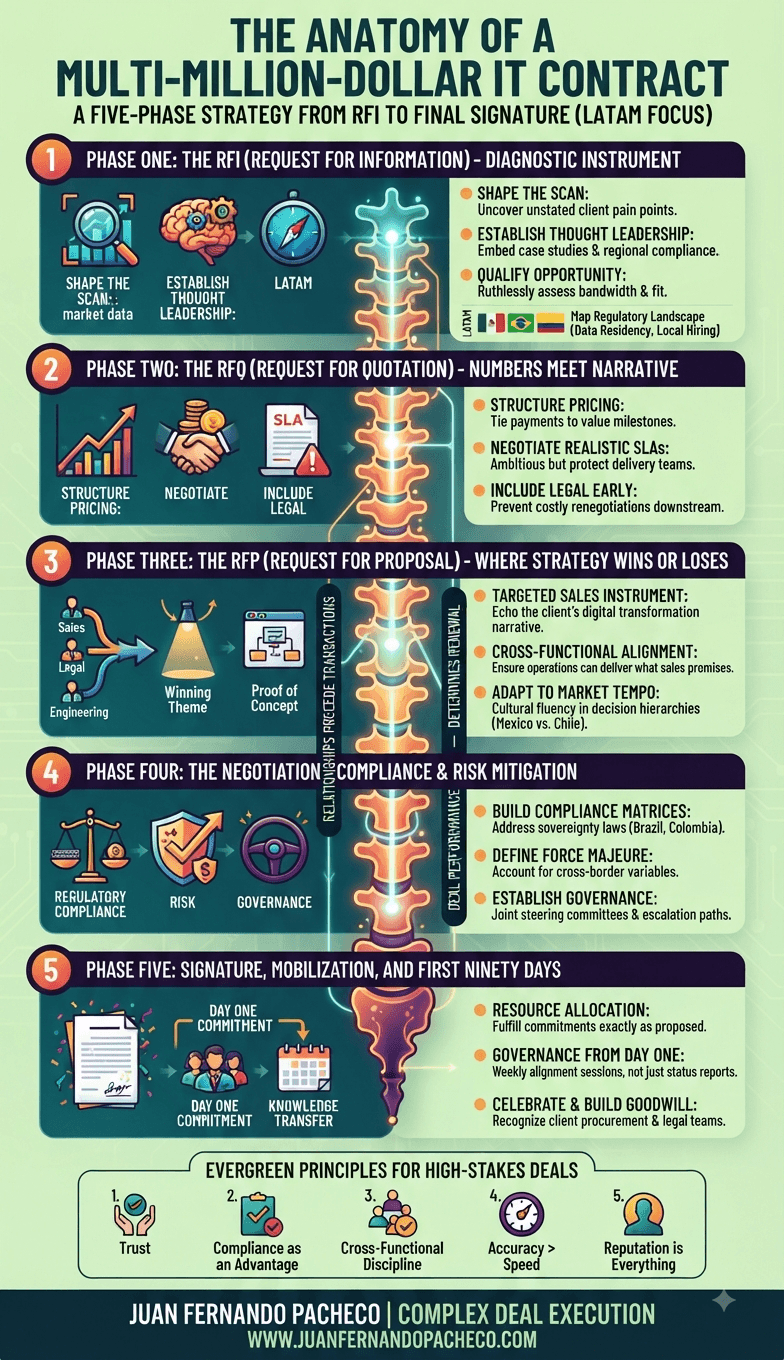
A multi-million-dollar IT contract is not a single event. It is an anatomy. Every phase connects to the next like vertebrae in a spine. Miss one, and the entire structure collapses.
Over twenty years leading complex deal execution across Mexico, Colombia, Peru, Chile, Argentina, Brazil, and Ecuador, I have dissected hundreds of these processes. The patterns remain consistent whether you close deals in 2026 or 2036. Technology shifts. Regulations evolve. But the anatomy of a high-stakes IT procurement cycle endures.
Let me walk you through each organ of that anatomy.
Phase one: the RFI as your diagnostic tool
Most professionals treat the Request for Information as a formality. They copy-paste boilerplate responses and move on. That approach leaves money on the table.
An RFI functions as a diagnostic instrument
The buyer uses it to scan the market. Your job is to shape that scan in your favor. When I lead RFI responses for banking and financial services clients, I focus on three objectives.
- First, I position our capabilities against the client’s unstated pain points. The written questions tell you what they think they need. The structure of those questions reveals what actually keeps their CTO awake at night. A client asking twelve questions about data sovereignty and only two about pricing is signaling regulatory anxiety, not budget anxiety.
- Second, I establish thought leadership early. I embed relevant case studies, regional compliance references, and architecture principles directly into the response. You want the evaluation committee to associate your name with expertise before the RFQ even lands.
- Third, I qualify the opportunity ruthlessly. Not every RFI deserves a full response. I assess whether the client’s timeline, budget signals, and technical requirements align with our delivery capacity. Saying no to a poor-fit RFI protects your team’s bandwidth for deals you can actually win.
In LATAM markets specifically, RFIs often carry implicit government mandates. Data residency requirements, local hiring quotas, and national security policies frequently surface at this stage. Ignoring them guarantees disqualification later. I always map the regulatory landscape before drafting a single paragraph.
Phase two: the RFQ where numbers meet narrative
The Request for Quotation narrows the field. Buyers now want specifics. Pricing models. Resource allocations. Delivery timelines. Penalty structures.
Here is where most vendors fail. They submit a spreadsheet and call it done.
I approach every RFQ as a narrative wrapped in numbers. The figures must be precise, yes. But the story around those figures determines whether you land in the “preferred vendor” column or the “backup option” column.
When I build RFQ responses for enterprise clients in the financial sector, I structure the pricing around value milestones rather than flat monthly fees. This approach accomplishes two things. It reduces the client’s perceived risk by tying payments to measurable outcomes. It also protects our margins by preventing scope creep from eroding profitability.
SLA negotiation typically dominates this phase. Uptime guarantees, response time commitments, escalation matrices, and financial penalties all come into play. I have learned to negotiate SLAs that are ambitious enough to win the deal but realistic enough to protect my delivery teams. A 99.99% uptime promise sounds impressive until your engineering lead calls you at 2 a.m. during a regional outage.
I also pay close attention to the legal clauses embedded in RFQ documents. Enterprise security requirements, intellectual property ownership, termination conditions, and liability caps often hide in annexes. I bring legal counsel into the RFQ stage, not after the RFP. Early legal alignment prevents costly renegotiations downstream.
Phase three: the RFP, where strategy wins or loses
The Request for Proposal is the centerpiece
This is where your commercial strategy, technical architecture, and relationship capital converge into a single document.
I treat every RFP response as a targeted sales instrument, not a generic capability brochure. The winning theme must thread through every section. If the client’s core challenge is digital transformation for legacy banking infrastructure, then every page of the proposal must echo that transformation narrative.
Cross-functional alignment becomes critical here
I coordinate product, sales, legal, engineering, and operations teams to ensure consistency. Nothing kills a multi-million-dollar IT contract faster than a technical section promising capabilities that the operations team cannot deliver or a legal section accepting liabilities that finance never approved.
In my experience across LATAM, the RFP phase also demands cultural fluency. Procurement committees in Mexico operate differently from those in Colombia or Chile. Decision hierarchies vary. Approval cycles stretch or compress. I adapt my engagement rhythm to each market’s tempo without sacrificing urgency.
Proof of concept demonstrations often surface during this phase
I have reduced customer request resolution by 30% through streamlined POC development. A tight, focused POC builds confidence faster than a hundred slides. I scope POCs to address the client’s top three anxieties and nothing more. Overbuilding a POC wastes resources and dilutes the message.
Stakeholder mapping intensifies during the RFP. I identify every evaluator, every influencer, and every silent veto holder. In banking and government-adjacent deals, a single compliance officer can override a unanimous technical recommendation. Knowing who holds that power shapes how I tailor the narrative.
Phase four: negotiation, compliance, and risk mitigation
Winning the RFP does not mean signing the contract. The negotiation phase introduces a new layer of complexity.
Regulatory compliance dominates this stage in LATAM. Data sovereignty laws in Brazil, financial services regulations in Colombia, and government procurement mandates in Ecuador each impose distinct requirements. I build compliance matrices early and reference them throughout negotiations. This preparation prevents last-minute surprises that delay signatures by weeks.
Contract structure demands equal attention
I negotiate payment terms tied to delivery milestones rather than calendar dates. This protects both parties. The client pays for verified progress. My teams receive clear targets rather than arbitrary deadlines.
Risk mitigation runs through every clause. I insist on defining force majeure terms clearly, especially for cross-border engagements. Political instability, currency fluctuations, and regulatory shifts represent real risks in emerging markets. A well-drafted multi-million-dollar IT contract accounts for these variables without paralyzing the partnership.
I also negotiate governance structures upfront
Joint steering committees, escalation paths, change request processes, and quarterly business reviews all get defined before signature. Ambiguity in governance creates friction during delivery. Friction during delivery erodes trust. Eroded trust kills renewal opportunities.
Throughout this phase, I maintain direct communication with C-level executives on the client side. Face-to-face meetings with senior management resolve impasses that email chains cannot. I have flown across the region more times than I can count to shake hands, read body language, and build the personal trust that no contract clause can replicate.
Phase five: signature, mobilization, and the first ninety days
The final signature feels like a finish line. It is not. It is a starting gate.
The first ninety days determine whether the contract delivers on its promises or unravels under operational pressure. I treat mobilization with the same rigor I applied to the RFP.
Resource allocation must match the proposal commitments exactly. If we promised a dedicated team of twelve engineers and a named project director, those individuals must appear on day one. Substitution at this stage signals bad faith and triggers contractual disputes.
I establish weekly governance cadences from week one. These meetings are not status reports. They are alignment sessions where both parties surface risks early, adjust priorities, and reinforce the partnership ethos. In banking engagements serving millions of end users, even minor delivery delays cascade into reputational damage for the client.
Knowledge transfer and documentation also begin immediately. User story mapping, backlog prioritization, and sprint planning translate the contract’s strategic vision into executable tasks. I have seen brilliant proposals fail because nobody translated the vision into a working backlog within the first month.
Celebrating the signature matters too. I acknowledge the client’s procurement team, legal counsel, and technical evaluators. Those individuals spent months reviewing proposals. Recognizing their effort builds goodwill that pays dividends during the inevitable challenges of delivery.
Evergreen principles that outlast any technology cycle
Specific tools change. Cloud platforms evolve. AI reshapes delivery models. But the principles governing a multi-million-dollar IT contract remain stable.
Relationships precede transactions
I have secured multi-year contracts not because our proposal scored highest on technical merit but because the client trusted us to solve problems we had not yet encountered. That trust took years of consistent engagement to build.
Compliance is a competitive advantage, not a burden. In regulated industries like banking and telecommunications, vendors who treat compliance as an afterthought lose to those who embed it into their DNA. I position regulatory expertise as a differentiator in every proposal.
Cross-functional discipline wins deals
No single department closes a multi-million-dollar IT contract. Product, sales, legal, engineering, operations, and marketing must move as one unit. I have led these cross-functional teams across ten-plus countries. Alignment does not happen organically. It requires deliberate orchestration.
Speed without accuracy creates liability. I have watched competitors rush proposals to meet deadlines, only to face penalty claims six months later because they overpromised. I prioritize accuracy and realistic commitments over speed. A slightly delayed but precise response beats a fast but flawed one every time.
Finally, the deal never truly ends. Delivery performance determines whether the contract renews, expands, or dies. I manage every engagement with the assumption that the next RFP will reference our track record. In LATAM’s interconnected business community, reputation travels faster than any marketing campaign.
Closing thoughts
The anatomy of a multi-million-dollar IT contract reveals no single hero moment. It rewards consistency, preparation, and strategic patience across every phase. From the first RFI inquiry to the final governance meeting in year three, each interaction compounds into either trust or doubt.
I have spent two decades learning this anatomy in boardrooms from Quito to São Paulo, from Mexico City to Santiago. The technology changes. The regulations tighten. The market expectations rise. But the fundamental discipline of understanding your client’s real problem, structuring a credible solution, and executing with operational rigor remains unchanged.
If you are preparing to enter your next high-stakes procurement cycle, resist the urge to skip ahead. Respect each phase. Diagnose before you prescribe. Quantify before you promise. And never, ever treat the signature as the end of the conversation.
It is always the beginning.