A deal leader’s playbook
Every enterprise technology deal I have led over the past twenty years taught me one uncomfortable truth. The contract signature is not the finish line. It is the starting gun. The real work begins when commitments on paper collide with the messy reality of implementation, regulatory scrutiny, and cross-functional execution. Operational risk in enterprise tech deals does not announce itself with a dramatic failure. It creeps in through vague SLAs, misaligned stakeholder expectations, and compliance gaps that nobody flagged during the proposal phase.
I have spent my career navigating these waters across Latin America, closing multi-million-dollar contracts with banking institutions, retail giants, and telecommunications leaders in Mexico, Colombia, Peru, Chile, Argentina, and Brazil. Each market brings its own regulatory texture, its own cultural rhythm, and its own definition of “acceptable risk.” What I learned the hard way is that mitigating operational risk in enterprise tech deals requires a disciplined, repeatable playbook. Not luck. Not heroics. A system.
This post lays out that system
Whether you are a deal leader, a business development manager, a product owner shepherding an enterprise engagement, or a solutions architect tasked with making promises real, this framework will serve you. The principles here do not expire with a fiscal year or a technology cycle. They hold because they address human, legal, and structural dynamics that remain constant regardless of the tooling du jour.
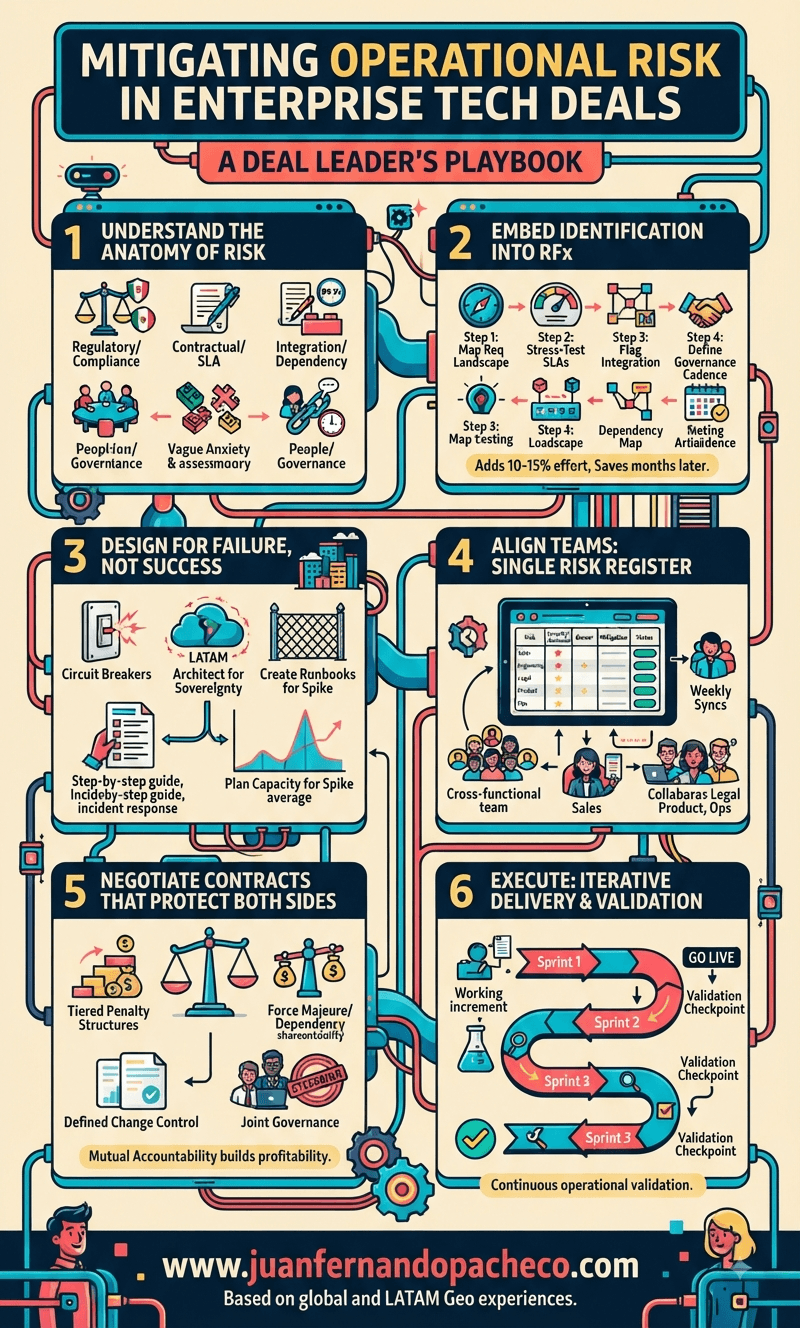
Understand the anatomy of operational risk
Before you can mitigate operational risk in enterprise tech deals, you must name it precisely. Most teams conflate project risk with operational risk. They are related, but distinct. Project risk concerns timelines, scope creep, and resource availability. Operational risk concerns what happens when the delivered solution interacts with the client’s live environment, regulatory obligations, and end-user behavior at scale.
In my experience, operational risk clusters into four categories:
Regulatory and compliance risk
Data sovereignty mandates, local privacy policies, and government procurement rules vary dramatically across LATAM jurisdictions. A solution architected for one country may violate data residency requirements in another. I have seen deals stall for months because legal teams discovered a cross-border data transfer clause only after technical validation.
Contractual and SLA risk
Enterprise clients, especially in banking and finance, demand stringent service-level agreements. Uptime guarantees of 99.95%, sub-minute response times, and steep penalty clauses create enormous pressure. If your delivery model cannot sustain those numbers under peak load, you inherit a liability from day one.
Integration and dependency risk
Large enterprises rarely operate on a clean slate. Your solution must plug into legacy cores, third-party middleware, and internal security protocols that predate modern architecture. Each integration point is a potential failure node.
People and governance risk
Cross-functional teams spanning product, engineering, legal, sales, and operations must stay aligned across time zones and organizational silos. Miscommunication at the governance layer cascades into execution failures downstream.
Naming these categories gives your team a shared vocabulary. It transforms vague anxiety into structured assessment.
Build risk identification into the RFx process itself
Too many organizations treat the RFI, RFQ, and RFP stages as purely commercial exercises. The deal team crafts a compelling value proposition, engineering validates technical feasibility, and legal reviews terms. Operational risk assessment, if it happens at all, gets deferred to a “post-award planning” phase.
That deferral is where deals go to die.
I embed operational risk identification directly into every RFx response cycle. Here is how the process works in practice:
- Step one: map the regulatory landscape before you write a single proposal paragraph. For every target account, I compile a regulatory matrix covering data protection laws, industry-specific mandates (central bank circulars for financial clients, telecom authority rules for carriers), and procurement compliance requirements. This matrix informs which architectural choices are viable and which are non-starters.
- Step two: stress-test SLA commitments against delivery capacity. Before we commit to a 99.9% uptime guarantee or a four-hour incident resolution window, I sit with engineering and operations leads. We model peak-load scenarios, dependency failures, and escalation paths. If the math does not work, we negotiate realistic terms or build in phased SLA targets.
- Step three: flag integration dependencies in the technical response. Rather than presenting an idealized architecture diagram, I document every known integration point, the client systems involved, and the assumptions we are making about their availability, documentation quality, and API stability. This transparency builds trust and prevents nasty surprises during implementation.
- Step four: define governance cadence in the commercial proposal. I specify meeting rhythms, escalation protocols, decision rights, and change-control procedures within the proposal itself. The client sees the operational scaffolding before they sign, which reduces post-award friction enormously.
This approach adds roughly ten to fifteen percent more effort to the RFx cycle. It saves months of rework and dispute resolution after contract execution. The trade-off is not close.
Design for failure, not just for success
A recurring mistake I observe in enterprise deal teams is solutioning for the happy path. The architecture assumes stable networks, cooperative legacy systems, and users who behave predictably. Then production reality arrives, and the happy path evaporates.
Operational risk in enterprise tech demands that you design for failure from the outset. In practical terms, this means:
Build circuit breakers into every critical integration
If a downstream banking core goes offline, your solution should degrade gracefully rather than cascade errors to end users. I insist that every integration layer includes timeout thresholds, retry logic, and fallback messaging.
Architect for data sovereignty from the first commit
In LATAM markets, regulators increasingly require that financial and personal data remain within national borders. I work with engineering leads to ensure that storage, processing, and backup strategies respect those boundaries from the initial deployment, not as a retrofit.
Create runbooks before go-live, not after the first incident
Every critical workflow needs a documented operational procedure: who responds, what steps they take, when they escalate, and how they communicate status to the client. I treat runbook completion as a go-live gate. No runbook, no launch.
Plan capacity for the spike, not the average
Banking clients in the region experience massive transaction surges around payroll cycles, tax deadlines, and promotional events. If your capacity model only accounts for average daily volume, you will breach SLAs during those peaks. I require load projections that include worst-case surge scenarios.
Designing for failure is not pessimism. It is professional responsibility. Clients in banking, finance, and telecommunications serve millions of users who depend on uninterrupted service. Our architecture choices carry real consequences for real people.
Align cross-functional teams around a single risk register
Throughout my career leading cross-functional teams across ten-plus countries, I have learned that operational risk multiplies in environments where information fragments. Sales promises one thing. Engineering builds another. Legal interprets a clause differently than operations does. The client receives conflicting signals, and trust erodes.
The antidote is a single, living risk register that every function contributes to and reviews. I maintain this register from the earliest proposal stage through contract execution and beyond. It tracks:
- Identified risks with severity and likelihood scores
- Ownership assignments (who is accountable for mitigation)
- Mitigation actions with target dates
- Dependency flags (which risks are interconnected)
- Client communication status (what the client knows versus what remains internal)
I review this register in weekly cross-functional syncs
Product, engineering, legal, sales, and operations each report updates. The discipline is non-negotiable. When a team member flags a new risk, we triage it within forty-eight hours. Ambiguity is the enemy of operational excellence.
This practice also protects the team psychologically. When someone raises a concern early, we address it collaboratively rather than assigning blame after the fact. Over years of practice, I have seen this culture shift reduce finger-pointing and accelerate resolution dramatically.
Negotiate contracts that protect both sides
A common trap in enterprise deal-making is treating contract negotiation as adversarial. The client pushes for maximum penalties, shortest timelines, and broadest liability. The vendor pushes back. Both sides concede just enough to close, then spend the engagement period resenting the terms they accepted.
I approach contract negotiation differently. Operational risk in enterprise tech deals shrinks when both parties share a realistic picture of what can go wrong and agree on proportional responses. Concretely, I advocate for:
Tiered penalty structures rather than binary pass/fail SLAs.
A single missed response-time target should not trigger the same financial consequence as a systemic outage. Tiered structures incentivize recovery and preserve the commercial relationship.
Clear force-majeure and dependency clauses
If the client’s internal infrastructure causes an integration delay, that delay should not count against the vendor’s delivery timeline. I ensure mutual accountability language appears in every contract I touch.
Defined change-control procedures with cost and timeline implications spelled out
Scope changes are inevitable in complex technology engagements. The contract should make the change process transparent, not punitive.
Joint governance committees with decision authority
I negotiate for a steering committee that includes senior stakeholders from both organizations, meeting at a defined cadence with explicit authority to resolve escalations. This prevents issues from festering at operational levels until they become contractual disputes.
These negotiation positions protect the vendor, yes. They also protect the client. A vendor operating under fair, realistic terms delivers better outcomes than one squeezed into impossible commitments. I frame every negotiation point around mutual success, and I have found that approach builds longer, more profitable relationships.
Execute with iterative delivery and continuous validation
Once the contract is signed, the temptation is to disappear into a long build phase and emerge months later with a finished product. In enterprise technology, that model invites operational catastrophe. Requirements shift. Stakeholders change. Regulatory environments evolve. A twelve-month waterfall delivery guarantees misalignment by month six.
I structure enterprise engagements around iterative delivery cycles, even when the client’s procurement language implies a fixed-scope, fixed-timeline model. Within the contractual framework, we break the work into incremental milestones with validation checkpoints. Each cycle ends with a working increment that the client can test, challenge, and refine.
This approach serves three risk-mitigation purposes:
- First, it surfaces integration issues early. If a legacy API behaves differently than documented, we discover that in sprint two rather than during final UAT.
- Second, it maintains stakeholder alignment. When the client’s business users see tangible progress every few weeks, they stay engaged and provide timely feedback. Silence from the client is a risk indicator I take seriously.
- Third, it preserves commercial flexibility. If market conditions shift or the client’s strategic priorities evolve, iterative delivery allows us to adjust scope without tearing up the contract.
I pair iterative delivery with continuous operational validation. Performance testing, security scanning, and compliance checks run in every cycle, not just at the end. Operational risk in enterprise tech deals does not wait for the final release to reveal itself. Neither should our testing.
Protect the relationship through transparent communication
The final pillar of my playbook is perhaps the most undervalued. Technical excellence and contractual rigor mean little if the client feels blindsided, ignored, or surprised. Operational risk escalates fastest in environments where communication breaks down.
I maintain a communication cadence that matches the engagement’s complexity. For large banking clients, that means weekly operational reviews, bi-weekly steering committee updates, and monthly executive briefings. Each forum serves a different audience and a different purpose. The operational review tracks SLA performance, open incidents, and immediate blockers. The steering committee addresses strategic alignment, scope decisions, and resource adjustments. The executive briefing reinforces the partnership narrative and surfaces long-term opportunities.
Transparency extends to bad news. When we miss a target, I communicate it immediately, with root-cause analysis and a corrective plan attached. Clients respect honesty far more than they respect silence. In twenty years of enterprise relationships across LATAM, I have never lost an account because I delivered difficult news promptly and constructively. I have seen competitors lose accounts because they hid problems until those problems became crises.
I also invest in relationship-building beyond transactional touchpoints. Face-to-face meetings with C-level executives, participation in industry forums, and genuine curiosity about the client’s strategic challenges all reinforce the partnership. When trust is high, operational hiccups become solvable problems. When trust is low, the same hiccups become contract disputes.
The playbook is a living document
I want to close with a principle that underpins everything above. This playbook is not static. Every engagement teaches me something new about operational risk in enterprise tech deals. A regulatory change in Colombia. A new data-residency requirement in Brazil. A novel integration pattern from a Peruvian fintech. Each lesson updates the framework.
I encourage every deal leader, product owner, and business development professional to build their own version of this playbook. Start with the four risk categories. Embed identification into your RFx process. Design for failure. Align your teams. Negotiate fairly. Deliver iteratively. Communicate relentlessly. Then refine the model with every deal you close and every lesson you earn.
The technology landscape will keep shifting. New platforms, new compliance regimes, new competitive dynamics will emerge. But the fundamentals of operational risk mitigation remain rooted in clarity, discipline, and respect for the complexity of enterprise environments. Those fundamentals do not age. They compound.
After more than two decades in this work, across banking, retail, and telecommunications, across ten countries and hundreds of stakeholders, I remain convinced of one thing. The deal leaders who treat operational risk as an afterthought will always firefight. The ones who treat it as a strategic discipline will always deliver. The choice is not about talent. It is about intention.
Build the playbook. Follow it. Improve it. The next enterprise deal is already on your desk, and the operational risks inside it are already forming. Your framework is the difference between a signed contract and a successful partnership.