Complex legal clauses into winning value propositions
Enterprise technology deals rarely close on product features alone. Procurement departments hold the real power. They deploy thick contracts filled with dense requirements. Most vendors view these documents as mere obstacles. They rush to sign or push back blindly.
This approach leaves money on the table. Smart deal leaders see things differently.
They recognize hidden opportunities within the fine print. Strict mandates actually reveal the client’s deepest fears. Addressing those fears directly creates a powerful competitive edge. You must learn to read between the lines. This post explores that exact translation process. We will turn restrictive text into compelling commercial narratives.
The anatomy of complex legal clauses
Legal teams draft contracts to minimize risk
They use specialized language to build protective walls. These walls often block standard sales conversations. Let us examine three common barriers.
- First, consider service level agreements. Procurement officers demand absolute uptime guarantees. They attach severe financial penalties to minor outages. Vendors usually accept these terms with crossed fingers. This creates massive hidden operational liabilities.
- Second, look at data sovereignty mandates. Governments require strict local data residency. Financial institutions face intense regulatory scrutiny. Standard cloud architectures often violate these local policies. Vendors must redesign their entire deployment strategy.
- Third, review indemnification clauses. Clients want total protection against third-party claims. They shift all intellectual property risks to the vendor. Accepting these terms blindly threatens your company’s survival.
Most sales representatives simply forward these documents to their legal department. The legal team then marks them up with red ink. The client receives a heavily edited contract. Negotiations stall for months. Both sides lose momentum. You need a better strategy. You must proactively translate these demands before the redlining begins.
The LATAM context
Latin American markets present unique regulatory landscapes. Each country enforces distinct digital policies. Mexico maintains strict financial data protection laws. Colombia constantly updates its cybersecurity frameworks. Ecuador demands rigorous local hosting for government and banking sectors.
Foreign vendors often misunderstand these regional nuances
They try to force standardized global contracts onto local entities. This arrogance guarantees failure. Local executives prioritize regulatory compliance above all else. They will reject superior technology if it risks a compliance violation.
You must respect these local realities. Understand the specific banking regulations in Bogota. Study the telecommunications mandates in Mexico City. Acknowledge the public sector constraints in Quito.
This deep regional knowledge becomes your strongest weapon. You stop acting like a generic software vendor. You become a trusted regional advisor. Clients notice this shift immediately. They reward partners who understand their local headaches. Your value proposition must explicitly address these geographic complexities.
The translation framework
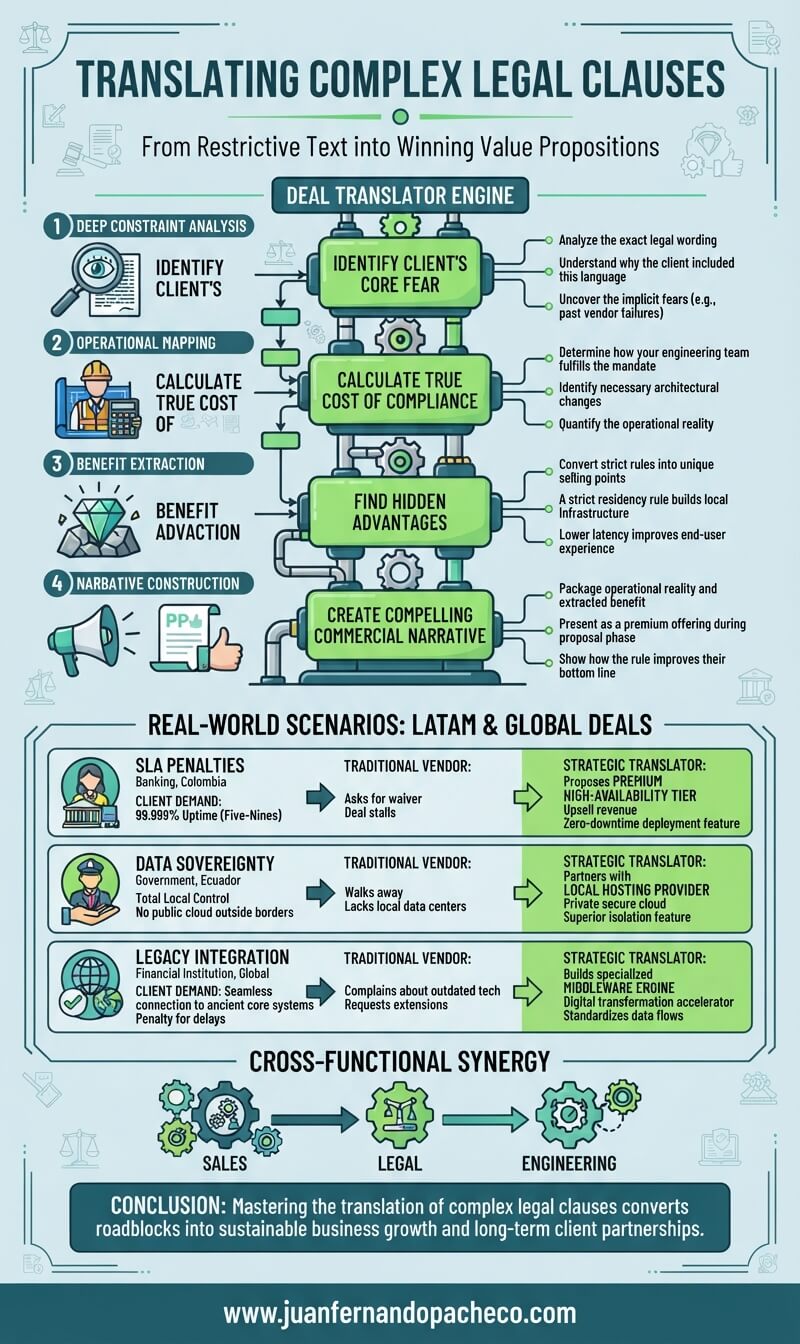
Converting restrictions into revenue requires a structured methodology. I use a four-step translation framework. This process aligns legal constraints with product capabilities.
- Step one involves deep constraint analysis. Read the specific clause carefully. Identify the core fear driving the requirement. Ask yourself why the client included this exact language. Usually, a past vendor failure triggered the demand.
- Step two focuses on operational mapping. Determine how your engineering team will actually fulfill the mandate. Calculate the true cost of compliance. Identify any necessary architectural changes. Do not guess at these operational realities.
- Step three requires benefit extraction. Find the hidden advantage within the constraint. A strict data residency rule forces you to build local infrastructure. That local infrastructure inherently reduces latency. Lower latency improves the end-user experience.
- Step four demands narrative construction. Package the operational reality and the extracted benefit into a sales pitch. Present this narrative during the proposal phase. Show the client how their strict rule actually improves their bottom line.
This framework shifts the conversation entirely. You stop negotiating penalties. You start selling premium operational excellence.
Real-world scenarios in deal execution
Let us apply this framework to actual deal scenarios. Abstract concepts mean nothing without practical application.
Imagine a major retail bank in Colombia issues an RFP
They demand a 99.999 percent uptime guarantee. The contract includes massive daily fines for any downtime. Your standard cloud offering only guarantees 99.9 percent.
A typical vendor asks for a waiver. The bank refuses. The deal dies.
A strategic leader approaches this differently. You analyze the constraint. The bank fears reputational damage during peak transaction hours. You map the operational reality. Achieving five-nines uptime requires redundant local availability zones. You extract the benefit. This architecture also enables zero-downtime deployments.
You construct a new narrative. You propose a premium high-availability tier. You price this tier to cover the redundant infrastructure. You highlight the zero-downtime deployment feature. The bank gets its uptime guarantee. Your company secures a higher-margin contract. The strict clause just drove upsell revenue.
Now consider a data sovereignty scenario
A government agency in Ecuador demands total local control. They refuse to use public cloud regions outside their borders.
Most global SaaS providers walk away. They lack local data centers.
You pivot your strategy. You partner with a certified local hosting provider. You build a secure, private cloud environment. You extract the benefit. This isolated environment offers superior protection against global cyber threats.
You pitch this isolation as a premium security feature. You win the contract because you embraced their restriction. Your competitors failed to adapt. You turned a geographic limitation into a fortress.
Finally, evaluate legacy integration requirements. Large financial institutions possess ancient core banking systems. They demand seamless integration with modern digital front-ends. They include massive penalty clauses for data synchronization delays.
Average vendors complain about the outdated technology. They request extensive timeline extensions.
Exceptional leaders see a product opportunity. You design a specialized middleware layer. You build an agile product roadmap around this integration engine. You extract the benefit. This engine standardizes data flows across the entire enterprise.
You sell this middleware as a digital transformation accelerator. The client accepts the complex integration clause. You secure a multi-year platform contract. The legal hurdle became your core product offering.
Aligning cross-functional teams
Executing this strategy requires intense internal alignment. Siloed departments destroy complex deals. Sales teams promise the moon. Legal teams reject the rocket. Engineering teams complain about the fuel.
You must act as the central translator. Bring all stakeholders together early in the RFx process. Do not wait for the final contract review.
- First, start with user story mapping. Involve product owners and subject matter experts. Break down the legal requirements into actionable product features. Prioritize these features in your agile backlog.
- Second, engage the engineering leads. Discuss the technical debt required for compliance. Ensure they understand the commercial value of these changes. Secure their buy-in for rapid proof of concept development.
- Third, align the legal counsel. Explain the commercial strategy behind your proposed redlines. Show them how you mitigated the operational risks. Legal teams support deals when they understand the business context.
This cross-functional synergy accelerates time-to-market. It reduces customer request resolution times. You build high-performing teams focused on MVP efficiency. Everyone rows in the same direction.
The UX perspective on legal constraints
My background in user experience design heavily influences my commercial strategy. Legal clauses directly impact the end user. Strict security mandates often create terrible digital experiences.
Consider multi-factor authentication requirements
Financial regulators demand rigorous identity verification. Procurement teams write clauses mandating constant re-authentication. This creates immense friction for mobile banking users. Customers abandon transactions out of sheer frustration.
Average vendors simply implement the clunky security flow. They blame the regulators for poor user retention.
Strategic product leaders find a better way.
- Analyze the exact legal wording. You discover the mandate requires secure verification, not constant disruption. You map an operational reality using biometric behavioral analytics.
- Extract a massive benefit. Continuous background authentication eliminates user friction. The customer enjoys a seamless mobile experience.
- Construct a compelling narrative for the client. You propose a premium biometric security module. You demonstrate how this module satisfies the complex legal clauses while boosting user adoption. The client gets compliance and happy customers. Your company sells a high-margin UX upgrade.
Streamlining the proof of concept phase
Complex deals always require rigorous technical validation. Clients demand extensive proofs of concept before signing. These POC phases often drag on for months. They drain engineering resources and stall revenue recognition.
You must streamline this validation process. Use your translated value propositions to define strict POC boundaries. Do not let the client test every single feature.
Focus the POC entirely on the complex legal clauses. Build a targeted MVP that proves compliance. Show the client the redundant architecture in action. Demonstrate the local data sovereignty environment. Prove the legacy middleware integration.
This targeted approach reduces customer request resolution time drastically. Engineering teams build exactly what the contract demands. Sales teams use the successful POC to close the deal faster.
You establish clear success metrics before writing any code. Both parties agree on the exact definition of done. This discipline prevents scope creep during the validation phase. You protect your margins while satisfying the client’s risk aversion.
Mitigating operational and legal risks
Winning the deal is only the first step. You must actually deliver on your translated promises. Overpromising during the RFx phase guarantees future disaster.
Establish strict governance protocols post-signature. Create a shared dashboard tracking SLA compliance. Monitor the specific metrics tied to the complex legal clauses.
Conduct quarterly business reviews with the client. Highlight your adherence to their strict mandates. Remind them of the premium value you deliver. This proactive communication prevents disputes.
Maintain detailed documentation of all architectural decisions. If a regulatory audit occurs, you need immediate proof of compliance. Keep your engineering and legal teams closely connected.
Risk mitigation is an ongoing process. Markets change. Regulations evolve. Your initial value proposition must adapt. Build flexibility into your product roadmaps. Anticipate future regulatory shifts in the LATAM region.
Clients remember vendors who deliver consistently. They reward reliable partners with long-term contract renewals. Your initial translation effort pays dividends for years.
The psychology of procurement officers
Understanding the human element changes everything. Procurement officers face immense internal pressure.
- They must protect their company from catastrophic failures. A bad vendor choice could cost them their job.
- They use complex legal clauses as defensive shields.
- They copy-paste aggressive language from industry templates.
- They rarely understand the technical implications of their demands.
Your job is to educate them gently
Do not confront them with technical jargon. Translate the technical reality into business risk.
Explain how their specific indemnification clause limits your ability to innovate. Show them how a rigid SLA prevents agile feature releases. Offer alternative risk-sharing mechanisms.
Propose shared governance models. Suggest joint steering committees for critical deployments. Give them a sense of control without crippling your operations.
When you reduce their personal anxiety, you win their trust. They become your internal champions. They will defend your proposal to their executive board. This psychological shift is the ultimate competitive advantage.
Future-proofing your commercial strategy
Technology trends fade quickly. Artificial intelligence and blockchain dominate current headlines. However, the fundamentals of complex deal execution remain constant.
Human beings will always fear risk. Corporations will always seek to transfer liability. Governments will always protect their digital borders.
Mastering the translation of complex legal clauses provides an evergreen skill set. This ability transcends specific software platforms. It applies to hardware, services, and consulting engagements.
Invest heavily in your commercial acumen. Study contract law basics. Understand financial risk modeling. Learn the regulatory frameworks of your target markets.
Build a personal library of successful translation frameworks. Document your wins and losses. Refine your methodology after every major RFx cycle.
Share this knowledge with your junior team members. Elevate the entire commercial capability of your organization. A company full of strategic translators dominates the market.
Financial modeling and pricing strategies
Translating text requires accurate financial modeling. You cannot price a premium value proposition blindly. Every complex legal clause carries a hidden operational cost. You must quantify these costs before submitting your proposal.
Start by calculating the infrastructure overhead. Local data sovereignty requires specific hardware deployments. Redundant availability zones double your cloud hosting bills. Add these exact numbers to your cost baseline.
Next, estimate the engineering effort. Custom middleware integrations demand specialized developer hours. Strict security audits require dedicated compliance officers. Factor these labor costs into your financial model.
Then, assess the risk premium. High penalty SLAs act like insurance policies. You must charge an insurance premium to accept that risk. Apply a specific margin multiplier to the base price.
Present this financial model to your internal stakeholders. Show the executive board the true cost of compliance. Secure their approval for the targeted profit margins.
Finally, structure the pricing for the client. Do not hide these costs in a generic licensing fee. Break out the premium features as distinct line items. This transparency justifies the higher price point. The client sees exactly what they are buying. They understand the direct correlation between their strict demands and your premium solution. This financial clarity builds immense trust during negotiations.
Navigating multi-vendor ecosystem complexities
Modern enterprise architectures rarely rely on a single vendor. Clients assemble complex ecosystems using multiple technology partners. Procurement teams write legal clauses that bind all these vendors together.
These multi-party dependencies create massive integration risks. A failure in a third-party system might trigger penalties against your contract. You must protect your company from external ecosystem failures.
Analyze the dependency clauses carefully. Identify where your solution connects to external platforms. Determine who holds the ultimate responsibility for end-to-end performance.
Map the operational boundaries. Define exactly where your system ends and the third-party system begins. Establish clear monitoring protocols at these integration points.
Extract a commercial benefit from this complexity. Offer to act as the primary ecosystem orchestrator. Propose a unified monitoring dashboard that tracks all vendor integrations.
Construct a narrative around ecosystem reliability. Pitch your orchestration service as a premium management tier. The client pays you to manage the headaches of multiple vendors. You turn a dangerous legal dependency into a lucrative managed service offering.
This strategy requires intense cross-company collaboration. You must build strong relationships with the other technology partners. Align your engineering teams to ensure seamless data flows. A unified vendor front presents a powerful value proposition to the client.
Stakeholder mapping and executive alignment
Complex deals involve numerous decision-makers. Procurement officers write the initial clauses. Technical teams evaluate the architectural feasibility. Financial directors approve the final budget. Legal counsel reviews the ultimate risk exposure.
You must map this entire stakeholder landscape. Understand the specific motivations of each individual. The technical lead cares about system stability. The financial director cares about total cost of ownership.
Tailor your translated value propositions for each audience. Do not present the same narrative to everyone.
Show the technical lead the robust architecture diagrams. Prove how your solution handles the stringent SLA requirements. Demonstrate the elegance of your middleware integration.
Present the financial director with your detailed pricing models. Highlight the long-term operational savings. Show how your premium security module reduces future audit costs.
Give the legal counsel a comprehensive risk mitigation plan. Provide detailed documentation of your compliance frameworks. Prove that your company assumes responsibility appropriately.
Finally, synthesize these narratives for the C-suite. Board members only care about strategic business outcomes. Show them how your solution accelerates their digital transformation. Explain how your deep regional knowledge minimizes market entry risks.
Aligning these diverse stakeholders requires exceptional communication skills. You must speak multiple business languages fluently. This ability to translate across departments is the hallmark of a true strategic deal leader. Consistent alignment ensures smooth contract execution and long-term partnership success.
Conclusion
The next time you receive a daunting RFP, smile. Do not see a barrier. See a blueprint for a premium value proposition.
Dive deep into the complex legal clauses. Find the hidden fears. Map the operational realities. Construct a compelling commercial narrative.
Align your internal teams. Deliver on your promises. Build lasting trust with your clients.
This strategic approach scales technology revenue across any market. It transforms restrictive text into sustainable business growth. Master this translation, and you will consistently win the most challenging deals.