Every enterprise technology deal I have led over the past twenty years shares one uncomfortable truth:
- The buyer does not trust your slide deck.
- They do not trust your reference architecture.
- They do not even fully trust your case studies.
What they trust is evidence they can touch, test, and break inside their own environment. That evidence takes the shape of a technical POC, and the way you design and execute it will determine whether you walk away with a signed contract or an expensive lesson.
I have run and overseen hundreds of these engagements across Mexico, Colombia, Ecuador, and broader LATAM markets. Some lasted two weeks. Others stretched across a full quarter. The ones that closed deals shared a common DNA: tight scoping, ruthless execution discipline, and a clear commercial through-line from day one to final presentation. The ones that failed almost always died from the same disease—ambiguity dressed up as flexibility.
This post lays out the framework I use to streamline technical POC execution. Whether you sell cloud infrastructure, cybersecurity platforms, ERP integrations, or AI-driven analytics, the principles hold. Markets shift. Technologies evolve. But the psychology of enterprise buying and the mechanics of proof remain remarkably stable.
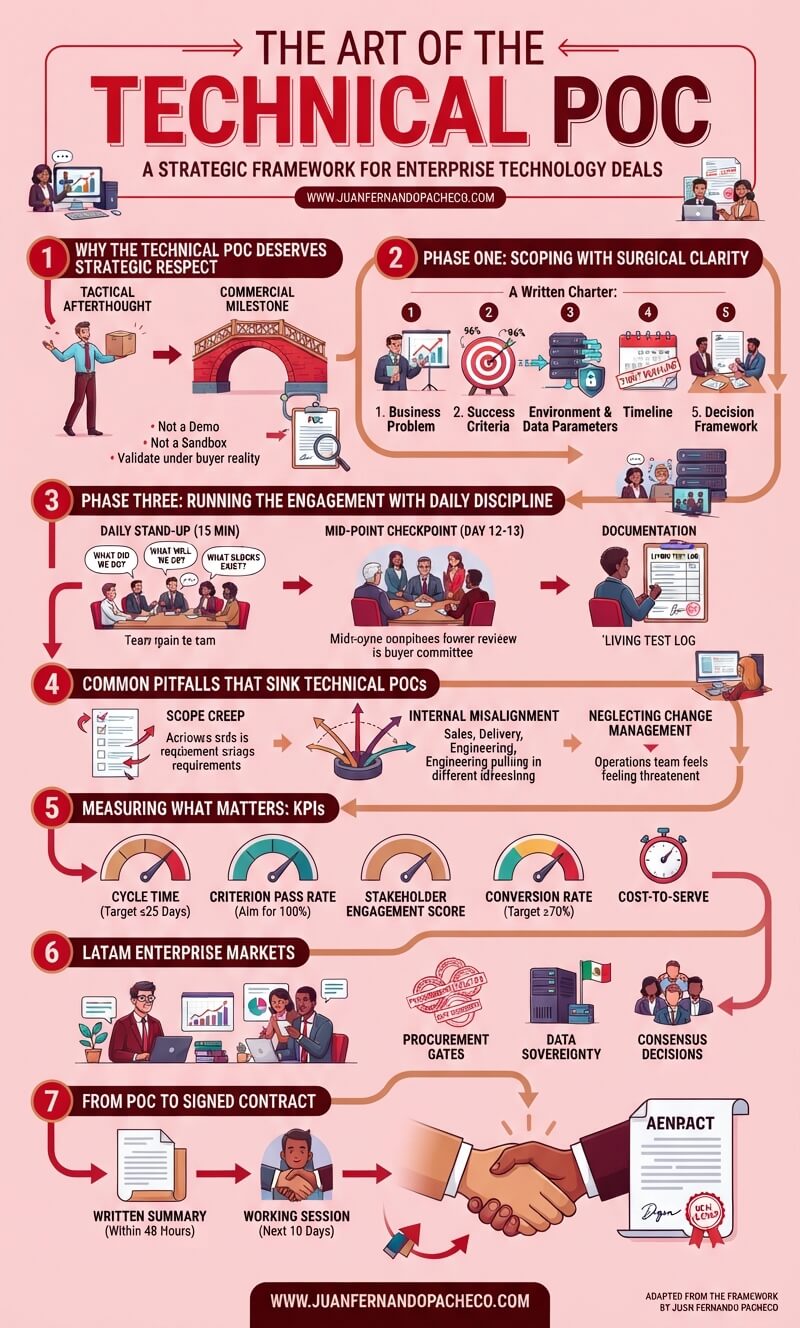
Why the technical POC deserves strategic respect
Many sales organizations treat the POC as a tactical afterthought
The account executive closes the discovery phase, tosses the requirements over the wall to a solutions engineer, and hopes the demo environment will impress the client. That approach wastes resources and erodes buyer confidence.
A technical POC is not a demo
It is not a sandbox trial. It is a structured, time-bound engagement in which the buyer validates that your solution performs under their specific conditions, with their data, and within their constraints. The buyer is essentially asking: “Will this work here, for us, under our reality?” Your job is to answer that question with precision and speed.
When I lead RFx processes for large enterprise technology deals, I treat the POC as a commercial milestone, not a technical exercise. It sits inside the deal pipeline with its own success criteria, its own stakeholders, and its own conversion target. That mindset shift changes everything downstream.
Phase one: scoping with surgical clarity
The single most common reason a technical POC fails is poor scoping
The buyer wants to “explore capabilities.” The seller wants to “showcase the platform.” Neither statement constitutes a scope. Both sides leave the kickoff meeting feeling optimistic, and three weeks later they argue about what success actually means.
I insist on a written POC charter before any environment spins up. This document captures five non-negotiable elements.
- First, the business problem. Not the technical problem. The business problem. “Reduce invoice processing time from fourteen days to two” beats “test OCR accuracy on PDF documents.” The buyer’s CFO funds the deal, not their infrastructure team. Anchor the POC to the outcome that makes the CFO nod.
- Second, success criteria. Define exactly three to five measurable criteria. No more. Each criterion needs a numeric threshold. “Process 500 test invoices with 96 percent accuracy or higher.” “Achieve sub-200-millisecond query response on a 10-million-row dataset.” Vague criteria produce vague results and vague buying decisions.
- Third, the environment and data parameters. Specify which systems the POC will touch, what data the buyer will provide, and what access your team requires. In LATAM enterprises, data residency rules and internal security reviews can add weeks if you discover them mid-engagement. Surface those constraints during scoping.
- Fourth, the timeline. I cap most technical POCs at thirty calendar days. Longer engagements lose momentum. Decision-makers shift attention. Internal champions get pulled into other priorities. Thirty days creates urgency without sacrificing rigor.
- Fifth, the decision framework. Who evaluates the results? What scorecard do they use? What happens if the POC passes? What happens if it partially passes? Write it down. Get signatures. This protects both sides.
Phase two: assembling the right execution team
A POC team needs three roles, and I have learned the hard way that one person cannot credibly fill all three.
- The technical lead owns the environment build, configuration, and test execution. This person must know the product deeply and troubleshoot without escalating to a vendor support queue. Nothing kills buyer confidence faster than watching your engineer say, “Let me open a ticket and get back to you in forty-eight hours.”
- The deal strategist owns the commercial narrative. In my case, this means connecting every technical result back to the RFx requirements, the total cost of ownership model, and the implementation roadmap. The buyer needs to see the bridge between “the POC worked” and “here is what full deployment looks like.”
- The client success liaison manages the buyer’s internal stakeholders. Enterprise POCs involve IT operations, security, compliance, business unit leads, and sometimes procurement. Someone must coordinate schedules, manage expectations, and surface objections early. I have seen technically flawless POCs collapse because nobody talked to the security team until week three.
For cross-border engagements in markets like Colombia or Ecuador, I also assign a local counterpart who understands regulatory nuances and cultural communication patterns. A buyer in Bogotá evaluates risk differently than a buyer in São Paulo. The technical POC execution must respect those differences.
Phase three: running the engagement with daily discipline
Once the charter is signed and the team is in place, execution begins. I run every POC with a lightweight daily rhythm.
Each morning, the team holds a fifteen-minute stand-up. Three questions only. What did we complete yesterday? What will we complete today? What blocks exist? No storytelling. No status theater. Just facts.
At the midpoint of the engagement—usually day twelve or thirteen in a thirty-day POC—I schedule a formal checkpoint with the buyer’s evaluation committee. We review progress against the success criteria, surface any environment issues, and recalibrate if necessary. This checkpoint prevents the dreaded “surprise failure” at the final presentation. If the POC is trending off-track, both sides know early enough to adjust scope or extend a specific test window.
Documentation runs continuously
I assign one team member to maintain a living test log. Every test case, every input dataset, every result, every anomaly gets recorded in real time. When the final report lands on the buyer’s desk, it reads like a forensic record, not a marketing brochure. That level of transparency builds trust in ways no sales pitch can replicate.
Phase four: presenting results as a commercial story
The final presentation is where most POC efforts either convert or evaporate. Here is my rule: never present technical results in isolation. Frame every finding inside the buyer’s business context.
If the POC proved that your platform processes invoices at 97 percent accuracy, do not stop there. Show the buyer what 97 percent accuracy means in operational savings. Translate it into headcount reallocation, error reduction, and cycle-time compression. Speak the language of the person who signs the purchase order.
I structure the closing presentation in four blocks
- Fisrt block restates the original business problem and the success criteria
- Second block walks through results against each criterion, using the test log as evidence
- Third block addresses gaps honestly
If one criterion fell slightly short, name it, explain why, and present a remediation path. Buyers respect candor far more than they respect spin. Block four lays out the commercial proposal: pricing, implementation timeline, support model, and next steps toward contract signature.
In high-stakes RFx environments, this presentation often goes to a committee of eight to twelve people. Some care about architecture. Some care about compliance. Some care about budget. The four-block structure lets each stakeholder find their answer without drowning in irrelevant detail.
Common pitfalls that sink technical POCs
After two decades in this space, I see the same failure patterns repeat across industries and geographies.
- Scope creep tops the list. The buyer asks for “one more test scenario” in week two. Then another in week three. Suddenly the POC covers eight use cases instead of three, and the timeline stretches indefinitely. Counter this by anchoring every new request to the signed charter. If the buyer wants additional scenarios, document them as a phase-two engagement with its own timeline.
- The second killer is internal misalignment on the seller side. Sales wants the POC to close in two weeks. Delivery wants six weeks to do it properly. Engineering wants to showcase features the buyer never asked about. I resolve this by making the POC charter the single source of truth. If it is not in the charter, it does not happen during the engagement.
- The third pitfall is neglecting the buyer’s change management reality. A technically successful POC can still fail if the buyer’s operations team feels threatened by the new solution. Engage those stakeholders early. Invite them to observe test runs. Ask for their input on integration touchpoints. Make them co-authors of the success story rather than spectators.
Measuring what matters: KPIs for technical POC execution
You cannot improve what you do not measure. I track five KPIs across every POC engagement.
- Cycle time measures calendar days from charter signature to final presentation. My target is twenty-five days or fewer for standard engagements.
- Criterion pass rate tracks how many of the defined success criteria the solution meets. I aim for 100 percent, but I will not force a result. If the honest answer is four out of five, I present four out of five with a remediation plan.
- Stakeholder engagement score captures whether all identified buyer stakeholders attended the midpoint checkpoint and final presentation. Missing stakeholders usually signal internal politics that could derail the deal after the POC.
- Conversion rate tracks the percentage of POCs that move to contract negotiation within sixty days. Across my portfolio, I target 70 percent or higher. Anything below that signals a scoping or qualification problem upstream.
- Cost-to-serve measures the internal resource hours invested per POC. This metric keeps the team honest about profitability. A POC that consumes four hundred engineering hours to chase a small contract is a bad investment, regardless of the technical outcome.
Lessons from LATAM enterprise markets
Running technical POCs in Latin America adds layers that global playbooks often miss. Procurement cycles in Mexico, Colombia, and Ecuador frequently involve multiple approval gates before a buyer can grant environment access. I now build a two-week buffer into every LATAM POC timeline specifically for access provisioning and security reviews.
Data sovereignty regulations also shape test design
In several sectors—financial services, healthcare, government—the buyer cannot move production data to an external cloud environment. The POC must run on-premises or inside a sovereign cloud region. Planning for that reality during scoping avoids a painful mid-engagement pivot.
Relationship dynamics matter too
In many LATAM enterprises, the technical evaluation committee operates by consensus. One dissenting voice can stall a decision for months. I identify potential dissenters during scoping and address their concerns proactively through the POC design. If the security lead worries about encryption standards, I build an encryption validation test into the charter before they object.
These are not obstacles. They are design parameters. The teams that win in these markets treat local complexity as a competitive moat, not a nuisance.
From POC to signed contract: closing the loop
The technical POC does not end when the final presentation concludes. The transition from validated proof to commercial agreement requires deliberate momentum.
Within forty-eight hours of the final presentation, I deliver a written summary that recaps results, addresses open questions, and attaches the formal proposal. Speed signals seriousness. Buyers who sit in evaluation limbo for two weeks start shopping alternatives.
I also schedule a follow-up working session—usually ten days out—where we walk through implementation planning, resource allocation, and contractual terms. This session shifts the conversation from “should we buy?” to “how do we deploy?” That linguistic shift is the moment the deal tips toward closure.
For RFx-driven engagements, I map every POC result back to the original RFx scoring criteria. The buyer’s procurement team needs a clear, auditable trail showing why your solution earned the highest technical score. I provide that trail in a structured format they can drop directly into their evaluation file.
Final thoughts
The technical POC is not a cost center. It is not a free trial. It is not a favor you do for a prospect who “might get budget next quarter.” It is the most powerful conversion mechanism in enterprise technology sales, and it deserves the same strategic rigor you would apply to any revenue-critical initiative.
Scope it tightly. Execute it with daily discipline. Present it as a commercial narrative. Measure it relentlessly. Adapt it to the cultural and regulatory texture of your target market. Do those five things consistently, and your win rate will climb in ways no amount of discounting can replicate.
I have built my career on the belief that complex enterprise deals close when preparation meets precision. The technical POC is where that belief gets tested in public, under the buyer’s microscope, with real data and real constraints. Embrace that pressure. Design for it. And treat every POC as the deal it already is.
The framework above has carried me through hundreds of engagements across LATAM and beyond. It will carry you through the next hundred too, whether you sell in 2026 or 2031. The technology changes. The buying psychology does not.