5 common pitfalls in complex enterprise tech proposals
I have reviewed, written, and led hundreds of enterprise tech proposals over the past years. Some won. Many did not. And the ones that lost rarely failed because of pricing or technical capability. They failed because of preventable, structural mistakes that crept into the document long before the submission deadline.
If you lead business development, manage RFx responses, or oversee proposal teams at a technology firm, you already know the sting. You invest weeks of senior talent. You pull engineers off billable work. You burn through weekends. Then the client sends a polite rejection email, and nobody explains why.
The frustration is real. But the root causes are almost always the same five problems
I see them in Mexico, Colombia, Ecuador, and every other market where I have supported deal teams. They persist because organizations treat proposal writing as an administrative task rather than a strategic commercial exercise.
This post walks through each pitfall in detail. More importantly, it gives you a clear path to fix each one. Whether you read this today or five years from now, the principles hold. Human evaluation committees do not change their fundamental behavior. Decision-makers still reward clarity, relevance, and confidence. They still punish vagueness, arrogance, and misalignment.
Let’s get into it.
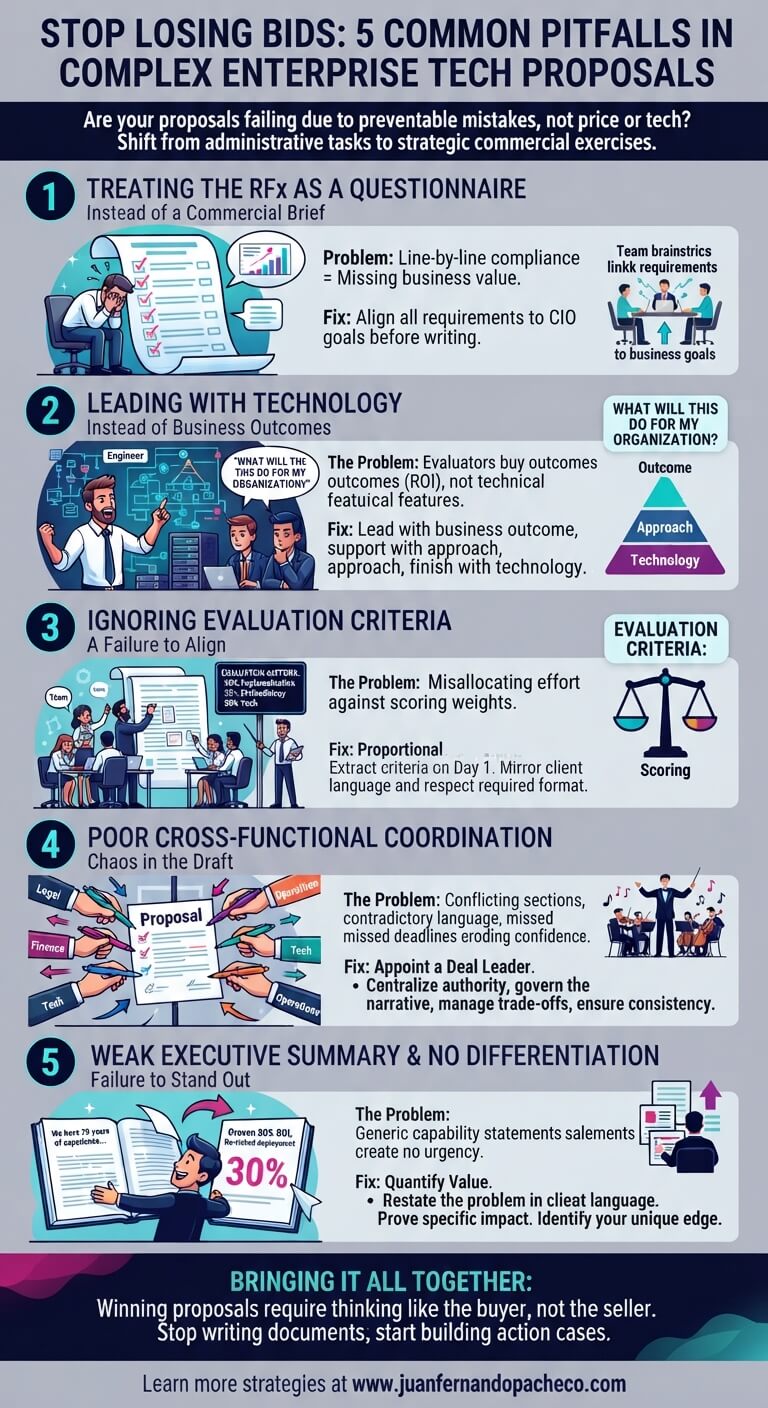
Pitfall 1: treating the RFx as a questionnaire instead of a commercial brief
The most damaging habit in enterprise tech proposals is answering the RFx line by line, as if the document were an exam. Teams open the requirements matrix, assign sections to writers, and start filling boxes. The result reads like a compliance checklist. It satisfies every literal requirement. And it wins nothing.
Here is the problem. An RFx is not just a list of technical specifications
It is a commercial brief disguised as a technical document. Behind every requirement sits a business pain, a political dynamic, or a strategic ambition. The client wrote that requirement because something hurt. Your proposal must speak to the hurt, not just the specification.
I learned this lesson early in my career while supporting a large infrastructure deal in Colombia. Our team answered every single question thoroughly. We included architecture diagrams, SLA tables, and implementation timelines. The client scored us technically adequate but chose a competitor whose response felt like a conversation rather than a recitation. That competitor addressed the underlying anxiety behind each requirement. They acknowledged risk. They proposed mitigation before the client even asked.
The fix is straightforward but demands discipline
Before anyone writes a single paragraph, run a discovery session with your proposal team. Map every requirement to a business driver. Ask:
- Why did the client include this?
- What keeps their CIO awake at night?
- What internal stakeholder pushed for this specific clause?
Then structure your response to address the driver first and the specification second.
This approach transforms your document from a compliance artifact into a persuasive commercial narrative. Evaluation committees notice the difference immediately. They feel understood. And people award contracts to those who make them feel understood.
Pitfall 2: leading with technology instead of business outcomes
Engineers love technology
I respect that passion. But evaluation committees do not award points for your enthusiasm about Kubernetes, microservices, or a particular cloud-native architecture. They award points for outcomes. Revenue protection. Cost reduction. Regulatory compliance. Speed to market.
Yet I see this mistake constantly. Proposal teams open their technical sections with platform descriptions. They dedicate pages to explaining how their solution works under the hood. They assume the reader shares their excitement. The reader does not. The reader is a procurement officer, a finance director, or an operations VP who wants to know one thing:
what will this do for my organization, and how fast?
In my experience across LATAM markets, this pitfall hits hardest in cross-border deals. A Mexican manufacturing client evaluating a digital transformation partner does not care that your platform uses a particular orchestration framework. They care that production downtime drops by 30 percent within two quarters. They care that the implementation does not disrupt their peak season. They care that their board sees a clear ROI narrative.
The correction requires a structural shift in how you organize content
Start every major section with the business outcome. Follow with the approach. Then, and only then, introduce the technology as the enabler. Use the technology to support the outcome, never the other way around.
A simple test helps. Read your executive summary aloud. If you cannot explain the value proposition without mentioning a single product name or technology stack, you have written it correctly. If the summary reads like a product brochure, rewrite it.
This principle applies equally to pricing sections. Do not present a cost table in isolation. Frame the investment against the return. Show the client what inaction costs them. Make the price feel like a fraction of the value you deliver.
Pitfall 3: ignoring the evaluation criteria and scoring methodology
This one surprises me every time because the solution sits right in front of the team. Most RFx documents include an evaluation methodology section. The client tells you exactly how they will score responses. They assign weights. They define thresholds. They sometimes even publish the scoring rubric.
And yet proposal teams routinely ignore it. They allocate word count based on internal preference rather than scoring weight. They spend fifteen pages on a section worth five percent of the total score and three pages on a section worth thirty percent. They bury their strongest differentiator in an appendix nobody reads.
I recall a deal in Brazil where the evaluation criteria assigned forty percent of the score to implementation methodology and change management. Our initial draft dedicated most of its depth to technical architecture. We caught the misalignment during an internal review, restructured the document, and shifted our best content into the implementation narrative. We won that bid. The margin was narrow. Without that correction, we would have lost.
The discipline here is simple
On day one of the proposal timeline, extract the evaluation criteria into a standalone worksheet. Assign every requirement a weight. Then allocate your writing effort proportionally. If a section carries twenty-five percent of the score, it deserves twenty-five percent of your best thinking, your strongest visuals, and your most senior reviewers.
Additionally, mirror the client’s language. If they call it “operational resilience,” do not call it “system reliability.” Use their words. Evaluation committees often score by keyword matching, especially in the first pass. Speaking their language reduces friction and signals alignment.
Finally, respect the format. If the client requests a specific structure, follow it exactly. Do not get creative with section ordering. Creativity belongs in your solution design, not in your document architecture. An evaluator who cannot find the section they need will score you lower, regardless of content quality.
Pitfall 4: poor cross-functional coordination during proposal development
Enterprise tech proposals demand input from solution architects, delivery leads, legal teams, finance, security specialists, and commercial managers. Coordinating these contributors under a tight deadline creates chaos unless someone owns the process end to end.
I have watched otherwise brilliant proposals collapse because the legal team inserted restrictive liability language that contradicted the commercial team’s risk-sharing narrative. I have seen finance submit pricing assumptions that conflicted with the delivery timeline the operations lead promised. These internal contradictions erode evaluator confidence faster than any external competitor can.
The root cause is almost always the absence of a single deal leader who holds authority over the final document. Without that role, each contributor optimizes their own section in isolation. The proposal becomes a patchwork of voices, tones, and assumptions. It reads as if five different companies wrote it.
My recommendation is non-negotiable
Appoint one person as the proposal owner. This individual does not write every word. But they control the narrative arc, enforce consistency, resolve conflicts between contributors, and make final calls on trade-offs. In my role as a strategic deal leader, this is precisely the function I serve. I sit between the technical teams and the commercial strategy, ensuring the document tells one coherent story.
Establish a clear governance rhythm as well
Run a kickoff alignment session where every contributor understands the win strategy, the client’s hot buttons, and the evaluation criteria. Schedule midpoint reviews where the owner checks for contradictions. Hold a final red-team session where senior leaders challenge the document as if they were the client’s evaluation panel.
For cross-border deals in LATAM, add a localization layer. A proposal written in English for a Colombian public-sector client needs more than translation. It needs cultural calibration. The tone, the formality level, the way you reference local regulations, all of these matter. I have seen deals stall because the proposal felt foreign, even when the technical content was strong.
Pitfall 5: a weak executive summary and no clear differentiation
The executive summary is the most-read and least-written section of any enterprise tech proposal. Senior evaluators often read only the summary before deciding whether to engage deeply with the rest of the document. If your summary is generic, you lose their attention in the first paragraph.
A generic summary looks like this:
“We are pleased to submit our proposal for your digital transformation initiative. Our company has over twenty years of experience and a global delivery network. We are confident we can meet your requirements.”
That paragraph could belong to any vendor. It says nothing distinctive. It creates no urgency. It earns no preference.
A strong executive summary does three things
- First, it restates the client’s problem in their own language, demonstrating that you listened.
- Second, it presents your specific approach as a direct answer to that problem, not a generic capability statement.
- Third, it quantifies the value. Give the evaluator a number. Reduced processing time. Lower total cost of ownership. Faster deployment. Something tangible.
Differentiation ties directly to this
In competitive enterprise tech proposals, you must answer the question the evaluator asks silently: why you and not the other three firms on the shortlist? If your document does not make that answer obvious within the first two pages, you have failed.
Differentiation does not mean listing awards or office locations
It means identifying the one or two aspects of your approach that genuinely reduce the client’s risk or accelerate their timeline. Maybe your delivery model includes embedded client staff from week one. Maybe your commercial structure ties payment milestones to measurable outcomes. Maybe your team includes a specialist who has delivered the same scope for a peer organization in the same industry.
Find that edge. State it plainly. Repeat it in the summary, the methodology, and the conclusion. Repetition builds memory. Evaluators discuss proposals in committee rooms. You want them to remember your differentiator when they debate the final scoring.
Bringing it all together
These five pitfalls interact
A proposal that misreads the RFx will also misallocate effort against the evaluation criteria. A document that leads with technology will produce a weak executive summary. Poor coordination amplifies every other weakness.
The common thread is mindset
Winning enterprise tech proposals require you to think like the buyer, not the seller. Every paragraph should answer the question: does this help the evaluator justify choosing us to their stakeholders? If the answer is no, cut the paragraph or rewrite it.
I have spent two decades refining this discipline across LATAM and international markets. The technology changes. The platforms evolve. The commercial models shift. But the psychology of a buying committee remains remarkably stable. People want to feel safe. They want to feel understood. They want a clear, defensible reason to say yes.
Build your proposals around those needs
Avoid the five pitfalls outlined here. Give your team the governance, the strategy, and the commercial clarity they need to produce documents that win.
The next bid does not have to be another loss. It can be the one that changes your revenue trajectory. But only if you treat the proposal as the strategic instrument it truly is.
Stop writing documents. Start building action cases.
That shift, more than any technology or pricing lever, will determine whether your firm wins or watches from the sidelines.