LATAM is the next frontier for enterprise fintech solutions
For years, consumer applications dominated the financial technology headlines across Latin America. Startups built flashy apps to help teenagers save money. Venture capitalists funded digital wallets targeting unbanked youth. Yet, a massive shift quietly reshapes the regional economy. Business leaders now demand robust enterprise fintech solutions to solve complex operational challenges. I watched this transition unfold over two decades.
My career spans user experience design and high-stakes commercial deal execution. This dual perspective reveals a clear market reality:
- Latin American corporations desperately need modern financial infrastructure.
- Legacy banking systems fail modern corporate treasuries.
- Cross-border trade creates immense friction.
- Supply chains require immediate liquidity.
- Therefore, the B2B sector represents the true next frontier for scalable revenue.
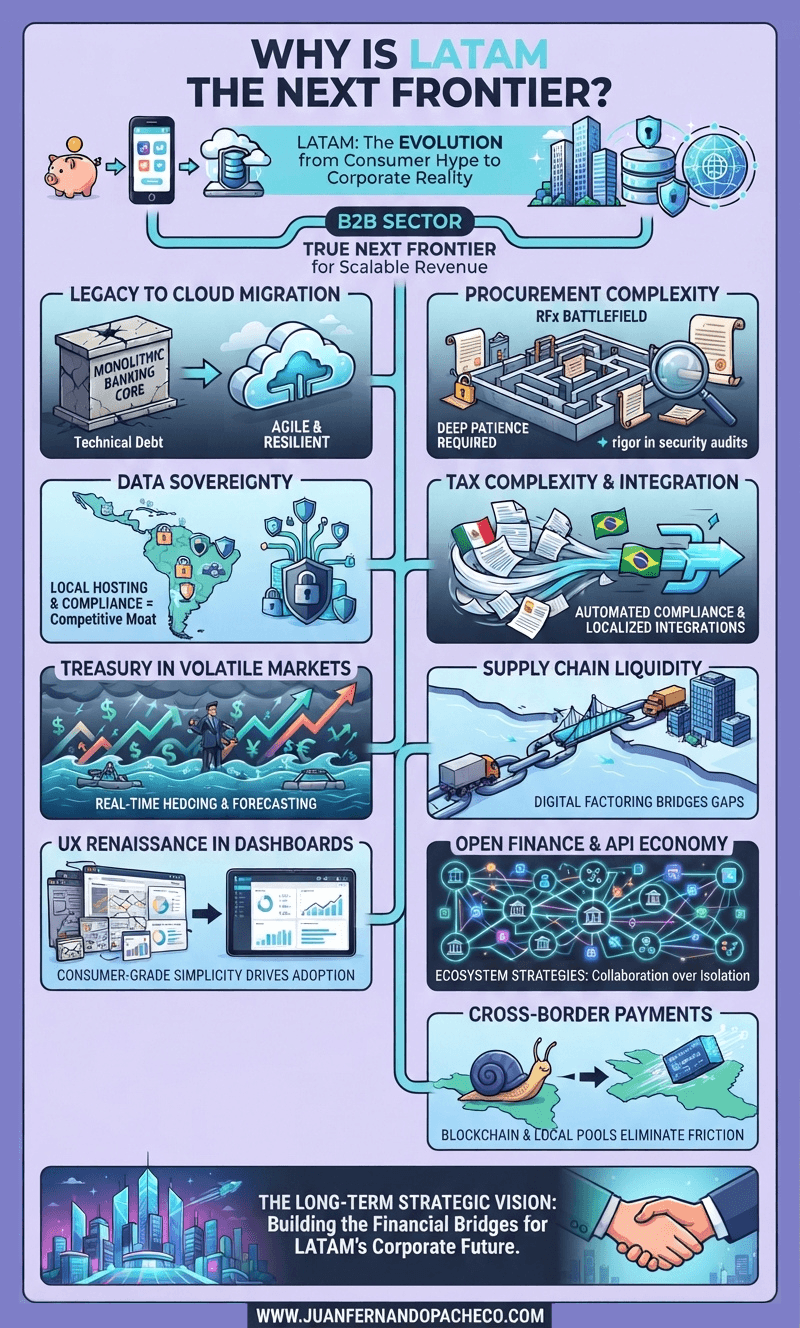
The evolution from consumer hype to corporate reality
Venture capitalists initially chased consumer apps aggressively, while early startups focused heavily on micro-lending and digital wallets; all of those companies successfully solved immediate financial inclusion problems. We celebrated their rapid user acquisition rates publicly.
Now, the market demands bigger structural changes entirely. Large corporations require sophisticated tools to manage complex cash flows, and this need creates a massive vacuum for specialized vendors; on the other hand, consumer apps teach users to expect seamless digital experiences. Employees bring those same expectations into their corporate roles, and they refuse to use clunky legacy software at work. This cultural shift forces enterprise software vendors to innovate rapidly.
Companies that ignore this B2B awakening will lose market share. The real revenue growth hides in complex corporate workflows.
The death of monolithic banking cores
Traditional banks built their core systems decades ago, and those monolithic architectures restrict rapid innovation significantly, while C-level executives recognize this dangerous technical debt clearly. Procurement teams actively seek modern cloud alternatives today, and Agile development methodologies accelerate this necessary transition smoothly.
On the other hand, software vendors must prove integration capabilities quickly. I often advise clients on these exact migration strategies; replacing a core banking system takes many years, and companies cannot pause operations during this massive upgrade.
Vendors provide parallel run environments to mitigate risks effectively. This approach guarantees continuous business operations safely, and financial institutions demand absolute stability during complex migrations.
Downtime costs millions in lost revenue instantly, and architects design resilient microservices to prevent sudden outages; that’s why these modern systems scale effortlessly during peak transaction periods.
Procurement complexity and the RFx battlefield
Selling to LATAM enterprises requires deep patience
The procurement cycle involves intense scrutiny from multiple departments, and vendors must navigate complex legal clauses carefully, while legal departments demand rigorous security audits before signing anything.
- Security questionnaires often exceed a hundred pages easily.
- Stringent SLA negotiations dictate severe uptime penalties financially.
Successful deal leaders anticipate these hurdles very early; that’s why we map every stakeholder in the buying committee meticulously, while technical teams evaluate the underlying code architecture thoroughly.
On the other end, financial officers analyze the total cost of ownership critically, and operational leaders test the actual user workflows practically. Aligning these diverse priorities requires exceptional communication skills daily.
I translate complex technical features into clear business value. This synergy accelerates the final contract signature significantly. High-stakes RFx execution separates true market leaders from mere participants.
Data sovereignty as a barrier to entry
Governments implement strict data protection laws globally now
New regional regulations mandate strict local data storage, and financial institutions face severe penalties for non-compliance; that’s why compliance teams scrutinize every vendor proposal. Smart providers build local data centers proactively everywhere to guarantee absolute data sovereignty to enterprise buyers confidently.
Regional nuances heavily complicate these technical deployments immensely.
- A cloud strategy working in Mexico fails in Brazil.
- Local hosting requirements increase infrastructure costs significantly overall.
Vendors must absorb these costs or pass them forward; that’s why you should use transparent pricing models to build trust with corporate buyers quickly. We structure contracts to address these specific mandates legally. Ignoring data sovereignty guarantees immediate disqualification from bids. Respecting local laws creates a formidable competitive moat successfully.
Tax compliance and localized integrations
Latin American tax systems remain incredibly complex
Governments change fiscal rules almost every single year. Corporations struggle to maintain accurate accounting records manually. Manual tax calculations invite severe government audits frequently. Modern platforms automate these tedious compliance workflows efficiently. They integrate directly with regional electronic invoicing systems seamlessly.
- Mexico requires specific digital stamps for every transaction.
- Brazil demands complex calculations for state and federal taxes.
Vendors must update their software continuously without fail. Development teams monitor official government portals daily for changes. This agility prevents costly operational disruptions for clients entirely. Buyers prioritize vendors who understand local fiscal realities deeply. We embed tax experts directly into our product squads. This strategy ensures perpetual compliance across all markets reliably.
Treasury management in volatile currencies
International trade drives regional economic growth continuously forward. Currency fluctuations threaten corporate profit margins daily without warning. Treasury departments need real-time hedging tools immediately available. Volatile markets punish slow manual processes severely. Modern platforms automate foreign exchange conversions instantly online. These systems connect directly to regional clearing houses securely.
Companies gain unprecedented visibility into their global liquidity. Treasurers execute cross-border payments with minimal friction overall. They lock in favorable exchange rates programmatically through APIs. This automation eliminates costly human errors forever. Financial directors sleep better knowing their exposure limits. We build dashboards that visualize currency risk clearly and visually. Actionable insights replace gut feelings in corporate finance departments. Predictive analytics forecast future cash flow requirements accurately.
Supply chain finance and liquidity gaps
Supply chains stretch across multiple international borders constantly. Small suppliers often lack access to cheap capital. Large corporations want to optimize their working capital efficiently. This disconnect creates massive liquidity gaps everywhere regionally.
- Enterprise platforms bridge this divide through digital factoring.
- Buyers approve invoices directly within the software portal.
- Financial institutions fund those approved invoices instantly online.
- Suppliers receive their money in mere hours, typically.
This ecosystem strengthens the entire supply chain network. Corporations extend their payment terms without harming suppliers. Vendors facilitate these transactions securely and transparently. We design APIs that connect ERPs with lending platforms. Seamless data flow accelerates credit decisions dramatically. Trust increases when all parties share a single ledger.
The UX renaissance in corporate dashboards
Historically, developers completely ignored B2B software aesthetics entirely because enterprise applications looked incredibly confusing and cluttered visually.
My background in UX design highlights this fatal flaw; that’s why I constantly push for beautiful interfaces that actually drive much higher adoption rates
- Clunky dashboards frustrate corporate accounting teams daily.
- Users demand consumer-grade simplicity in their workplace environments.
Design thinking transforms complex financial workflows entirely; in addition, we conduct extensive user story mapping sessions regularly.
These workshops reveal the true pain points of employees, while product teams build minimum viable products rapidly together, and we test these prototypes with actual corporate accountants. Their feedback shapes the final product roadmap directly. Reducing customer request resolution times boosts overall productivity. Happy users champion the software to their executives loudly.
Open finance and API ecosystem strategies
Isolation guarantees failure in modern financial markets today
Fintechs must integrate deeply with incumbent banks strategically, while Open Banking APIs facilitate these crucial technical connections. Banks possess the regulatory licenses and customer trust, and partnerships bridge the gap between agility and scale. We build robust networks across ten different countries.
Ecosystems thrive on mutual value creation.
Vendors provide secure developer portals for third parties, while external developers build niche applications on top platforms, ussually this strategy expands the core product utility massively, and enterprise buyers prefer solutions with extensive integration libraries.
They want to connect their CRM with their ERP, and we support standard RESTful architectures for easy connectivity. Comprehensive documentation reduces integration time for client teams.
Cross-border payment friction and solutions
Moving money across LATAM borders remains painfully slow. Intermediary banks charge exorbitant fees for wire transfers. Corporate treasurers lose days waiting for fund settlements. This friction stifles regional commerce and trade growth. Innovative startups utilize blockchain technology to bypass intermediaries. They establish local liquidity pools in every country. A company sends local currency from its account. The platform instantly credits the recipient in another nation. This mechanism eliminates traditional correspondent banking delays. Enterprises reduce their transaction costs by huge margins. We negotiate favorable SLAs to guarantee execution speeds. Regulatory compliance remains our top priority during transfers. Transparent reporting satisfies the strictest corporate auditors easily.
Talent acquisition and regional team building
Building great software requires exceptional local talent always. The competition for senior engineers remains incredibly fierce. Companies must offer compelling value propositions to developers. We foster inclusive cultures that encourage bold innovation. Remote work policies expand our talent search drastically. We hire experts from Mexico down to Argentina. Diverse teams understand regional nuances much better naturally. Product managers travel frequently to visit key clients. Face-to-face meetings build unbreakable relationships with stakeholders. Trust forms the foundation of every successful deal. I mentor junior team members on complex deal execution. This investment guarantees our long-term commercial success. High-performing teams deliver exceptional value to our clients.
Cybersecurity mandates in enterprise procurement
Cyber threats target financial institutions relentlessly every single day. Corporate boards prioritize information security above all else. Procurement officers demand exhaustive penetration testing reports regularly. Vendors must maintain current global security certifications continuously. ISO standards provide a baseline for corporate trust. We implement zero-trust architectures across all our platforms. This methodology verifies every single user access request strictly. Encryption protects sensitive data both in transit and at rest. Security operations centers monitor network traffic around the clock. Automated systems detect anomalous behavior and block threats instantly. Clients require detailed incident response plans before signing contracts. We conduct regular tabletop exercises with our engineering teams. This preparation minimizes potential downtime during actual cyberattacks. Transparent communication builds lasting confidence with enterprise security officers.
The shift toward embedded finance models
Software companies increasingly integrate financial services directly into platforms. E-commerce portals now offer instant credit at checkout moments. Logistics applications provide freight insurance with a single click. This trend blurs the lines between software and banking. Non-financial companies generate new revenue streams through these integrations. We help enterprises embed payment gateways seamlessly into workflows. Developers utilize our robust APIs to build custom experiences. Customers enjoy frictionless transactions without leaving their favorite applications. This convenience dramatically increases overall conversion rates for merchants. Traditional banks provide the underlying regulatory compliance and capital. Fintechs supply the agile technology and user interfaces. These strategic partnerships create incredibly powerful commercial ecosystems rapidly. Enterprise buyers seek vendors who facilitate these embedded models easily.
Artificial intelligence in credit risk assessment
Traditional credit scoring models rely on historical banking data. This approach excludes millions of capable regional businesses entirely. Machine learning algorithms analyze alternative data points effectively. AI evaluates supply chain invoices and utility payment histories. These models predict default probabilities with remarkable accuracy today. Lenders approve loans for previously invisible corporate segments safely. We train our algorithms on diverse regional economic datasets. This prevents biased outcomes and ensures fair lending practices. Risk managers monitor model performance through intuitive visual dashboards. Automated alerts notify teams about shifting macroeconomic variables immediately. Continuous learning improves the predictive power of these systems. Financial institutions reduce their non-performing loan ratios significantly. Borrowers receive faster decisions and much better interest rates. Technology democratizes access to vital corporate growth capital efficiently.
Change management and corporate training hurdles
Deploying new software disrupts established corporate routines heavily. Employees often resist abandoning their familiar legacy spreadsheets. Successful implementations require comprehensive change management strategies upfront. We design intuitive onboarding flows directly inside the application. Contextual tooltips guide users through complex financial workflows gently. Gamification elements encourage employees to explore advanced platform features. Dedicated customer success managers support key accounts proactively. They conduct weekly review meetings with corporate project sponsors. These sessions highlight quick wins and celebrate user adoption metrics. We translate complex technical jargon into simple business benefits. Training materials feature short video tutorials and interactive quizzes. This approach reduces the burden on internal corporate IT departments. Confident users maximize the return on their software investments.
Environmental, social, and governance reporting tools
Global investors demand strict ESG compliance from regional partners. Corporations must track their carbon footprints and social impact accurately. Manual data collection makes this reporting process incredibly tedious. Modern enterprise platforms automate these vital sustainability metrics continuously. We integrate directly with corporate supply chain management systems. The software calculates emissions based on logistics and procurement data. Financial officers generate compliance reports for international auditors instantly. This transparency attracts foreign investment and lowers borrowing costs. We help companies align their operations with global sustainability goals. Dashboards visualize progress toward specific environmental targets clearly. Executives use these insights to make better strategic decisions daily. Technology transforms ESG reporting from a burden into an advantage. Sustainable businesses ultimately build stronger and more resilient economies.
Mobile-first strategies for field operations
Corporate employees frequently work outside traditional office environments. Sales representatives visit clients across vast regional territories daily. Field technicians inspect remote supply chain facilities constantly. These workers need immediate access to financial tools on mobile. We build responsive applications that function perfectly on smartphones. Offline capabilities allow users to input data without connectivity. The system synchronizes automatically once the device reconnects online. This mobility accelerates invoice generation and payment collection significantly. Managers track field team performance through real-time geographic dashboards. Route optimization algorithms reduce fuel consumption and travel time. Companies empower their frontline workers with powerful enterprise technology. This strategy bridges the gap between headquarters and remote operations. Productivity increases when employees carry their entire office anywhere.
The role of digital identities in B2B onboarding
Verifying corporate identities manually takes weeks or months. Fraudsters exploit these slow onboarding processes to open fake accounts. Governments now issue secure digital identities to registered businesses. We integrate directly with these official national verification databases. Our platform validates corporate tax records and legal representatives instantly. This automation reduces the onboarding timeline from weeks to minutes. Compliance teams appreciate the cryptographic proof of identity verification. The system flags suspicious discrepancies before approving new credit lines. Fast onboarding improves the initial customer experience dramatically. Companies capture market share by activating clients faster than competitors. We prioritize data privacy during these sensitive verification checks. Secure digital identities form the bedrock of modern B2B commerce. Trust scales efficiently when machines verify legal entities accurately.
Navigating regional political and economic shifts
Latin America experiences frequent political transitions and policy changes. New administrations often alter international trade agreements suddenly. Currency controls might appear without much prior public warning. Resilient enterprise software architectures absorb these external shocks gracefully. We design modular systems that adapt to new rules quickly. Development teams push compliance updates globally within mere hours. This agility protects our clients from severe regulatory fines. Diversifying operations across multiple countries mitigates localized economic risks. We maintain strong relationships with regional industry associations continuously. These networks provide early warnings about impending legislative changes. Strategic foresight allows companies to pivot their operations proactively. We build financial buffers to withstand temporary market volatility effectively. Long-term success requires extreme adaptability in dynamic emerging markets.
Conclusion: The long-term strategic vision
Latin America offers unprecedented opportunities for B2B growth continuously. Structural shifts and digital adoption drive this massive transformation forward. Enterprise fintech solutions solve real corporate operational challenges effectively. Vendors must navigate complex procurement and regulatory mazes carefully. Success requires deep local expertise and technical excellence combined. We combine commercial strategy with user-centered design principles flawlessly. This unique approach scales revenue across diverse markets rapidly. The next decade belongs to companies executing these strategies flawlessly. I look forward to building these critical financial bridges together. Let us transform the regional economy together, strategically and boldly. Future generations will benefit from the robust infrastructure we build.