Introduction to regional complexity
Over the past two decades, my career has evolved from designing user interfaces to architecting multi-million-dollar enterprise technology deals across the most dynamic and complex markets in the world. When you spend twenty years transforming user needs and business goals into scalable products, you quickly realize that success is rarely about having the best code.
It is about understanding the intricate web of regional complexities, regulatory environments, and human behaviors that dictate how business is actually done. Scaling operations in this part of the world is not a simple exercise in geographic replication. It requires a fundamental rethinking of how commercial strategy, product development, and operational execution intersect.
Many global technology firms view this region as a single, monolithic growth engine
They deploy a standardized playbook, expecting the same procurement cycles, legal frameworks, and user adoption rates they experience in North America or Europe. This approach inevitably leads to stalled pipelines, bloated operational costs, and failed implementations. The reality on the ground is vastly different. To achieve sustainable revenue growth, organizations must adopt a blueprint that respects local nuances while maintaining global operational rigor.
This post outlines the strategic pillars necessary for successful tech expansion in South America, drawing on extensive experience in high-stakes procurement, agile product leadership, and cross-border team alignment. Whether you are a startup looking to establish a regional foothold or an enterprise aiming to optimize your existing footprint, these principles will remain relevant for years to come.
The myth of a unified market
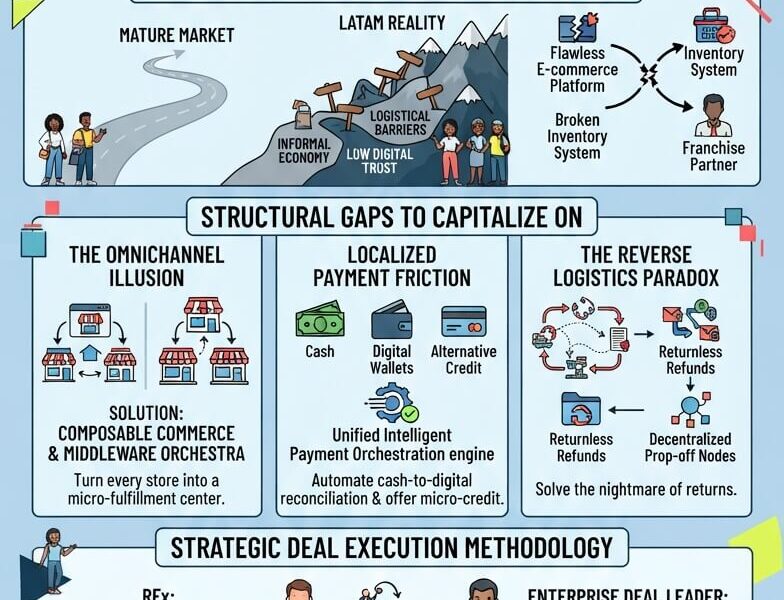
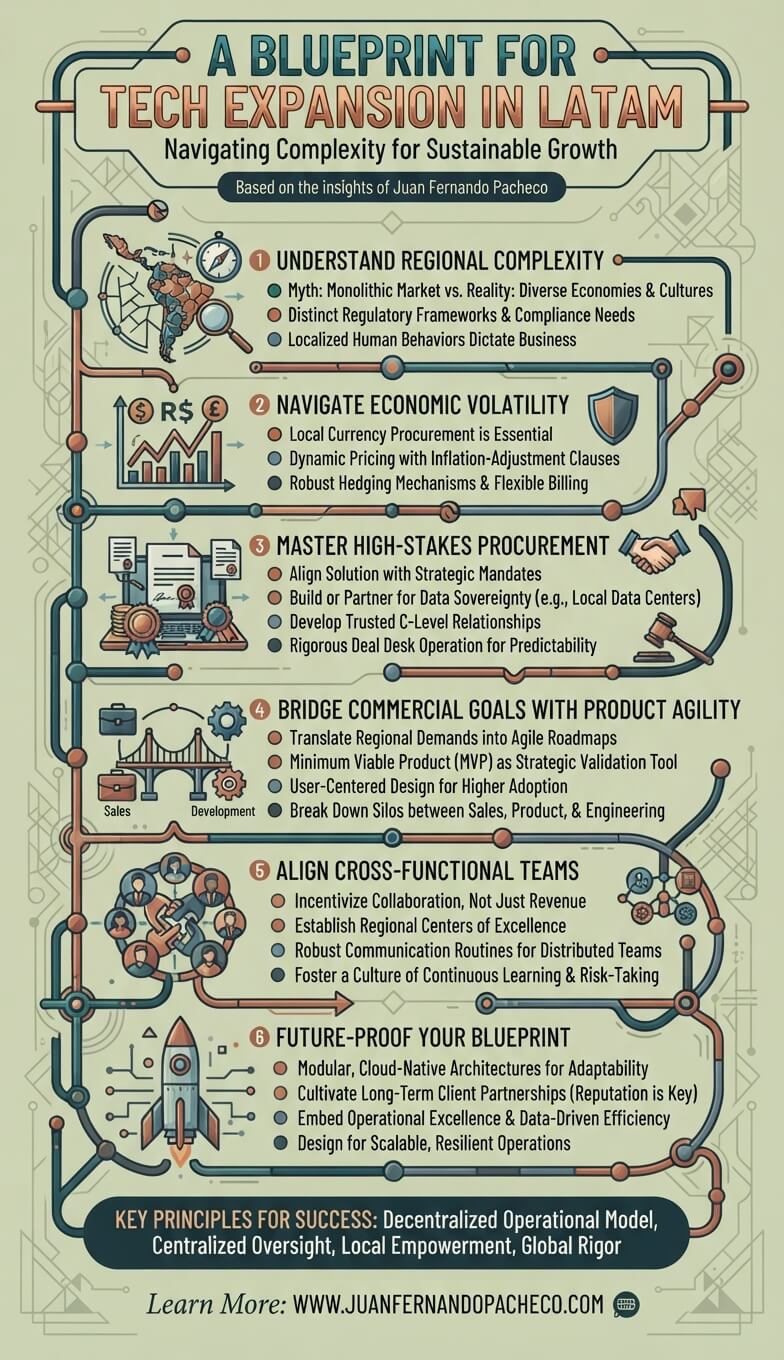
The most common pitfall for international technology companies is treating the southern continent as a single, homogeneous market. It is a vast, incredibly diverse region comprising distinct economies, languages, regulatory frameworks, and cultural attitudes toward technology and risk. A strategy that works flawlessly in Bogotá might fail in sao paulo or Santiago. Understanding this fragmentation is the first step toward building a resilient operational blueprint.
Consider the sheer scale and complexity of Brazil. It represents a massive opportunity, but it also presents unique linguistic barriers and highly specific data sovereignty laws. Enterprise buyers here demand localized support, deep integration with local financial systems, and strict adherence to national data protection regulations. You cannot simply translate your platform and expect enterprise adoption. You must engineer your operations to handle local compliance natively, which requires significant upfront investment in localized product roadmaps and regional legal expertise.
Conversely, the Andean region—encompassing Colombia, Peru, Ecuador, and Chile—operates on a different frequency. These markets are often characterized by rapid digital transformation initiatives, particularly in the banking and telecommunications sectors. However, procurement cycles can be heavily influenced by shifting political landscapes and localized economic policies. In these environments, agility is your greatest asset. Your operational model must allow for rapid pivoting, enabling local teams to adjust their commercial strategies and product offerings without waiting for approval from a distant global headquarters.
Then there is the Southern Cone, where markets like Argentina present a unique set of challenges and opportunities. Economic volatility and currency fluctuations require a highly flexible commercial approach. Enterprise deals in these regions must be structured to mitigate financial risk for both the vendor and the buyer. This often involves creative pricing models, localized service level agreements, and a deep understanding of the local macroeconomic environment. Scaling operations here means building a financial and operational buffer that can absorb external shocks while maintaining consistent service delivery to your clients.
Ultimately, a successful regional strategy requires a decentralized operational model with centralized strategic oversight. You must empower local leaders who understand the cultural and commercial nuances of their specific territories, while providing them with the global resources, technological infrastructure, and brand backing necessary to compete at the highest levels. This delicate balance between local autonomy and global alignment is the cornerstone of long-term success in these diverse markets.
Navigating economic volatility and currency risks
Expanding into emerging markets inherently involves exposure to economic volatility, and this region is no exception. Currency fluctuations, inflationary pressures, and shifting monetary policies can rapidly erode profit margins if your operational blueprint is not designed to absorb these shocks. Many technology companies price their enterprise contracts in hard currencies like the US dollar or the euro, assuming that local buyers will simply absorb the exchange rate risk. This assumption is increasingly flawed in today’s economic climate.
Enterprise buyers, particularly in the public sector and heavily regulated financial institutions, are often mandated to procure services in local currency. When you force a dollar-denominated contract onto a buyer facing severe currency devaluation, you create a massive barrier to entry. Your solution suddenly becomes unaffordable, regardless of its technical merit. To scale operations effectively, your commercial strategy must incorporate sophisticated hedging mechanisms, localized pricing tiers, and flexible billing structures that protect both your bottom line and the client’s budget.
Furthermore, inflation can wreak havoc on long-term service level agreements and multi-year maintenance contracts. If your operational costs rise by twenty percent due to local inflation, but your contract locks you into a fixed-price model for three years, you are effectively subsidizing the client’s operations at your own expense. Future-proofing your expansion requires building dynamic pricing models that include inflation-adjustment clauses tied to local economic indicators. This level of commercial sophistication requires deep collaboration between your regional sales leaders, global finance teams, and legal counsel.
Beyond pricing, economic volatility impacts the procurement timelines of your clients. During periods of economic uncertainty, enterprise boards become highly risk-averse. They will scrutinize every line item in your proposal, demand extended proof of concept phases, and delay final signatures to preserve cash flow. Your operational model must be resilient enough to sustain long, drawn-out sales cycles without burning through regional resources. This means maintaining a lean, highly efficient pre-sales engineering team that can support complex technical validations without requiring massive upfront capital expenditure.
Successfully navigating these economic realities is not just about protecting your margins; it is about demonstrating to your clients that you are a stable, reliable partner who understands their local financial pressures. When you proactively offer solutions that mitigate their currency and inflation risks, you elevate your position from a mere technology vendor to a strategic business partner. This trust is the foundation upon which multi-million-dollar, long-term enterprise relationships are built.
Mastering high-stakes procurement and RFx execution
If there is one area that separates successful technology expansions from failed ones, it is the ability to navigate complex, high-stakes procurement processes. Enterprise deals in this region are rarely won on technical specifications alone. They are won by the vendor who can most effectively mitigate risk, navigate bureaucratic hurdles, and align their solution with the strategic mandates of the buying organization. Mastering the request for information, request for quote, and request for proposal processes is not just a sales function; it is a core operational competency.
Government mandates and regulatory compliance play an outsized role in enterprise procurement here. Data sovereignty, in particular, has become a critical deciding factor in major technology contracts. Financial institutions and government entities are increasingly mandated to keep citizen and customer data within national borders. If your operational blueprint relies on a centralized, offshore cloud infrastructure that cannot guarantee local data residency, you will be disqualified from the most lucrative opportunities before you even submit a proposal. Scaling operations requires building or partnering with local data centers and architecting your solutions to support multi-region deployments seamlessly.
Beyond data residency, enterprise buyers are incredibly focused on complex legal clauses and stringent service level agreements. They are not just buying software; they are buying operational continuity. They want to know exactly what happens when things go wrong. Your proposals must address uptime guarantees, response times, and financial penalties with absolute clarity. Negotiating these terms requires a deep collaboration between your sales, legal, and engineering teams. If your legal team does not understand the technical realities of your infrastructure, they will agree to penalties that your engineering team cannot meet, leading to operational failure and damaged client relationships.
Furthermore, building trust with C-level executives and board members requires a level of transparency and strategic alignment that goes far beyond standard sales pitches. These decision-makers are looking for partners who understand their long-term business objectives and the regional complexities they face. This means facilitating face-to-face meetings, engaging in deep market research, and presenting value propositions that speak directly to their bottom line and risk profile. It requires a consultative approach where your business development managers act as strategic advisors rather than just product vendors.
To execute this effectively, your organization must implement a rigorous deal desk operation. This centralized function oversees the progress of key deals, ensures accurate project estimations, and manages the relationship development process in close collaboration with internal stakeholders. By standardizing your proposal creation process, highlighting key differentiators, and routinely measuring progress against quarterly targets, you transform procurement from a chaotic, reactive exercise into a predictable, scalable revenue engine. This level of operational discipline is what allows companies to secure multi-year contracts and achieve one hundred percent on-time delivery, even in the most complex regulatory environments.
Bridging commercial goals with product agility
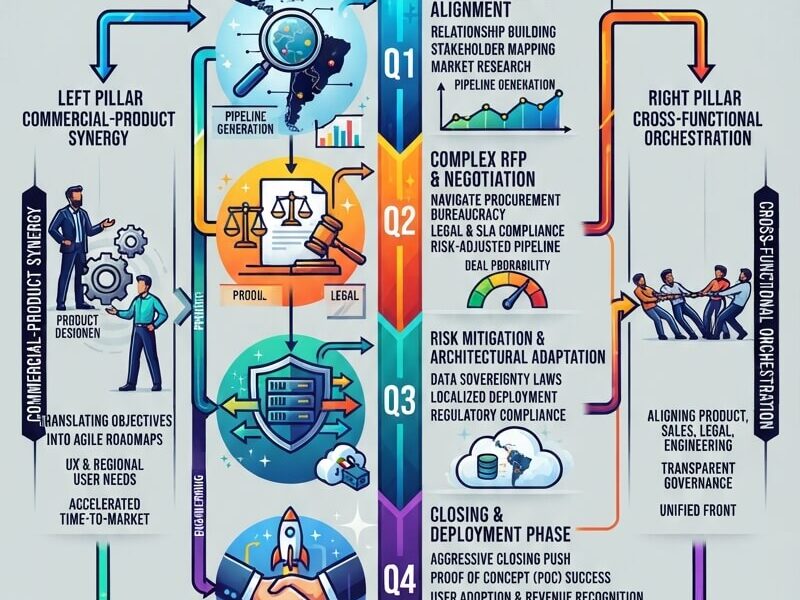
One of the most persistent challenges in enterprise technology is the disconnect between what the commercial team sells and what the product team can actually deliver. This misalignment is particularly destructive in markets where client expectations are high and tolerance for failure is low. Drawing on my background as a senior user experience designer and product owner, I have found that the most successful expansions are those that treat commercial strategy and product development as two sides of the same coin. Scaling operations requires a seamless synergy between market demands and agile execution.
Too often, business development teams secure contracts based on customized feature requests that are absent from the core product roadmap. This leads to bloated engineering backlogs, delayed time-to-market, and frustrated clients. To prevent this, organizations must translate client objectives and regional requests into agile product roadmaps that serve the broader market while satisfying specific enterprise needs. This requires a rigorous process of user story mapping and backlog prioritization, ensuring that engineering resources are focused on features that drive the highest commercial value and user adoption.
The concept of the minimum viable product is often misunderstood in enterprise contexts. Executives sometimes view it as a half-finished solution. In reality, a well-executed minimum viable product is a strategic tool for accelerating time-to-market and validating assumptions with real users. By streamlining proof of concept development and execution, companies can reduce customer request resolution times significantly. This agility allows you to demonstrate value quickly, secure early buy-in from key stakeholders, and iterate based on actual user feedback rather than hypothetical requirements.
Boosting user adoption is the ultimate metric for enterprise tech success. It does not matter how sophisticated your backend architecture is if the end-users reject the interface. This is where a deep foundation in user-centered design becomes a critical commercial advantage. By embedding user experience principles into the earliest stages of product strategy, you ensure that the solutions you bring to market are intuitive, accessible, and aligned with the daily workflows of your target audience. This focus on usability directly translates to higher retention rates, expanded cross-selling opportunities, and stronger client advocacy.
Achieving this synergy requires breaking down the silos between sales, product, and engineering. Product owners must be actively involved in high-stakes procurement discussions to ensure that client expectations are technically feasible and commercially viable. Conversely, sales teams must be educated on the core product vision and agile methodologies so they can sell the roadmap, not just the current feature set. When these teams operate in lockstep, you create a feedback loop where market insights directly inform product innovation, and product capabilities directly enable commercial growth. This alignment is the engine that drives sustainable revenue scaling.
Building and aligning cross-functional regional teams
Technology and strategy are only as effective as the people executing them. Scaling operations across multiple countries requires building high-performing, cross-functional teams that can collaborate seamlessly across different time zones, languages, and cultural contexts. The operational backbone of any successful regional expansion is the ability to align product, sales, legal, engineering, and operations around a shared vision and a unified set of key performance indicators.
In my experience leading teams across more than ten countries, the biggest barrier to execution is not a lack of talent, but a lack of stakeholder alignment. When regional sales teams are incentivized purely on revenue, they may close deals that operations cannot fulfill. When engineering teams are measured solely on code velocity, they may ignore the critical compliance features required by local markets. Overcoming these silos requires a deliberate organizational design that rewards cross-functional collaboration and shared outcomes.
One effective strategy is to establish regional centers of excellence that bring together subject matter experts from various disciplines. These hubs act as internal consultancies, providing localized support to account teams while ensuring that global best practices are maintained. For example, a regional center of excellence focused on financial services can provide deep expertise in local banking regulations, standard security requirements, and integration protocols. This allows local sales teams to punch above their weight, presenting highly sophisticated, compliant solutions to enterprise clients without needing to reinvent the wheel for every deal.
Communication is the lifeblood of a distributed operational model. It is not enough to rely on asynchronous messaging and quarterly all-hands meetings. You must establish robust routines for sharing critical issues, celebrating wins, and analyzing failures. This includes regular cadence meetings between regional leaders and global performance managers to review progress against targets, identify operational bottlenecks, and reallocate resources as needed. Transparency is key; when teams understand the broader strategic objectives and the challenges their peers are facing, they are more likely to collaborate effectively and support one another.
Furthermore, building a culture of continuous learning and adaptation is essential for long-term resilience. The technological and economic landscapes in these markets are constantly evolving. Teams must be empowered to experiment with new go-to-market strategies, test new pricing models, and adopt emerging technologies. By fostering an environment where calculated risks are encouraged and failures are treated as learning opportunities, you build an organization that is not just capable of executing a static blueprint, but one that can continuously evolve and improve its operational effectiveness over time.
Future-proofing your operational blueprint
The only constant in the global technology sector is change, and this is especially true in rapidly developing markets. An operational blueprint that works today may be obsolete in five years if it is not designed with adaptability in mind. Future-proofing your expansion requires a relentless focus on scalable architectures, flexible commercial models, and a deep commitment to operational excellence.
From a technological standpoint, your solutions must be built on modular, cloud-native architectures that can easily scale up or down based on regional demand. Monolithic systems are inherently brittle and difficult to adapt to new regulatory requirements or shifting market dynamics. By embracing microservices and API-driven integrations, you empower your local teams to customize solutions for specific enterprise clients without compromising the integrity of the core platform. This technical flexibility is a massive competitive advantage in high-stakes procurement processes where buyers demand highly tailored solutions.
Commercially, future-proofing means building relationships that transcend individual transactions. The most valuable asset you can develop in these markets is a reputation for reliability and strategic partnership. This means consistently delivering on your promises, maintaining one hundred percent on-time delivery, and proactively addressing potential issues before they impact the client. When economic volatility strikes, clients will stick with the vendors they trust to navigate the storm with them. Cultivating these deep, multi-year relationships requires a long-term perspective that prioritizes client success over short-term revenue extraction.
Finally, operational excellence must be embedded into the DNA of your organization. This means continuously refining your internal processes, from lead generation and proposal creation to project estimation and post-implementation support. By leveraging data analytics to identify inefficiencies, automate routine tasks, and optimize resource allocation, you can reduce operational costs while simultaneously improving the quality of your service delivery. This relentless pursuit of efficiency is what allows companies to maintain healthy profit margins even in highly competitive and price-sensitive markets.
Conclusion
Expanding enterprise technology operations into this vibrant and complex region is not for the faint of heart. It requires a sophisticated blend of commercial acumen, product vision, and operational discipline. By abandoning the myth of a unified market, mastering the intricacies of high-stakes procurement, bridging the gap between sales and product, aligning cross-functional teams, and designing for long-term adaptability, organizations can unlock immense value and drive sustainable growth. The blueprint outlined here is not a quick fix; it is a strategic framework for building a resilient, scalable, and deeply rooted presence in some of the most exciting technology markets in the world. The companies that succeed will be those that view regional complexity not as a barrier, but as a catalyst for innovation and operational excellence.