The evolution from user experience to enterprise strategy
Over the past two decades, my career has evolved from the granular details of user experience design to the high-altitude strategy of enterprise deal leadership. When I first started as a web and UX designer, my primary focus was on understanding the end-user.
I spent countless hours mapping user journeys, identifying friction points, and designing interfaces that made complex digital interactions feel intuitive and seamless. Today, as a strategic product and deal leader facilitating face-to-face meetings with C-level executives across LATAM, my core objective remains remarkably similar, even though the scale and stakes have changed exponentially.
I am still mapping a journey and identifying friction points, but the “user” is now a chief executive officer, a chief information officer, or a chief financial officer, and the “interface” is a multi-million-dollar enterprise technology contract.
Technology professionals mistakenly believe that securing a meeting with the C-suite is the ultimate victory
They spend weeks getting past gatekeepers, only to walk into the boardroom and deliver a highly technical, feature-heavy presentation that completely misses the mark.
The reality of high-stakes IT procurement is that senior executives do not buy software, cloud architectures, or JavaScript frameworks. They buy business outcomes, risk mitigation, and competitive advantage. They are looking for partners who can navigate regional complexities, ensure regulatory compliance, and drive measurable growth.
Facilitating a successful executive meeting requires a fundamental shift in perspective.
You must transition from being a vendor pitching a product to a strategic advisor co-creating a roadmap for the future. Whether you are dealing with a massive banking institution in Mexico or a telecommunications giant in Colombia, the principles of executive engagement remain constant.
This post draws on many years of experience in scaling technology revenue and executing complex request for proposal processes to provide a comprehensive, evergreen framework for mastering the boardroom.
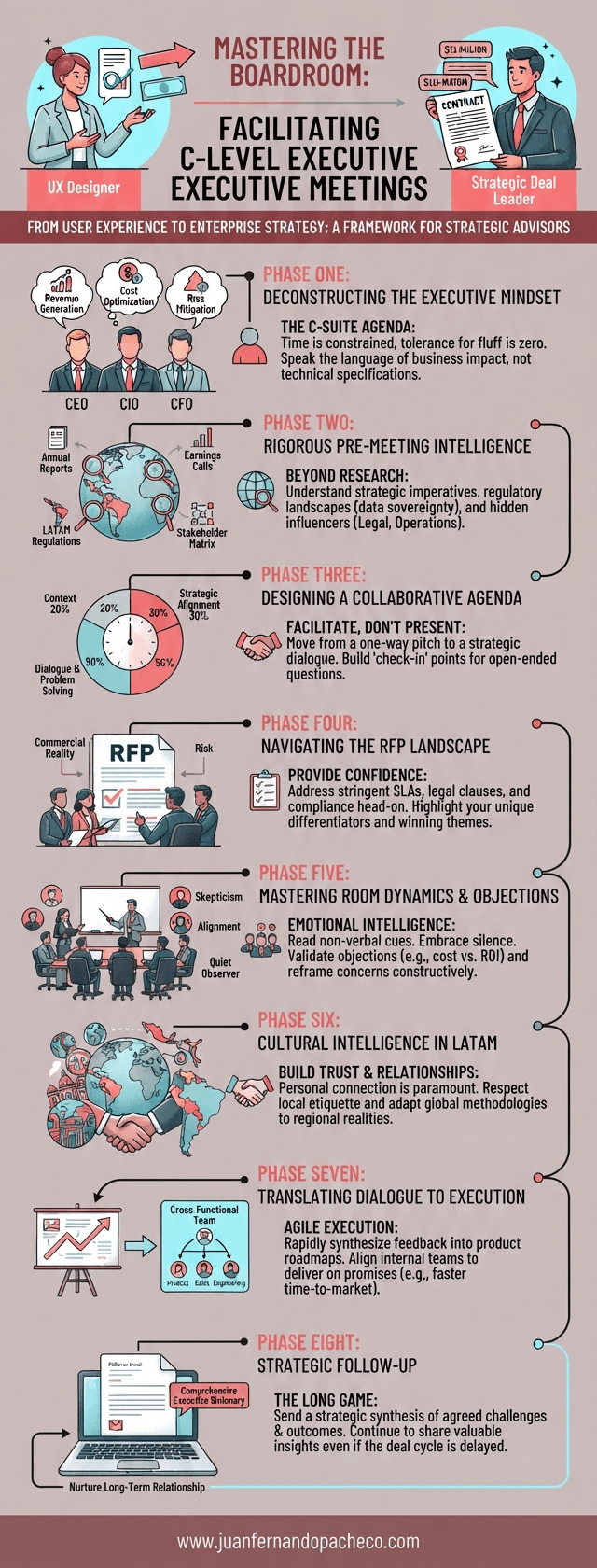
Phase one: deconstructing the executive mindset
To effectively lead a discussion with senior leadership, you must first understand the environment in which they operate.
C-level executives are inundated with decisions, crises, and pitches on a daily basis. Their time is their most severely constrained asset, and their tolerance for fluff is virtually zero.
When you sit across from them, you must recognize that their primary concerns revolve around three core pillars: revenue generation, cost optimization, and risk mitigation.
In the banking and finance sectors, a major focus of my career across LATAM, risk mitigation often overshadows everything else. A chief information security officer or a chief risk officer is not primarily interested in how fast your new application can process transactions; they are deeply concerned with data sovereignty, local government mandates, and enterprise security requirements.
If your proposed solution introduces even a fractional increase in regulatory or operational risk, the deal will die in the boardroom, no matter how innovative the technology.
Therefore, your approach to face-to-face meetings with C-level executives must be rooted in commercial-product synergy. You must be able to translate complex technical capabilities into clear business value.
For example, instead of discussing the underlying mechanics of an Agile product roadmap, you must articulate how that roadmap will accelerate time-to-market by twenty percent, or how a specific user story mapping exercise will boost user adoption by fifteen percent among millions of retail banking customers.
You must speak their language, which is the language of market share, operational efficiency, and shareholder value.
Furthermore, you must understand that the C-suite is inherently focused on the macro environment.
They are thinking about geopolitical shifts, changing consumer behaviors, and long-term market positioning. If your conversation remains trapped in the micro-level details of project management and software deployment, you will quickly lose their attention.
You must elevate the dialogue to align your technology solutions with their overarching corporate strategy.
Phase two: rigorous pre-meeting intelligence gathering
The foundation of any successful boardroom interaction is laid long before you enter the building.
In high-stakes deal execution, walking into a meeting without a deep, analytical understanding of the client’s business is a guaranteed path to failure.
Preparation goes far beyond reading the company’s latest annual report or skimming the executive’s profile on a professional networking site. It requires a deep dive into the strategic, operational, and regional nuances that affect their business.
When preparing to meet with executives in diverse markets like Peru, Chile, Argentina, or Brazil, I always start by analyzing their recent earnings calls, press releases, and strategic partnerships.
- What are their stated goals for the next three to five years?
- Are they focused on digital transformation, expanding into new demographics, or consolidating their operations to reduce overhead?
By identifying their strategic imperatives, you can tailor your discussion to show exactly how your technology services act as a catalyst for those specific goals.
Equally important is mapping the stakeholder matrix
A meeting with a chief executive officer rarely happens in a vacuum. The C-suite relies heavily on the counsel of their direct reports and subject matter experts. Before the meeting, you must identify the hidden influencers within the organization.
- Who is the head of legal who will scrutinize your complex legal clauses?
- Who is the operations director who will be responsible for implementing stringent service level agreements?
Understanding the motivations and pain points of these secondary stakeholders allows you to preemptively address their concerns during your executive presentation, demonstrating a holistic understanding of their enterprise ecosystem.
In the context of complex deal execution, particularly within heavily regulated industries, this intelligence gathering must also include a thorough review of the regional regulatory landscape.
In LATAM, data sovereignty and local policies are critical factors that can make or break an IT procurement deal. If you can walk into a meeting and proactively address how your solution complies with specific local government mandates regarding data residency, you immediately position yourself as a trusted advisor rather than just another technology vendor.
Phase three: designing a collaborative agenda
A common mistake technology leaders make is treating a strategic meeting as a one-way presentation
They bring a fifty-slide deck detailing their company history, their global footprint, and their technical specifications, and they spend an hour talking at the executives. This approach is fundamentally flawed. Face-to-face meetings with C-level executives should not be presentations; they should be facilitated strategic dialogues.
To achieve this, you must design an agenda that prioritizes interaction and discovery
A highly effective framework for an executive meeting allocates 20% of the time to establishing context, 30% to presenting strategic alignment, and 50% to open dialogue, Q&A, and collaborative problem-solving. The goal is to get the executives talking about their challenges as early as possible.
Start the meeting by briefly acknowledging their current market position and the strategic imperatives you identified during your intelligence-gathering phase. This demonstrates that you have done your homework and respects their time.
From there, pivot quickly to the “strategic gap”—the space between where they are today and where they need to be to achieve their long-term goals. This is where you introduce your value proposition, not as a list of features, but as a bridge across that strategic gap.
When discussing potential solutions, focus on the business impact
Draw upon your experience in building high-performing teams and streamlining proof of concept development. Explain how your approach to minimum viable product efficiency can reduce customer request resolution times, allowing their organization to pivot faster and capitalize on emerging market opportunities.
By framing your capabilities in terms of agility and operational efficiency, you align your offerings with the core desires of modern enterprise leadership.
Crucially, you must build “check-in” points into your agenda
Every ten to fifteen minutes, pause and ask open-ended questions that force the executives to engage with the material. Questions like:
- How does this align with your current risk tolerance regarding third-party integrations?
- What internal bottlenecks have you experienced when trying to deploy similar solutions in the past?
These questions not only provide you with invaluable real-time intelligence but also transform the dynamic from a vendor pitch to a collaborative consulting session.
Phase four: navigating the request for proposal landscape
In the realm of enterprise technology sales, face-to-face meetings with C-level executives are often deeply intertwined with the complex request for proposal process.
Whether you are in the early stages of shaping a request for information, responding to a detailed request for quote, or defending your proposal during the final stages of a request for proposal, the executive meeting is where the ultimate decision is influenced.
C-level executives are rarely involved in the minutiae of scoring vendor matrices or evaluating technical compliance sheets. Their role in the procurement process is to assess strategic fit, evaluate risk, and make the final capital allocation decision.
Therefore, your objective in the boardroom is to provide them with the narrative and the confidence they need to champion your solution internally.
You must be prepared to discuss the commercial and legal realities of the deal
High-stakes IT procurement involves navigating complex legal clauses and enterprise security requirements that can significantly impact the total cost of ownership and the long-term viability of the partnership.
Do not shy away from these difficult topics. Instead, address them head-on. Demonstrate how your organization approaches stringent service level agreement negotiations, including uptime guarantees, response times, and financial penalties.
By showing a willingness to engage transparently with operational and legal risks, you signal that your organization is mature, reliable, and prepared for a true partnership.
Furthermore, use the executive meeting to highlight your winning themes
- What is the unique differentiator that sets your proposal apart from the competition?
- Is it your deep understanding of the local market?
- Is it your proven track record of mitigating operational risks to ensure one hundred percent on-time delivery?
- Is it your ability to seamlessly integrate with their legacy systems while simultaneously building a modern, scalable architecture?
Whatever your winning theme is, it must be clearly articulated and tied directly to the executive’s strategic priorities.
Remember that the procurement process is often long and arduous
The executives you meet with will rely on the impressions you make in the boardroom to guide their internal teams through the months-long evaluation process. Your ability to project confidence, competence, and strategic alignment during this face-to-face interaction will heavily influence the internal momentum of your bid.
Phase five: mastering room dynamics and handling objections
The true test of a deal leader is not how well they deliver a rehearsed script, but how they handle the friction and unpredictability of a live room. Executive boardrooms are dynamic environments, often characterized by shifting power dynamics, competing internal agendas, and rigorous skepticism.
Mastering the room requires high emotional intelligence, acute observation skills, and the ability to think critically under pressure.
When facilitating the meeting, pay close attention to the non-verbal cues of the participants
- Who is leaning in and taking notes?
- Who is checking their phone or exchanging glances with a colleague?
- Who is the dominant voice in the room?
- Who is the quiet observer whose buy-in might actually be the most critical?
By reading the room, you can adjust your pacing, direct your questions to the right individuals, and ensure that all key stakeholders feel heard and engaged.
Objections are a natural and necessary part of any high-stakes negotiation
When a chief financial officer challenges your pricing model, or a chief technology officer questions the scalability of your architecture, do not become defensive.
View objections as valuable data points that reveal their underlying concerns. Use a framework of active listening and validation. Acknowledge the validity of their concern, provide a clear, data-backed response, and then tie your response back to their strategic objectives.
For example, if an executive expresses concern about the upfront costs of a digital transformation initiative, do not simply offer a discount. Instead, reframe the conversation around the total cost of ownership and the long-term return on investment.
Discuss how your streamlined proof of concept development reduces initial risk, and how your Agile product roadmaps ensure that value is delivered incrementally, allowing them to realize benefits long before the final deployment is complete.
Silence is another powerful tool in the executive facilitator’s arsenal
After you make a significant point or ask a probing question, allow for a few seconds of silence. Executives are used to vendors rushing to fill every quiet moment with nervous chatter.
By embracing the silence, you project confidence and give the executives the space they need to process complex information and formulate thoughtful responses. Often, the most profound insights and strategic alignments emerge during these quiet moments of reflection.
Phase six: cultural intelligence in LATAM markets
Operating across LATAM presents a unique set of challenges and opportunities that require a nuanced approach to executive engagement.
The business cultures in Mexico, Colombia, Ecuador, Brazil, and other countries in the region are deeply rooted in relationship-building, trust, and mutual respect. While the technical and commercial requirements of a deal may be identical to those in North America or Europe, the path to securing executive buy-in is often distinctly different.
In many LATAM markets, trust is not established solely through a polished slide deck or a robust legal contract; it is forged through personal connection and demonstrated commitment to the region.
Face-to-face meetings are not just a formality; they are a critical prerequisite for doing business. Senior executives in this region want to look you in the eye, understand your character, and gauge your long-term commitment to their market before they entrust you with their critical infrastructure or customer-facing applications.
To succeed in these environments, you must blend rigorous commercial strategy with genuine cultural intelligence. Take the time to understand the local business etiquette, the historical context of the region’s economic challenges, and the specific cultural nuances that influence decision-making.
Show respect for local customs and demonstrate a willingness to adapt your global methodologies to fit local realities.
Recognize that the definition of “risk” can vary across different regions
In some LATAM markets, the primary risk might be political instability or currency fluctuation; in others, it might be the pace of regulatory change or the availability of local technical talent.
By acknowledging these regional complexities and proactively discussing how your organization mitigates them—whether through local data centers, regional support teams, or flexible commercial structures—you demonstrate a level of empathy and understanding that resonates deeply with local leadership.
Building high-performing, cross-functional teams that span across these diverse geographies is also essential
When you bring subject matter experts, engagement managers, and engineering leads into the executive meeting, ensure they reflect a deep understanding of the local context.
A unified, culturally aware team that speaks with one voice is incredibly persuasive and helps to solidify the trust that is so vital in LATAM business relationships.
Phase seven: translating dialogue into agile execution
A successful face-to-face meeting with C-level executives is merely a milestone, not the destination
The true measure of your effectiveness is what happens after the meeting concludes. The insights gathered, the strategic alignments forged, and the objections raised in the boardroom must be rapidly translated into actionable execution plans.
This is where the synergy between commercial leadership and product development becomes critical.
Immediately following the meeting, it is essential to synthesize the discussion and align your internal cross-functional teams. This includes product management, sales, legal, engineering, and operations.
The C-suite expects a seamless experience; they do not want to see the internal silos or the operational friction that often plagues large technology organizations.
By coordinating relationship-building efforts and ensuring that every internal stakeholder is well-informed about critical issues, you maintain the momentum generated in the boardroom.
Use the strategic objectives discussed with the executives to refine your Agile product roadmaps
- If the chief marketing officer emphasized the need for faster user acquisition, work with your product owners to prioritize user story mapping that focuses on frictionless onboarding.
- If the chief operating officer expressed concerns about system reliability, ensure that your engineering teams are focused on stringent service level agreement compliance and robust failover mechanisms.
By directly linking executive feedback to backlog prioritization, you ensure that the product being built is exactly the product that was sold.
This phase is also where you execute on the promises made regarding proof of concept development and minimum viable product efficiency. Reducing customer request resolution times and accelerating time-to-market are not just buzzwords; they are operational imperatives that must be tracked and measured.
Routinely report and measure progress against the targets discussed in the executive meeting, sharing these updates with both the client’s senior leadership and your internal regional and industry leaders. This transparency builds immense credibility and reinforces the narrative that you are a reliable, execution-focused partner.
Phase eight: the strategic follow-up and long-term relationship management
The follow-up process is where many deals stall or fall apart
A generic “thank you for your time” email is entirely insufficient after a high-stakes strategic meeting. Your follow-up must be a carefully crafted continuation of the strategic dialogue, reinforcing the value propositions and winning themes that resonated most strongly in the room.
Within twenty-four hours of the meeting, distribute a comprehensive executive summary to all attendees
This document should not be a mere transcript of the conversation, but a strategic synthesis that outlines the agreed-upon business challenges, the proposed technological solutions, and the clear, measurable outcomes that the partnership will deliver.
Highlight the specific ways in which your organization will mitigate their operational and legal risks, and clearly define the next steps in the complex deal execution process.
Maintaining strong partner ties and cultivating relationships with top business decision-makers requires consistent, value-driven engagement over time. Even if the immediate procurement cycle is delayed or the request for proposal process is put on hold, you must continue to nurture the relationship.
Share relevant market research, insights on emerging technologies, or case studies from similar cross-segment markets that demonstrate your ongoing commitment to their success.
As a business development manager, my primary focus has always been on fostering growth, aligning with clients’ missions, and building robust relationships with stakeholders throughout the region.
This long-term perspective is crucial. The executives you meet with today may not sign a contract with you tomorrow, but if you have established yourself as a trusted, strategic advisor, you will be the first call they make when their strategic priorities shift or when a new budget cycle begins.
Conclusion: the long game of enterprise leadership
Facilitating face-to-face meetings with C-level executives is an intricate blend of art and science
It requires the analytical rigor to understand complex financial and operational models, the technical acumen to design scalable IT products, and the emotional intelligence to navigate high-stakes human dynamics.
It is about moving beyond the transactional nature of traditional sales and embracing the role of a strategic partner who is deeply invested in the client’s long-term success.
Over my career, from designing early web interfaces to leading multi-million-dollar IT procurement deals across Latin America, the core lesson has always been the same: true value is created when we deeply understand the needs of the people we are serving.
Whether that person is a retail banking customer trying to transfer funds on a mobile app, or a chief executive officer trying to navigate a complex digital transformation, the mandate is to listen intently, strategize collaboratively, and execute flawlessly.
By approaching every executive interaction with rigorous preparation, a focus on commercial-product synergy, and a deep respect for cultural and regional nuances, you elevate your role from a vendor to an indispensable strategic leader.
The boardroom is not a place to be feared; it is a crucible where the most impactful partnerships are forged. Master the art of facilitation, align your technology with their business goals, and you will not only secure complex deals but also drive meaningful, scalable growth across the global technology landscape.