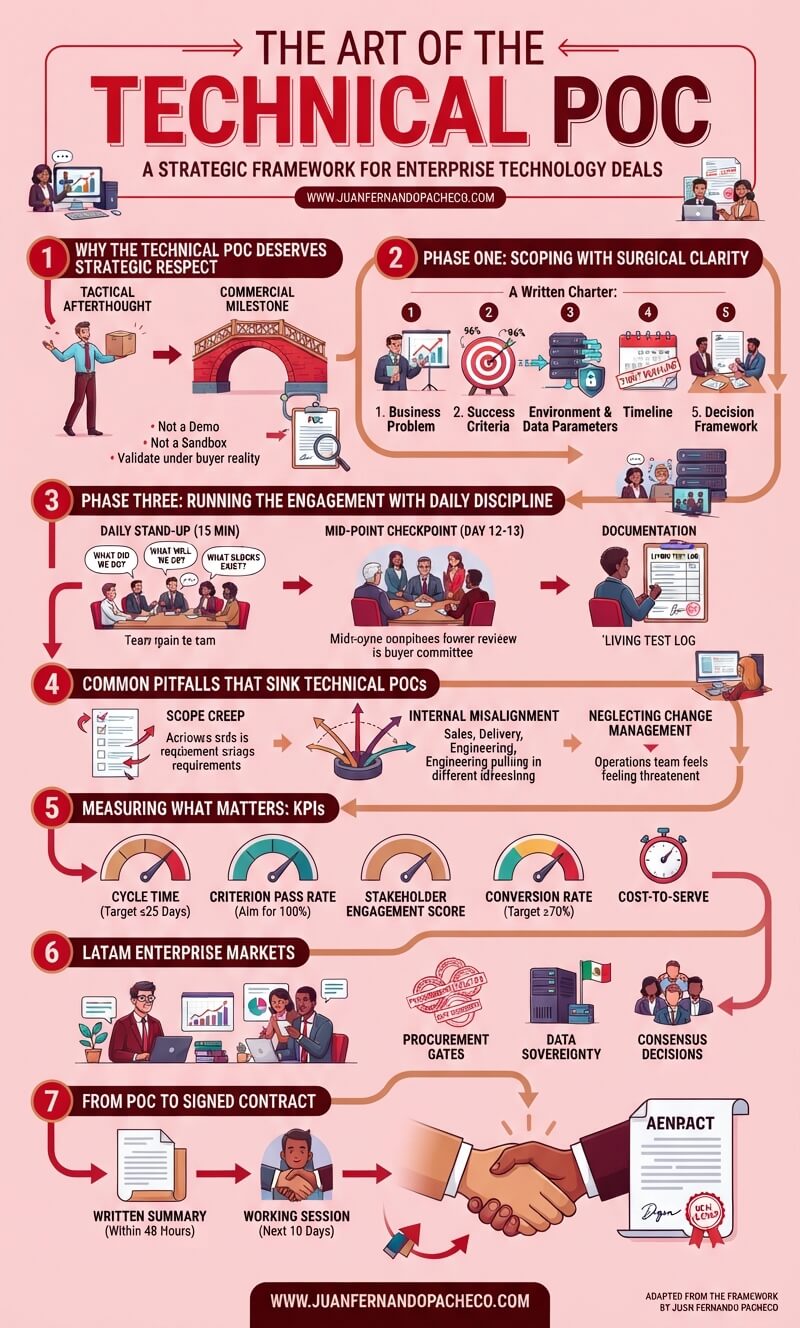
An infographic titled 'THE ART OF THE TECHNICAL POC' outlining a strategic framework for enterprise technology deals in seven numbered steps. The steps include 1) Strategic Respect (Tactical vs Commercial), 2) Scoping with Surgical Clarity (Written Charter), 3) Running the Engagement (Daily Discipline), 4) Common Pitfalls, 5) Measuring KPIs, 6) LATAM Enterprise Markets, and 7) From POC to Signed Contract. The graphic features a light pink background, red headers, and illustrations of business professionals, charts, and checklists.

A technical POC can make or break a multi-million-dollar enterprise deal. This guide breaks down a repeatable framework for planning, running, and converting proof-of-concept engagements into signed contracts, drawing on two decades of deal leadership across LATAM and global markets.

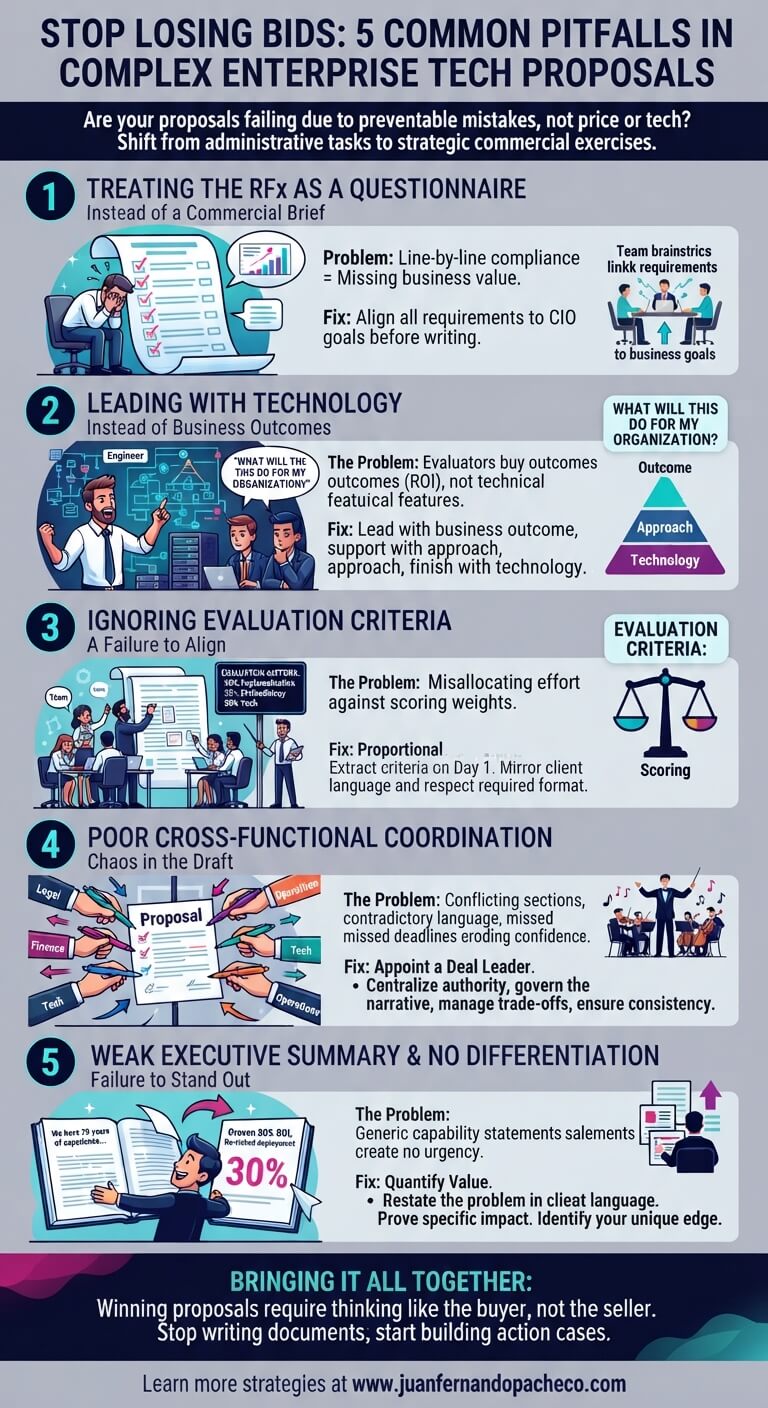
An infographic titled "Stop Losing Bids: 5 Common Pitfalls in Complex Enterprise Tech Proposals" with a subtitle about shifting from administrative tasks to strategic commercial exercises. It details five numbered sections: 1. Treating the RFx as a Questionnaire, 2. Leading with Technology, 3. Ignoring Evaluation Criteria, 4. Poor Cross-Functional Coordination, and 5. Weak Executive Summary & No Differentiation. Each section includes a illustrative icon, problem description, and fix, concluding with a summary text "Bringing it all Together" and a website URL at the bottom.

Most enterprise tech proposals fail before the evaluation committee even finishes reading them. This article breaks down five recurring mistakes that cost technology firms millions in lost revenue, and it offers practical corrections drawn from two decades of high-stakes RFx execution across LATAM and global markets.
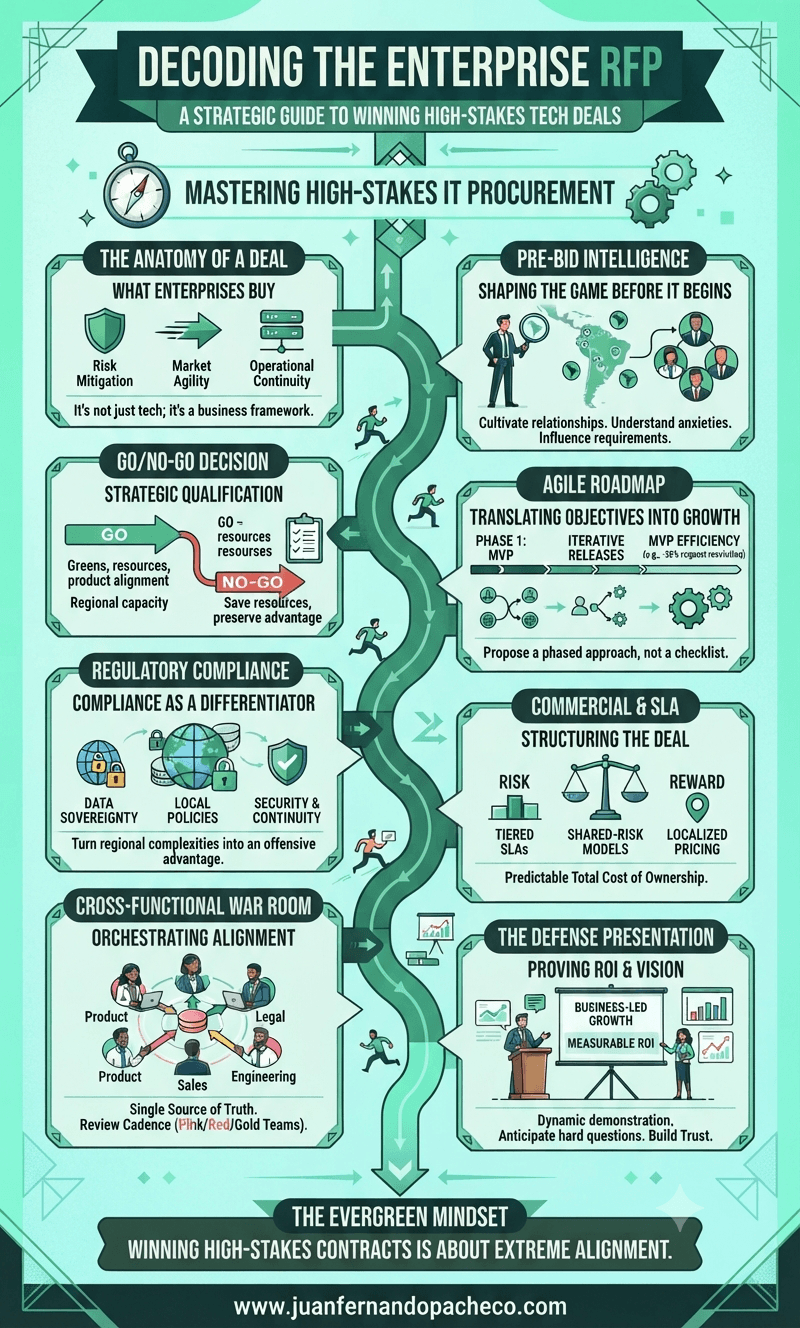
A vertical infographic titled "Decoding the Enterprise RFP" with a teal and green color scheme, illustrating a strategic, multi-stage path to winning high-stakes tech deals. The path includes steps like Pre-Bid Intelligence, Go/No-Go Decision, Agile Product Roadmap, Regulatory Compliance, Commercial & SLA Negotiation, and the Defense Presentation. Small figures navigate the pathway toward "Extreme Alignment" and the final goal at www.juanfernandopacheco.com.

Winning multi-million-dollar technology contracts requires more than just compliance; it demands a deep understanding of commercial-product synergy, risk mitigation, and regional nuances. This guide breaks down the anatomy of a winning enterprise RFP strategy from pre-bid intelligence to final defense.
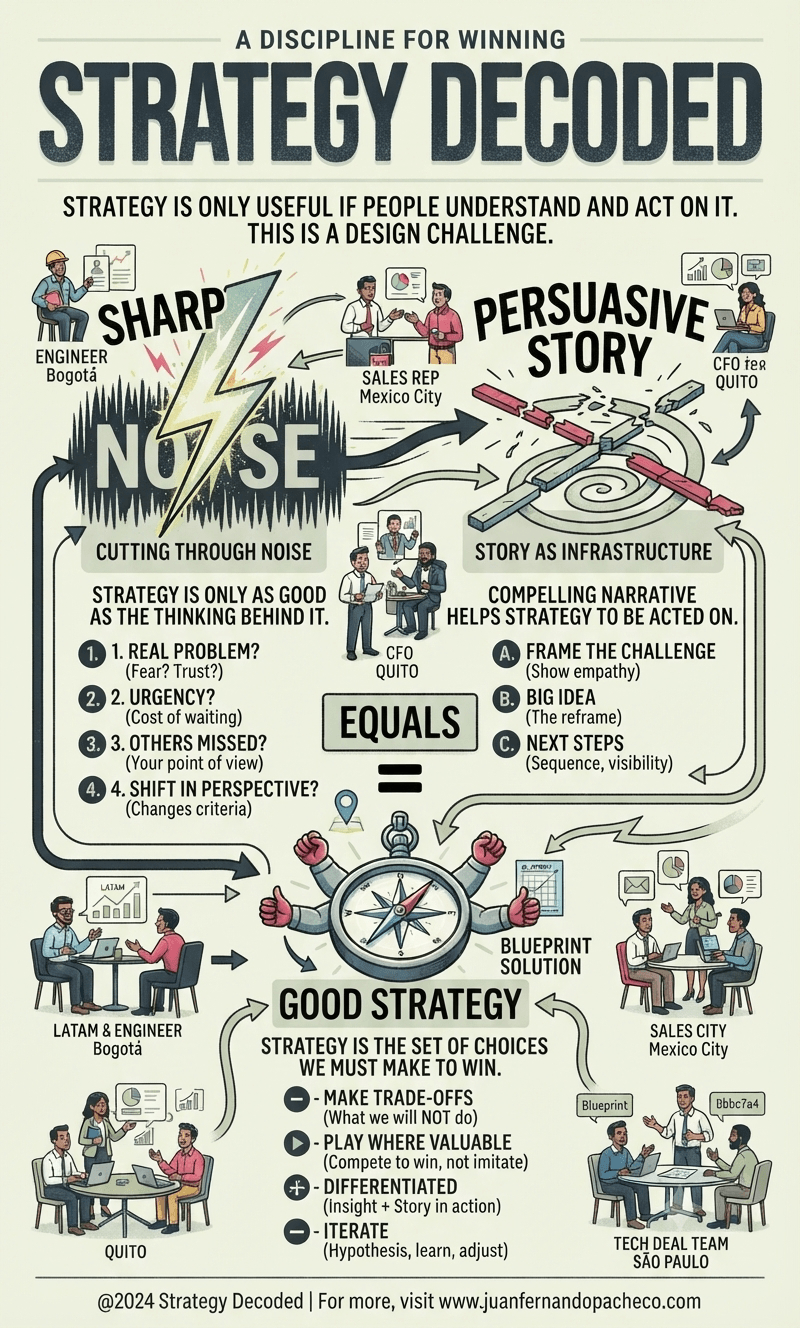
A detailed vertical infographic titled 'Strategy Decoded: A Discipline for Winning' against a light background, featuring three main sections. The top section, 'Sharp Insight,' shows a lightning bolt cutting through noise waves and lists four questions: '1. REAL PROBLEM?', '2. URGENCY?', '3. OTHERS MISSED?', and '4. SHIFT IN PERSPECTIVE?'. The middle section, 'Persuasive Story,' depicts a broken path being mended into a clear spiral and lists three moves: 'A. FRAME THE CHALLENGE', 'B. BIG IDEA', and 'C. NEXT STEPS'. A central 'EQUALS' sign connects these two to a bottom section, 'Good Strategy,' symbolized by a central compass with many directional arms and two "thumbs up" hands, surrounded by illustrations of diverse business teams in Bogotá, Mexico City, Quito, and São Paulo. The text 'STRATEGY IS THE SET OF CHOICES WE MUST MAKE TO WIN.' is prominent, with bullet points for 'MAKE TRADE-OFFS', 'PLAY WHERE VALUABLE', 'DIFFERENTIATED', and 'ITERATE'. The footer contains '@2024 Strategy Decoded | For more, visit www.juanfernandopacheco.com'. The overall style is illustrative and professional, using a muted color palette.

A good strategy is not a long document; it is a clear insight told as a persuasive story that people can actually act on. This post shows how to find what others miss, turn it into a message that sticks, and convert both into the choices that win deals, markets and careers.

An infographic titled "Influence Skills," illustrating how strategists move people from insight to action through a three-step loop: Synthesis (turning noise into meaning), Storytelling (translating meaning into belief), and Decision-Making (converting belief into motion). The visual design uses flowing, isometric elements with a color palette of cream, deep purple, electric pink, and teal, replacing previous branding with [www.juanfernandopacheco.com](https://www.juanfernandopacheco.com).

Strategy fails more often in the room than in the analysis. This post breaks down the three influence skills — synthesis, storytelling and decision making — with practical habits that keep working no matter the year, the tool or the market.
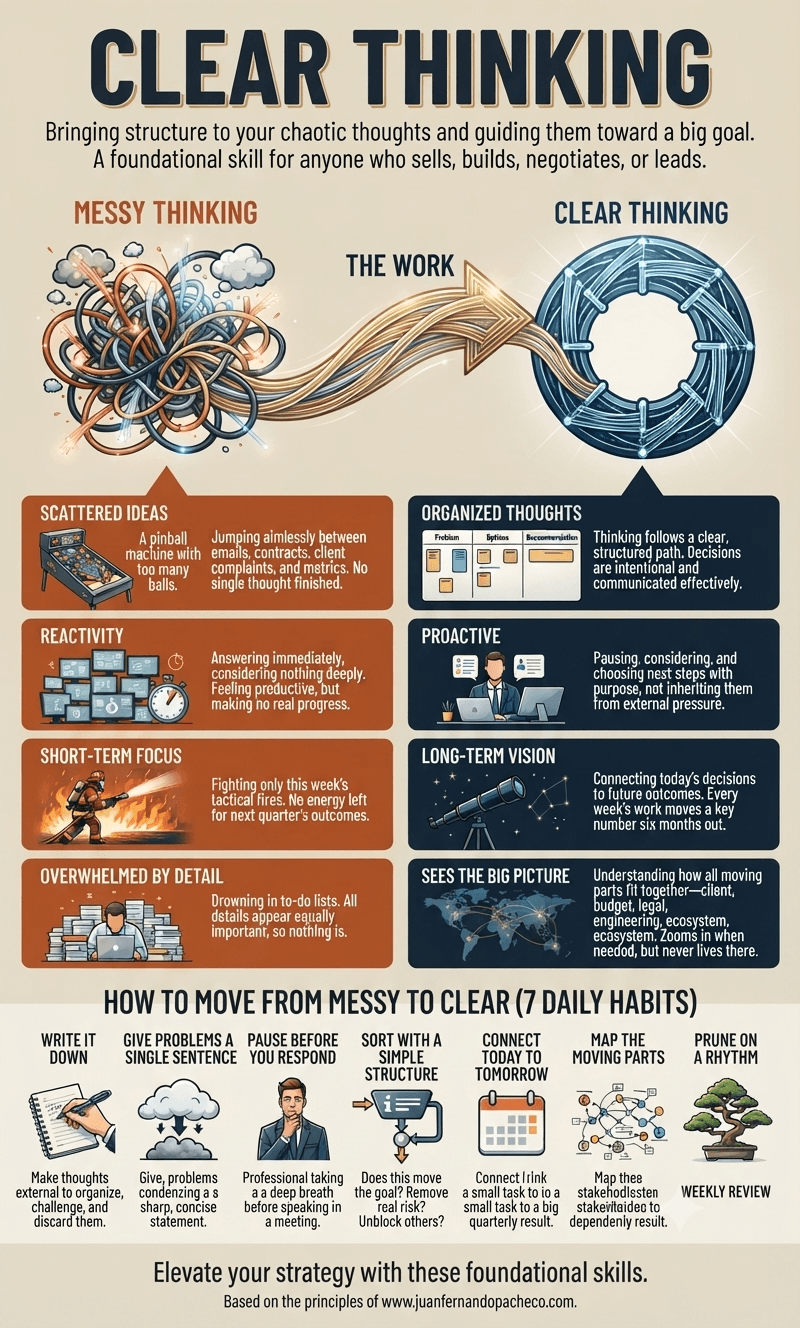
An infographic titled "Clear Thinking" illustrating a transformation from a chaotic tangle of orange wires on the left, representing "Messy Thinking," to a structured blue geometric circle on the right, representing "Clear Thinking." A golden arrow labeled "The Work" connects the two. Below the main illustration, four bullet points detail the characteristics of "Messy Thinking" (Scattered Ideas, Reactivity, Short-Term Focus, Overwhelmed by Detail) contrasted with four for "Clear Thinking" (Organized Thoughts, Proactive, Long-Term Vision, Sees the Big Picture). The bottom section outlines seven steps under the heading "How to Move from Messy to Clear (7 Daily Habits)," featuring icons and brief descriptions for practices like writing things down, giving problems a single sentence, and pausing before responding. The very bottom includes the text "Elevate your strategy with these foundational skills" and the URL "Based on the principles of www.juanfernandopacheco.com".

Clear thinking is the practice of bringing structure to your thoughts and guiding them toward a big goal, instead of juggling too many at once. This post looks at how messy thinking shows up in real commercial and product work, and how to build the organized, proactive, long-term habits that turn noise into judgment.
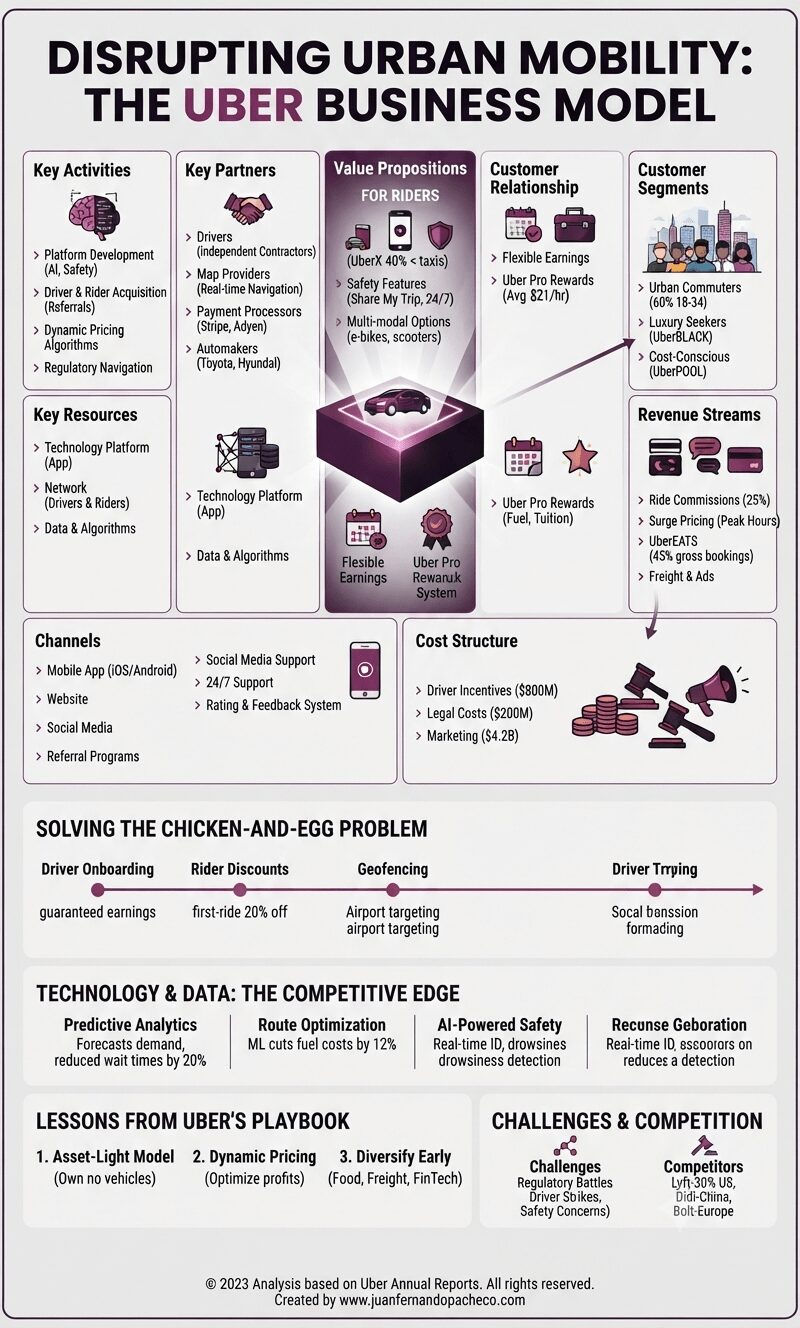
Infographic illustrating Uber's business model, including key activities, resources, partners, value propositions for riders and drivers, customer segments, revenue streams, and cost structure. The graphic features the text "DISRUPTING URBAN MOBILITY: THE UBER BUSINESS MODEL" and includes a footer with attribution to Juan Fernando Pacheco.

Uber’s relentless innovation—from self-driving cars to drone deliveries—positions it to dominate the future of mobility. By prioritizing scalability, data, and user experience, Uber remains a blueprint for disruptors worldwide.
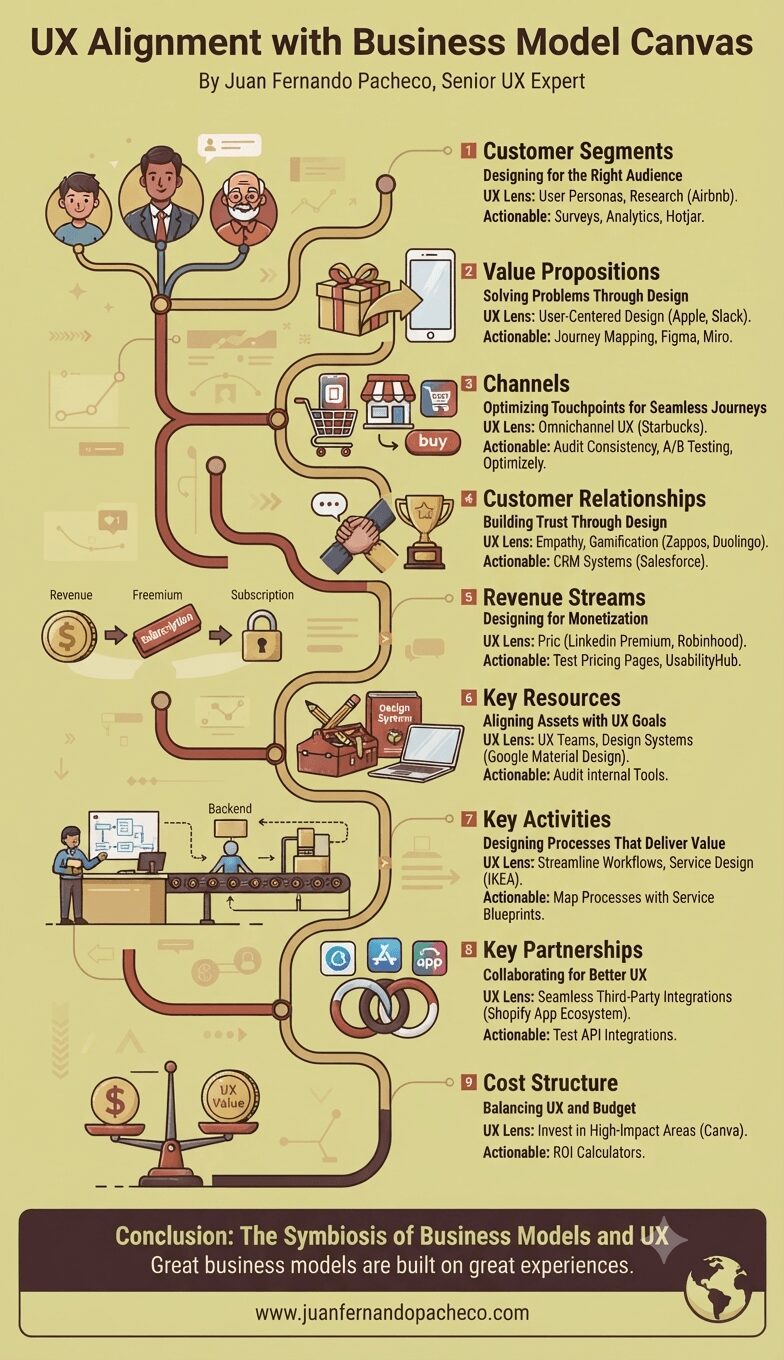
An infographic titled "UX Alignment with Business Model Canvas" by Juan Fernando Pacheco, presented in a professional, illustrative style on a warm beige background. The image details nine building blocks arranged vertically along an organic, winding path. Each block features a title, a corresponding icon, a "UX Lens" perspective, and an "Actionable Insight."

The Business Model Canvas isn’t just a strategic tool—it’s a blueprint for designing experiences that resonate. By aligning each building block with UX principles, businesses can create value that’s both sustainable and user-centric. Whether you’re a startup or an enterprise, remember:

Great business models are built on great experiences.