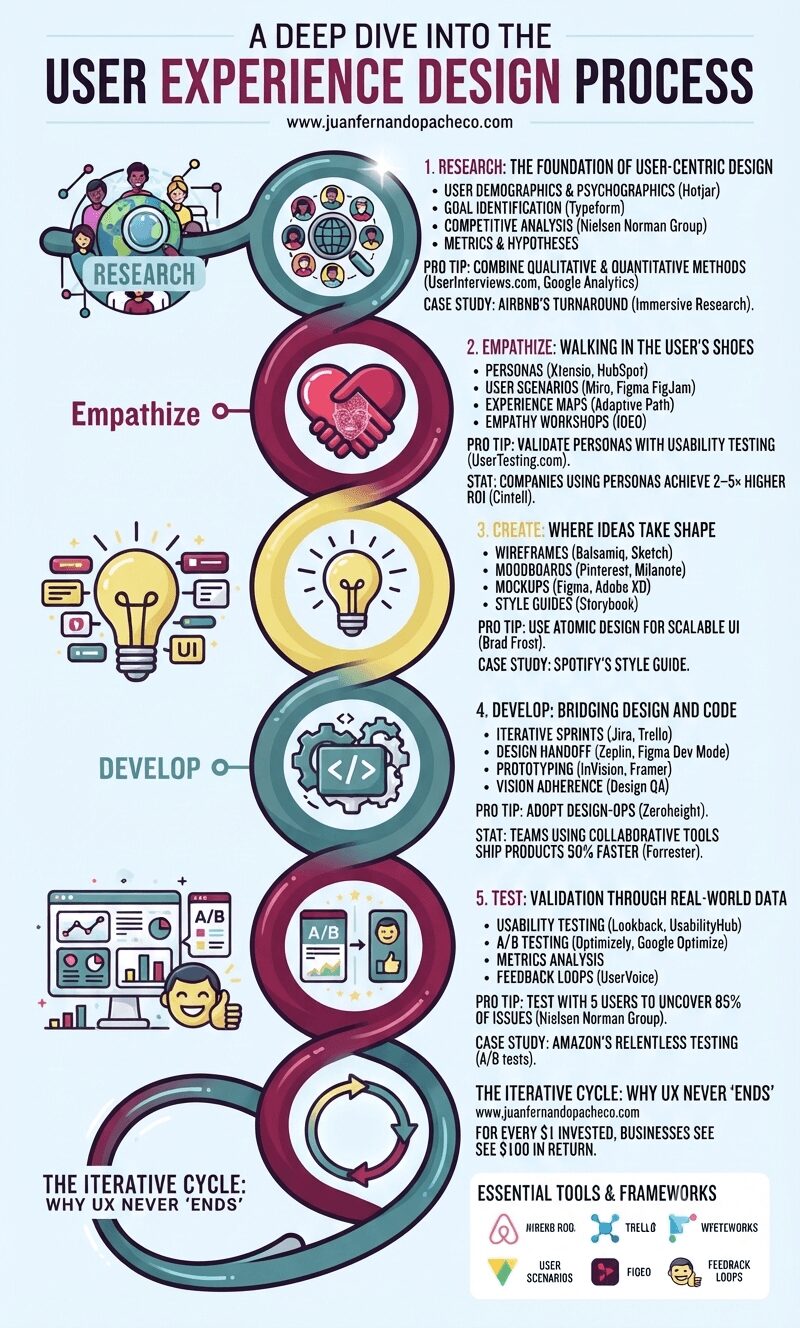
An infographic titled "A Deep Dive into the User Experience Design Process," presented as a stylized, continuous helix structure with five distinct, glowing nodes against a light blue background. From top to bottom, the nodes are: Research (#558c8c teal): Icons of users and a magnifying glass. Text includes "1. RESEARCH: THE FOUNDATION OF USER-CENTRIC DESIGN" and mentions Hotjar, Typeform, competitive analysis, and success metrics. Pro tip: "COMBINE QUALITATIVE & QUANTITATIVE METHODS (UserInterviews.com)." Empathize (#82204a magenta): Icons of two hands forming a heart with a wireframe face. Text includes "2. EMPATHIZE: WALKING IN THE USER’S SHOES" and mentions personas, user scenarios, experience maps (Adaptive Path), and empathy workshops (IDEO). Pro tip: "VALIDATE PERSONAS." Create (#e8db7d yellow): An icon of a glowing lightbulb with UI elements. Text includes "3. CREATE: WHERE IDEAS TAKE SHAPE" and mentions wireframes (Balsamiq), moodboards, mockups (Figma), and style guides (Storybook). Pro tip: "USE ATOMIC DESIGN (Brad Frost)." Develop (#558c8c teal): Icons of cogs and code brackets. Text includes "4. DEVELOP: BRIDGING DESIGN AND CODE" and mentions iterative sprints (Jira), design handoffs (Zeplin), prototyping, and design QA. Pro tip: "ADOPT DESIGN-OPS." Test (#82204a magenta): Icons of data charts, A/B testing, and a happy user. Text includes "5. TEST: VALIDATION THROUGH REAL-WORLD DATA" and mentions usability testing (Lookback), A/B testing (Optimizely), metrics analysis, and feedback loops. Pro tip: "TEST WITH 5 USERS (Nielsen Norman Group)." The helix loops back at the bottom to a final section: "THE ITERATIVE CYCLE: WHY UX NEVER ‘ENDS’" with an arrow circle, the ROI statistic (Forrester), and a list of "ESSENTIAL TOOLS & FRAMEWORKS" (Hotjar, SurveyMonkey, Google Analytics, Miro, UserTesting.com, Xtensio, Figma, Sketch, Adobe XD, Storybook, Zeplin, Jira, Framer, UsabilityHub, Optimizely, FullStory, HEART, Double Diamond, JTBD). The URL www.juanfernandopacheco.com is visible at the top and bottom.

Neglecting UX risks obsolescence. Brands like Apple and Tesla dominate by embedding user-centricity in their DNA. Start small: interview 5 users today. Map one customer journey. Test one button. The process compounds—each iteration deepens empathy, refines solutions, and ultimately, builds products humans love.

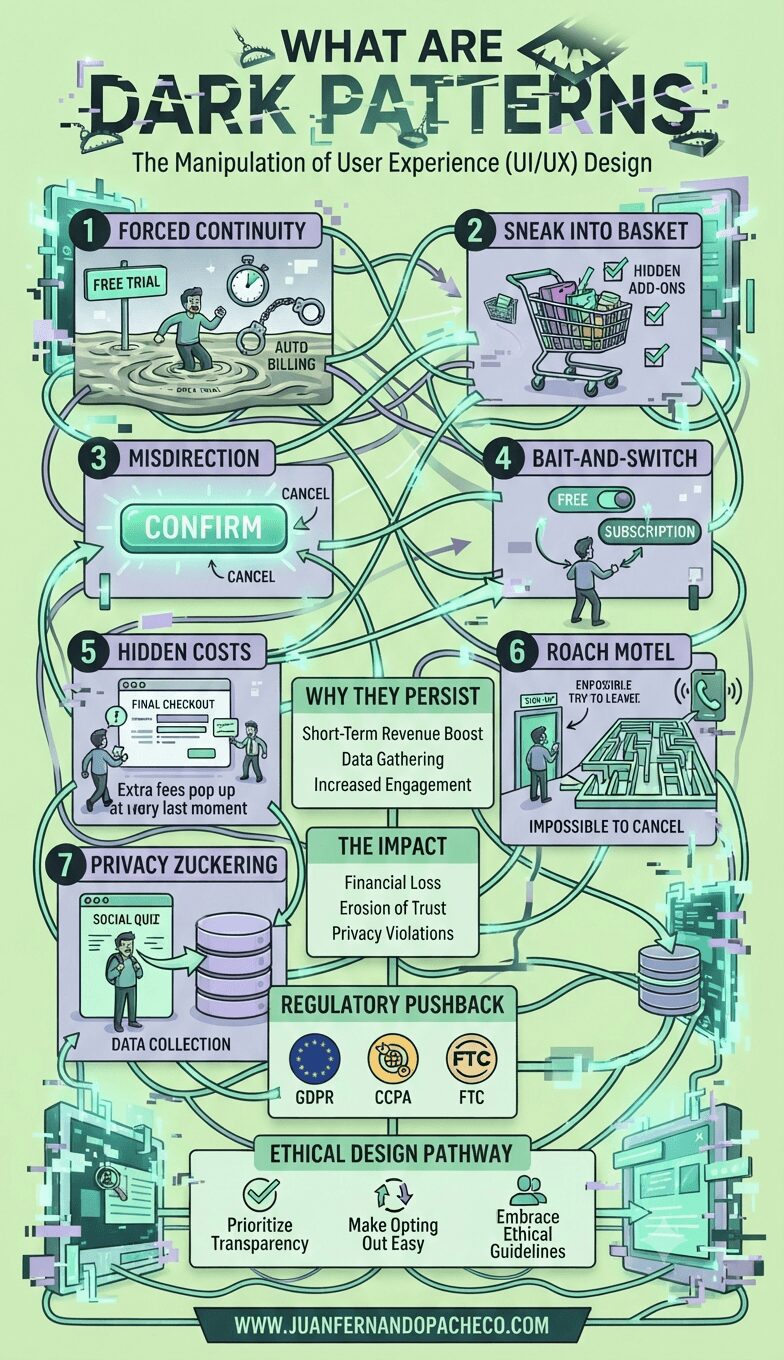
A detailed infographic titled "What are Dark Patterns" explaining manipulative UI/UX design techniques. It illustrates seven common examples: Forced Continuity, Sneak into Basket, Misdirection, Bait-and-Switch, Hidden Costs, Roach Motel, and Privacy Zuckering. Central sections outline why they persist and their impact on users, followed by regulatory pushback from GDPR, CCPA, and FTC. The footer promotes ethical design and lists the website www.juanfernandopacheco.com.

Dark patterns represent the darker side of design, exploiting user vulnerabilities for profit. While effective in the short term, they erode trust, invite regulatory scrutiny, and harm users. By embracing ethical design principles, businesses can foster loyalty, build sustainable relationships, and lead with integrity.
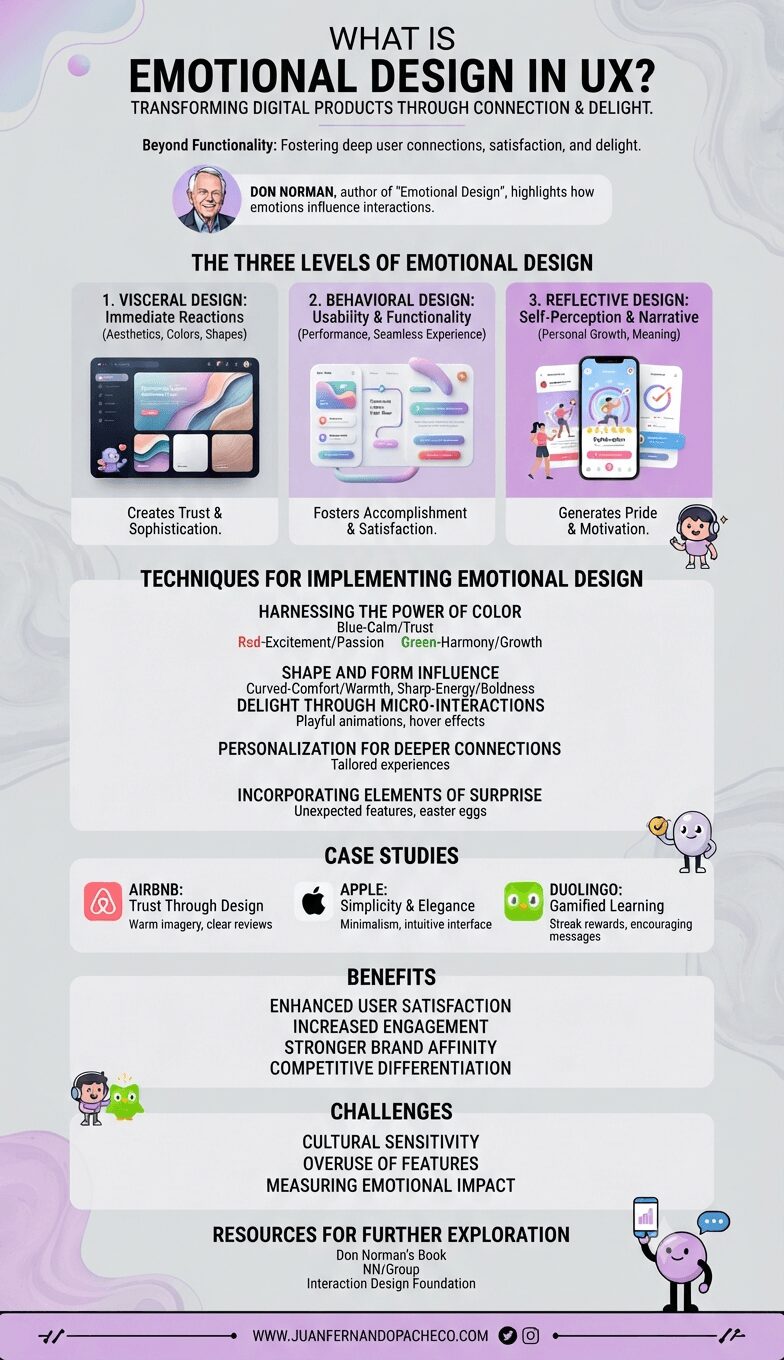
An infographic titled "What is Emotional Design in UX?" detailing Don Norman’s framework of Visceral, Behavioral, and Reflective Design. The image outlines techniques like using color psychology and micro-interactions, provides case studies of Airbnb, Apple, and Duolingo, and lists key benefits and challenges. It includes a footer with the website JuanFernandoPacheco.com.

Emotional Design in UX (User Experience) represents a transformative approach to creating products and services that resonate deeply with users.
By crafting experiences that evoke specific emotional responses, designers can foster a sense of connection, satisfaction, and delight that extends beyond mere functionality.