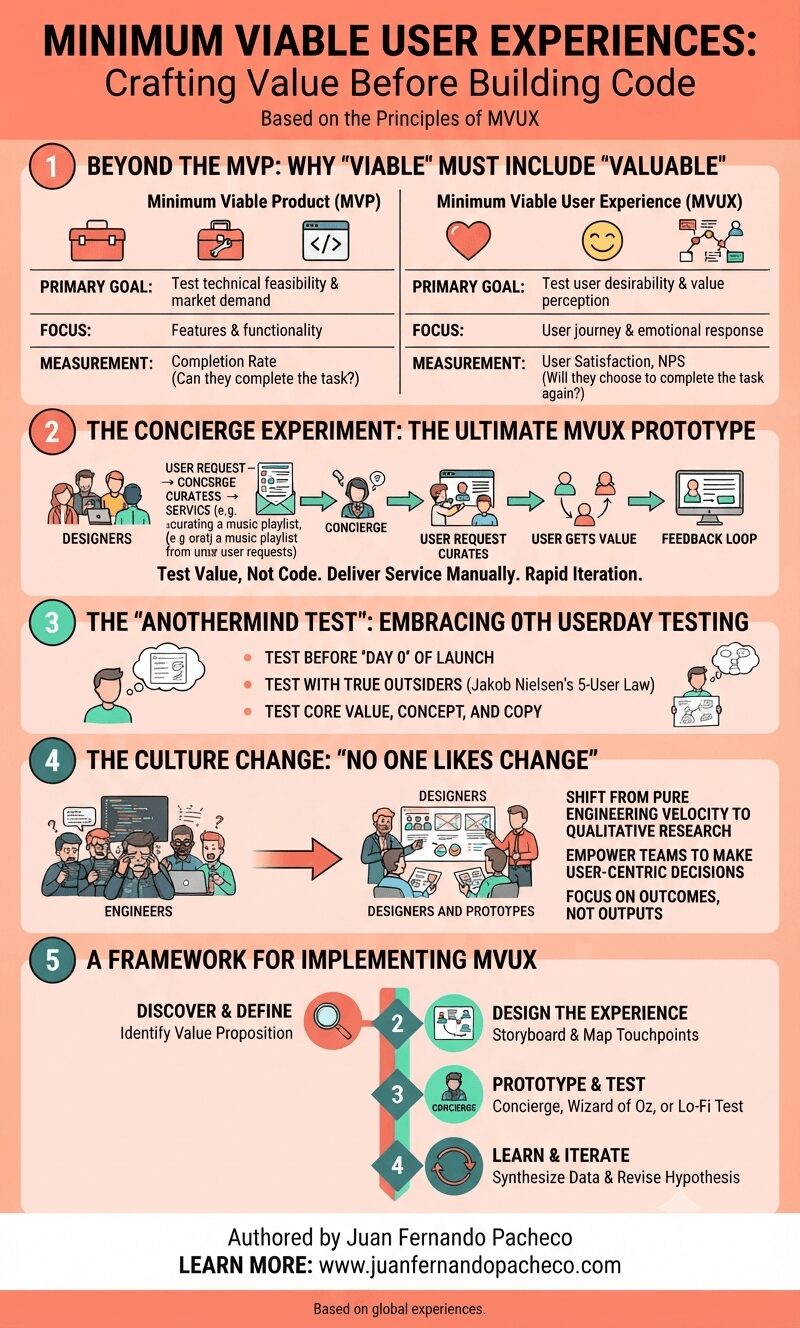
An infographic titled "MINIMUM VIABLE USER EXPERIENCES: Crafting Value Before Building Code," authored by Juan Fernando Pacheco. It presents a five-part framework for transitioning from MVP to MVUX. Section 1 compares MVP (focusing on features and technical feasibility) with MVUX (focusing on user journey and emotional response). Section 2 illustrates the "Concierge Experiment," showing a process of manual service delivery to test value before building code. Section 3 describes the "Anothermind Test" for 0th userday testing with outsiders. Section 4 explains the necessary "Culture Change," shifting from engineering velocity to user outcomes. Section 5 provides a four-step implementation framework: Discover, Design, Prototype, and Learn. The image uses a clean, professional design with icons and flowcharts.

After 20 years in this field, all you need to know is this:

The winning product is rarely the one with the most features.

It is almost always the one with the most thoughtful, frictionless, and valuable experience. The MVUX is your strategy to find that experience efficiently and effectively.

It’s a commitment to being human-centered from the very first sketch. It’s about being a concierge for your users, understanding their needs so deeply that the product you eventually build feels like it was made for them, and them alone. Because it was.
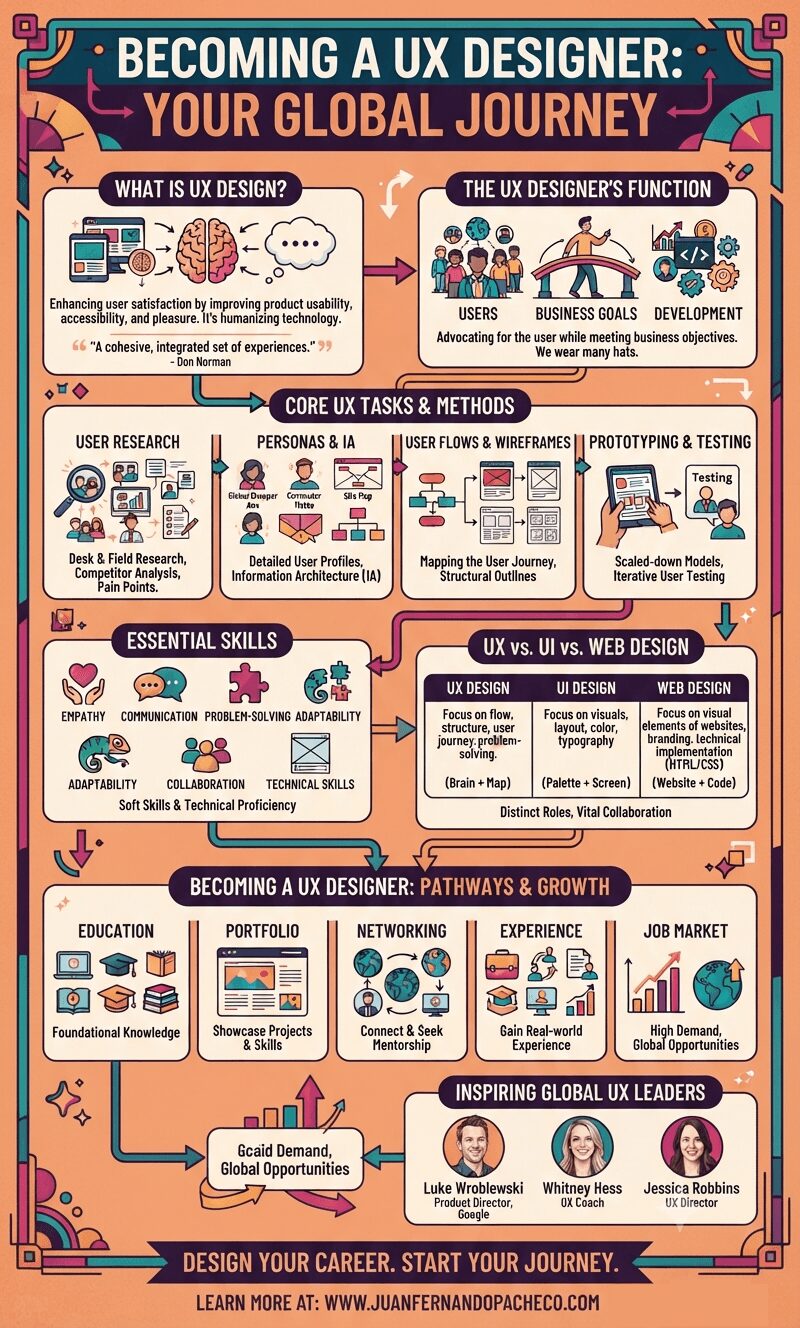
An intricate infographic titled "BECOMING A UX DESIGNER: YOUR GLOBAL JOURNEY" with a peach background. It outlines key UX concepts including definitions, the designer's function as a bridge between users and business, core methodologies (research, personas, flows, prototyping, testing), essential skills, comparisons to UI and web design, career paths (education, portfolio, networking), and features three inspiring leaders. Arrows connect the sections, and a footer directs to www.juanfernandopacheco.com.

Becoming a UX Designer: Learn User Experience Design by William N. Aldrich serves as a foundational guide for anyone looking to enter or better understand the field of User Experience (UX) design. The book aims to demystify UX design, clarifying its purpose, the responsibilities of a UX designer, and the essential skills required to succeed in this dynamic profession.