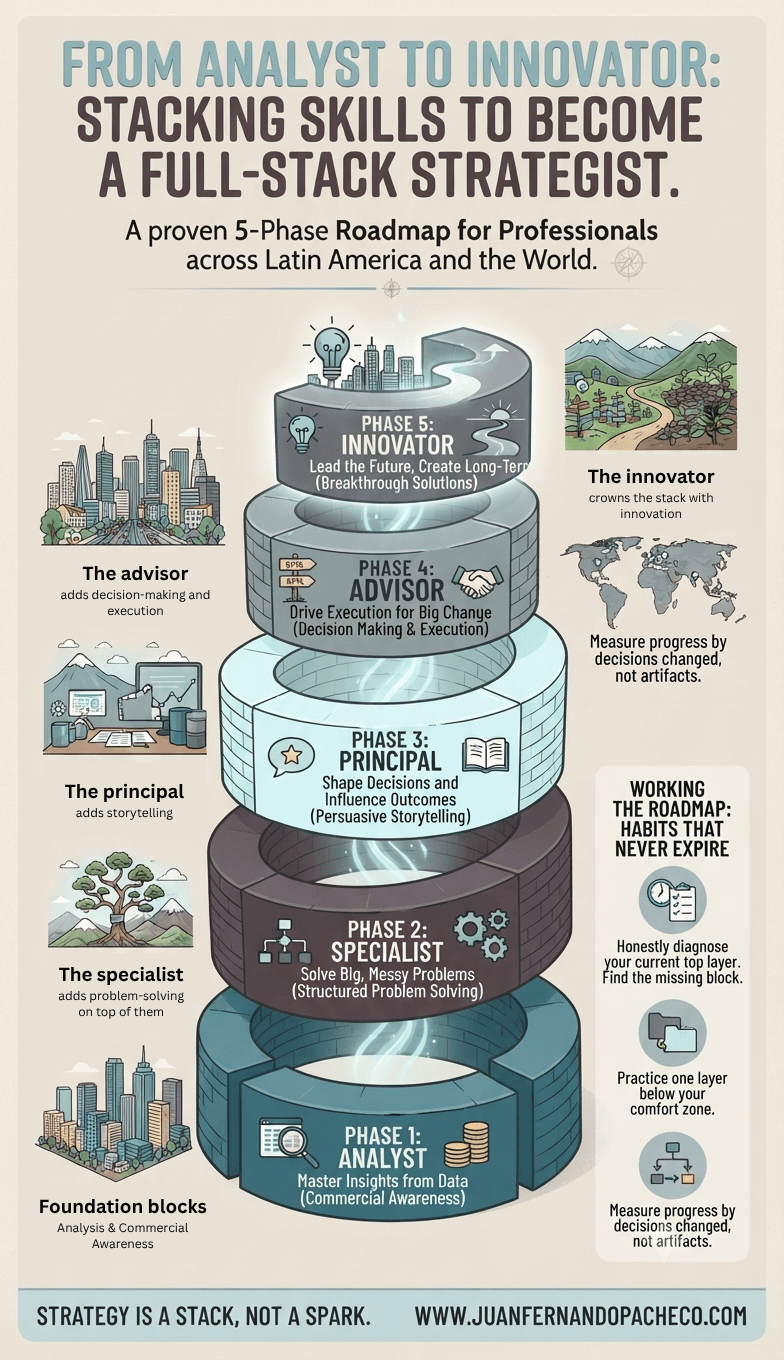
From analyst to innovator: stacking skills to become a full-stack strategist
There is a myth in technology and consulting that strategy is a gift. You either have the instinct, or you spend your career delivering while other people decide. I believed some version of it for years.
Then I looked back at my own path — from web design in Quito, through solutions architecture and product ownership, to business development across Latin America — and I noticed that every step closer to the decisions came from a skill I had added on top of the old ones, never from a title.
From Zero to Pro Strategist
That is exactly the argument behind a simple roadmap called Zero to Pro Strategist. Its core line is worth memorizing: the secret to becoming a pro strategist is to stack high-value skills.
Five phases, each adding one layer: analyst, specialist, principal, advisor, innovator. Nothing in that sentence depends on a tool, a platform, or a market cycle, which is why the model is evergreen and why I am writing about it here.
The core idea: strategy is a stack, not a spark
Look closely at the roadmap, and you will notice something elegant: skills never disappear. The analyst phase gives you two foundation blocks, analysis and commercial awareness.
- The specialist adds problem-solving on top of them.
- The principal adds storytelling.
- The advisor adds decision-making and execution.
- The innovator crowns the stack with innovation.
Every senior skill rests on everything below it, which means the order matters. You cannot tell a persuasive story about nothing. You cannot execute a decision that was never structured. Most stalled strategy careers are not missing intelligence; they are missing a layer, and everything above the gap wobbles.
The order also teaches patience.
Each phase is a season of practice, not a promotion. You do not graduate from analysis; you keep doing it for the rest of your career, only now it quietly powers bigger judgments. That is what “full-stack” means: not that you finished the early work, but that the early work is still alive inside you.
Phase 1: analyst — master insights from data
The foundation is two blocks wide.
Analysis is the discipline of turning data into clear insights; commercial awareness is the discipline of caring what those insights do to revenue, cost, and risk. The early habits are simple and never expire: practice turning data into clear insights, analyze data seriously instead of decoratively, and build commercial models and scenarios so you can say what happens if prices move, volumes shift, or a competitor reacts.
I learned this layer the hard way in banking and finance projects, long before I had “strategy” in any job title. A beautiful interface or a clever architecture only mattered if the numbers behind it made sense: adoption, cost to serve, time to market. The same is true in deal work. The analyst phase is where you learn to read an opportunity the way an accountant reads a ledger — size, probability, margin, risk — and to notice when a number is hiding a decision.
The evergreen lesson
An insight is not an observation. An observation describes the world; an insight changes what you do next. If your analysis ends in a chart, you are an analyst in title only. If it ends in a different action, you have started the stack.
Phase 2: specialist — solve big, messy problems
The second layer adds problem solving, and the problems get deliberately messy. This is the phase where you learn structured problem solving — MECE breakdowns, issue trees, hypotheses — and where you design strategic plays that position you to win instead of merely to participate.
This is the layer I use every time a complex RFx lands on my desk.
A regional bank issuing a request for proposal is never asking one question. It is asking fifty at once: data sovereignty and government mandates, legal clauses and enterprise security requirements, uptime commitments and penalty regimes, local policies in every country where the service will run.
The amateur answers all fifty in the order they appear. The specialist builds an issue tree, separates what must be complied with from what can be negotiated, and finds the two or three branches that actually decide the deal. Structure before opinions, always.
The evergreen lesson
Messiness is not a defect of the problem; it is the raw material. If a problem arrives perfectly clean, someone has already solved it, and there is no value left for you. The specialist gets paid to bring order where order does not exist yet.
Phase 3: principal — shape decisions and influence outcomes
Now the stack gets its most misunderstood skill: Storytelling.
Many strong analysts stall here because they believe good work sells itself. It does not. The best analysis loses to a good story every single time, because decisions are made by people, and people move through narrative, not through spreadsheets.
The mid-career habit is to craft a persuasive story
And in commercial work, that story has a name: the win theme.
- What do we believe?
- What does the client need? and
- Why are we uniquely placed to deliver it?
I have sat across the table from C-level executives and board members in Mexico, Colombia, Peru, Chile, Argentina, and Brazil, and I can tell you that the meetings that changed a deal were never the ones with more slides.
They were the ones where the situation, the tension, and the resolution fit together so cleanly that the decision felt obvious. Storytelling at this level is not decoration. It is the packaging of a decision, built so that a busy executive can carry it into the next room.
The evergreen lesson
If you cannot explain your recommendation in three sentences that a tired board member could repeat at dinner, you do not have it yet. Shape the decision, or watch someone less informed shape it for you.
Phase 4: advisor — drive execution for big change
The fourth layer adds decision-making and execution, and it is where strategy stops being a document. The late-career habits are blunt: translate strategy into KPIs, roadmaps, and actions; facilitate strategic decisions with leaders; and own the outcome rather than the deck.
This is the phase where my work lives today
A multi-year contract is not won on the day it is signed; it is won every quarter after that, through stakeholder alignment, backlog prioritization, and stringent SLA negotiation where uptime, response times, and penalties are agreed in writing and then honored in practice.
Driving execution for big change means coordinating product, sales, legal, engineering, and operations across ten or more countries, reporting progress against quarterly targets, and absorbing the risk so the client does not have to. Mitigating operational and legal risk until delivery lands on time, every time, is strategy in its most honest form.
The evergreen lesson
Execution is not the phase after strategy; it is strategy continued by other means. An advisor is trusted with decisions precisely because everyone knows they will still be in the room when the consequences arrive.
Phase 5: innovator — lead the future, create long-term value
The top layer is innovation, and note where it sits
Last, not first. Innovation here is not brainstorming or novelty. It is the ability to design breakthrough solutions and new models — to reimagine the commercial model itself, not just the product inside it — while every layer below keeps the work honest. Analysis grounds it, problem-solving structures it, storytelling funds it, execution delivers it.
That order protects you from the most expensive disease in our industry
Innovation theatre, where new ideas are performed but never create long-term value. The innovator phase asks a harder question than “what is new?” It asks “what will still create value in five years?” In Latin American markets, where regulation, currency, and infrastructure shift faster than most roadmaps, that question is the only durable competitive advantage.
The evergreen lesson
Innovators do not abandon the stack; they reuse all of it at once. The novelty you admire on the surface is always powered by fundamentals you cannot see.
Working the roadmap: habits that never expire
The practical question is how to use this model on an ordinary Tuesday. Three habits keep it alive.
- Diagnose your top layer honestly. Most professionals overrate their storytelling and underrate their analysis. Find the missing block, because that is where your stack wobbles.
- Practice one layer below your comfort zone. If you are a specialist, write the story. If you are an advisor, rebuild the issue tree yourself once a quarter. The foundations rust silently.
- Measure progress by decisions changed, not artifacts produced. Insights, trees, stories, and roadmaps are only evidence of work. Changed behavior is the work.
And respect the seasons.
Early careers should obsess over data and commercial models. Mid careers should live inside structured problem solving and persuasive stories.
Late careers should translate strategy into KPIs, facilitate decisions with leaders, and design the new models. Skipping a season does not make you faster; it makes you fragile at the exact moment the stakes get high.
Closing thoughts
The roadmap is evergreen for a simple reason
It describes how human judgment is built, and that process does not get disrupted. Tools will change, markets will cycle, and the next five years will surprise all of us — but the order in which a person learns to analyze, solve, persuade, execute, and finally invent will not.
So start where you are.
Stack the next skill on top of the ones you have, and keep the old ones warm. Titles are rented; skills compound. That is the whole game, from zero to pro, and it is open to anyone willing to play it in order.

