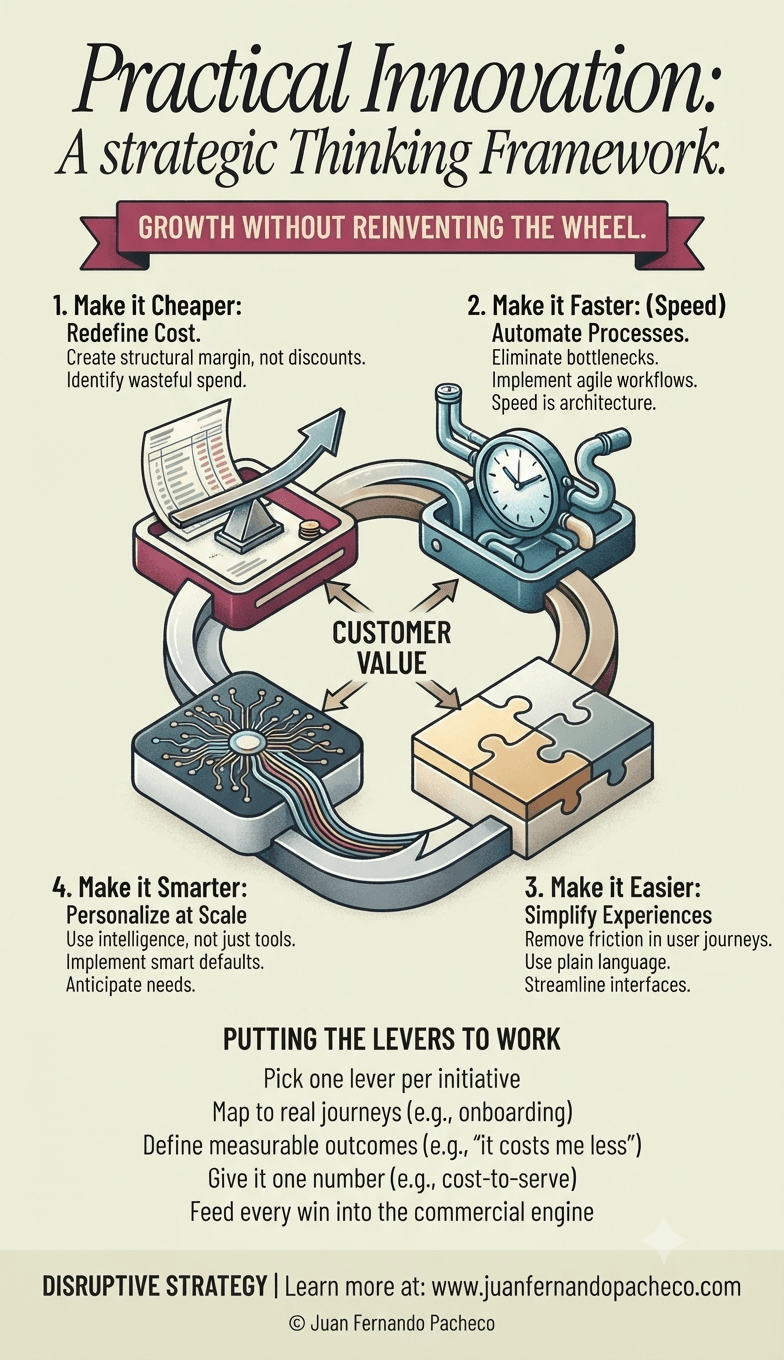
Practical innovation: grow without reinventing the wheel
There is a stubborn myth in modern business
The idea that innovation only counts when it is dramatic. We celebrate the moonshot, the disruptive entrant, the keynote reveal, and we quietly ignore the smaller, deliberate improvements that compound into durable advantage.
After more than twenty years working across product design, solution architecture, and business development in Latin America, from banking platforms in Quito to multi-country enterprise deals across Mexico, Colombia, Peru, Chile, Argentina, and Brazil, I have learned to distrust the drama.
The innovation that survives contact with budgets, regulators, and enterprise buyers is practical
The discipline of creating more value without reinventing the wheel.
The framework behind this idea is simple enough to fit on one page and deep enough to run a portfolio with. It has four levers: make it:
- Cheaper (cost)
- Faster (speed)
- Easier (ease of use)
- Smarter (personal)
Each lever is a different answer to the same question:
how do we deliver more value to the customer with what we already have?
None of them requires a breakthrough. All of them require intention. And together they form a model of growth that works in any market, in any industry and in any year, which is exactly why it deserves a permanent place in how we plan, build and sell.
Why the wheel does not need reinventing
Most organizations already own the raw material they need to innovate.
They own processes, products, contracts, journeys and data that simply have not been examined with fresh intent. The four-lever model turns innovation from a lottery into a review: instead of asking what entirely new thing we should invent, we ask what existing thing we can make cheaper, faster, easier or smarter.
That shift — from invention to attention — is what makes the approach practical, and it is what makes it accessible to teams without research budgets or innovation labs. You do not need a skunkworks project to remove a form field, renegotiate a supplier term, automate a manual report or set a smarter default. You need a decision.
It is also the language your buyers already speak.
In an RFI, RFQ, or RFP, evaluators rarely award points for novelty. They award points for lower total cost of ownership, shorter implementation timelines, simpler onboarding, and evidence that the vendor understands their context.
The four levers are, quite literally, the scoring grid of an enterprise deal
When your innovation program and your proposal library speak the same language, strategy and revenue stop competing for attention, and every improvement you ship internally becomes a win theme you can defend externally.
And the questions do not age.
Technologies will keep changing, regulations will keep evolving, and new tools will keep arriving — but your customers will still want to spend less, wait less, struggle less, and feel understood more.
That is the test of a good framework: you can reread it in five years and still act on it the following Monday.
First lever: make it cheaper
Cheaper is the most misunderstood lever, because it is instantly confused with discounting
It is not a race to the bottom, and it is not margin erosion. The target is more value at lower cost and higher margin — for the customer and for you.
That happens through discipline, not desperation: identify and eliminate wasteful spending, streamline operations so the cost of serving actually falls, negotiate better terms with partners and suppliers so savings reach the customer instead of evaporating on the way, and rework the pricing model itself to offer lower-cost options.
That last practice is the most strategic, because price is a design decision
A consumption model instead of a license model, an operating-expense structure instead of a capital one, a tiered entry point that lets a regulated bank start small and scale with confidence — each of these changes what the customer perceives and what the deal economics look like, without touching the product at all. In my own deal work, the proposals that win are rarely the ones with the lowest sticker price.
They are the ones that make the economics easier to defend in front of a CFO: clear total cost of ownership, predictable scaling, and risk moved to the party best able to manage it. Cheaper, done properly, is a business model argument, not a discount column.
Cost innovation also demands honesty about margin
If cheaper for the customer simply means worse for you, that is not innovation; that is discounting with extra steps, and it ends the same way every time — in a renewal conversation you cannot win. The durable move is to redesign the cost base: what you buy, how you operate, what you automate, what you stop doing altogether.
When the cost to serve falls structurally, the customer pays less while you keep enough margin to invest. Done well, this lever quietly funds the other three.
The evergreen rule for this lever: make it cheaper by design, not by desperation.
Second lever: make it faster
Speed is the lever people feel before they measure it
More value with speed and responsiveness means eliminating bottlenecks in the workflow, automating repetitive tasks and manual processes, making experiences on-demand, and improving turnaround times on requests.
None of that is glamorous. All of it is felt — by the user waiting for a response, by the client waiting for a quote, by the evaluator waiting for a proposal that was promised on Friday.
In enterprise deals, I have watched faster beat better many times
A competitor with a stronger product but a six-week proof of concept loses to a vendor that answers in days, because speed is interpreted as competence: if they respond this fast before the contract, imagine how they will behave after it.
- When one of the teams streamlined proof-of-concept development and execution, customer request resolution time fell by thirty percent, and the pipeline changed character — fewer stalled opportunities, more live evidence in front of decision-makers.
- When client objectives were translated into agile roadmaps with real backlog prioritization, time-to-market improved by roughly a fifth and user adoption followed. Speed, in short, is a product feature that is delivered by operations.
The compounding effect is the real prize
Every bottleneck you remove stays removed. Every manual step you automate is a tax you never pay again. Every turnaround time you publish becomes a promise that disciplines the whole organization, because a public commitment is the cheapest performance system ever invented.
Speed is not urgency — urgency is emotional, loud and temporary. Speed is architecture, and architecture persists.
The evergreen rule for this lever: do not ask people to run faster; ask the process to get shorter.
Third lever: make it easier
This is the lever closest to my origins as a user experience designer, and the one with the widest definition in enterprise contexts. Make it easier means simplifying the experience and removing friction: remove friction from the customer journey, make onboarding and usage intuitive, use plain language and clear instructions, and streamline forms, interfaces, and communications.
Friction is a tax that every customer pays and no treasury records
In consumer products, it shows up as abandoned carts and silent churn. In enterprise technology, it shows up as stalled procurements: the security questionnaire that takes three weeks, the contract full of undefined terms, the onboarding plan that assumes the client already knows how you work.
The buyer journey in a regulated market includes legal clauses, data-sovereignty mandates, SLA negotiation and compliance evidence — and the vendor that makes that journey easy wins deals that a more powerful but harder vendor loses. Plain-language contracts, clear uptime and penalty terms, pre-packaged compliance answers, one form instead of four: none of it is innovation theatre, and all of it shortens the sales cycle.
Ease is also a trust signal. A clear form says we respect your time.
A simple interface says we thought about you before we thought about us. Plain language says we will be honest with you when something goes wrong.
In markets where buyers sign multi-year contracts, those signals are commercial assets, because they reduce the perceived risk of the relationship — and perceived risk is always priced into the deal, either as a discount demanded or as a competitor chosen.
The evergreen rule for this lever: the easiest path wins, even when the alternative is more powerful.
Fourth lever: make it smarter
The fourth lever attracts the most excitement, so it is worth slowing down.
Make it smarter means using intelligence to personalize the journey — and note the deliberate word: intelligence, not any specific technology. Whatever the tool of the moment happens to be, the practices are stable.
Personalize content, features, and suggestions. Add smart defaults that anticipate user needs. Use automation to reduce repetitive work. Show insights and prompts at the right time.
- In banking platforms that serve millions of users, smarter is the difference between a generic menu and a journey that anticipates why the customer came today.
- In deal work, smarter means studying the client’s market, regulators, and public mandates before the request for proposal is published, so the first conversation is already relevant instead of merely polite.
A smart default is simply a decision you make once so the customer does not have to make it every time — and every good default is a small act of respect, repeated at scale, thousands of times a day.
The phrase “at the right time” carries more weight than it looks like
An insight that interrupts is noise; an insight that arrives exactly when it is useful is service. Personalization that feels like surveillance destroys trust; personalization that feels like attention builds it.
The difference is not the algorithm; it is the intent — and intent is a strategy question, not a technology question, which is precisely why this lever will not expire when the current tools do.
The evergreen rule for this lever: smart is not a feature; it is attentiveness at scale.
Putting the four levers to work
A framework only matters if it changes what happens on Monday. My suggestion is to run it as a short quarterly ritual, whether you lead a product team, a sales region, or an entire portfolio.
First, pick one lever per initiative
Trying to be cheaper, faster, easier, and smarter in a single project usually means being none of them measurably.
Second, map the lever to a real journey
A customer onboarding, a proposal response, a support ticket, a renewal — and find the single step where the pain concentrates.
Third, phrase the outcome as a sentence
The customer would actually say: “it costs me less”, “I get it sooner”, “it is easier”, “it knows me”. If the customer would not say it, it is not innovation; it is internal decoration.
Fourth, give the initiative one number
Cost to serve, turnaround time, steps in the journey, adoption of the default — and review it with the same seriousness as revenue.
Fifth, and this is where my commercial bias shows, feed every win into the commercial engine.
Each lever you pull becomes a win theme in the next proposal, a case study in the next negotiation, a reference story in the next board meeting. Innovation that never reaches the proposal library is a hobby; innovation that reaches it is revenue.
And in discovery conversations, the four levers double as a listening tool: when a client complains about cost, time, friction or relevance, they are telling you exactly which lever to pull — and exactly which proposal will win.
A framework that ages well
The wheel does not need reinventing
Your customers do not need a moonshot. They need to spend less, wait less, struggle less and feel understood more — this year, next year and five years from now.
Build that habit and innovation stops being an event that sometimes happens to your organization and becomes a discipline that always happens for your customer. That is practical innovation, and it compounds longer than any breakthrough.
If you are leading growth in complex markets, start with one lever this quarter. The rest of the framework will take care of itself.

.](https://juanfernandopacheco.com/wp-content/uploads/2026/08/Influence-Skills-From-Insight-to-Action-for-Strategists-800x600.png)