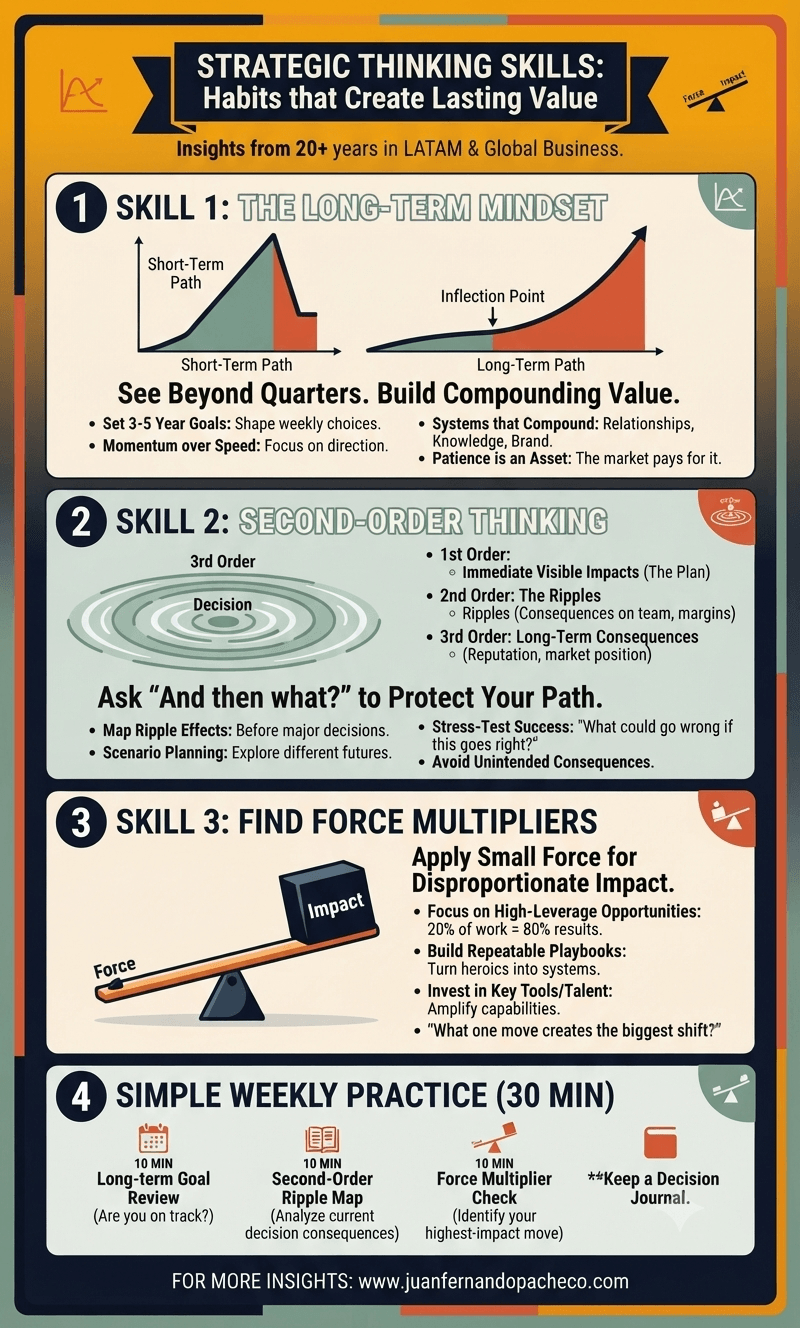
Strategic thinking skills: three habits that create lasting value
After more than twenty years working across Latin America — starting as a web designer, then UX designer, solutions architect, product owner, and now business development manager — I have sat on both sides of the table in hundreds of strategic decisions.
I have designed interfaces for banking users, architected solutions for regulated industries, and led RFI, RFQ, and RFP processes that ended in multi-million dollar, multi-year contracts. And the longer I do this work, the more I notice that the quality of a strategy rarely depends on the quality of the slides. It depends on the quality of the thinking behind them.
The difference is not effort
Teams with the same data, the same budgets, and the same markets produce very different outcomes. The difference is not effort. It is a small set of thinking skills that some people practice almost instinctively.
Strategists who create high-impact and lasting value for their businesses tend to master three of them in particular:
a long-term mindset, second-order thinking, and the ability to find force multipliers.
In this post, I want to unpack each one the way I apply them in real commercial and product work, and leave you with simple habits you can practice regardless of your role, your industry, or the market cycle you happen to live in.
Why thinking skills matter more than strategic documents
Most companies do not suffer from a lack of strategy.
They suffer from strategy that evaporates on contact with quarterly pressure. Plans are written, workshops are facilitated, maps are drawn, and then the noise of the immediate takes over: a competitor launches something, a client asks for a discount, a metric dips for a month. The plan dies by a thousand small reactions.
This is why thinking skills are the real asset.
A document expires; a way of thinking compounds. When you change how you see time, consequences, and leverage, every decision you touch improves, from a pricing line in a proposal to a product roadmap to the next move in your career.
The three skills below are not abstract philosophy. They are practical disciplines that can be trained, and they are as useful in a negotiation room in Bogotá or São Paulo as they are in your personal planning on a Sunday evening.
Skill one: the long-term mindset
Imagine two curves on a graph.
The short-term curve rises fast and flattens: quick wins, easy optimizations, the satisfaction of visible movement. The long-term curve starts almost flat, almost invisible, and then crosses the first one at an inflection point and climbs steeply.
Most people and most organizations live on the first curve. Strategists learn to live comfortably on the second one, knowing the inflection point exists even when they cannot see it yet.
I have watched this graph play out in enterprise technology deals again and again.
A relationship with a bank or a telco does not become a multi-year contract in one quarter. It starts with a small proof of concept, a well-run pilot, a meeting where you gave honest advice instead of a sales pitch. For months it looks like nothing is happening. Then a budget cycle opens, a mandate changes, a competitor fails, and suddenly the “overnight” opportunity appears — built on years of invisible accumulation. The people who only work the short-term curve are surprised by these moments. The people with a long-term mindset have been positioning for them.
The same logic applies to products and to careers.
A feature shipped to please one loud client flattens quickly; a roadmap aligned to a clear vision compounds into adoption and trust. A job change made for a small salary bump is a short-term curve; skills, reputation, and relationships compound into the long-term one.
A few habits keep this mindset alive
Set three-to-five year goals and review them often enough that they shape weekly choices. Ask about any significant decision, “what would my future self thank me for?”
Think in terms of momentum, not just immediate results: a small action repeated in the same direction beats a big action scattered. And focus on systems that compound over time — relationships, knowledge, playbooks, brands — instead of one-off wins. The market always pays for patience, because patience is scarce.
Skill two: second-order thinking
If the long-term mindset decides where you are going, second-order thinking protects you on the way.
It is the habit of asking “and then what?” after every decision.
- First-order effects are the immediate, visible impacts: we sign the deal, we ship the feature, we cut the price.
- Second-order effects are the ripples: what does that signature change about our margins, our team, our client’s expectations?
- Third-order effects are the long-term consequences: what does all of this do to our reputation, our market position, our ability to invest years from now?
Let me give you a familiar example from high-stakes procurement.
Imagine an RFP where the client demands aggressive SLA penalties.
- The first-order move is to accept everything to win: the contract is signed, the quarter looks great.
- Second order: the delivery team now works under fear of penalties, every incident becomes a legal conversation, margins erode quietly.
- Third order: your best engineers rotate out of the account, the client experiences a disengaged team, and your company becomes a vendor instead of a partner — replaceable at the next tender.
The deal was won, and the relationship was lost. I have seen this pattern more times than I can count, and it is always invisible to the person who only reads first-order effects.
The reverse question is equally powerful:
“What could go wrong if this goes right?”
Winning a large contract can overload delivery capacity.
A viral launch can expose an unprepared support team. Success is also a stress test, and second-order thinking is how you prepare for it. Before major decisions, map the possible second and third-order effects on paper.
Use scenario planning to explore different futures instead of betting on a single forecast. You will not predict everything — the goal is not prophecy; it is to avoid being blindsided by consequences you could have seen coming.
Skill three: the force multiplier
Archimedes said that with a lever long enough and a fulcrum to place it on, he could move the world.
A small force, applied at the right point, produces disproportionate impact. The third thinking skill is the habit of looking for that point. Strategists do not ask “what can we do?” They ask “what is the one move that creates the biggest shift?” They look for assets and capabilities where effort can produce broad-based impact, instead of spreading energy evenly across everything.
In practice, this starts with identifying high-leverage opportunities
The twenty percent of the work that creates eighty percent of the results.
- In deal work, that is often the win theme and the compliance strategy of a proposal, not the cosmetic polish of the document.
- In product work, it is the friction point that, once removed, changes adoption for every user.
Then it continues with repeatable playbooks. Every time a team reinvents the wheel — rewriting the same proposal sections, rebuilding the same proof of concept from scratch, re-negotiating the same clauses without a playbook — it pays full price for value it already owns.
When I worked on streamlining how we built and ran proofs of concept, the gain did not come from people working harder; it came from turning individual heroics into a repeatable system, and resolution times dropped dramatically. That is what a lever feels like: the same force, a different result.
Force multipliers ask you to invest in tools or talent deliberately.
A good tool used by many people multiplies capability; a good hire in a key role multiplies judgment. The discipline is to keep asking, every quarter, which single investment would make everything else easier. Not every move deserves the same energy. Find the fulcrum, and put your weight there.
How the three skills work together
These three skills are not a list; they are a system.
- The long-term mindset chooses the direction and gives you the patience to wait for compounding.
- Second-order thinking scans the path, revealing trade-offs and unintended consequences before they become expensive.
- The force multiplier decides where to apply your limited energy so the journey actually moves.
Remove one and the structure weakens. Long-term mindset without second-order thinking becomes naive optimism. Second-order thinking without a long-term horizon becomes anxiety — every ripple looks like a threat.
Leverage without direction becomes a fast way to go far in the wrong direction. Used together, they turn strategy from a document into a discipline: you know where you are going, you know what your moves will trigger, and you know which move matters most.
A simple practice you can start this week
You do not need a new framework subscription to train these skills.
You need a small, repeatable ritual. Once a week, take thirty minutes and divide them in three.
- First, ten minutes on the long term: review your three to five year goals and ask whether this week’s calendar moved you toward them; ask what your future self would thank you for.
- Second, ten minutes on consequences: take the biggest decision currently on your table and write down its first, second, and third-order effects, plus one answer to “what could go wrong if this goes right?”
- Third, ten minutes on leverage: list your active efforts and mark the one with the highest potential impact; ask what playbook, tool, or person could multiply it.
Keep a decision journal so that, months later, you can compare what you expected with what actually happened. That feedback loop is where judgment comes from. None of this depends on a specific platform, methodology or market condition. That is the test of an evergreen skill: it works in a boom, it works in a crisis, and it works quietly in the ordinary weeks in between.
Final thoughts
Careers, products and companies are shaped less by the dramatic decisions everyone sees and more by the quiet thinking that happens before them.
- Master the long-term mindset, and you will stop being distracted by noise.
- Master second-order thinking and you will stop being surprised by your own successes and failures.
- Master the force multiplier, and you will stop confusing motion with progress.
The three together are the difference between planning and strategy, between activity and impact. Thinking is the only asset your competitors cannot copy quickly, because it is built one deliberate decision at a time.
Start this week, keep the practice, and let the compounding do its quiet work.
.](https://juanfernandopacheco.com/wp-content/uploads/2026/08/Influence-Skills-From-Insight-to-Action-for-Strategists-800x600.png)
