Why sharp insight and a persuasive story make a good strategy
Every company I have worked with in more than twenty years of product design, business development, and deal leadership has, at some point, produced a strategy that nobody could repeat.
- Document was thick.
- Slides were beautiful.
- Workshop was energetic.
And six months later, nothing had changed, because the people who had to act on the strategy never truly understood it. That is not a failure of ambition. It is a failure of design.
The frame I am reviewing here, called Strategy Decoded, compresses the answer into one equation
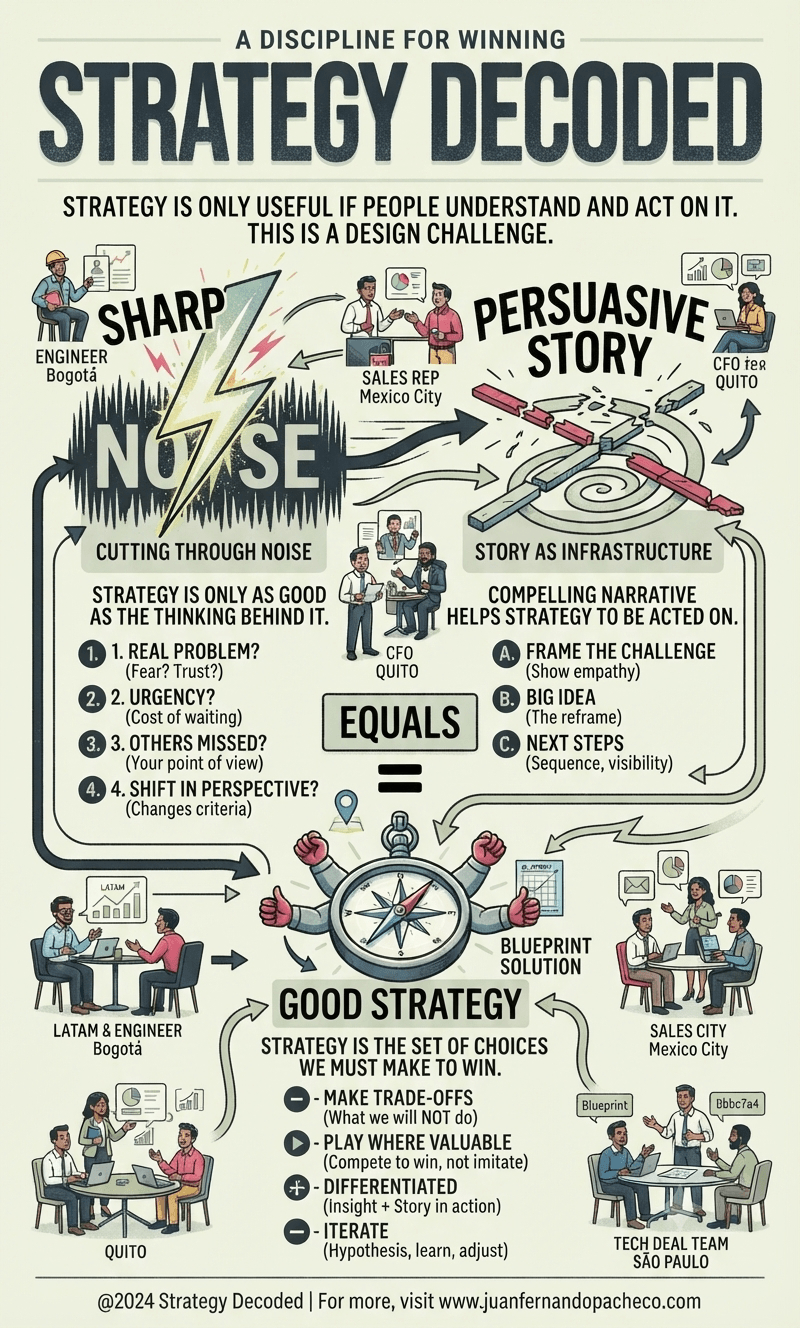
Sharp insight plus persuasive story equals good strategy. It sounds almost too simple, and that is exactly why it works. Simplicity is the feature. A strategy that a sales rep in Mexico City, a delivery lead in Bogotá, and a CFO in Quito cannot repeat over coffee is not a strategy. It is a wish.
In this post, I want to unpack that equation the way I would unpack it with a deal team before a major enterprise pursuit: what insight really means, why story is not decoration, and how the two combine into the set of choices we must make to win.
I will use examples from enterprise technology deals and RFx processes because that is my world, but the logic travels. It works for a product roadmap, a market entry plan, a personal career move.
It will work today, and it will work in five years, because it is about how human beings understand and act, and that does not change on a product cycle.
Strategy is only useful if people understand it and act on it
Let’s start with the definition buried in the frame, because it is the most disciplined one I know: strategy is the set of choices we must make to win. Read it twice. Choices, not aspirations. To win, not to participate.
Most documents called strategy fail both tests.
They list goals — grow revenue, expand to new markets, improve customer satisfaction — and goals are not choices. A choice is something you can say no to. It is the decision to pursue one client segment and consciously abandon another, to bet on one architecture, to compete on outcome rather than on price even when price is where the conversation starts. If your strategy cannot name what you will stop doing, it is not making choices; it is making wishes.
But even a real choice dies if it is not understood.
This is where my designer’s brain takes over. In user experience, we say that an interface the user cannot navigate is a broken interface, no matter how elegant the code behind it. Strategy is the same. The users of a strategy are the people who must act on it every day: sellers, engineers, partners, executives. If the strategy demands a manual to explain it, the strategy is broken. Understandability is not a nice-to-have; it is the specification.
That is why the equation has two inputs and not one.
Insight makes the strategy true. Story makes the strategy usable. Truth without usability sits in a drawer. Usability without truth is propaganda. Together they produce a good strategy: a blueprint for a differentiated solution that people can repeat, defend, and execute.
Sharp insight: strategy is only as good as the thinking behind it
The first input is sharp insight.
The frame says it plainly: clear insight helps you cut through noise and explain what is really going on, and what you need to do. Notice the word sharp. An insight that covers everything explains nothing. A sharp insight is a blade; it separates the signal from the dozens of slides of market data that every team already has.
Here is the trap I see in enterprise deals, and I have reviewed hundreds of proposals across Latin America and beyond: teams confuse data with insight. Data says the market is growing, the client issued an RFP, the budget is this, the competitors are those. Insight says something the data does not say. Insight is a point of view about what is really going on. To get there, the strategy decoded frame offers four questions, and I have learned to treat them as a mandatory gate before any proposal is written or any plan is approved.
What is the real problem?
The stated problem is rarely the real one. In a public tender, the RFP might ask for a list of features and service levels, but the real problem behind it might be fear: the executive sponsoring the project is afraid of a failed migration, or two internal divisions cannot agree on a single vendor, or the previous vendor burned them and trust is the true currency now. The vendor who answers the literal questions loses to the vendor who answers the real ones.
What is the urgency?
Every deal, every initiative, every career move has a why-now. If you cannot name the cost of waiting, you cannot create momentum. Urgency is not pressure tactics; it is honesty about the price of standing still.
What are we seeing that others have missed?
This is the differentiator question. If your insight is the same as your three competitors’, you have no insight; you have a market average.
In a deal, maybe you noticed that the client’s true bottleneck is not technology but operating model; maybe you saw that their stated timeline silently assumes a dependency nobody is managing. That observation, said out loud with respect, is worth more than a discount.
What is the shift in perspective that changes the way we solve this?
Great insights reframe. They move the conversation from buying software to reducing the risk of a core operation, from hiring an agency to building a capability. A reframe changes the buying criteria, and when the criteria change in your favor, the competition starts playing your game.
Sit with those four questions long enough, and you earn the right to an opinion. That opinion, held with conviction and evidence, is the sharp insight. Everything else is homework.
Persuasive story: the engine that turns thinking into action
Now the second input, and the one that business culture tends to underrate: persuasive story. The frame’s claim is precise: a compelling narrative helps strategy to be acted on. Story turns your thinking into a message people can understand and rally behind.
Skeptics hear story and think decoration, spin, marketing.
In a deal room, story is infrastructure. Think about how a large enterprise decision actually happens. You present to ten people. Those ten people must then convince ten more who were not in the room.
- Budget owner.
- Legal team.
- Technical reviewer.
- General manager.
Your proposal does not travel; your story does.
If the people in the room cannot retell your case in two minutes in an elevator, your case arrives dead at the next floor. The same happens inside a company: a strategy only survives the journey from the executive floor to the front line if it can be retold without loss.
The strategy decoded frame gives three moves to do it well, and they map almost perfectly to how a winning proposal is built.
Start by framing the challenge.
Before you present your idea, describe the client’s — or the market’s — situation so accurately that the listener feels understood. In design we call this empathy; in deals we call it earning the right to be heard. A well-framed challenge does half the selling, because the audience leans in and thinks: yes, that is exactly our problem.
Introduce the big idea that changes the game.
This is your reframe made memorable. One sentence, one image, one contrast. Not we offer an end-to-end integrated solution, which everyone says, but a shift like: you are not buying technology, you are buying the certainty that your operation will not stop. The big idea is the handle your audience will carry out of the room.
Explain the specifics of what we should do next, and in what sequence.
A story without steps is a slogan. Sequence is what makes a narrative credible: first we stabilize, then we migrate, then we scale; first we prove value in one country, then we expand. When people can see the next step and the one after it, anxiety drops and commitment rises. This is where my UX background shows: a good story is a good user journey, with a clear beginning, a manageable middle, and a visible end.
Insight gives you the truth; story gives the truth legs.
Good strategy: the set of choices we must make to win
Add the two inputs, and you get the output the frame describes: insight and story come together as a blueprint for a differentiated solution. Strategy is the set of choices we must make to win.
Three words in that sentence deserve respect.
Choices mean trade-offs made in public.
A good strategy names what we will not do: the segments we will not chase, the discounts we will not offer, the features we will not build, the deals we will walk away from. Trade-offs are painful, which is exactly why they protect you. Competitors can copy your offering; they cannot easily copy your discipline.
To win means playing where we can be uniquely valuable, not where we are merely present.
In Latin American markets, I have seen too many companies compete by imitation — same message, same price war, same tired deck — and then wonder why margins evaporate. Winning starts with choosing a game you can actually win.
Differentiated is the child of insight and story.
Differentiation rarely lives in the raw ingredient; it lives in the point of view and in the way it is told. Two vendors can offer the same cloud, the same licenses, the same bodies. The one whose insight reframes the problem and whose story makes the path feel safe and sequenced wins the deal at a better margin. The solution becomes different because the understanding behind it is different.
And then, the last line of the frame, the one that keeps the whole system honest: take action and use the learnings to iterate. A good strategy is not a promise carved in stone; it is a hypothesis executed with conviction. Markets move, clients change, competitors react. The discipline is to act fully, measure honestly, and adjust without shame. Iteration is not weakness; it is how conviction learns.
Putting the equation to work, any year, any market
Because this framework is about understanding and action, it does not expire. Here is a simple rhythm I use with teams, and you can use it for a deal, a product, a company, or a career.
First, write your insight in one sentence.
If it needs a paragraph, it is not sharp yet. Pressure-test it with the four questions: real problem, urgency, what others miss, the shift in perspective. If the sentence survives, you have a blade.
Second, craft the story in three beats.
Frame the challenge so the audience feels understood. Name the big idea that changes the game. Lay out the next steps in sequence, few enough to remember, concrete enough to schedule. Then test it the way we test in deals: tell it to one honest colleague and ask them to repeat it back. What they repeat is your real strategy. Everything else was noise.
Third, make the choices explicit.
Write down what you will do, what you will stop doing, and how you will know you are winning. A strategy without a stop-doing list is a strategy without edges.
Fourth, act and iterate on a cadence.
Review the insight quarterly, the story monthly, the actions weekly. Keep the equation on the wall, not the hundred-slide deck.
Do this, and something quiet but powerful happens: meetings get shorter, deals get clearer, teams pull in the same direction. People understand, and because they understand, they act.
That is the entire game. Strategy decoded is not a poster; it is a discipline. Sharp insight, persuasive story, and the courage to choose. The rest is execution.