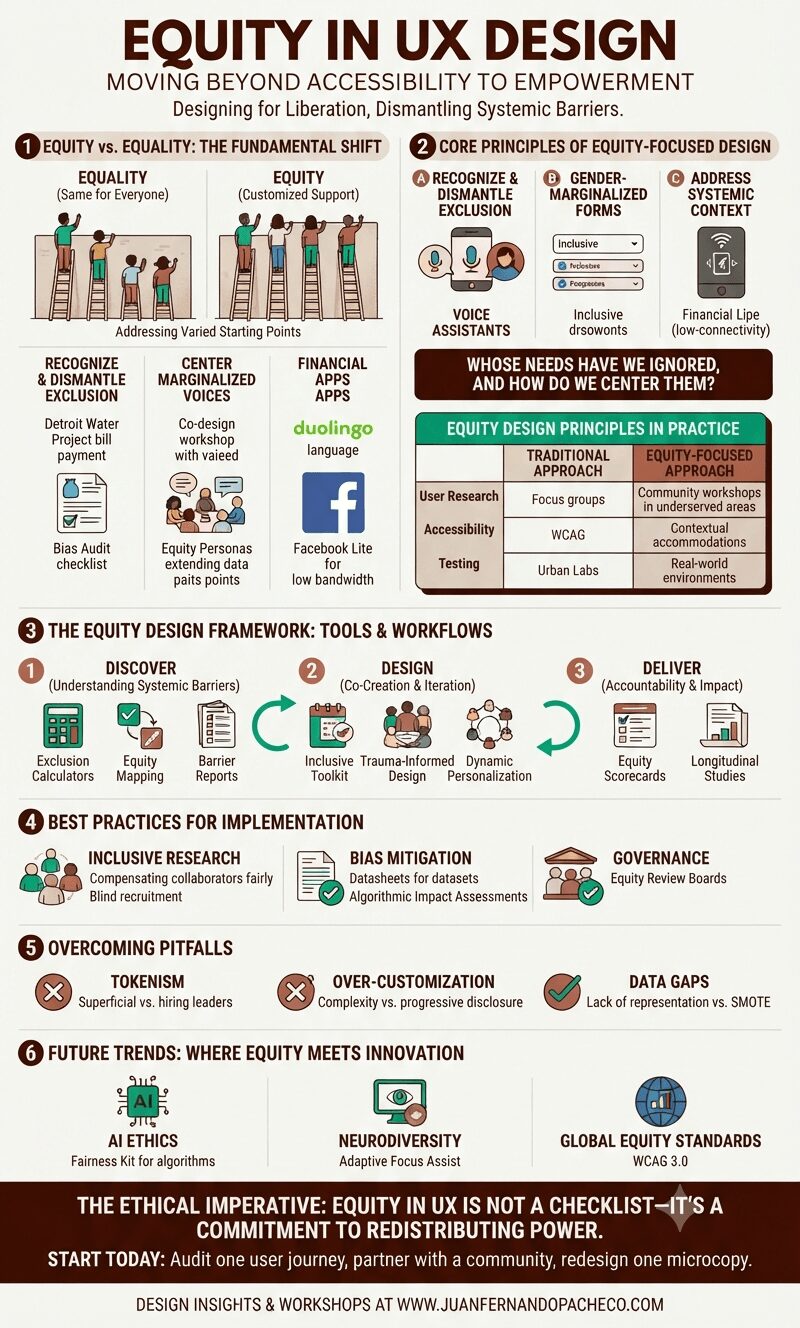
A comprehensive vertical infographic titled "Equity in UX Design," with a background in a light cream color (#f7f9f9) and accented with teal, beige, terra cotta, and dark brown. The graphic is structured into six main sections detailing the shift from equality to equity, core principles, a three-stage framework, best practices, pitfalls, and future trends. It includes comparative tables, illustrative diagrams, and specific examples like the Detroit Water Project and Xbox Adaptive Controller. The footer includes the URL www.juanfernandopacheco.com.

For decades, UX design focused primarily on usability and accessibility—creating products that functioned efficiently for the “average” user. Today, we recognize that this approach perpetuates exclusion.

Equity in UX design demands that we create experiences that actively address systemic barriers, ensuring all users—especially those from historically marginalized groups—can thrive in digital spaces.

As a veteran UX designer and architect, I’ve witnessed how equity transforms not only products but societal narratives.
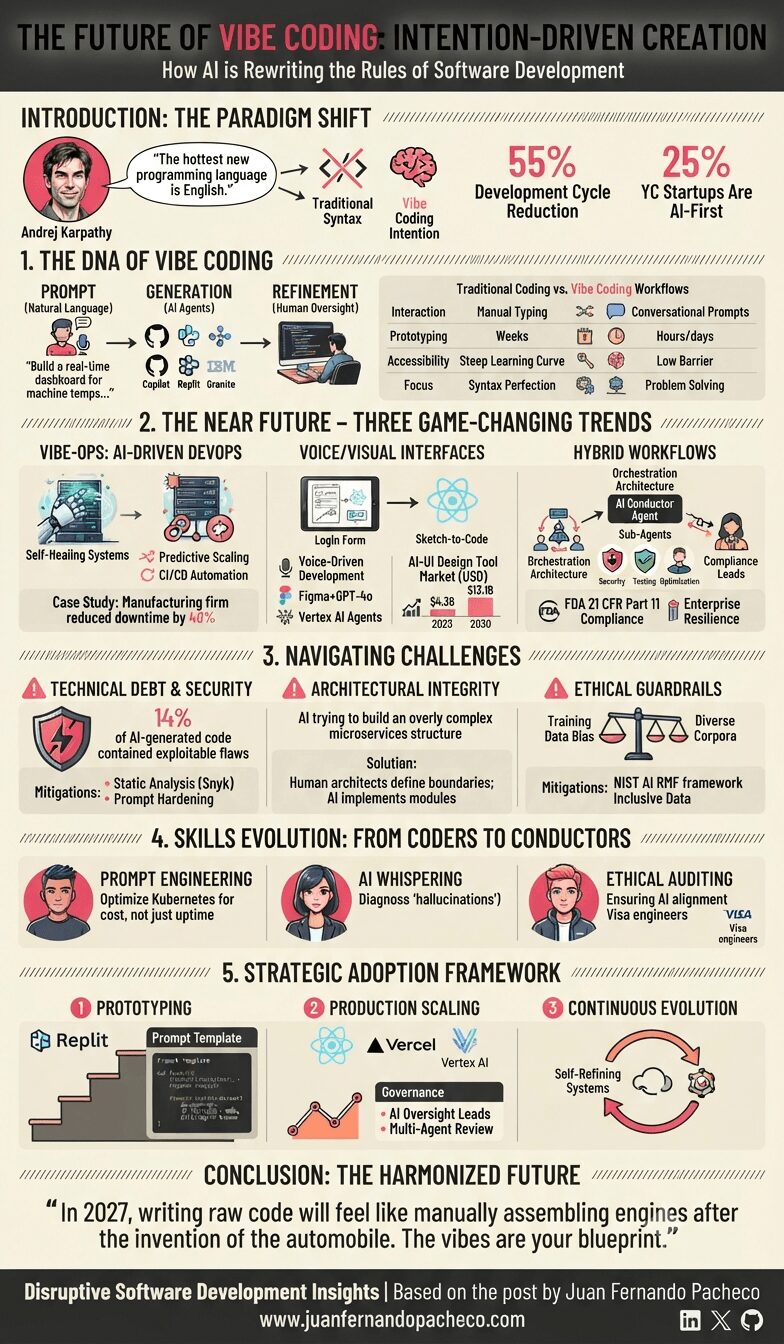
A detailed infographic titled "The Future of Vibe Coding: Intention-Driven Creation," exploring the shift from traditional syntax-based software development to AI-driven, natural-language programming. The graphic covers the paradigm shift led by Andrej Karpathy’s vision, the DNA of vibe coding workflows, three future trends (VibeOps, Voice/Visual Interfaces, Hybrid Workflows), key challenges and skills evolution, a strategic adoption framework, and a concluding quote predicting a future where raw manual coding is obsolete. It includes data, tool logos, and illustrations across five structured sections on a light beige background, referencing www.juanfernandopacheco.com.

Vibe coding isn’t about replacing developers—it’s about elevating creativity. As Karpathy noted, we’re moving from “character-by-character typing” to “seeing stuff, saying stuff, running stuff”.

The future belongs to teams that wield AI as a co-pilot: voice interfaces accelerating ideation, VibeOps hardening infrastructure, and hybrid workflows merging human ingenuity with machine efficiency.

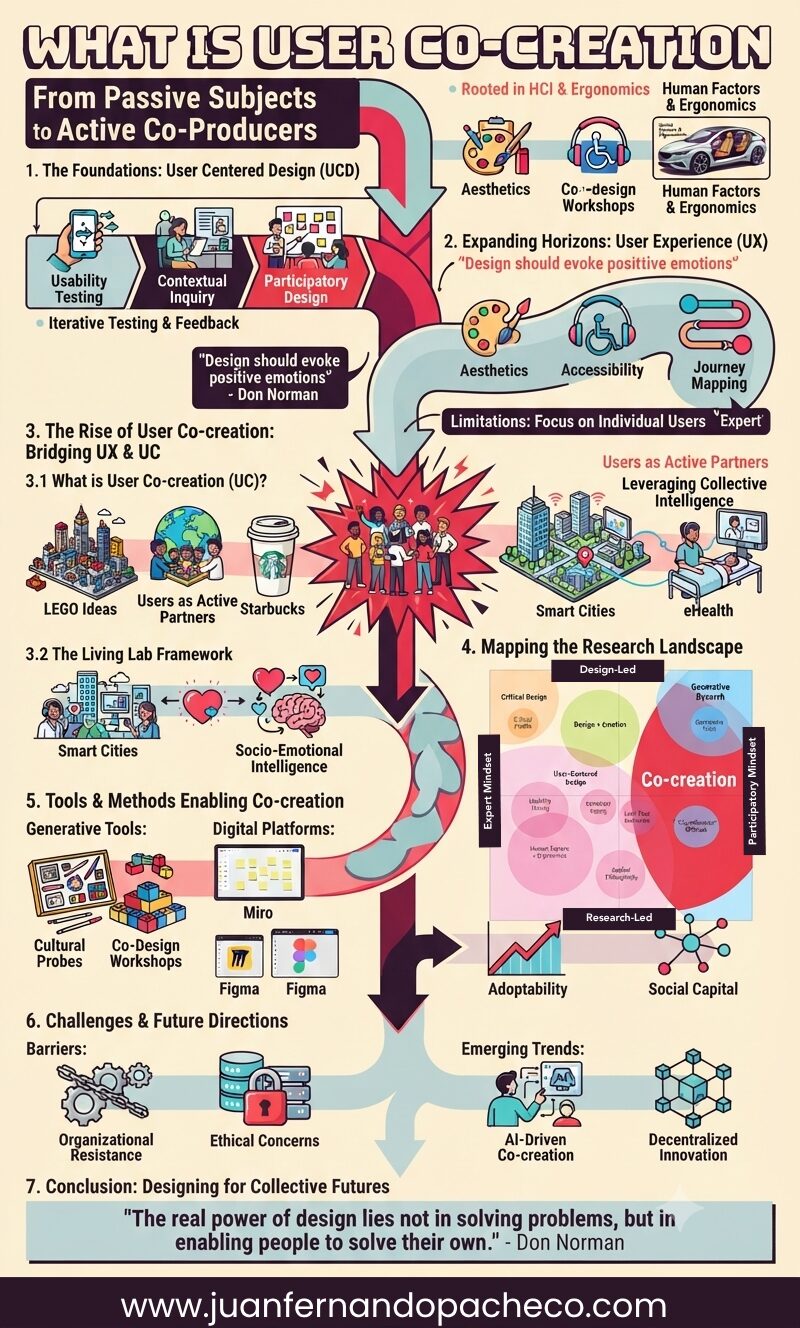
An intricate infographic titled "What is User Co-creation: From Passive Subjects to Active Co-Producers," illustrating the historical evolution of design methodologies from User Centered Design (UCD) to User Experience (UX) and finally to User Co-creation (UC). The graphic uses a vibrant color palette and segmented arrows to flow through seven key sections, detailing principles, tools (e.g., LEGO Ideas, Starbucks, Miro, Figma), frameworks (Living Labs, Sanders & Stappers' Research Map), metrics (Social Capital), challenges, and future trends (AI-Driven, Decentralized Innovation). It includes a concluding quote from Don Norman and branding for www.juanfernandopacheco.com.

The shift from User Centred Design (UCD) to User Co-creation (UC) marks a democratization of innovation. By embracing Living Labs and participatory frameworks, designers can harness the collective genius of users. As Don Norman aptly stated:

“The real power of design lies not in solving problems, but in enabling people to solve their own.”

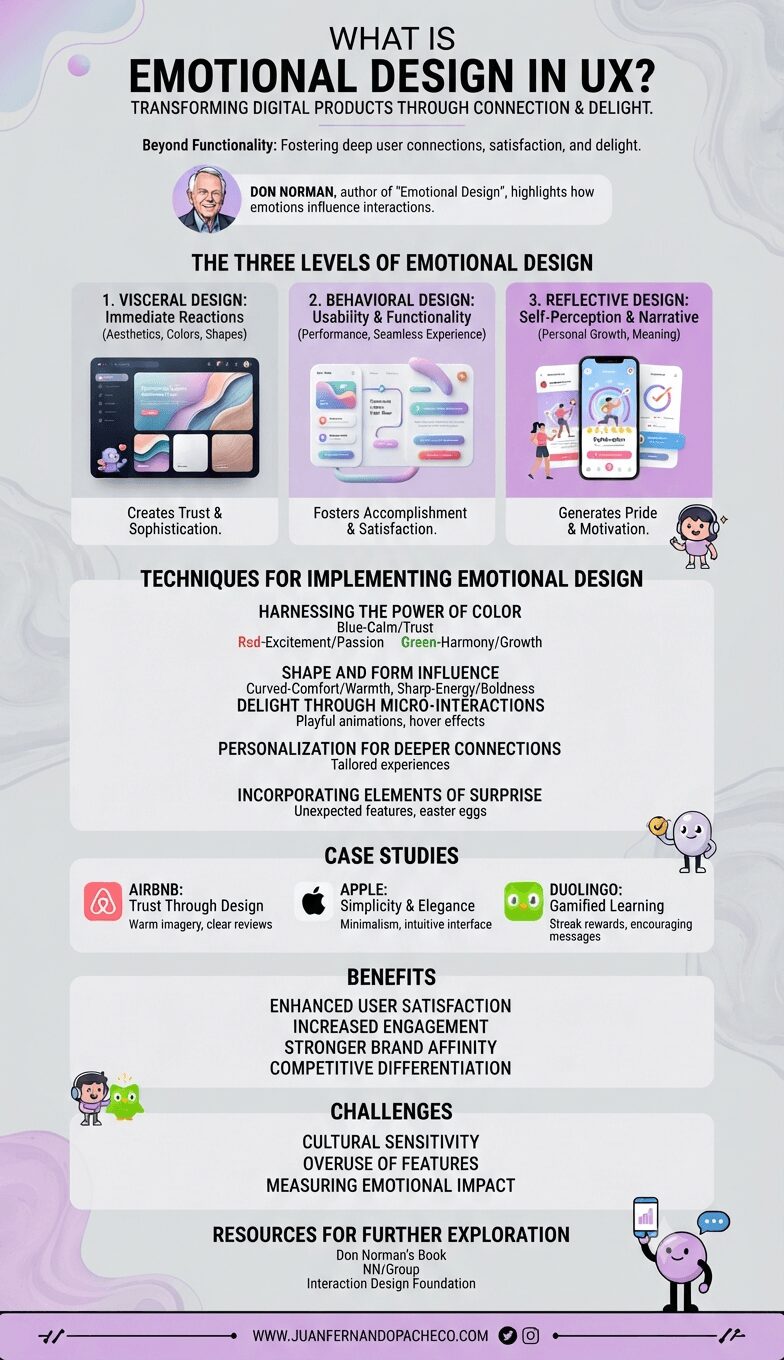
An infographic titled "What is Emotional Design in UX?" detailing Don Norman’s framework of Visceral, Behavioral, and Reflective Design. The image outlines techniques like using color psychology and micro-interactions, provides case studies of Airbnb, Apple, and Duolingo, and lists key benefits and challenges. It includes a footer with the website JuanFernandoPacheco.com.

Emotional Design in UX (User Experience) represents a transformative approach to creating products and services that resonate deeply with users.
By crafting experiences that evoke specific emotional responses, designers can foster a sense of connection, satisfaction, and delight that extends beyond mere functionality.