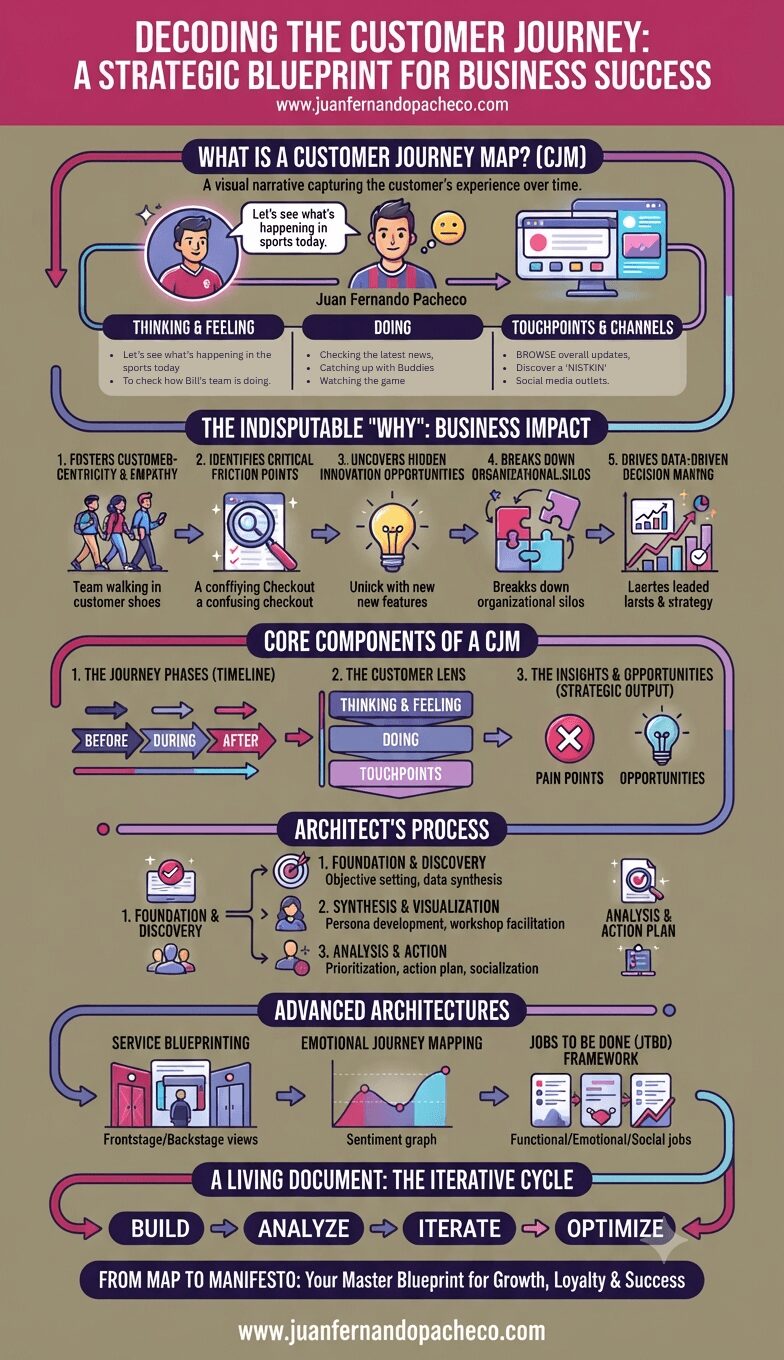
An infographic titled "Decoding the Customer Journey" that serves as a strategic blueprint for business success. The vertical graphic, set against a muted olive background, uses a color palette of pink, purple, and blue. It outlines the definition of a Customer Journey Map (CJM), its business impact, core components (phases, lens, insights), the architectural process (foundation, synthesis, action), advanced frameworks (blueprinting, emotional mapping, JTBD), and the iterative cycle of review. The URL www.juanfernandopacheco.com is included at the top and bottom.

Decoding the customer journey is the first, most critical step in building a truly customer-centric organization. The map of Juan Fernando Pacheco is more than a diagram; it’s a manifesto. It declares that the company’s success is inextricably linked to his success in achieving his goals—be they finding community, proving his knowledge to his buddies, or simply enjoying the thrill of the game.

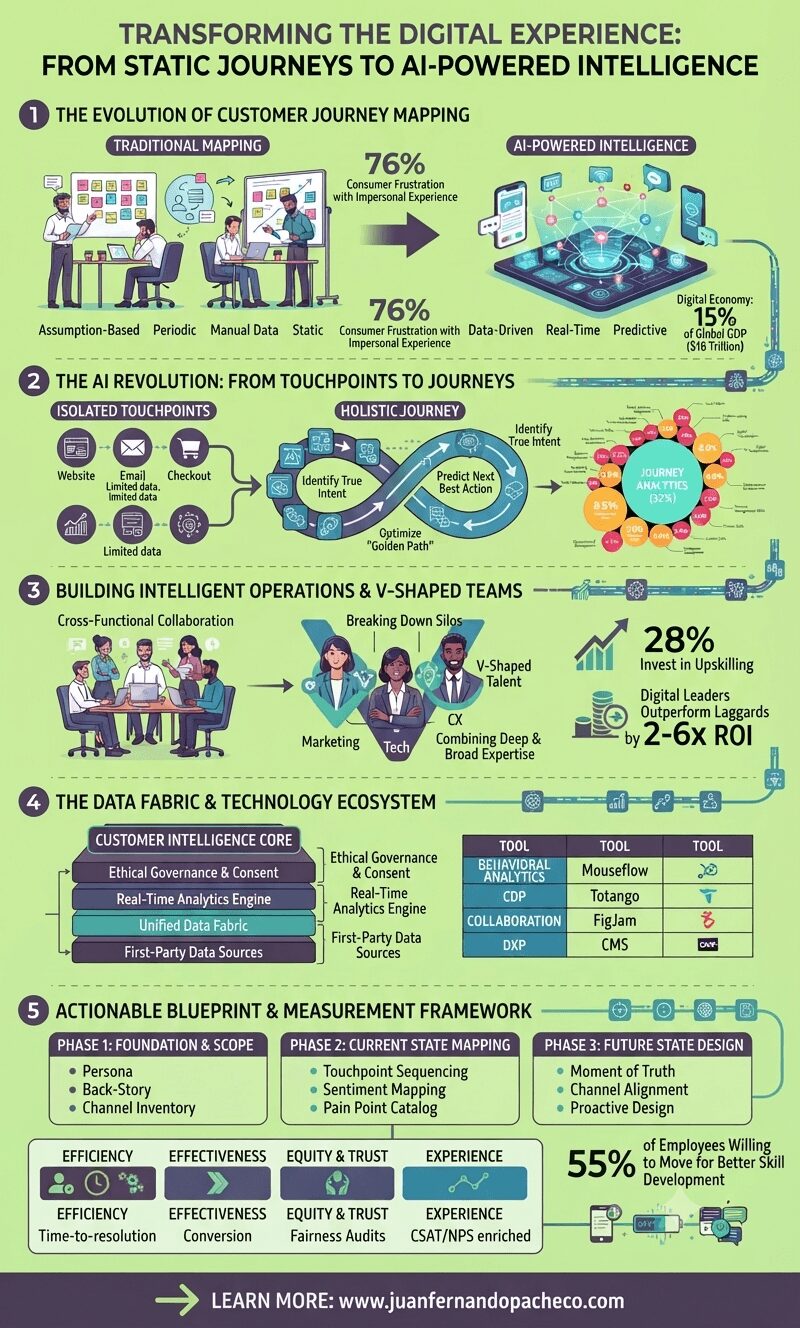
A vertical infographic featuring a light green background, styled with dark purple and teal accents, illustrating the evolution of customer journey mapping from traditional sticky notes to AI-driven predictive intelligence. It highlights V-shaped cross-functional teams, a data fabric architecture, and an actionable three-phase implementation blueprint, complete with a reference to www.juanfernandopacheco.com.

The future of customer journey mapping lies in creating dynamic, self-updating systems that not only reflect current customer behaviors but also predict future needs and preferences. This requires investment in both technology and talent—particularly in developing V-shaped employees who can bridge functional silos and translate data insights into human-centered experiences.
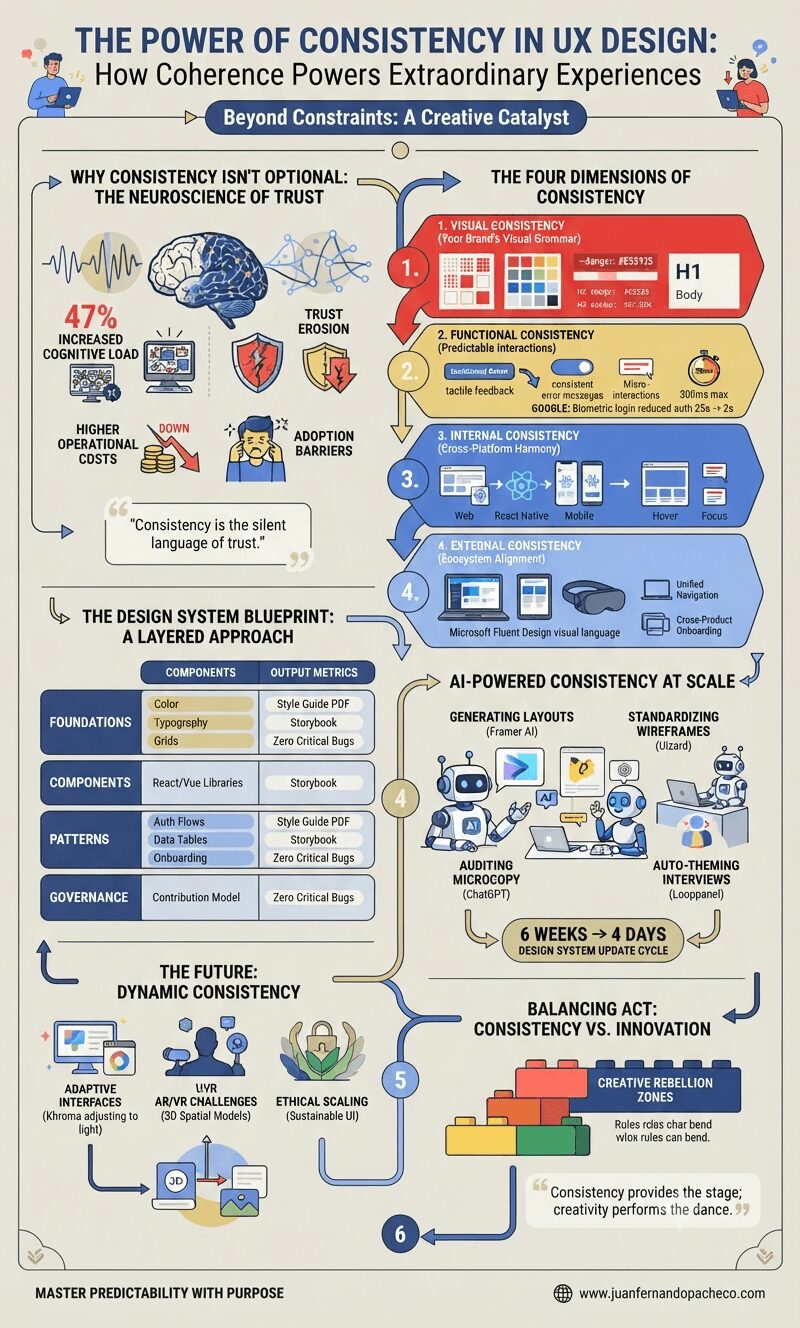
A detailed vertical infographic titled "The Power of Consistency in UX Design" on a light beige background, broken into sections with charts, icons, and text illustrating why consistency matters. Key sections include neuroscience of trust, four dimensions of consistency (visual, functional, internal, external), design system layers, AI tools, future trends like AR/VR, and a final section on balancing consistency with innovation, featuring a LEGO metaphor and a URL for www.juanfernandopacheco.com at the bottom.

Why Consistency Isn’t Optional: The Neuroscience of Trust

Our brains are prediction engines. Every micro-interaction—a button hover effect, navigation placement, error message tone—trains users’ mental models. Research shows inconsistent interfaces increase cognitive load by 47%, directly impacting task completion rates. Consider these tangible impacts: