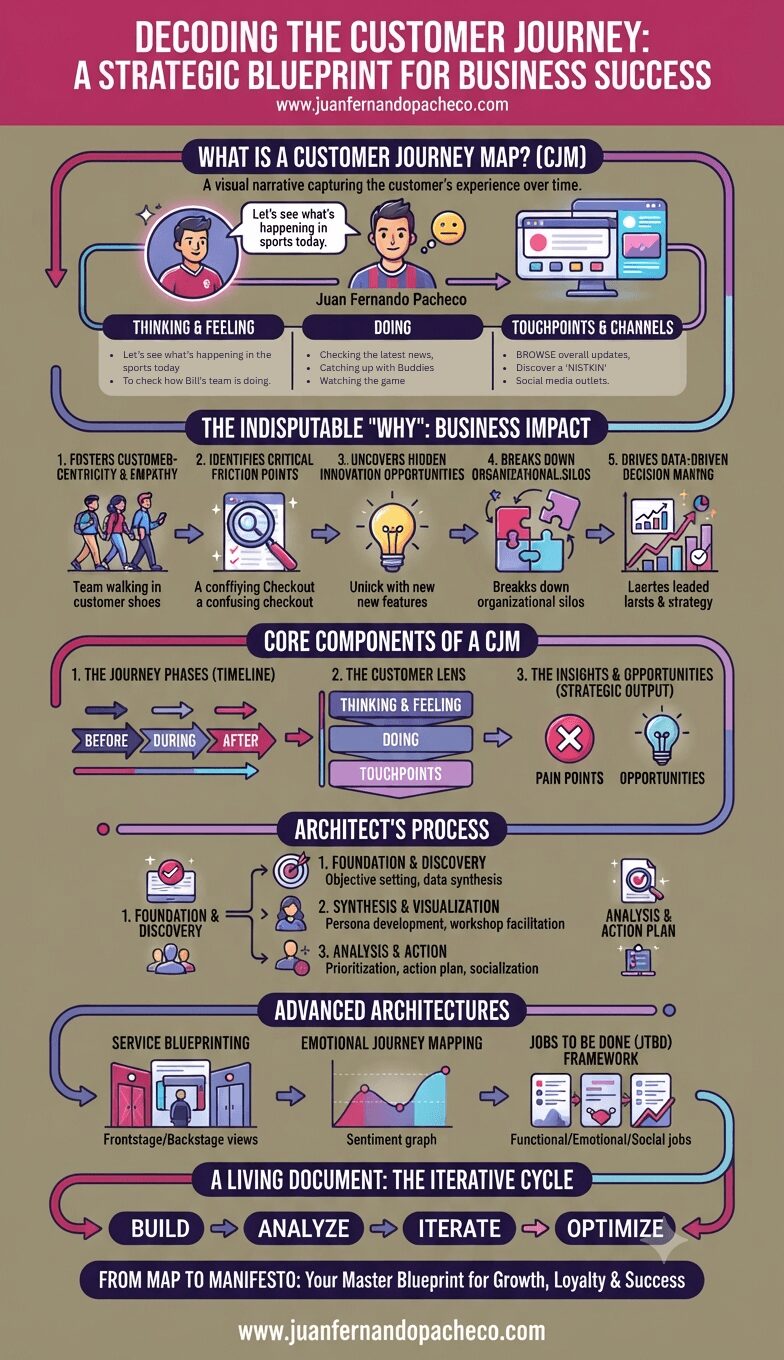
An infographic titled "Decoding the Customer Journey" that serves as a strategic blueprint for business success. The vertical graphic, set against a muted olive background, uses a color palette of pink, purple, and blue. It outlines the definition of a Customer Journey Map (CJM), its business impact, core components (phases, lens, insights), the architectural process (foundation, synthesis, action), advanced frameworks (blueprinting, emotional mapping, JTBD), and the iterative cycle of review. The URL www.juanfernandopacheco.com is included at the top and bottom.

Decoding the customer journey is the first, most critical step in building a truly customer-centric organization. The map of Juan Fernando Pacheco is more than a diagram; it’s a manifesto. It declares that the company’s success is inextricably linked to his success in achieving his goals—be they finding community, proving his knowledge to his buddies, or simply enjoying the thrill of the game.

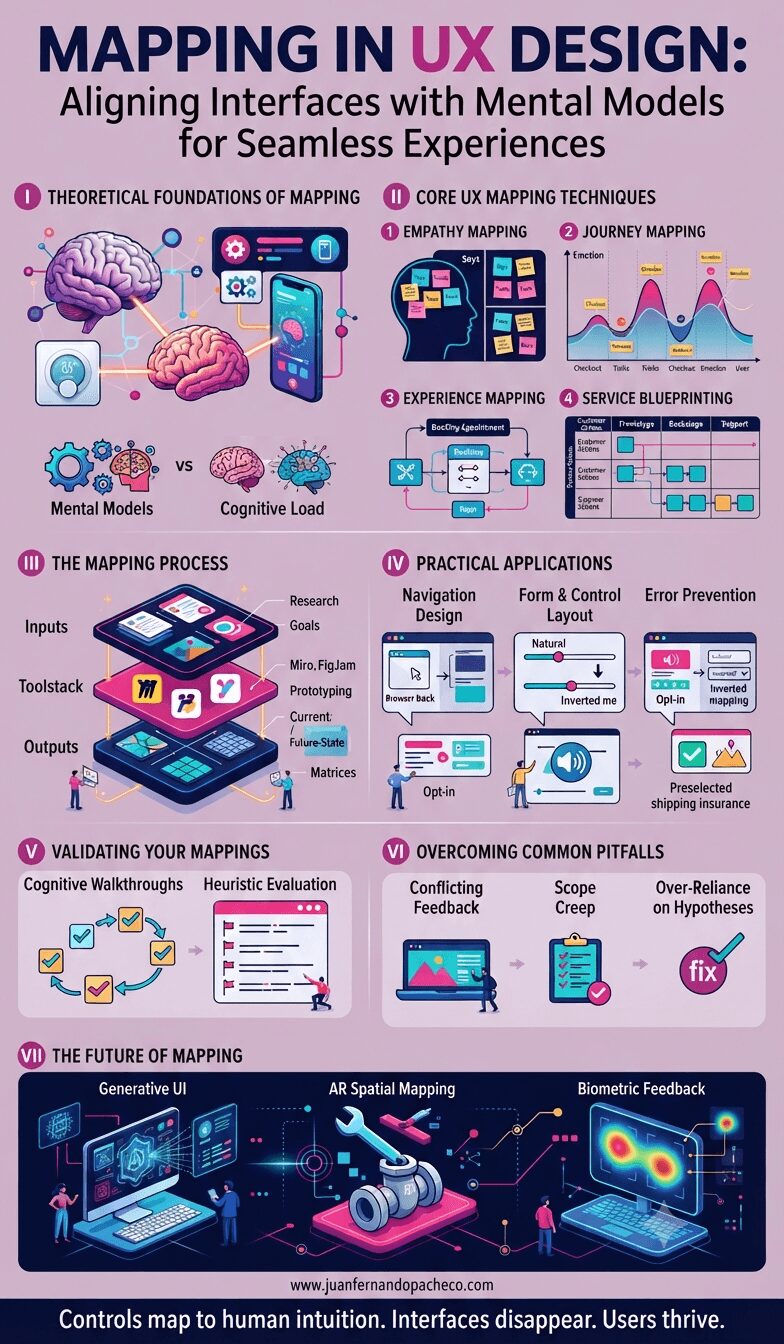
A comprehensive infographic titled 'Mapping in UX Design: Aligning Interfaces with Mental Models for Seamless Experiences' is divided into seven sections. Section I covers Theoretical Foundations (Mental Models, Cognitive Load). Section II details Core Techniques (Empathy, Journey, Experience Mapping, Service Blueprinting). Section III outlines the Process (Inputs, Toolstack, Outputs). Section IV shows Practical Applications (Navigation, Forms, Error Prevention). Section V explains Validation (Walkthroughs, Heuristics). Section VI addresses Pitfalls, and Section VII explores the Future (Generative UI, AR, Biometrics). The footer includes www.juanfernandopacheco.com and the tagline 'Controls map to human intuition. Interfaces disappear. Users thrive.'

Mapping transcends diagramming—it’s the art of translating cognition into interface.

By anchoring designs in mental models, we reduce cognitive friction, build trust, and accelerate task completion.

Start small: pick one critical user journey, blueprint its current state, then redesign one touchpoint using empathy-driven insights.
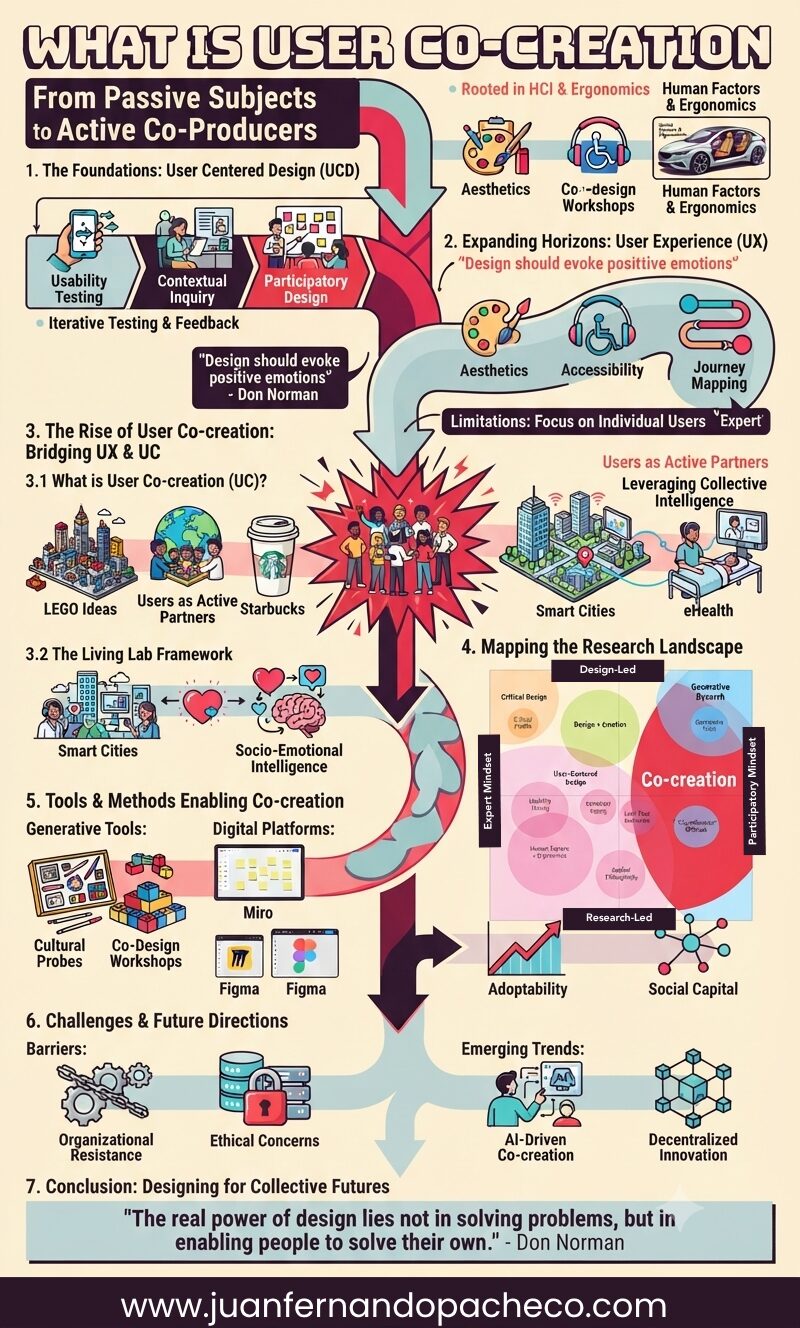
An intricate infographic titled "What is User Co-creation: From Passive Subjects to Active Co-Producers," illustrating the historical evolution of design methodologies from User Centered Design (UCD) to User Experience (UX) and finally to User Co-creation (UC). The graphic uses a vibrant color palette and segmented arrows to flow through seven key sections, detailing principles, tools (e.g., LEGO Ideas, Starbucks, Miro, Figma), frameworks (Living Labs, Sanders & Stappers' Research Map), metrics (Social Capital), challenges, and future trends (AI-Driven, Decentralized Innovation). It includes a concluding quote from Don Norman and branding for www.juanfernandopacheco.com.

The shift from User Centred Design (UCD) to User Co-creation (UC) marks a democratization of innovation. By embracing Living Labs and participatory frameworks, designers can harness the collective genius of users. As Don Norman aptly stated:

“The real power of design lies not in solving problems, but in enabling people to solve their own.”