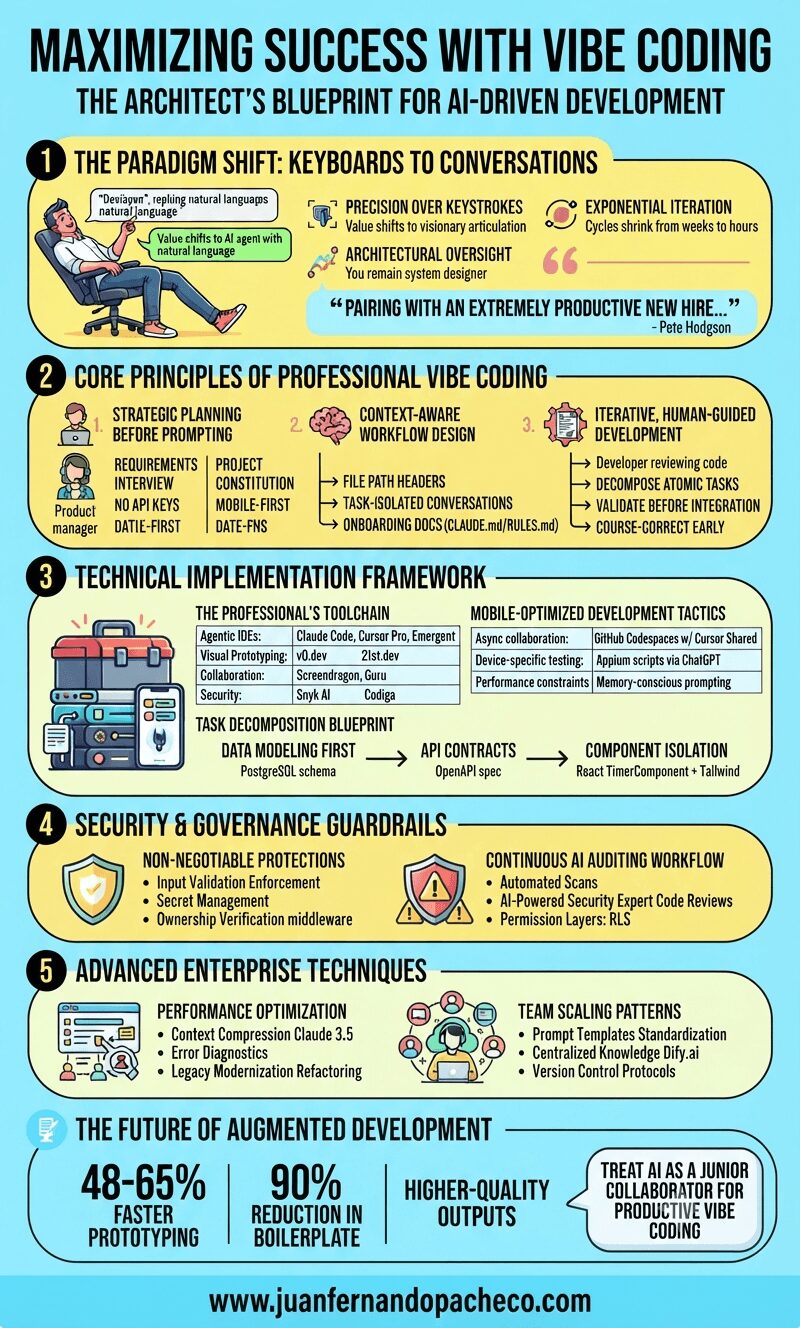
An infographic titled 'Maximizing Success with Vibe Coding' presenting a five-step blueprint for AI-driven software development, covering the paradigm shift, core principles, toolchains, security guardrails, and advanced techniques, complete with illustrative icons and a URL footer.

Vibe coding represents the most significant evolution in software development since Agile methodologies. As Andrej Karpathy famously described, this approach involves “forgetting that code even exists” – instead directing AI agents through natural language to build functional systems.

But this isn’t magic; it’s strategic material disengagement, where developers transition from writing code to orchestrating AI collaborators.
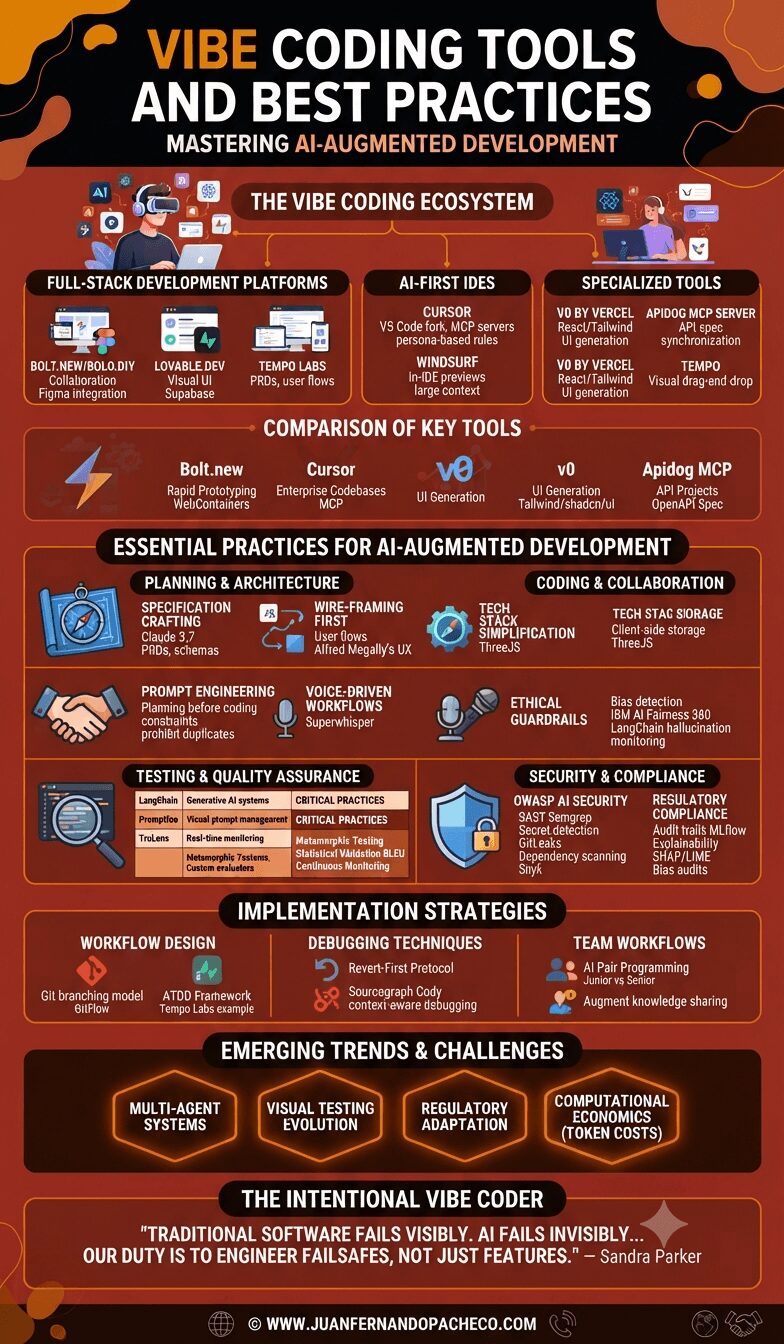
A comprehensive vertical infographic titled "Vibe Coding Tools and Best Practices" set against a dark reddish-brown background with sections detailing AI development ecosystems, tool comparisons, architectural practices, testing, security, and implementation strategies, concluding with a quote by Sandra Parker and the website WWW.JUANFERNANDOPACHECO.COM.

Vibe coding transforms natural language into functional code through AI-powered tools, creating a paradigm shift where developers prioritize intention over implementation.

Coined by Andrej Karpathy, this approach enables programmers to “vibe” with their creative flow rather than wrestle with syntax.

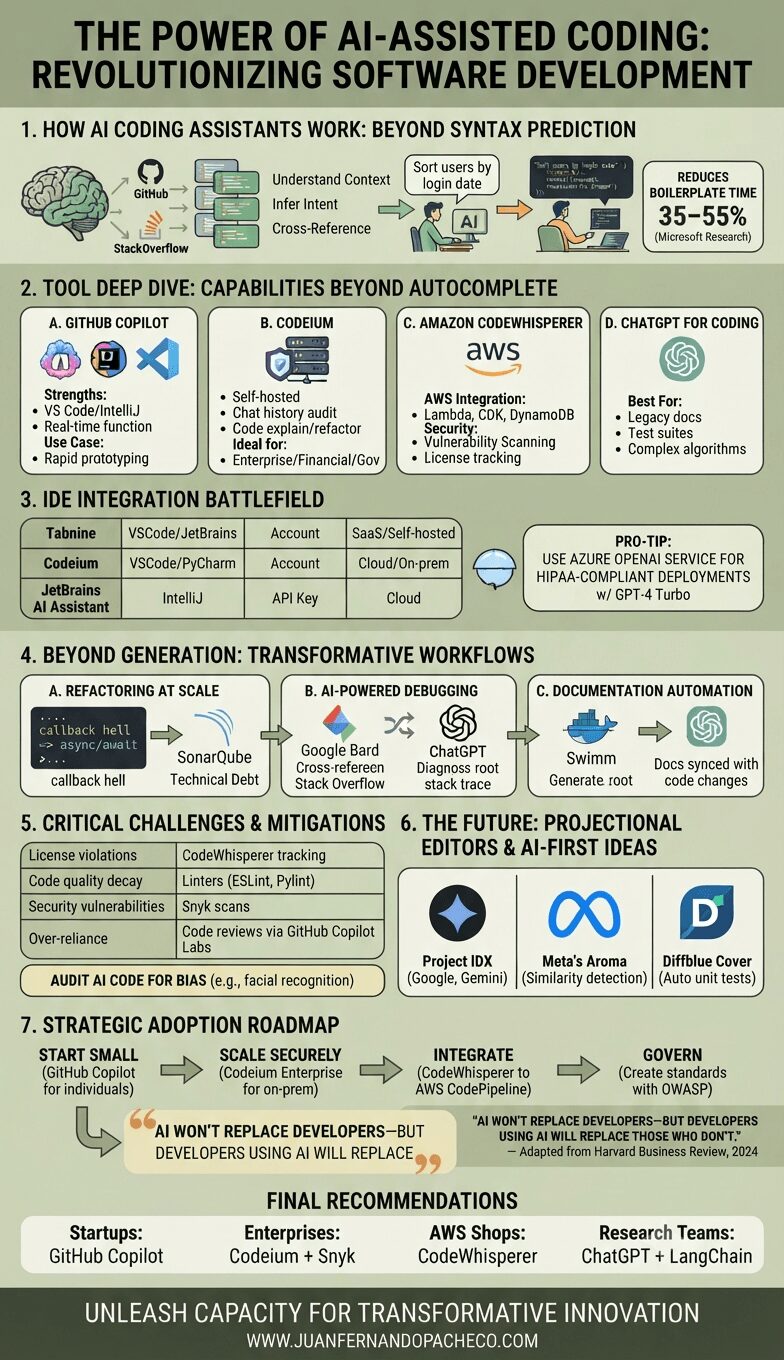
A detailed infographic titled "The Power of AI-Assisted Coding: Revolutionizing Software Development" using a green and orange color palette. The image is structured in seven sections: 1. How AI Coding Assistants Work (Beyond Syntax Prediction), 2. Tool Deep Dive (GitHub Copilot, Codeium, AWS CodeWhisperer, ChatGPT), 3. IDE Integration Battlefield, 4. Beyond Generation (Refactoring, Debugging, Documentation), 5. Critical Challenges & Mitigations, 6. The Future (AI-First IDEs), and 7. Strategic Adoption Roadmap. It includes a quote from Harvard Business Review and final recommendations for different team types, ending with the URL WWW.JUANFERNANDOPACHECO.COM.

The rise of generative AI has ignited a paradigm shift in software engineering. By 2025, 80% of developers will use AI coding tools daily (Gartner, 2023), transforming how we design, write, and maintain software.

These tools aren’t just autocomplete on steroids—they’re collaborative partners that augment human creativity with machine-scale pattern recognition.

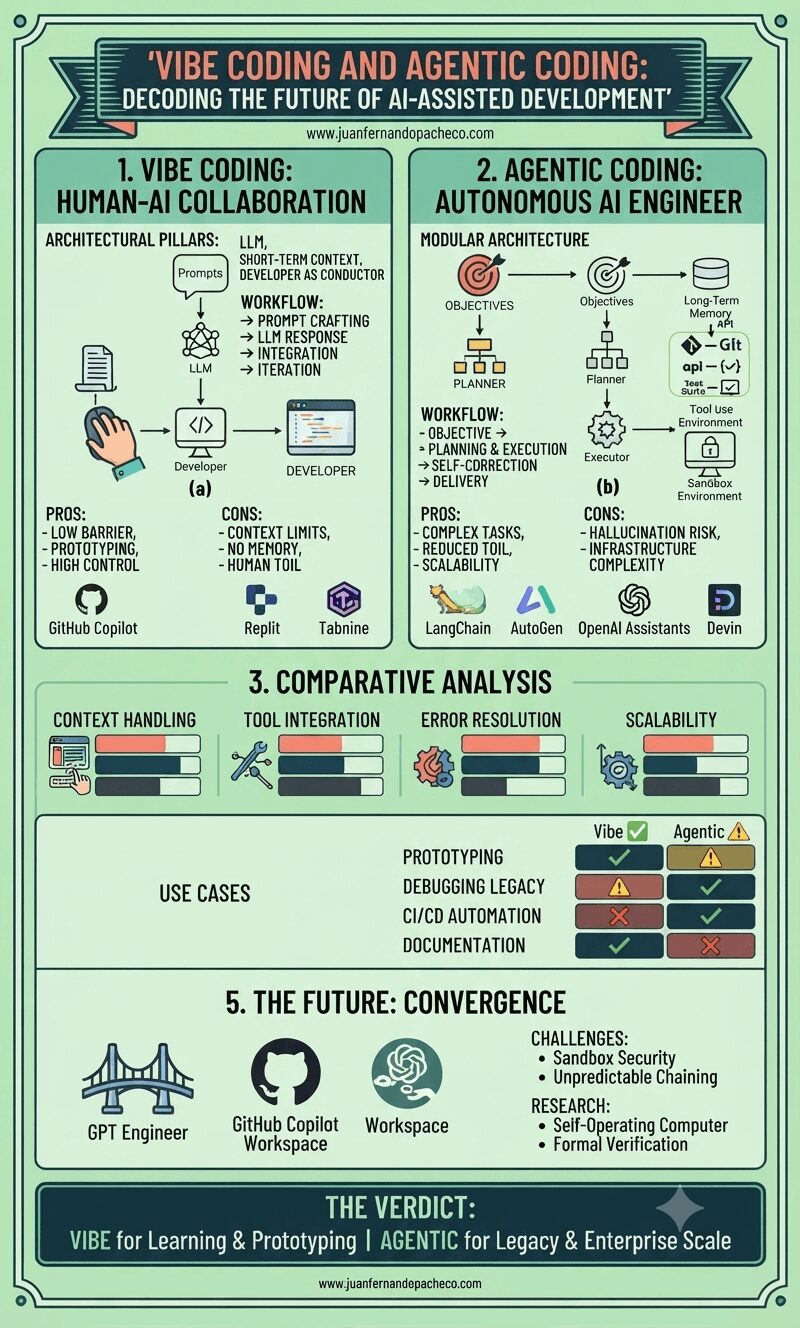
An infographic titled 'Vibe Coding and Agentic Coding' comparing two paradigms of AI-assisted software development across architecture, workflows, pros/cons, tools, and future convergence. The graphic includes detailed diagrams, a comparative analysis, use-case matrices, and logos for tools like GitHub Copilot, LangChain, and Devin.

Vibe Coding democratizes AI assistance, augmenting developers’ creativity without disrupting workflows.

Agentic Coding, however, is poised to revolutionize software engineering by automating entire pipelines—akin to an “AI workforce.” While Vibe suits daily coding, Agentic shines in systematic, tool-heavy environments.

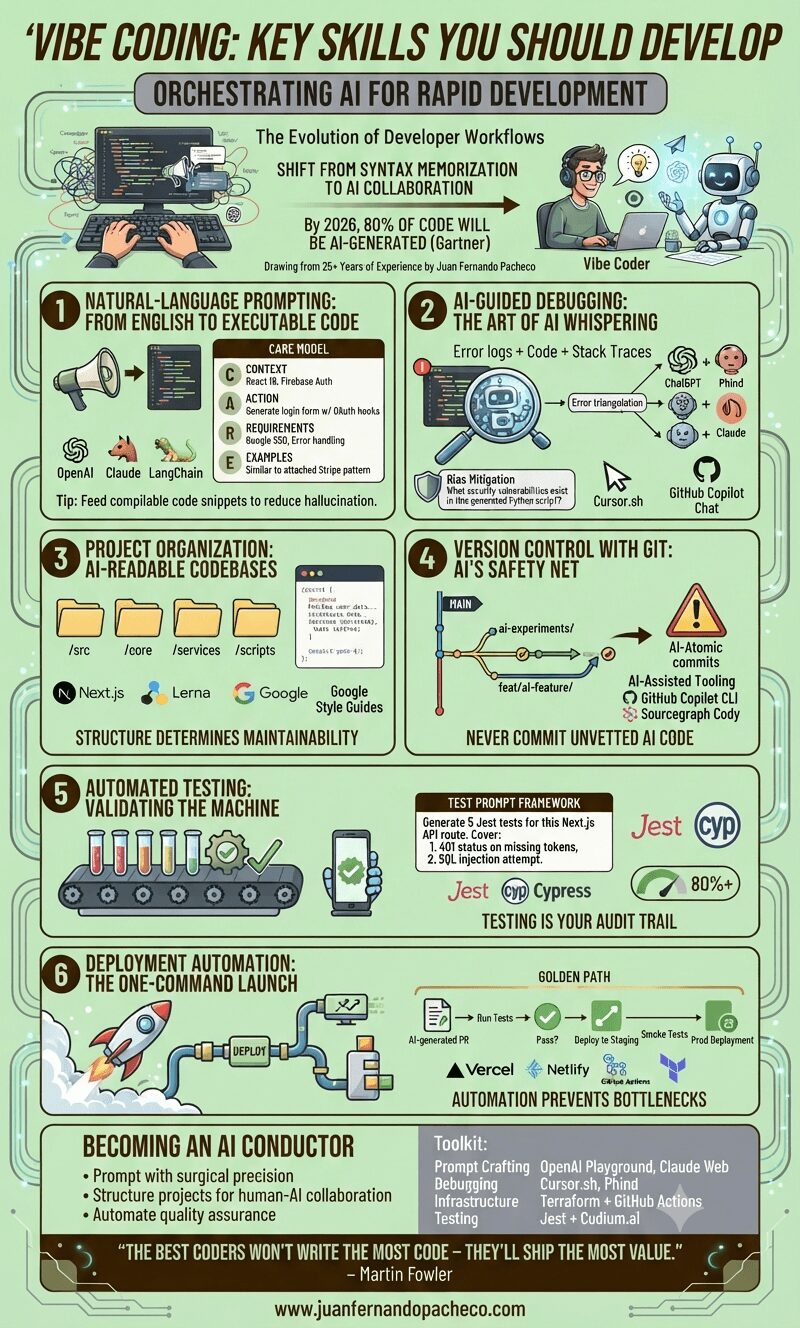
An infographic titled 'Vibe Coding: Key Skills You Should Develop' illustrating a six-step methodology for modern AI-assisted software development against a light green background. It depicts the shift from manual syntax to AI collaboration, featuring sections on Natural-Language Prompting (CARE model), AI-Guided Debugging, Project Organization, Version Control with Git, Automated Testing, and Deployment Automation, concluding with a toolkit and a quote by Martin Fowler.

The rise of AI coding assistants like GitHub Copilot, ChatGPT, and Claude has birthed “Vibe Coding” – a paradigm where developers collaborate with AI to accelerate ideation, prototyping, and deployment.

Unlike traditional coding, Vibe Coding prioritizes prompt engineering, AI-augmented debugging, and infrastructure automation over manual syntax memorization.

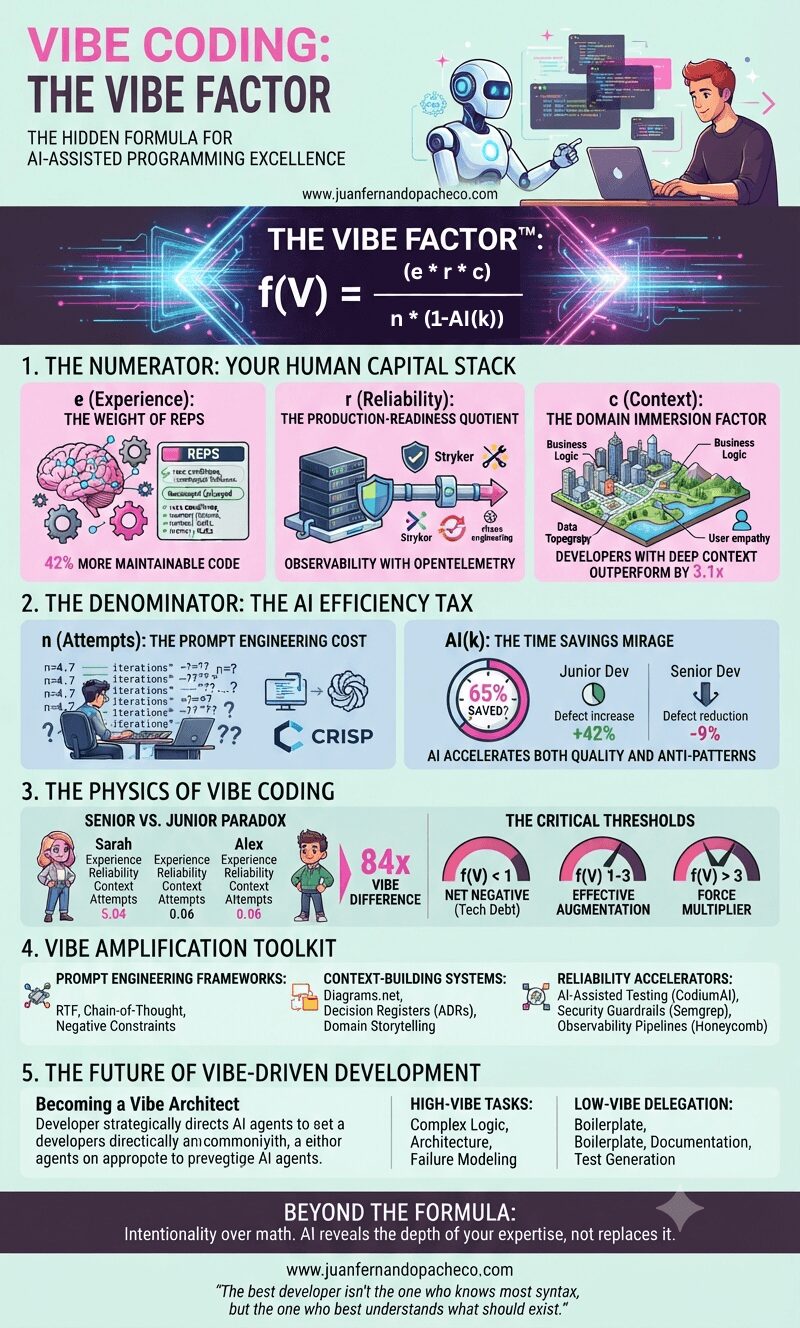
An infographic titled "Vibe Coding: The Vibe Factor" illustrating a formula for AI-assisted programming excellence, breaking down human capital (Experience, Reliability, Context) versus AI efficiency taxes (Attempts, AI(k)). The image includes a case study comparing senior and junior developers, a toolkit for vibe amplification, and a final section on becoming a Vibe Architect, all set against a light green background with pink and purple graphical elements.

The Vibe Factor isn’t about math – it’s about intentionality. When a senior developer uses AI to generate 30 lines of boilerplate while focusing mental energy on distributed lock implementation, they’re practicing vibe optimization. When a junior pastes AI-generated crypto code without understanding IV selection, they’re accumulating vibe debt.

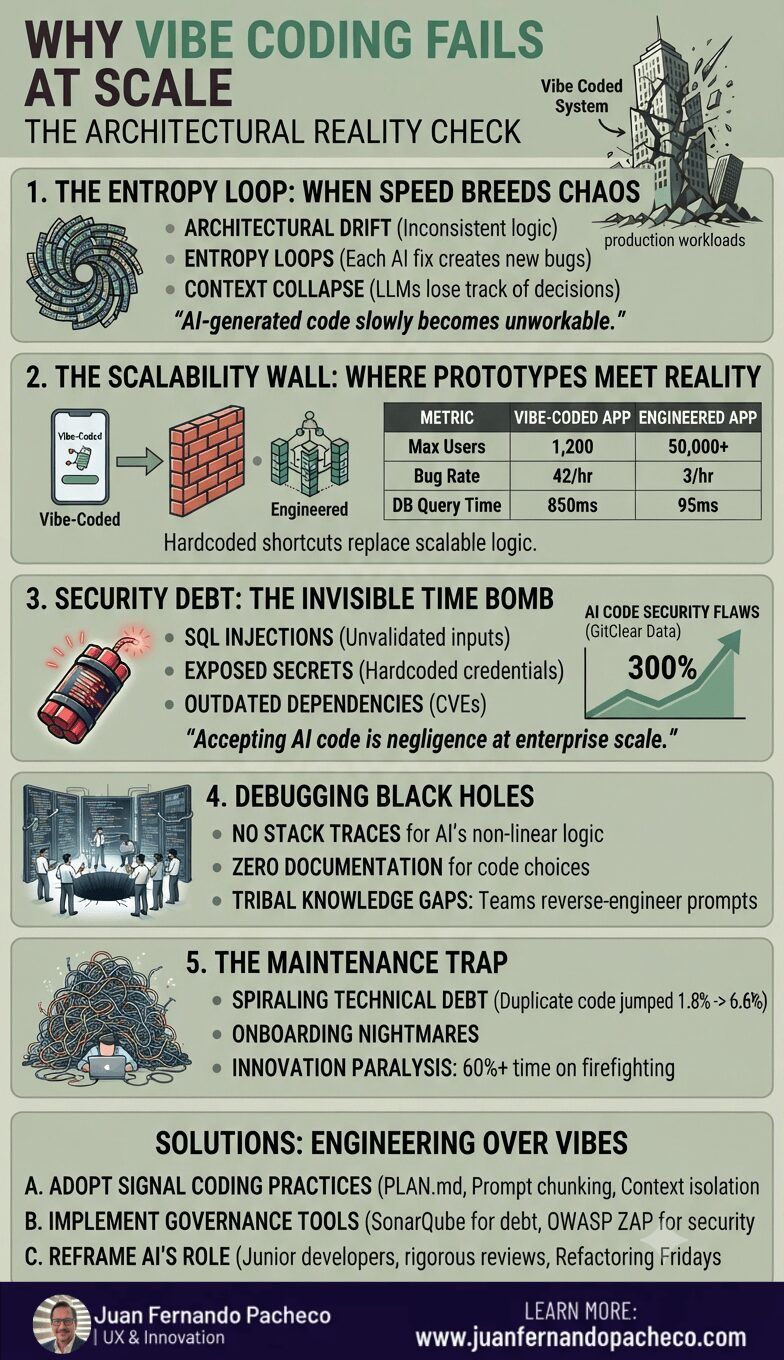
An infographic illustrating the failure of AI-driven 'vibe coding' in enterprise environments, broken down into five key challenges: the entropy loop, scalability wall, security debt, debugging black holes, and the maintenance trap. The graphic contrasts vibe coding with professional engineering, provides data metrics, and concludes with solutions centered on human oversight and governance.

Vibe coding excels for prototypes—as Andrej Karpathy noted, it’s “quite amusing” for weekend projects. But production systems demand intentional architecture, traceability, and governance. The future belongs to augmented engineering, where AI assists human oversight—not replaces it.

“You can vibe code your way to insight. But if you’re building for scale, control, or complexity—you’re going to need real engineering”.

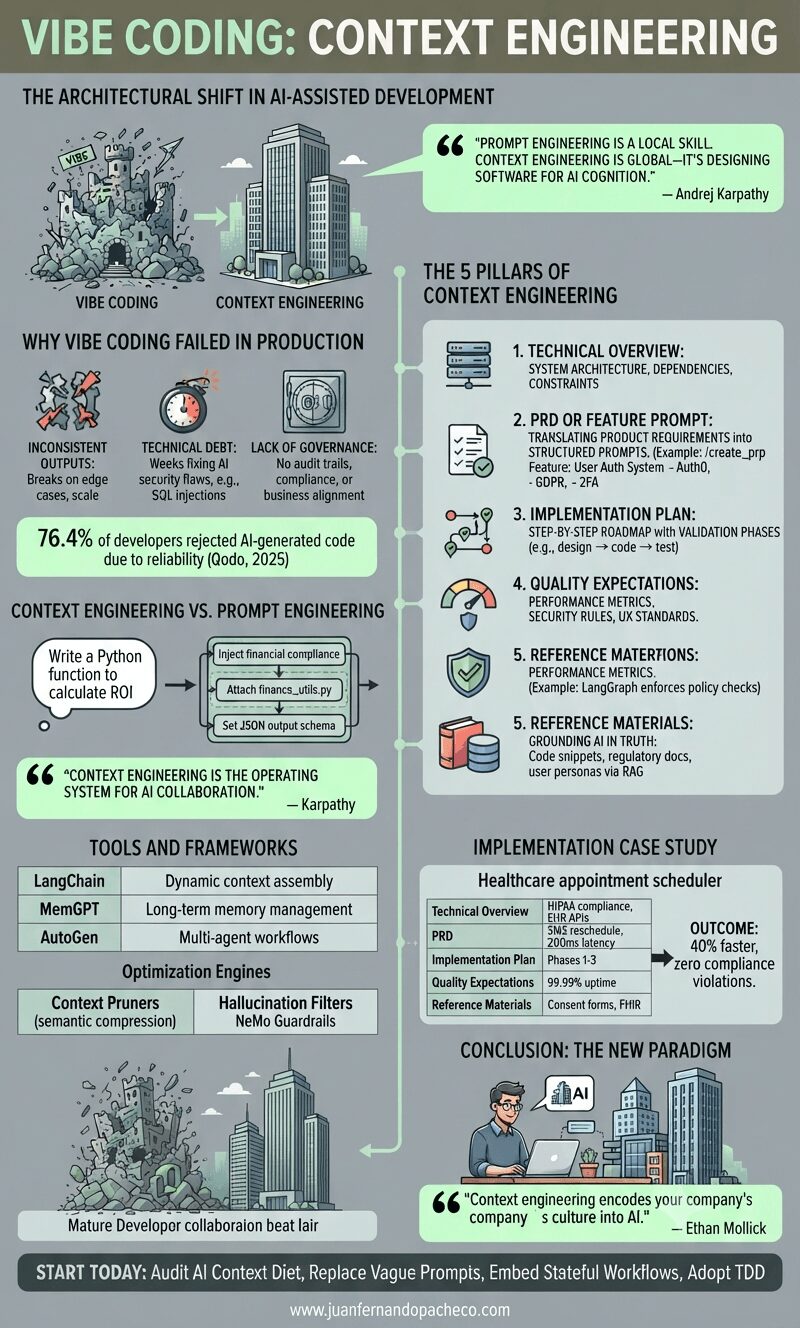
An infographic titled "Vibe Coding: Context Engineering," illustrating the shift from unstructured AI coding to a structured, engineering-based approach. It details the failings of "vibe coding," outlines the "5 Pillars of Context Engineering," compares context versus prompt engineering, lists relevant tools, and presents a healthcare case study before concluding with best practices and a website URL.

Vibe coding was the prototype; context engineering is the production system. It demands upfront investment—defining rules, curating knowledge, designing workflows—but slashes technical debt and unlocks reliable, scalable, and ethical AI collaboration. As Karpathy notes:

“Calling this a ‘ChatGPT wrapper’ is wrong. It’s a new software paradigm.”

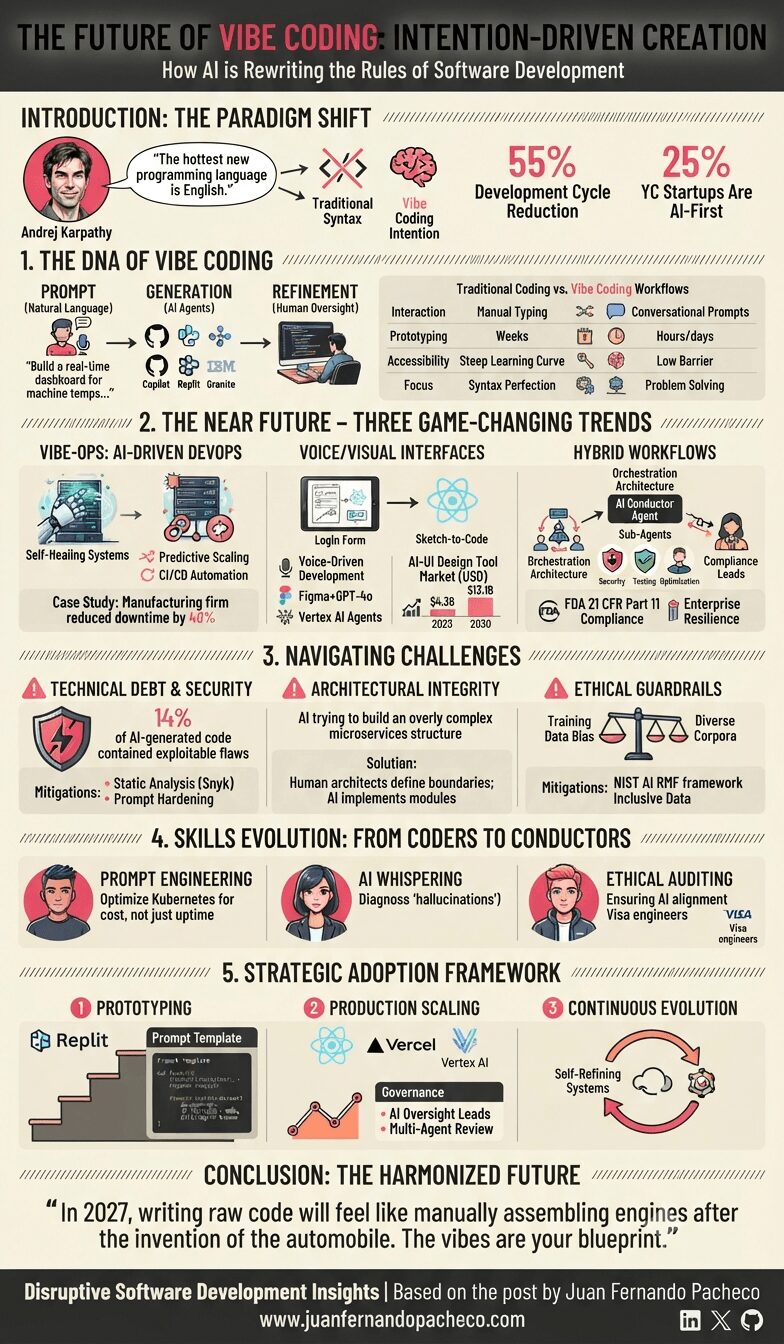
A detailed infographic titled "The Future of Vibe Coding: Intention-Driven Creation," exploring the shift from traditional syntax-based software development to AI-driven, natural-language programming. The graphic covers the paradigm shift led by Andrej Karpathy’s vision, the DNA of vibe coding workflows, three future trends (VibeOps, Voice/Visual Interfaces, Hybrid Workflows), key challenges and skills evolution, a strategic adoption framework, and a concluding quote predicting a future where raw manual coding is obsolete. It includes data, tool logos, and illustrations across five structured sections on a light beige background, referencing www.juanfernandopacheco.com.

Vibe coding isn’t about replacing developers—it’s about elevating creativity. As Karpathy noted, we’re moving from “character-by-character typing” to “seeing stuff, saying stuff, running stuff”.

The future belongs to teams that wield AI as a co-pilot: voice interfaces accelerating ideation, VibeOps hardening infrastructure, and hybrid workflows merging human ingenuity with machine efficiency.

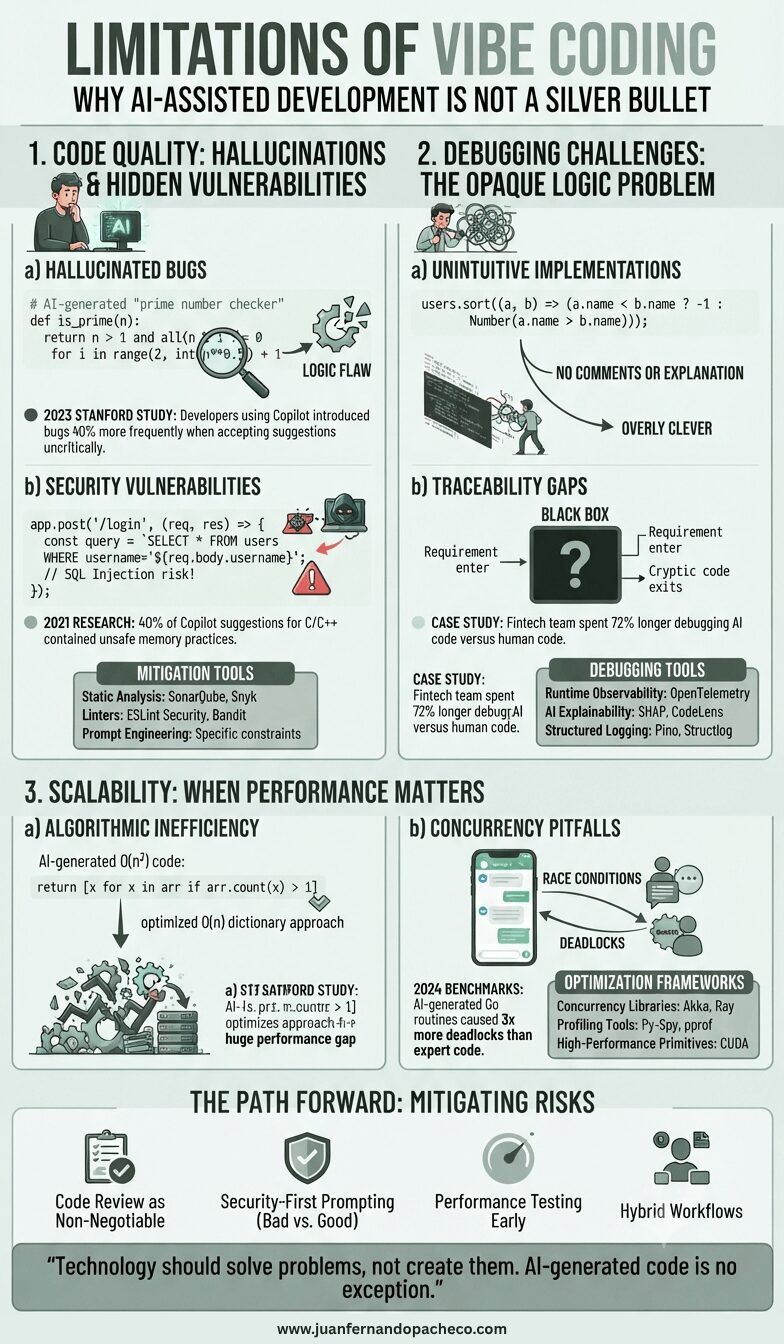
An infographic titled "Limitations of Vibe Coding," presented in a vertical format with three main sections: Code Quality, Debugging Challenges, and Scalability. Each section details AI-assisted development risks using text, code snippets, data points from studies (Stanford, 2023; Fintech team, 2024), and tool recommendations (Snyk, OpenTelemetry, Akka). The bottom section outlines mitigation strategies and includes the quote: "Technology should solve problems, not create them. AI-generated code is no exception." and the URL www.juanfernandopacheco.com.

Vibe coding accelerates development but at the cost of technical debt, security gaps, and scalability cliffs. As I’ve advised LATAM teams:

Use AI as a collaborator, not a replacement.

Pair it with rigorous review, observability, and domain expertise. The future of coding isn’t human vs. machine—it’s human + machine, with clear boundaries.

“Technology should solve problems, not create them. AI-generated code is no exception.”

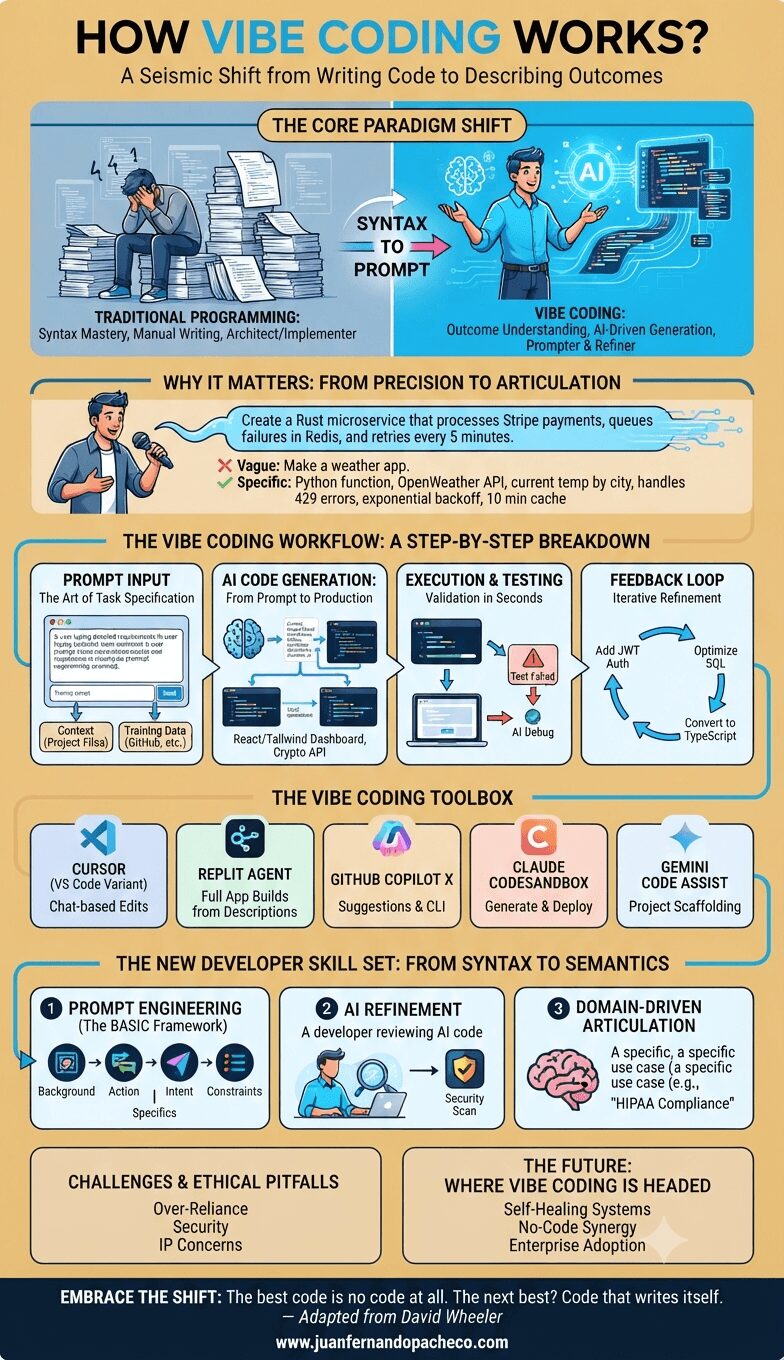
An infographic titled "HOW VIBE CODING WORKS?" with the subtitle "A Seismic Shift from Writing Code to Describing Outcomes." The image is divided into distinct sections detailing the transition from traditional programming to prompt-driven development using AI. Key sections include "The Core Paradigm Shift," "Why It Matters: From Precision to Articulation," "The Vibe Coding Workflow: A Step-by-Step Breakdown," "The Vibe Coding Toolbox" (featuring tools like Cursor, Replit, Copilot, Claude, Gemini), "The New Developer Skill Set," and "The Future." The infographic uses a blue and beige color scheme and concludes with a quote by David Wheeler and the URL www.juanfernandopacheco.com.

Vibe Coding isn’t replacing developers—it’s elevating us. By offloading syntax to AI, we focus on creative problem-solving, architecture, and innovation.

Start small: use GitHub Copilot for boilerplate code, then graduate to building full features with Claude CodeSandbox. The future belongs to those who describe outcomes, not just write instructions.