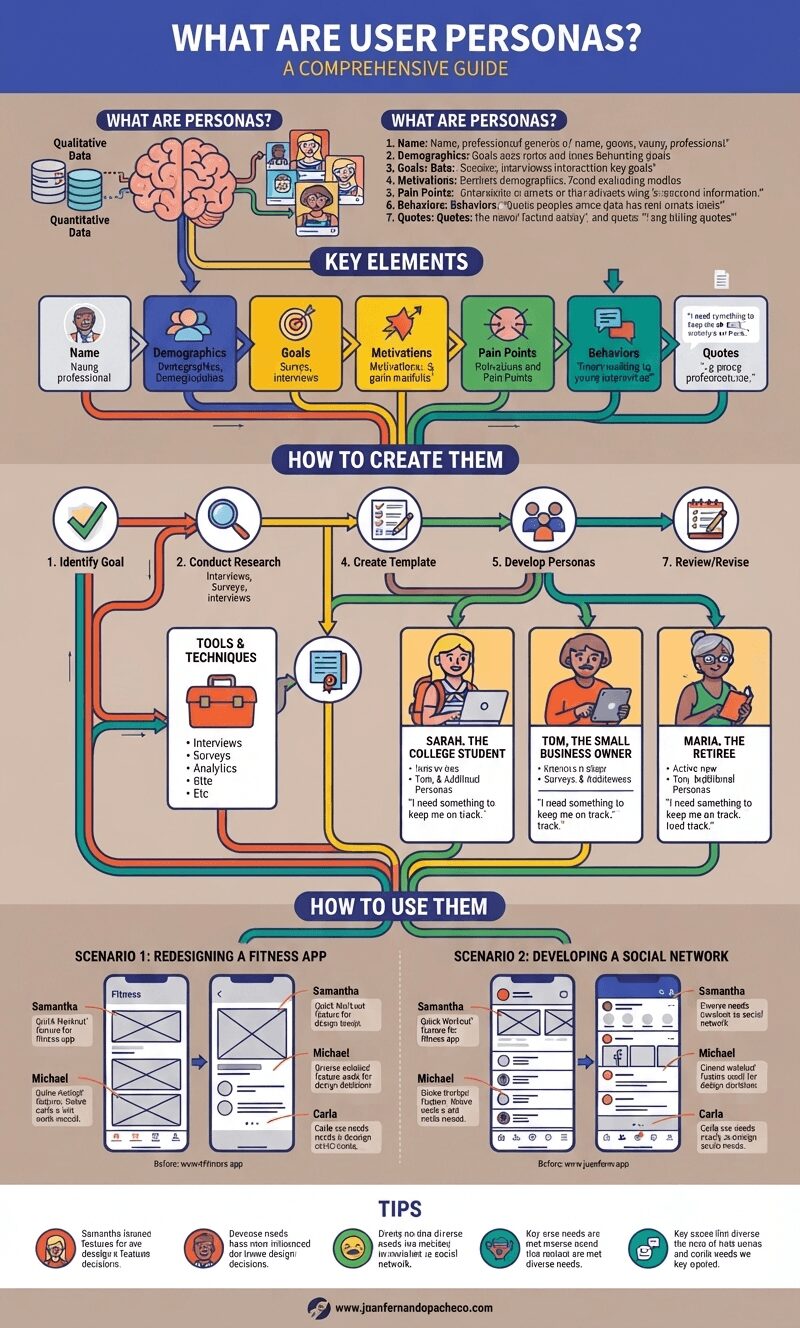
A detailed infographic titled "WHAT ARE USER PERSONAS? A COMPREHENSIVE GUIDE," set against a muted, earthy background. The image is a flowchart and structured text guide that explains user personas. It features sections for "What are Personas?" with a brain icon and data inputs, "Key Elements" with seven categorized steps, "How to Create Them" with a seven-step process, "Tools & Techniques," and "How to Use Them" with two detailed scenarios (Redesigning a Fitness App, Developing a Social Network). It concludes with "Tips." The infographic includes illustrative portraits of Sarah, Tom, and Maria, and app wireframe examples. The URL www.juanfernandopacheco.com is at the bottom.

In the world of user experience (UX) design, User Personas play a pivotal role. These fictional, yet representative, characters embody the different types of users for a product or service.

Crafted from extensive research and data, personas help designers and stakeholders understand the diverse needs, goals, and behaviors of their target audience. In this blog post, we’ll dive deep into the concept of user personas, how to create them, and their role in the design process.
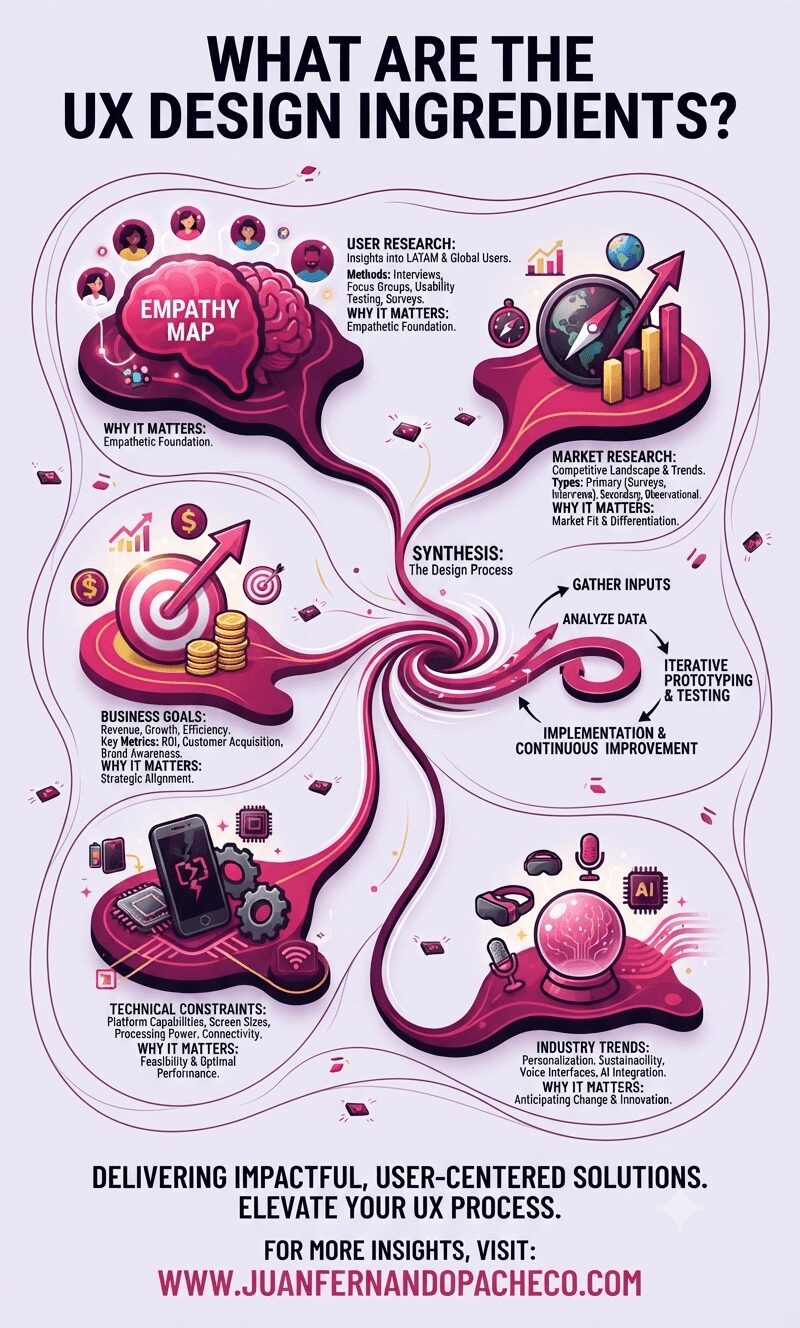
An illustrative infographic titled "WHAT ARE THE UX DESIGN INGREDIENTS?" displayed against a light purple background. It features five distinct, interconnected sections—User Research, Market Research, Business Goals, Technical Constraints, and Industry Trends—represented by 3D icons like a brain, compass, target, broken phone, and crystal ball. These sections flow into a central spiral labeled "Synthesis: The Design Process." Below the diagram, the text reads: "DELIVERING IMPACTFUL, USER-CENTERED SOLUTIONS. ELEVATE YOUR UX PROCESS." followed by the website "WWW.JUANFERNANDOPACHECO.COM".

UX design (user experience design) is a multifaceted field requiring the integration of diverse inputs to create user-centric solutions.

The term “UX design ingredients” refers to the core elements that inform and shape the design process. These ingredients provide the foundation for building products and services that meet both user needs and business goals.

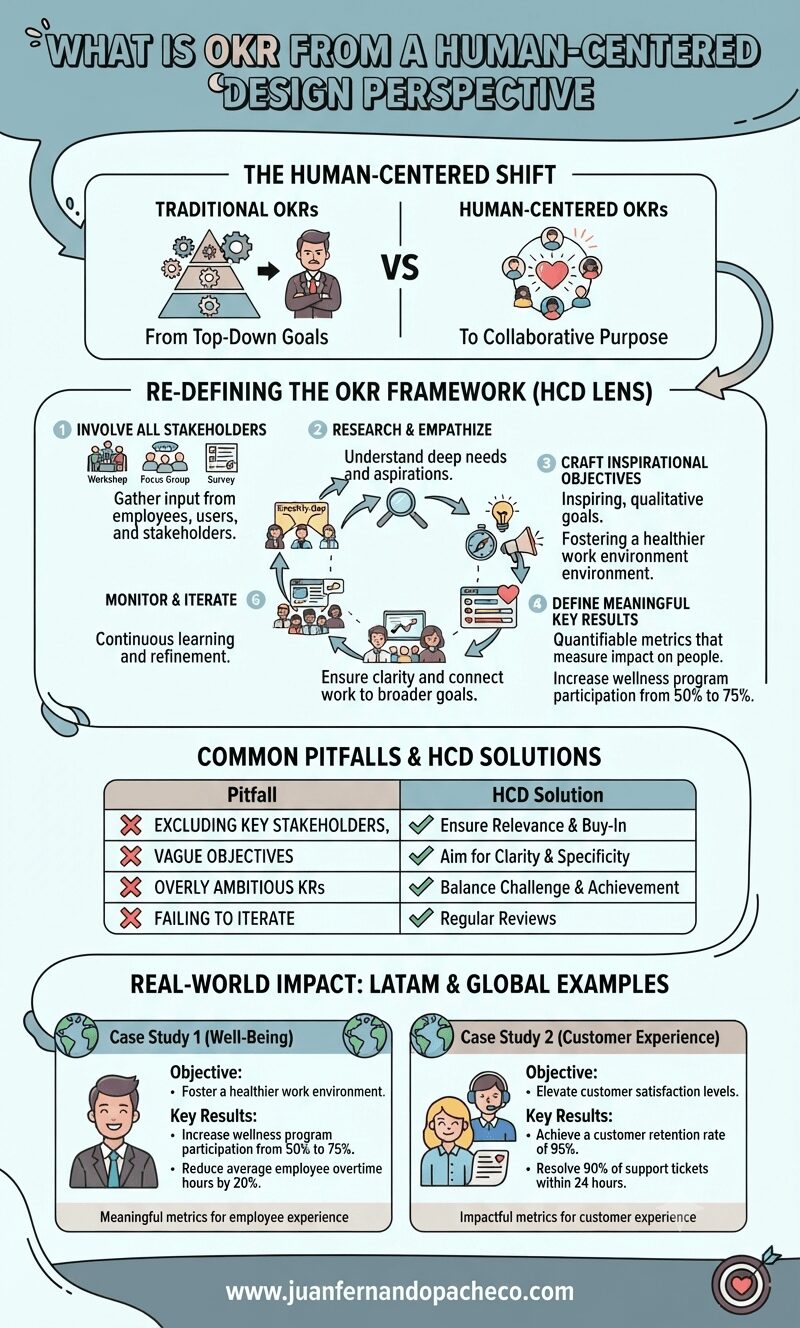
An infographic titled "What is OKR from a Human-Centered Design Perspective" illustrates a six-step framework for setting goals with empathy and collaboration. It compares traditional top-down goal setting with human-centered approaches, lists common pitfalls and solutions, and provides real-world examples for employee well-being and customer experience. The design uses a color palette of teal, cream, mauve, and grey. The footer includes the website www.juanfernandopacheco.com.

OKRs, or “Objectives and Key Results,” are a widely used framework for setting, tracking, and achieving goals within organizations.
Originally developed at Intel in the 1970s and later popularized by John Doerr in Measure What Matters, OKRs have become a cornerstone of goal management for companies like Google, LinkedIn, and Twitter.

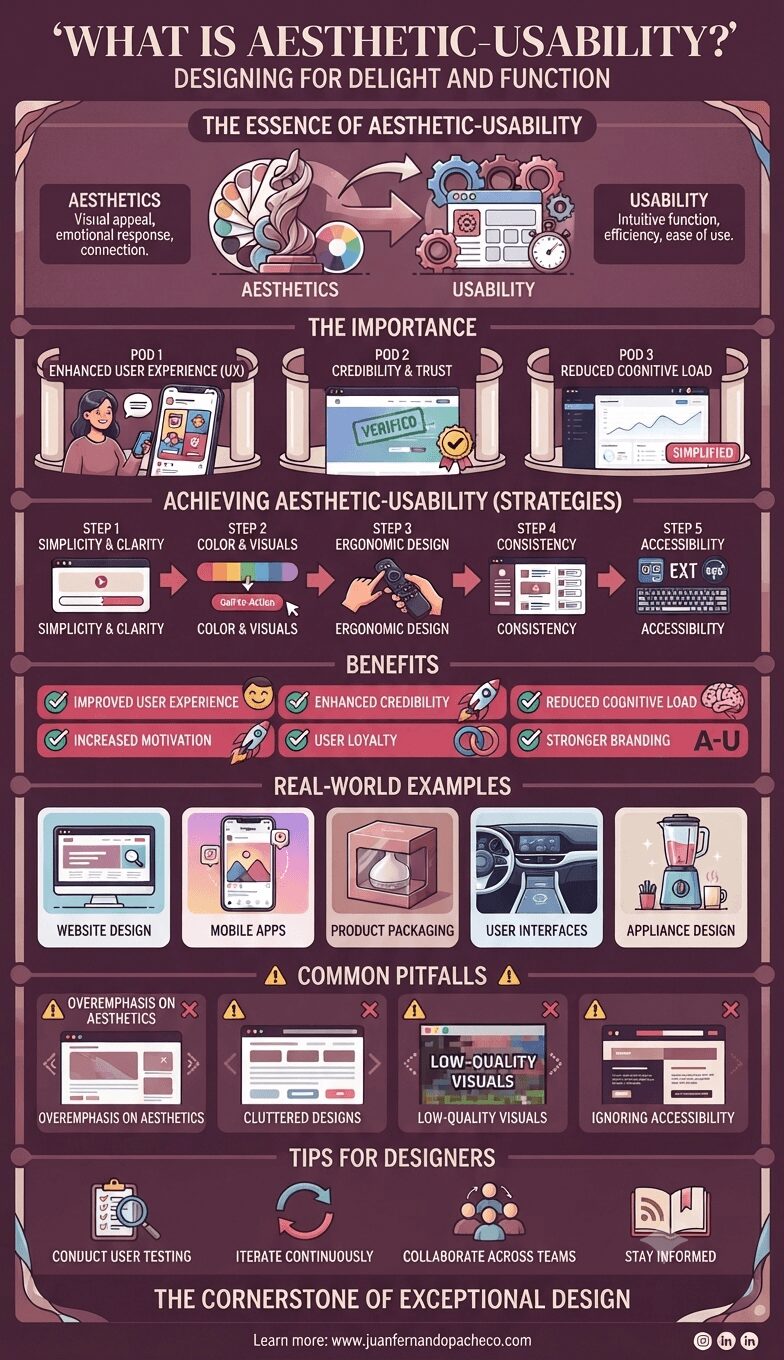
An infographic titled "WHAT IS AESTHETIC-USABILITY? DESIGNING FOR DELIGHT AND FUNCTION" on a deep plum background. It visually explains the concept through six main sections: The Essence, Importance, Achieving Strategies, Benefits, Real-World Examples, Common Pitfalls, and Tips. Illustrations include a balance scale for aesthetics and usability, user interface examples, step-by-step icons, and a footer referencing juanfernandopacheco.com.

Aesthetic-Usability is a fundamental concept in user experience (UX) design, emphasizing that a product should be both visually appealing and easy to use.
Rooted in the idea that beauty can enhance functionality, aesthetic-usability plays a pivotal role in shaping how users interact with and perceive a product.

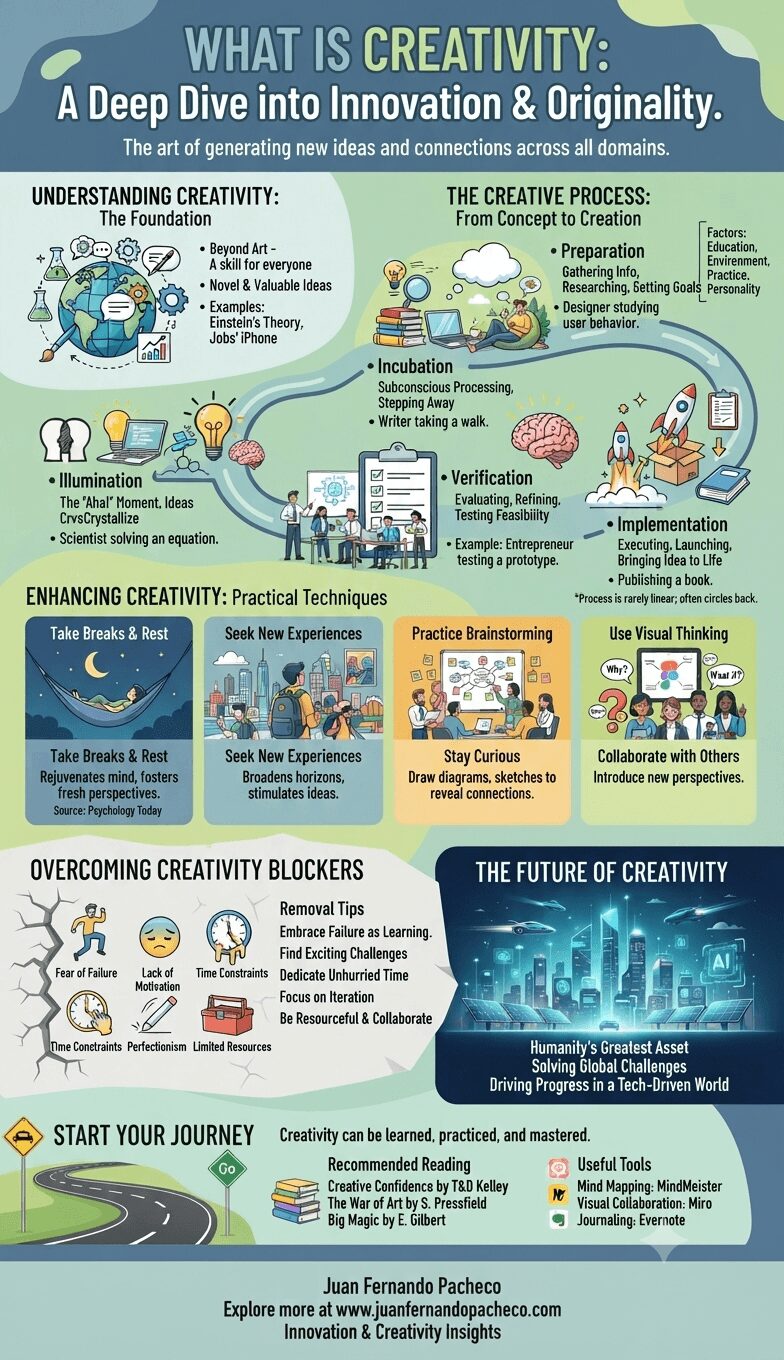
An infographic titled "WHAT IS CREATIVITY: A Deep Dive into Innovation & Originality." The image uses a teal and yellow-green palette to illustrate the foundation, the non-linear process (including icons from image_0.png: Preparation, Incubation, Illumination, Verification), six enhancement techniques, five blockers with tips, and the future of creativity. It includes branding for Juan Fernando Pacheco.

Creativity is one of humanity’s most cherished and enigmatic qualities. At its core, creativity is the ability to generate new and original ideas, thoughts, or connections between existing concepts.

While often associated with artistic pursuits like painting, writing, or music, creativity extends far beyond the arts and is a crucial element in fields as diverse as science, business, technology, and everyday life.

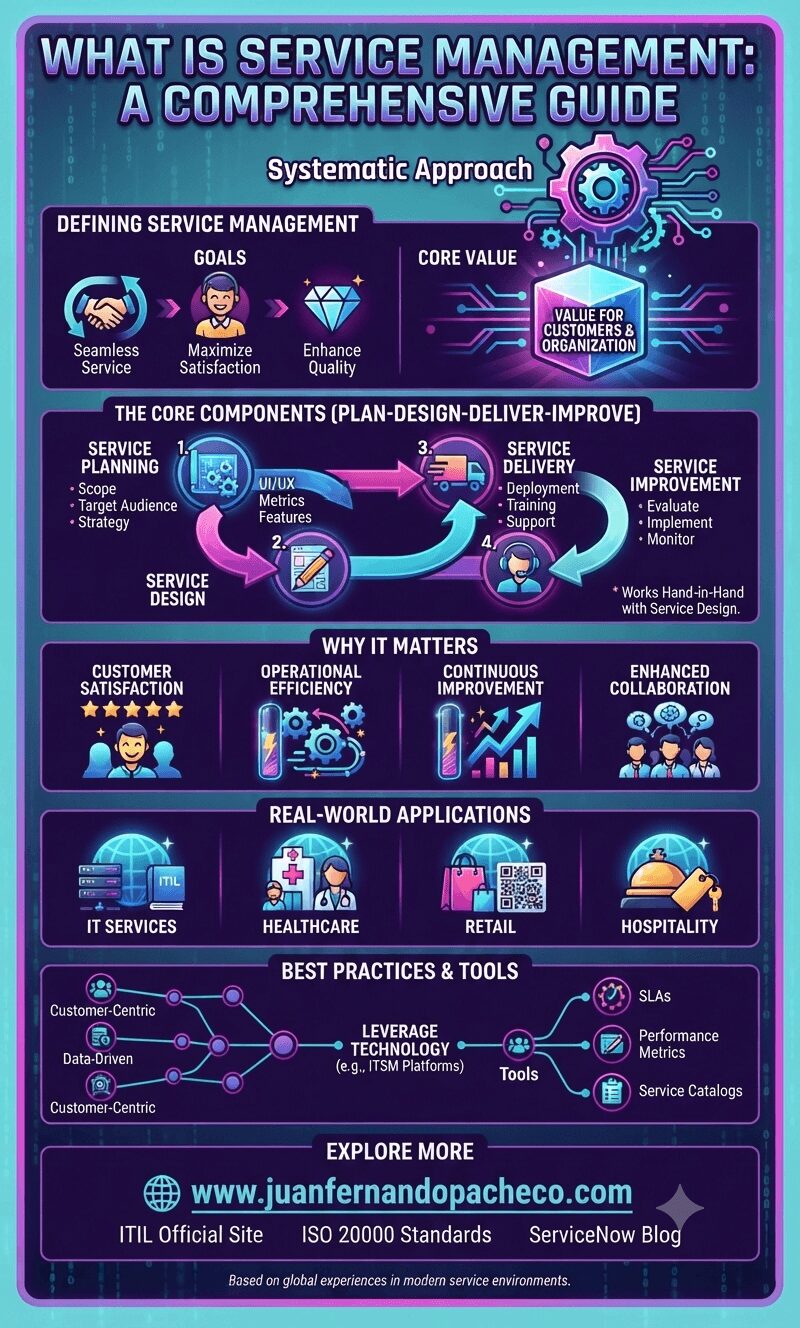
An intricate, vertical infographic titled "WHAT IS SERVICE MANAGEMENT: A COMPREHENSIVE GUIDE" with a systematic approach, organized into distinct modules: Defining Service Management (Goals, Core Value), The Core Components (Plan, Design, Deliver, Improve), Why It Matters, Real-World Applications, Best Practices & Tools, and an "Explore More" section with the URL "www.juanfernandopacheco.com". The design uses a vibrant, neon-tech aesthetic with a color palette of purples, blues, and magentas against a teal background.

Service management is a cornerstone of modern business operations. By systematically planning, designing, delivering, and improving services, organizations can drive customer satisfaction, operational efficiency, and long-term success.

Whether you’re a small business or a global enterprise, adopting robust service management practices is essential for thriving in today’s dynamic marketplace.

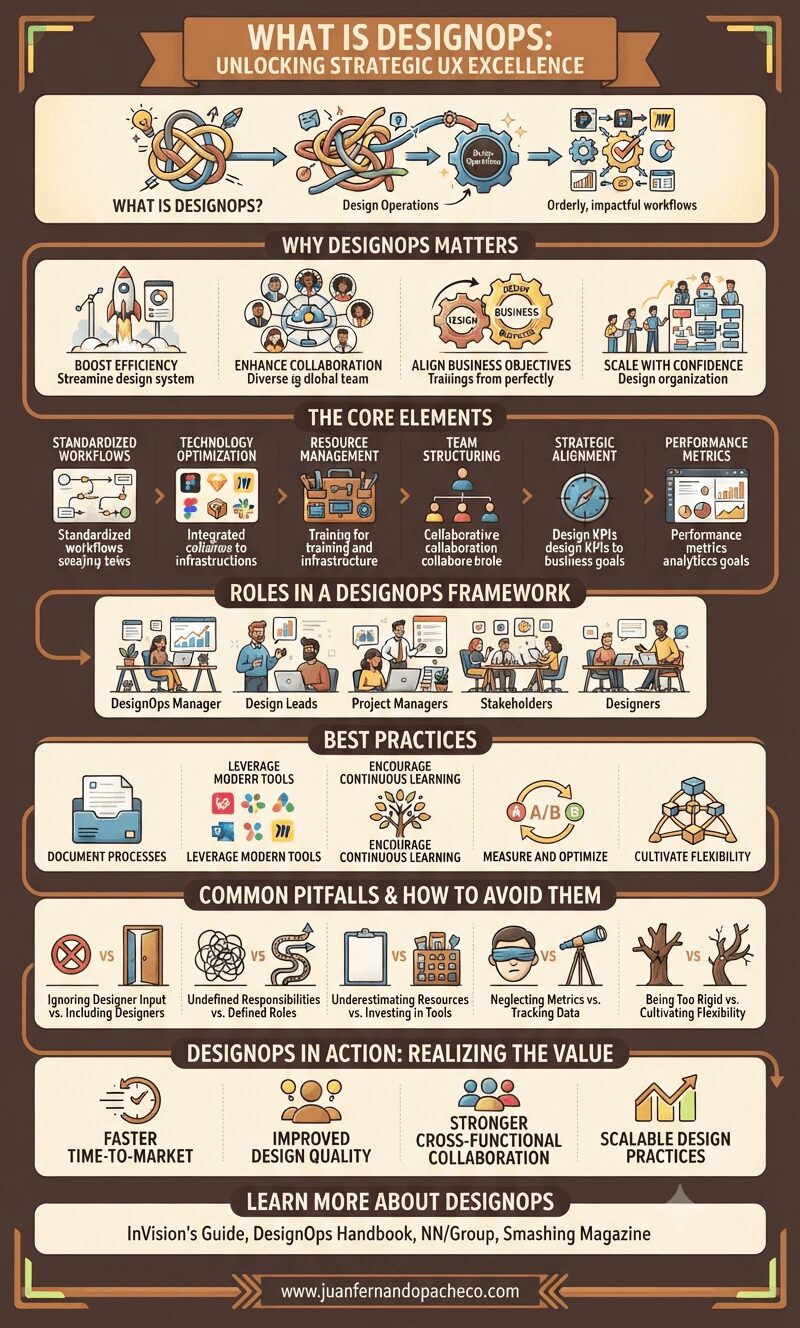
An infographic titled "WHAT IS DESIGNOPS: UNLOCKING STRATEGIC UX EXCELLENCE" with a brown background and cream-colored sections. It defines DesignOps and illustrates why it matters (efficiency, collaboration, alignment, scale), its core elements, key roles, best practices, pitfalls to avoid, the value it provides, and lists further resources, ending with the URL www.juanfernandopacheco.com.

By adopting DesignOps, organizations can harness the full potential of their design teams, driving innovation, efficiency, and alignment with strategic goals.

The result? Exceptional user experiences that propel business success.