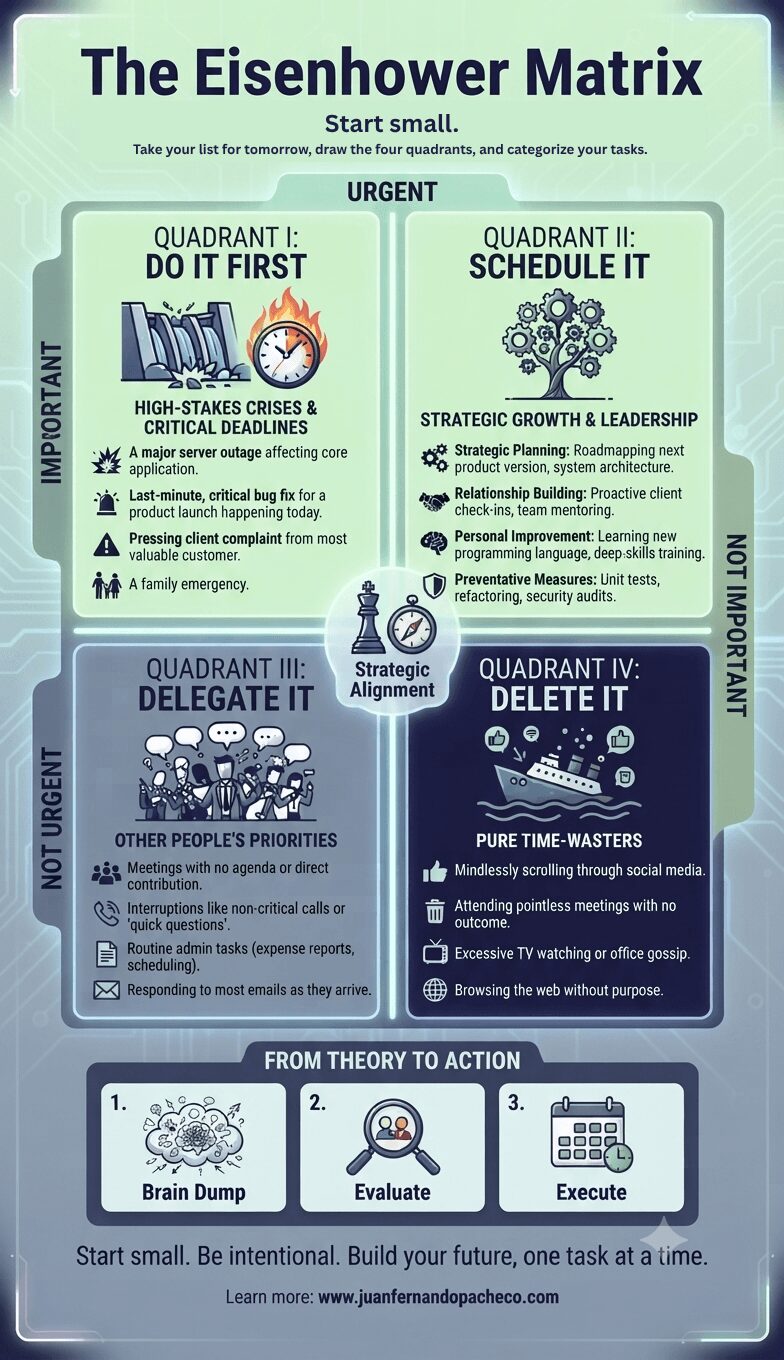
An infographic titled 'The Eisenhower Matrix' deconstructing a productivity framework. A large 2x2 grid is divided by axes labeled 'Urgent', 'Not Urgent', 'Important', and 'Not Important'. Quadrant I (Urgent/Important, top-left) is 'Do It First' with icons of a breaking dam and fire. Quadrant II (Not Urgent/Important, top-right) is 'Schedule It' with a growing tree and gears. Quadrant III (Urgent/Not Important, bottom-left) is 'Delegate It' with a group of people. Quadrant IV (Not Urgent/Not Important, bottom-right) is 'Delete It' with a sinking ship. Below the matrix, a three-step process ('Brain Dump', 'Evaluate', 'Execute') shows how to apply the method. The bottom of the image includes the URL www.juanfernandopacheco.com.

The Eisenhower Matrix is more than a productivity hack; it is a philosophy of intentional living. It teaches us to be the architects of our time rather than the tenants of other people’s urgency. By consistently asking, “Is this important?” we align our daily actions with our long-term vision.

The goal is not to achieve a perfect, static state where no emergencies exist. The goal is to cultivate the habit of discernment—to spend more of our precious time in Quadrant II, building a meaningful future, one scheduled, important task at a time.
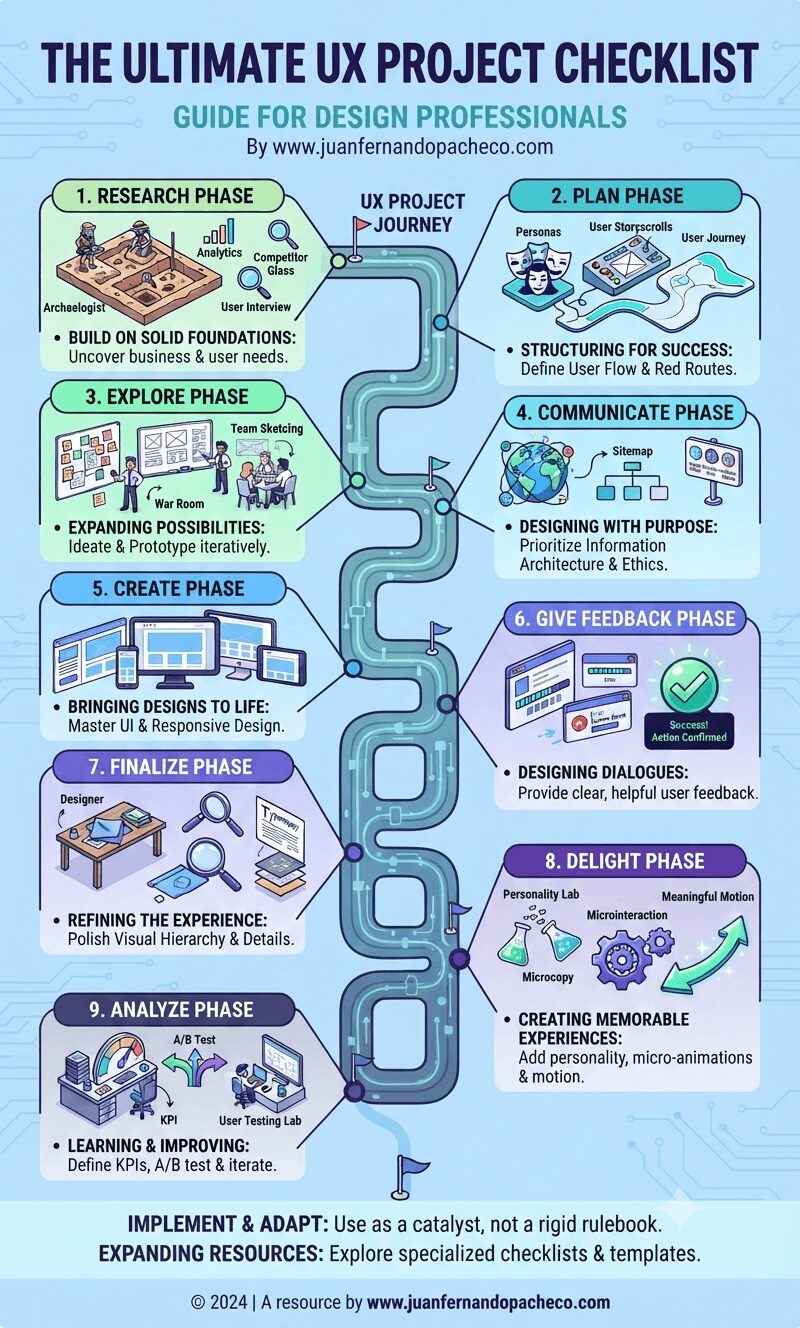
An infographic titled "The Ultimate UX Project Checklist" featuring a winding central milestone path connecting nine distinct UX phases—Research, Plan, Explore, Communicate, Create, Give Feedback, Finalize, Delight, and Analyze—against a light blue background, with brand reference www.juanfernandopacheco.com.

The UX Project Checklist represents more than just a list of tasks—it embodies a comprehensive approach to designing exceptional user experiences. As the field continues to evolve with new technologies, interaction patterns, and user expectations, this checklist should serve as a foundation rather than a final word.

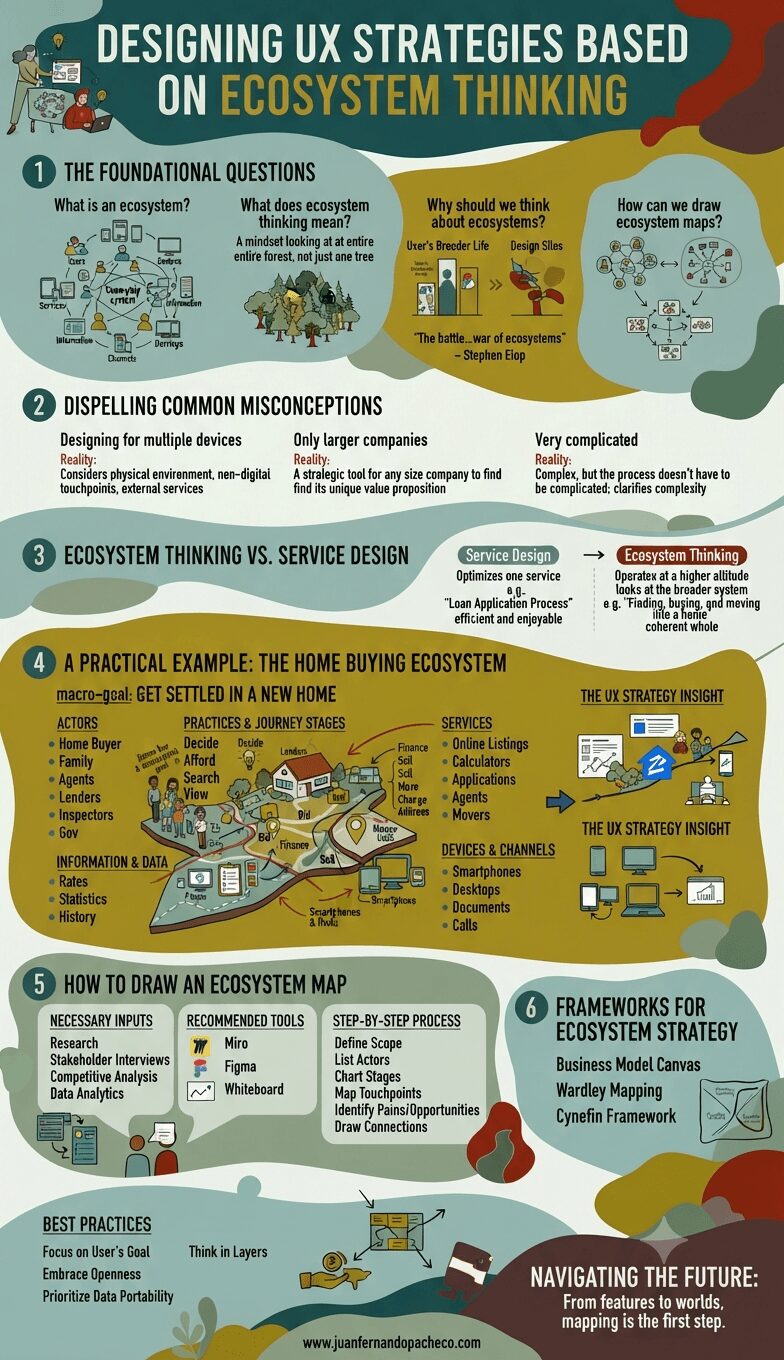
An educational infographic with a modern, illustrated aesthetic, structured into six sections with a teal and earth-tone color palette. It defines ecosystem thinking in UX design, dispels misconceptions, compares it to service design, provides a detailed home-buying example, outlines how to draw maps, lists strategic frameworks, and includes best practices and the website www.juanfernandopacheco.com.

The future of UX design is not in crafting perfect, isolated interactions. It is in designing intelligent, adaptive, and respectful nodes within a vast and complex human ecosystem. It requires us to be not just designers, but strategists, systems thinkers, and diplomats who can navigate the relationships between services, businesses, and most importantly, people.

By adopting ecosystem thinking, we move from creating products that people use to crafting environments that people live in. We stop building features and start building worlds. The map is the first step. It’s time to start charting.

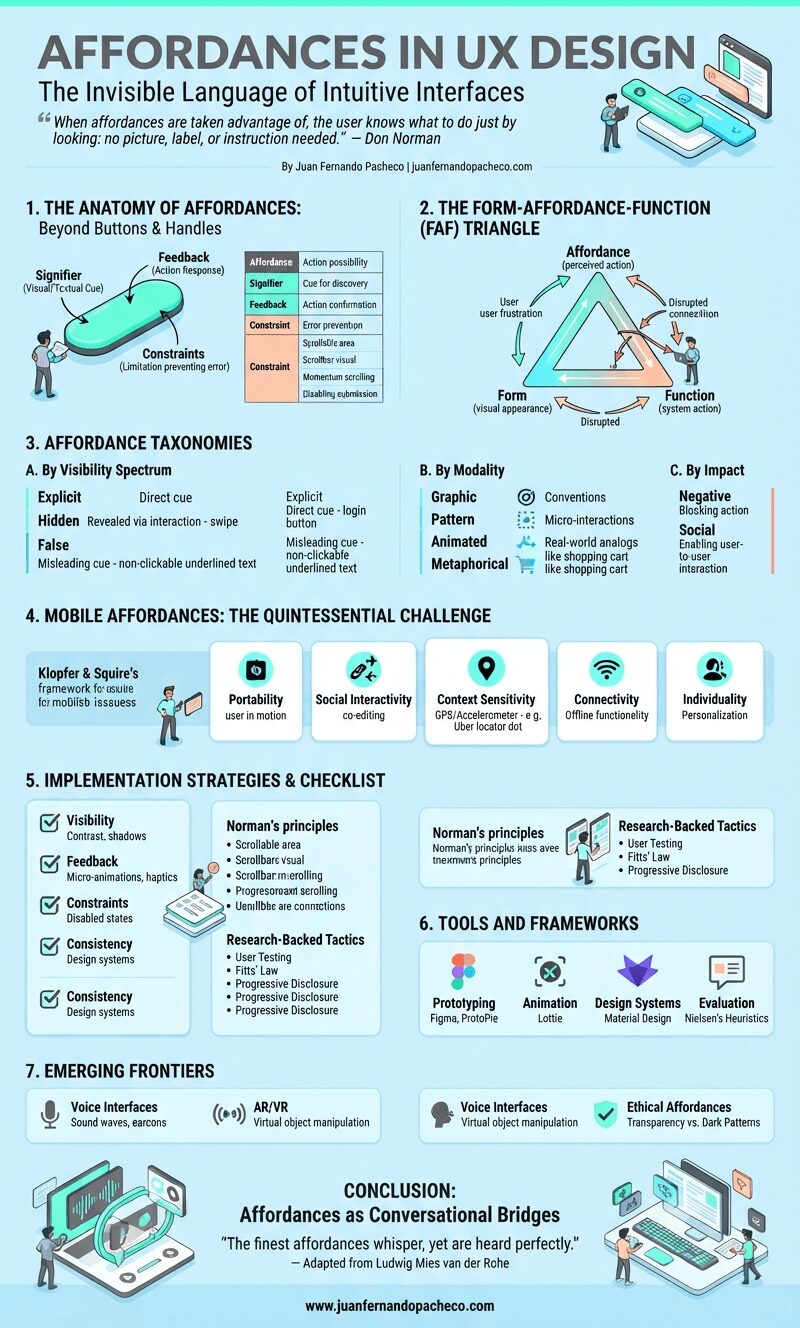
A long vertical infographic titled "Affordances in UX Design" detailing the principles, anatomy, and taxonomies of user interface elements. It features a light blue background with seven sections covering topics like the Form-Affordance-Function triangle, mobile affordances, implementation strategies, and emerging frontiers like AI and spatial computing. The infographic includes diagrams, tables, and icons referencing various design frameworks and the website juanfernandopacheco.com.

Affordances originate from James Gibson’s ecological psychology theory (1977), defining them as action possibilities latent in environments relative to an actor.

Don Norman later adapted this for design, emphasizing perceived affordances—not what an object can do, but what users believe it can do.

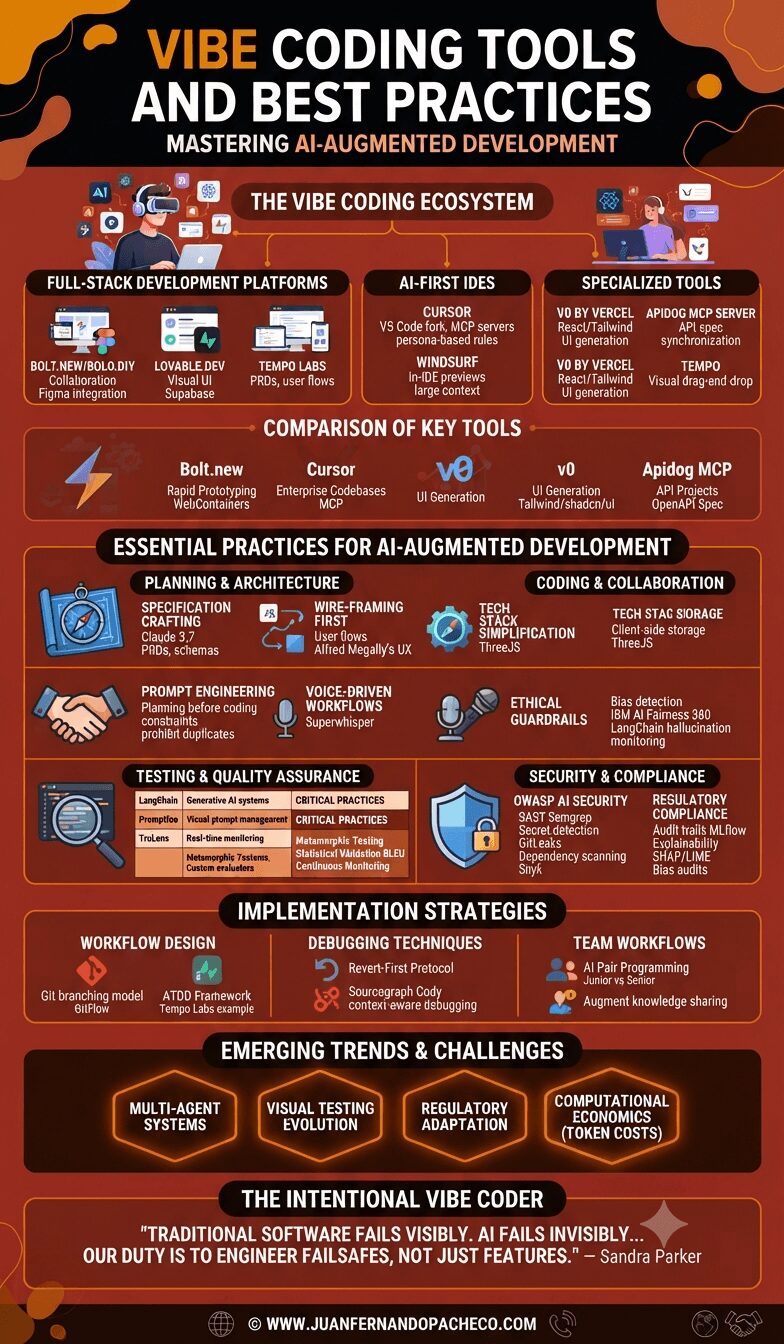
A comprehensive vertical infographic titled "Vibe Coding Tools and Best Practices" set against a dark reddish-brown background with sections detailing AI development ecosystems, tool comparisons, architectural practices, testing, security, and implementation strategies, concluding with a quote by Sandra Parker and the website WWW.JUANFERNANDOPACHECO.COM.

Vibe coding transforms natural language into functional code through AI-powered tools, creating a paradigm shift where developers prioritize intention over implementation.

Coined by Andrej Karpathy, this approach enables programmers to “vibe” with their creative flow rather than wrestle with syntax.

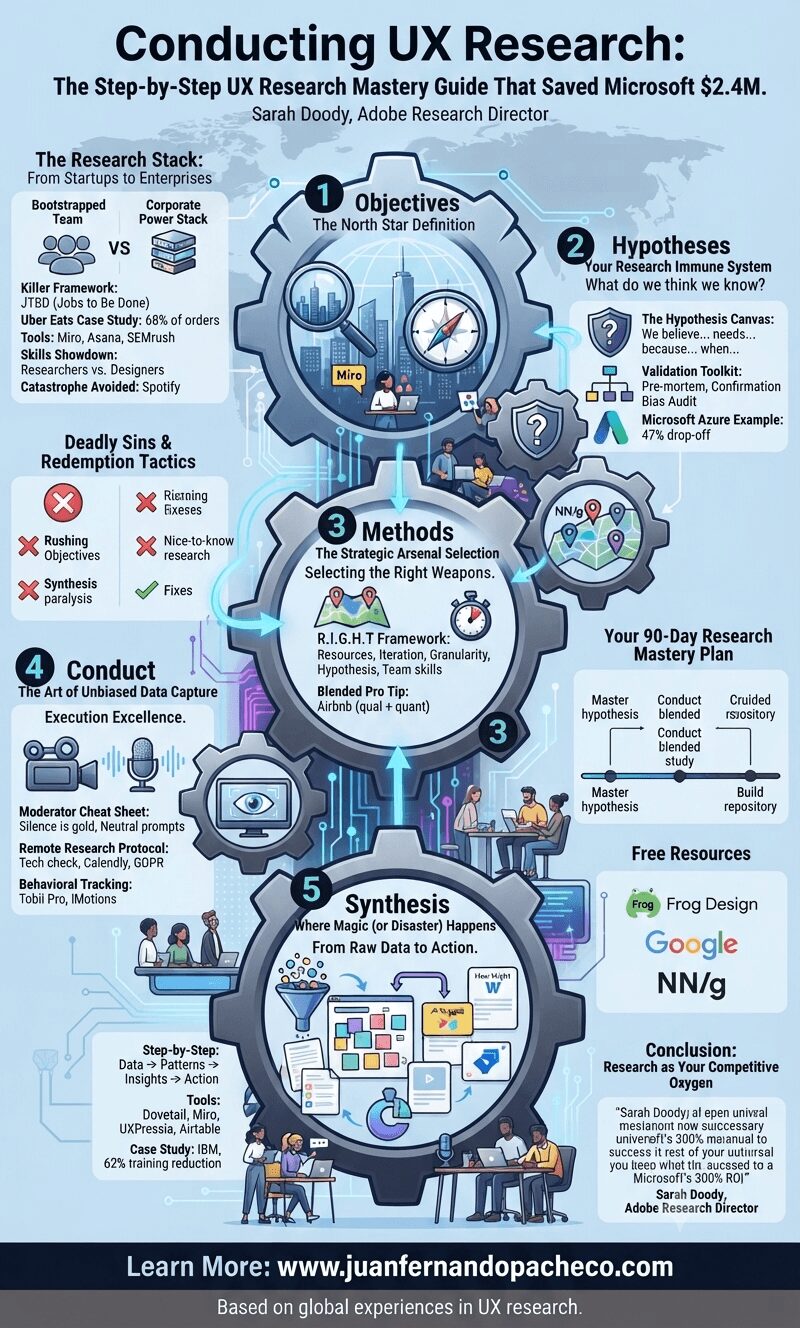
An intricate infographic with a blue and grey color scheme illustrating a five-step UX research process as a interconnected series of cogs. The title is "Conducting UX Research: The Step-by-Step UX Research Mastery Guide That Saved Microsoft $2.4M." Each cog represents a phase: 1. Objectives, 2. Hypotheses, 3. Methods, 4. Conduct, and 5. Synthesis. Detailed text within and around the cogs breaks down key frameworks (JTBD, R.I.G.H.T.), tools (Miro, Asana, Dovetail, etc.), case studies (Uber Eats, Spotify, Microsoft Azure, IBM), and skills. Additional sections include "The Research Stack," "Deadly Sins & Redemption Tactics," "Your 90-Day Research Mastery Plan," and "Free Resources." The footer displays "Learn More: www.juanfernandopacheco.com" and "Based on global experiences in UX research."

As a UX research lead, I’ve witnessed teams waste millions by skipping Step 2 (hypotheses). The Frog Design framework in your image isn’t academic theory—it’s a battle-tested survival blueprint. Let me walk you through each phase with real-world tactics you can implement tomorrow.

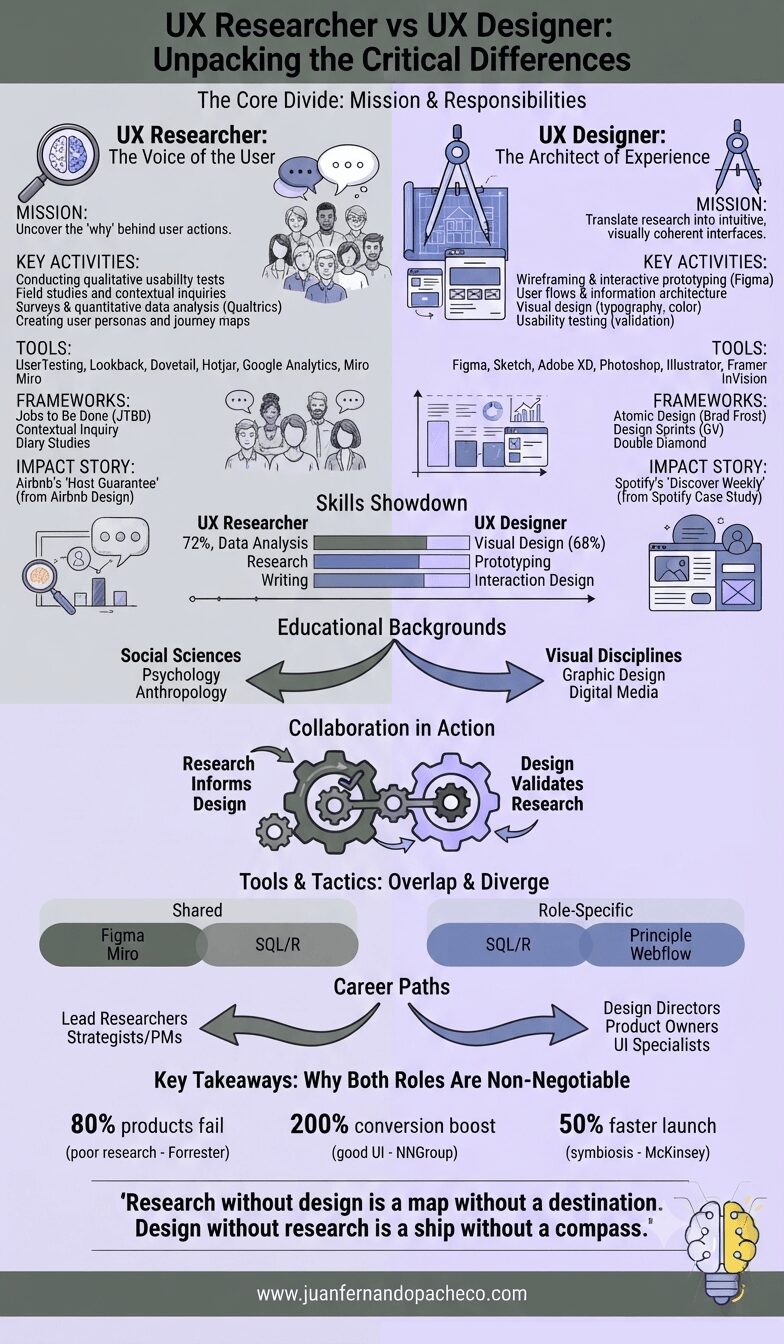
An infographic comparing UX Researchers and UX Designers, detailing their missions, key activities, tools, frameworks, skills showdown, educational backgrounds, collaboration, and career paths, styled in soft purple tones with references to www.juanfernandopacheco.com.

UX Researchers and Designers aren’t rivals—they’re co-pilots navigating the same destination: user delight. Researchers illuminate the path with data; designers pave it with ingenuity. In an era where user expectations skyrocket daily, investing in both isn’t optional—it’s existential.

“Research without design is a map without a destination. Design without research is a ship without a compass.”

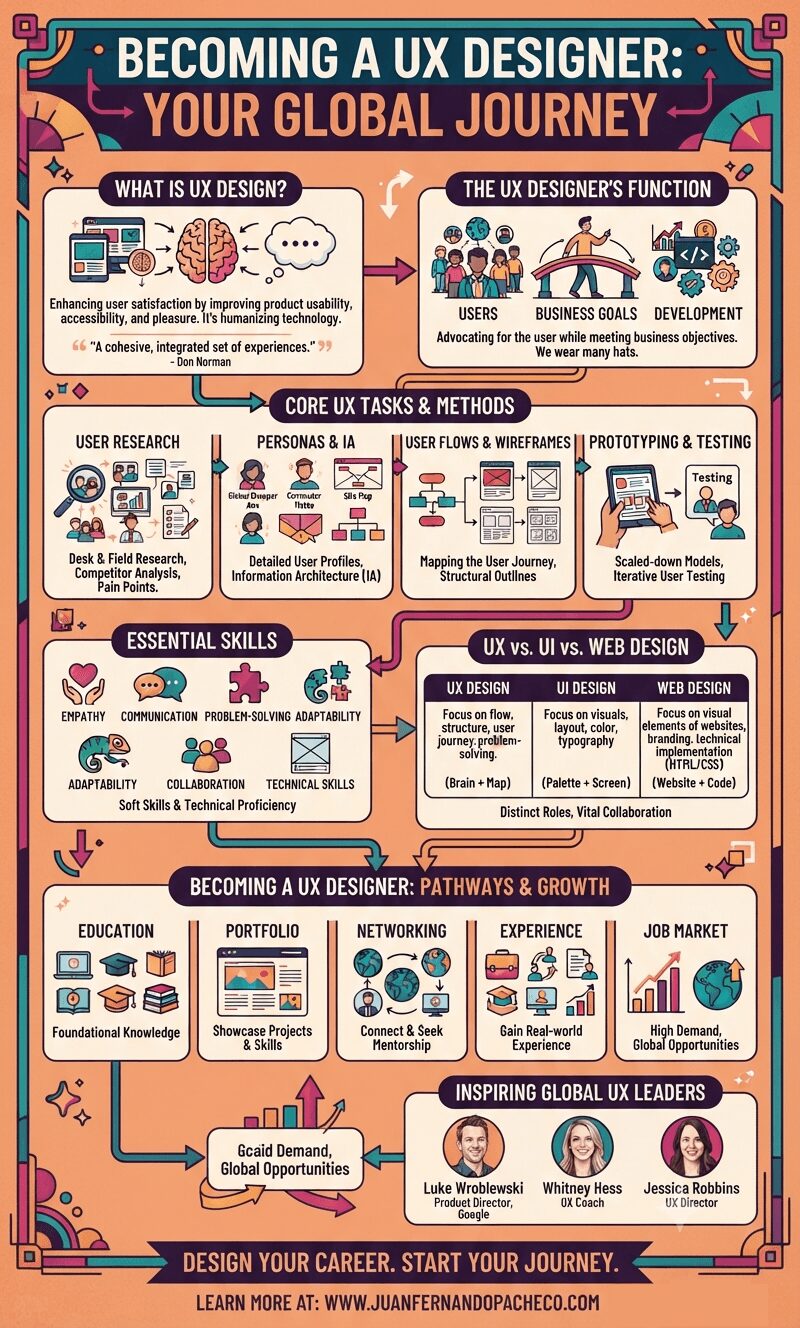
An intricate infographic titled "BECOMING A UX DESIGNER: YOUR GLOBAL JOURNEY" with a peach background. It outlines key UX concepts including definitions, the designer's function as a bridge between users and business, core methodologies (research, personas, flows, prototyping, testing), essential skills, comparisons to UI and web design, career paths (education, portfolio, networking), and features three inspiring leaders. Arrows connect the sections, and a footer directs to www.juanfernandopacheco.com.

Becoming a UX Designer: Learn User Experience Design by William N. Aldrich serves as a foundational guide for anyone looking to enter or better understand the field of User Experience (UX) design. The book aims to demystify UX design, clarifying its purpose, the responsibilities of a UX designer, and the essential skills required to succeed in this dynamic profession.