Ohmae’s 3Cs: the quiet framework that still decides who wins technology deals
Every few years our industry invents a new strategic fashion. New acronyms, new canvases, new decks. And every few years most of them fade, because they were built to describe a moment rather than a market. A small number of frameworks survive decades, not because they are sophisticated, but because they are honest about how value is created.
Ohmae’s 3Cs belong to that second group, and after more than twenty years of designing products, building offers, and leading enterprise deals across Latin America, I rely on it more than any other model I know.
Kenichi Ohmae, the Japanese organizational theorist, popularized the idea in “The Mind of the Strategist” in the early 1980s.
The claim is deceptively simple
A company does not operate in a vacuum, nor does its customer, nor does its competitor. Strategy is not a plan that starts from your own ambition. It is a balance between three forces — company, customer and competitors — and real strategy only exists where the three overlap. Miss one circle and you do not have a strategy; you have a wish, a complaint or a price war.
What the triangle actually says
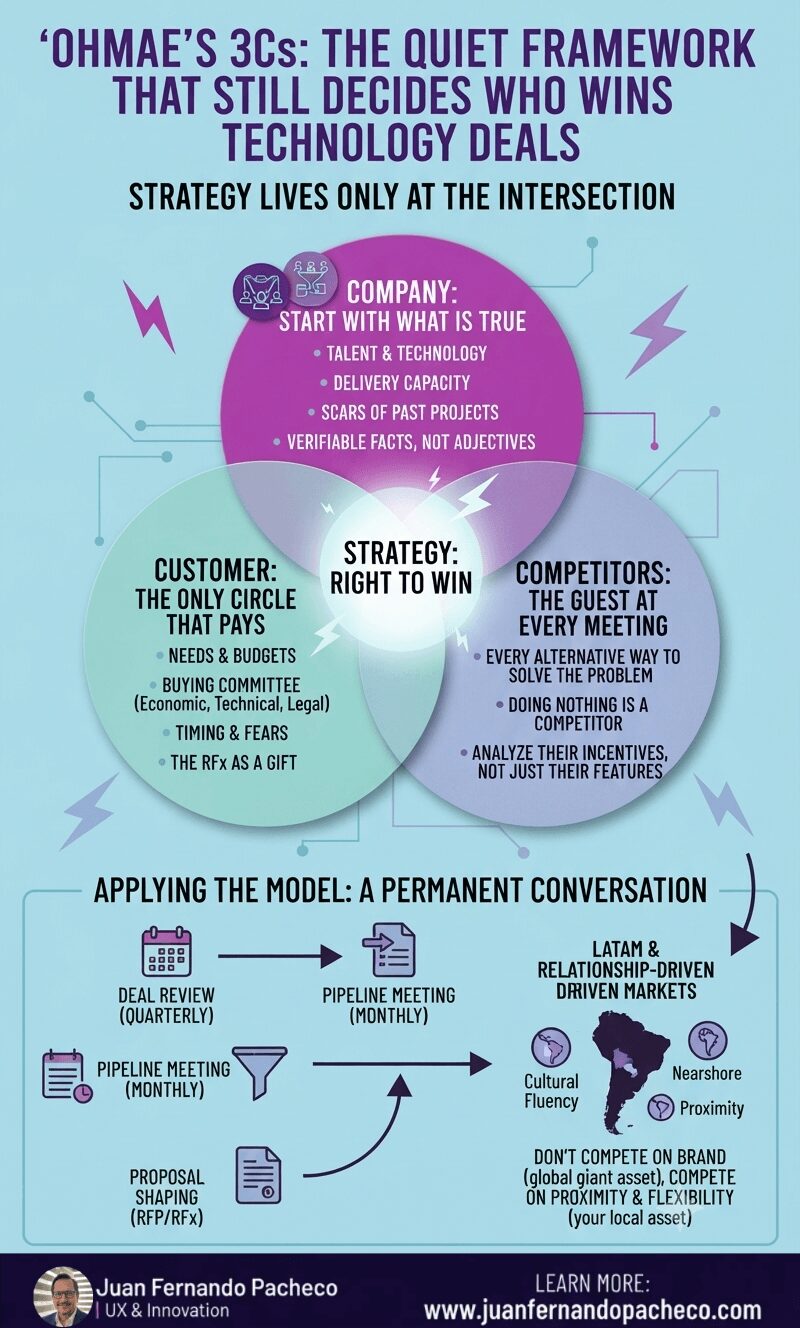
Look at the classic picture
Three circles, partially overlapping, with strategy sitting in the middle.
- The company circle is everything you bring to the table — talent, technology, delivery capacity, capital, brand, partnerships, the scars and lessons of past projects.
- The customer circle is the market as it really is, not as you would like it to be: needs, budgets, fears, politics, buying committees, timing.
- The competitors circle is the alternative: every other way the customer could solve the problem, including doing nothing.
The note that usually accompanies the diagram gives a healthy example
A business uses its R&D strength (company) to build products that meet emerging consumer preferences (customer), while studying competitors’ offers (competitors) to keep its value distinct.
The point is not the example; the point is the verb tense. All three circles are being read at the same time, continuously. Strategy, in Ohmae’s view, is not an annual event. It is a permanent conversation between what you are good at, what someone will pay for, and what someone else is offering.
That is why the model ages so well.
Technologies change, channels change, economies cycle, but the triangle does not. Whether you sell software in 1982, cloud services today, or whatever we will be selling in five years, the customer still compares you to someone, and you still have to win that comparison with capabilities you actually possess.
Company: start with what is true about you
The company circle is where most organizations lie to themselves.
We write capability decks full of adjectives — agile, innovative, world-class — and forget that the customer never reads adjectives. In enterprise technology and services, this circle is made of verifiable facts: what you delivered, for whom, at what scale, with what outcome; the engineers and architects you can staff in week one, not in quarter three; your certifications and partnerships; your financial strength to support a multi-year commitment; your ability to show up in the geographies and languages the deal requires.
In my own work scaling technology revenue across LATAM markets, the discipline of the company circle has saved deals more than once. It is tempting to bid on everything that comes out of a procurement portal, because revenue targets do not wait.
But a bid built on capabilities you do not yet have is not growth; it is a liability with a signature page. Ohmae’s first question is therefore uncomfortable and necessary: given what we truly are today, which battles can we win? The strategic answer is usually a shorter list than the commercial instinct wants, and that shorter list is where margin lives.
Customer: the only circle that pays
The customer circle is the most written about, and the least listened to.
Most companies say they are customer-centric; few can describe how their next largest prospect actually decides. In enterprise deals, the customer is never one person. It is a committee with conflicting incentives: an economic buyer who owns the budget, technical evaluators who own the risk, end users who own the adoption, legal and procurement who own the contract. Each of them reads your offer through a different lens, and each of them compares you to a different alternative.
This is why I treat a well-written RFx as a gift
It is the customer’s voice, formalized. The evaluation criteria, the weighting, the mandatory requirements, the questions asked during clarification rounds — all of it tells you what the customer circle actually values, beyond the polite language of the introduction.
Read between the lines, and you can often see which competitor the customer fears, which past failure still hurts, and which stakeholder is driving the process. A strategist reads an RFx the way a sailor reads the water: not for what it says, but for what it reveals.
And because the model is evergreen, the habit transfers to any era: interview users, sit in on negotiations, read the transcripts of lost deals. The customer circle is a living system of people solving a problem under constraints, and your job is to know those constraints better than the people selling against you.
Competitors: the guest at every meeting
The third circle is the one executives most often neglect or exaggerate.
Neglect looks like ignoring the competition: proposing as if you were alone in the room, pricing as if no alternative existed. Exaggeration looks like obsession: copying the competitor’s features, discounting against their list price, letting their roadmap set your agenda. Ohmae’s point is that the competitor is a structural part of your strategy, whether you like it or not. The customer will always ask, consciously or in a scoring sheet, “why not the other guy?”
Useful competitor intelligence is therefore not a wall of logos.
It is a small number of sharp answers: who is likely on this shortlist? What does their business model force them to do — defend margin, buy share, protect an installed base? Where are they genuinely strong, and where is their offer only a brochure? What story will they tell about us, and what evidence makes that story collapse? When you understand a competitor’s incentives, their moves stop being surprises and start being predictions.
Strategy lives only in the intersection
Here is the part the diagram captures with a single arrow
Strategy is not the sum of three analyses; it is the intersection. You can have three excellent memos — one about your capabilities, one about the market, one about the competition — and still have no strategy, because nobody asked the connecting question: given what this customer needs and what that competitor offers, what can we do that is distinctly ours, and provable?
Imbalance always punishes.
A company-only strategy produces engineering ego: brilliant products nobody asked for, roadmaps searching for a problem. A customer-only strategy produces servitude: endless customization, discounts that eat the margin, a portfolio that looks like a list of client complaints. A competitor-only strategy produces imitation: me-too features, price wars, a race to the bottom where the customer wins once and everyone loses forever. The triangle is a warning against all three temptations, and that is why it reads the same in any decade.
Running an RFx through the triangle
Because much of my work is high-stakes RFx execution, let me be concrete about how the model operates inside a live bid. Before we commit resources, the triangle becomes a bid/no-bid gate.
- Company: do we have the right to play — real capability, capacity, references?
- Customer: is the need and budget real, did we engage before the document was published, or are we being used as a price anchor to pressure someone else’s deal?
- Competitors: on the likely shortlist, do we have a credible path to win, or are we donating effort to a process designed to crown an incumbent?
If the deal passes the gate, the triangle shapes the response.
- The customer circle sets the structure: mirror their evaluation criteria, answer questions in the order asked, make scoring easy for a tired evaluator.
- The company circle sets the proof: every claim backed by evidence — case studies, named teams, measurable outcomes — because in a formal tender an unproven claim scores zero.
- The competitors circle sets the contrast: you do not need to name the rival to reframe the decision around the dimensions where you win.
A good proposal quietly changes the question from “who is cheaper?” to “who removes my risk?” — and that reframing is strategy, not decoration.
Pricing follows the same logic.
A price built only from your costs ignores the customer’s value and the competitor’s alternative. A price built only from the competitor’s guess ignites a war. The triangle asks for a number that the customer can defend internally, the competitor cannot easily match, and your own P&L can survive. Three constraints, one number. That is the intersection again.
The triangle in LATAM and other relationship-driven markets
I have applied this model across Mexico, Colombia, Ecuador, and other markets in the region, and the honest observation is this: the triangle does not change, but the inputs do.
In relationship-driven economies
- The customer circle includes trust accumulated over years, personal reputation, and the ability to support a client in their own language and time zone.
- The competitors circle is a mix of global giants and nimble local boutiques, each with a different cost base and a different definition of victory.
- The company circle prizes proximity: nearshore talent, cultural fluency, the resilience to price in volatile currencies and still keep the commitment.
There is also a truth specific to our region that Ohmae would recognize immediately
Competing head-on with a global vendor on brand is a company-circle mistake, because brand is their asset, not yours. The winning move is usually an intersection move — using proximity and flexibility (company) to de-risk adoption for a customer who has been burned before (customer), in segments where the global player is too rigid or too expensive to respond (competitors). That sentence is the entire model in one breath, and it works as well in Bogotá or Mexico City as it does in Tokyo or Frankfurt.
A simple habit to keep the model alive
Frameworks die when they live only in kickoff decks.
To keep Ohmae’s 3Cs alive, I use a small habit that costs nothing: in every deal review, every pipeline meeting, every quarterly planning session, ask three questions in the same order.
- What has changed in the customer’s world since we last spoke?
- What has changed in the competitor’s behavior?
- What has changed in our own capabilities? Then ask the fourth, connecting question:
- What does that mean for our point of difference?
Write the answers down. Compare them quarter over quarter. Strategy reveals itself in the deltas, not in the declarations.
Why it will still work in five years
This post is meant to age well, so let me say plainly why the model will outlive whatever comes next. Ohmae’s 3Cs do not depend on a particular technology, channel, or macroeconomic cycle.
They depend on three permanent facts of commercial life: resources are limited, customers compare, and value is relative. As long as those facts hold, the triangle holds. New tools will change how we gather intelligence about each circle — better data, better analytics — but no tool will remove the need to choose, and choosing with balance is exactly what the triangle enforces.
Conclusion: strategy as a discipline of balance
After two decades moving between product design, user experience, and business development, I see the same pattern everywhere: teams fail not because they lack intelligence, but because they look at only one circle.
- Designers fall in love with the user and ignore the business.
- Sellers fall in love with the quota and ignore the customer.
- Executives fall in love with the org chart and ignore the market.
Ohmae’s 3Cs remain useful because they force the whole picture into one simple question, every single time: company, customer, competitors — where do we actually overlap?
When the answer is clear, the deal feels almost easy.
When the answer is fuzzy, no amount of effort will fix it. That is the quiet power of the old triangle: it does not tell you what to do. It tells you whether you have the right to win. And knowing that difference, before you spend a quarter chasing the wrong deal, is worth more than any forecast.