Porter’s five forces analysis: a practical guide for technology deals in Latin America
Every deal I have been part of, from a small software engagement to a multi-year banking contract worth millions of dollars, was shaped by five invisible pressures. Sometimes the client held all the cards and negotiated every penalty clause line by line. Sometimes a shortage of specialized engineers gave our own suppliers the upper hand. And sometimes a substitute nobody took seriously, like the client deciding to build in-house, quietly killed the opportunity months before the proposal was even submitted.
For most of my career, I learned to read those pressures by instinct, deal by deal, loss by loss.
Then I realized Michael Porter had already given us a disciplined way to see them in advance. His five forces model, first published in 1979, is still one of the most practical strategy tools ever created, not because it is sophisticated, but because it forces you to look beyond the competitors you can name and examine the entire structure of the market you fight in.
This post is written to be useful today and beyond. The forces never change; only the names of the players do.
What the model actually measures
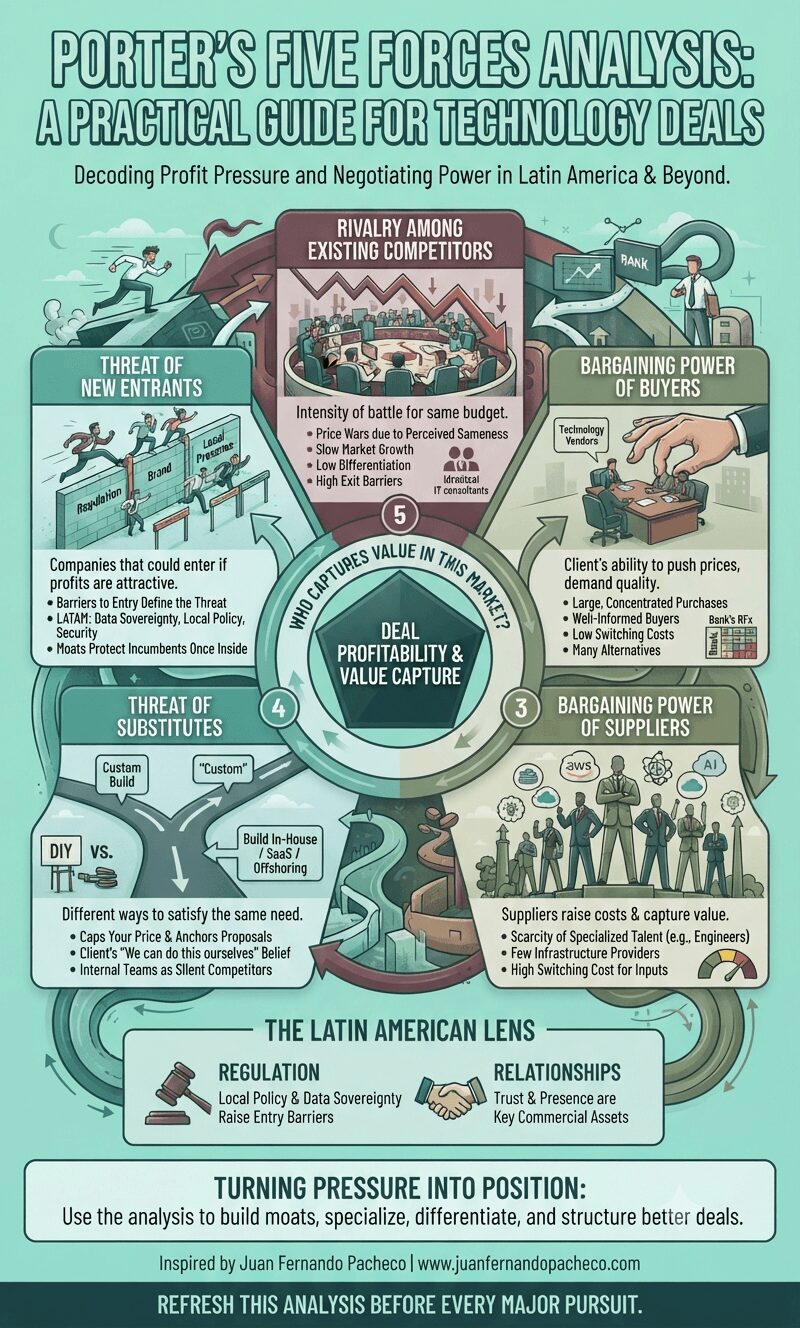
A common mistake is treating Porter’s five forces analysis as a map of competitors. It is not. It is a map of profit pressure and negotiating power.
The model examines five sources of pressure:
- Rivalry among existing competitors,
- The bargaining power of buyers,
- The bargaining power of suppliers,
- The threat of substitutes, and
- The threat of new entrants.
Together they answer one question: who captures the value in this market? When the forces are weak, companies keep profit and set the terms. When the forces are strong, value leaks away to clients, suppliers, newcomers, or alternatives.
This is why the model matters so much in enterprise technology. In our industry, a deal rarely fails because the solution was bad. It fails because one of the five forces was stronger than we assumed, and we priced, positioned, or negotiated as if it did not exist.
The five forces, in plain language
Rivalry among existing competitors
This is the force most people mean when they say competition: the intensity with which current players fight for the same budget. Rivalry turns destructive when many companies offer similar promises, when market growth slows, when differentiation is low, and when exit barriers are high, so companies stay and fight on price.
In IT services, rivalry is what converts a technical conversation into a price war. If three consultancies present equivalent teams, equivalent methodologies and equivalent stacks, the client has no rational reason to pay a premium. The pressure was never about quality; it was about perceived sameness.
Bargaining power of buyers
Buyer power is the client’s ability to push prices down, demand higher quality, and play competitors against each other. It grows when the purchase is large and concentrated, when the buyer is well informed, when switching costs are low, and when many qualified alternatives exist.
Anyone who has responded to a bank’s RFP knows this force intimately. A large financial institution running a structured RFx with a scoring matrix, a legal team and six qualified bidders holds enormous power. It negotiates uptime commitments, response times, penalties, data sovereignty clauses and audit rights. Buyer power is not a defect of the market; it is the natural result of concentration and transparency.
Bargaining power of suppliers
Suppliers push in the opposite direction: they raise your costs and capture part of the value you create. Supplier power grows when inputs are scarce, specialized, or expensive to switch.
In technology, the classic supplier is talent. When a project depends on a handful of engineers with a rare certification or a rare language combination, those people, and the firms that employ them, hold the power. Infrastructure concentrates power too: a market served by few cloud or licensing providers inherits their pricing discipline whether it likes it or not.
Threat of substitutes
A substitute is not a competitor; it is a different way of satisfying the same need. In our industry, the substitutes include building in-house, buying a SaaS product instead of a custom build, offshoring to another region, or simply leaving the process manual for another year.
Substitutes matter because they cap your price. A client may never mention the internal team that could take over the project, but that team silently anchors every number you propose. Many deals are not lost to a competitor; they are lost to the client’s belief that “we can do this ourselves”.
Threat of new entrants
New entrants are companies that are not in your market today but could join tomorrow if profits look attractive. The threat depends on barriers to entry: capital, brand, access to channels, certifications, regulation, and local presence.
In Latin America, these barriers are real and often underestimated. Data sovereignty rules, local policy, security requirements and the expectation of a local delivery presence keep many global players at the edge of the market. The same barriers that frustrate you as a seller protect you once you are inside.
How to run the analysis without turning it into bureaucracy
The model dies when it becomes a workshop artifact. To keep it useful, run it light and run it often.
- First, define the market precisely. “IT services in Latin America” is not a market; it is a continent. “Core banking integration for mid-size banks in the Andean region” is a market. The forces change completely with the boundary you draw.
- Second, list the players behind each force, not only the direct competitors. Name the buyers, the suppliers, the substitutes, and the plausible entrants.
- Third, rate each force as low, medium, or high, and force yourself to provide evidence: win-and-loss interviews, price movement across recent deals, salary inflation for key roles, and the number of bidders invited to recent RFx processes.
- Fourth, identify the dominant force. In most markets, one force sets the economics. Find yours, because that is where your strategy must work hardest.
- Fifth, decide what you will change. Either reposition within the market, through differentiation, switching costs, specialization, or partnerships, or choose a different market where the forces are kinder.
Finally, put the analysis on a rhythm. Refresh it before every major pursuit and at least once a quarter. A five forces analysis is a compass, not a photograph.
Reading the five forces inside an RFx
This is where the model becomes personal for me.
A well-designed RFx document is the five forces made visible, and learning to read it that way changes how you respond.
The number of invited bidders and the scoring weights show you rivalry. If six vendors are invited and price carries half the weight, you are in a price war before you write a single line.
The compliance matrix, the required certifications, the local presence clauses and the data sovereignty requirements show you the barriers to entry, and more importantly, they show you who has been kept out of the room. Every requirement your team meets that your rivals struggle with is a small moat.
The evaluation of alternatives shows you substitute pressure.
When the client compares your proposal against an internal build plan, your real opponent is the client’s own optimism about cost and time. Sell against that optimism with evidence: total cost of ownership, time to market, and the hidden cost of maintaining a custom platform alone.
The SLA draft, the penalty clauses and the audit rights show you buyer power.
Do not fight it; reshape it. Buyer power shrinks when the client perceives switching risk. A proven track record, references from similar institutions, a clear transition plan and a team the client already trusts all reduce the sense that you are interchangeable.
And when your response depends on scarce talent or scarce partners, you feel supplier power inside the deal. Answer it with bench depth, with alliances, and with delivery models that do not depend on a single irreplaceable person.
Read this way, your proposal stops being a feature list and becomes a strategy.
The win themes you choose, the differentiators you highlight, and the risks you volunteer to own should each answer one of the five forces.
A Latin American lens
The model is universal, but its intensity is local. In Latin America, two ingredients shift the forces more than most outsiders expect: regulation and relationships.
Regulation moves several forces at once.
Data sovereignty and local policy raise entry barriers, protect incumbents, and increase the value of compliance capability. In countries where the regulator expects local infrastructure and local accountability, a certified local delivery operation is not an expense; it is a position of strength.
Relationships move buyer power.
In many markets of the region, decisions concentrate in small circles of executives and board members, and trust is built face to face over years, not through a portal. A vendor with deep, long-standing stakeholder relationships faces a different buyer than a vendor who appears for the first time at the RFP deadline. Presence, continuity and reputation are commercial assets in this region, not soft skills.
Currency and distance also matter, and they cut both ways: they discourage entrants, and they raise supplier costs. The leaders in this market design their delivery footprint so the forces work for them: local presence where regulation demands it, regional hubs where scale matters, and global alliances where talent gets scarce.
Mistakes that make the model useless
After applying this model for years, I keep seeing the same failure patterns.
- First is analyzing at the wrong level, for the whole company instead of a specific market. The forces are different in retail banking than in telecom; averaging them produces fiction.
- Second is confusing substitutes with competitors. A competitor fights you for the deal; a substitute removes the deal. They require different answers.
- Third is scoring without evidence, turning the model into an opinion poll. If “high buyer power” is not backed by what recent deals actually showed, it is decoration.
- Fourth is treating the output as a document instead of a decision. The analysis is only worth the choices it forces: where to differentiate, what to stop offering, which client segments to leave, which capabilities to build.
Turning pressure into position
Strategy, in the end, is the art of choosing where to absorb pressure and where to create it.
Where buyer power is high, reduce perceived interchangeability
Specialize, quantify risk mitigation, and sign the SLAs others will not sign. Where rivalry is intense, refuse to compete on the same table; move the conversation to outcomes, speed, and adoption. Where substitutes loom, compete on time and total cost, not on sticker price. Where suppliers hold power, build benches, partnerships and delivery models that dilute dependence. Where entrants approach, strengthen the barriers you control: certifications, local presence, references and trust.
None of this expires. Players rotate, technologies rotate, currencies rotate; the pressures remain. That is exactly why a model published in 1979 still reads as if it were written this morning.
The takeaway
Before your next deal, take one hour with your team and ask the five questions.
- Who fights us today,
- who buys,
- who supplies,
- what replaces us, and
- who is knocking at the door?
The answers will not fit on a slide, but they will fit in a better proposal, a better negotiation, and a better margin.
That is the quiet power of Porter’s five forces analysis: it does not predict the future. It simply stops you from being surprised by it.