Why most AI banking initiatives fail to scale
After two decades of working with enterprise technology deals across Latin America, I’ve seen countless digital transformation initiatives stall after the pilot phase. The pattern is remarkably consistent: organizations invest heavily in proofs-of-concept, demonstrate promising results in controlled environments, and then hit an invisible wall when trying to scale across the enterprise.
The banking sector is particularly vulnerable to this trap.
Financial institutions are under immense pressure to modernize, compete with fintech challengers, and meet evolving customer expectations. Yet many are approaching AI transformation as a technology problem rather than an architectural and organizational challenge.
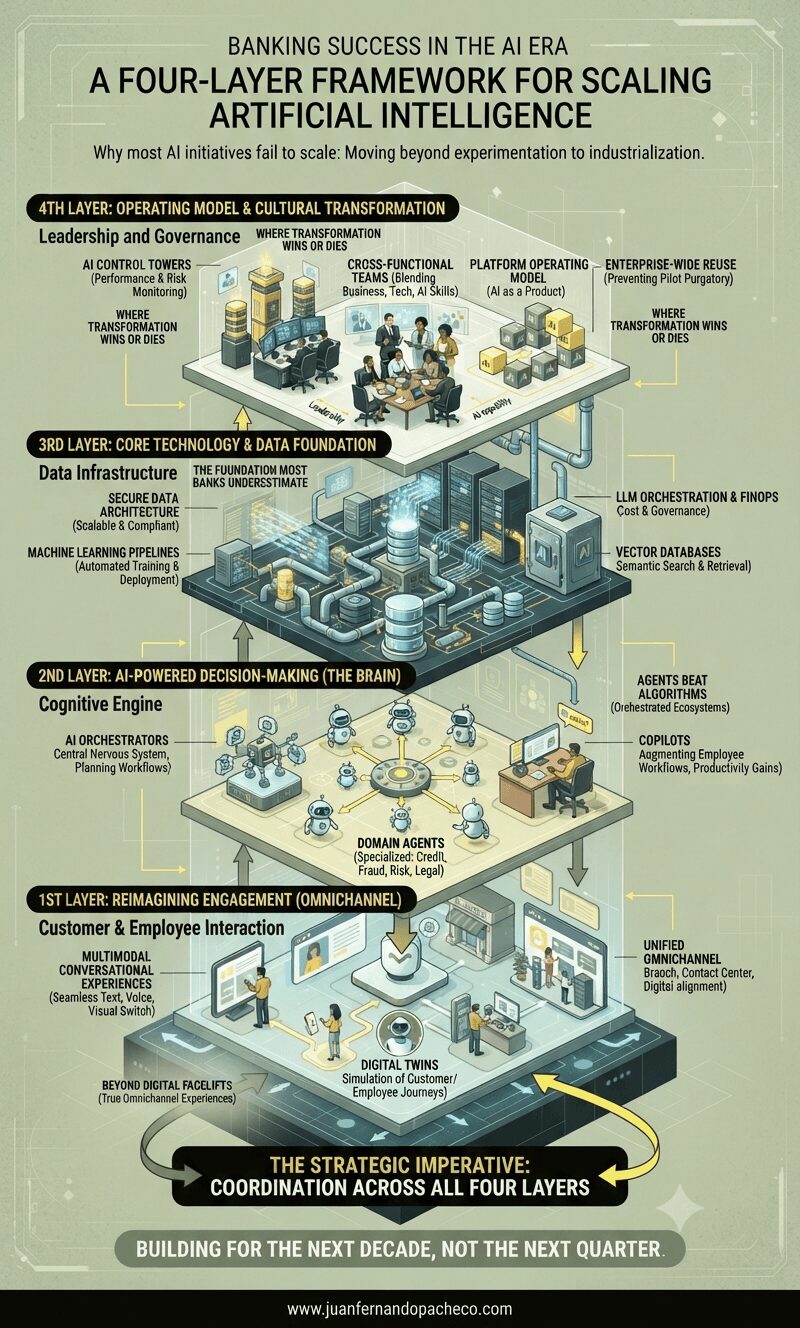
The framework I’m sharing today—based on emerging best practices from leading institutions—reveals why isolated AI projects fail and what separates banks that merely experiment from those that truly transform. This isn’t about the latest machine learning algorithm or chatbot feature. It’s about building a coherent, four-layer architecture that industrializes artificial intelligence across the entire organization.
Whether you’re reading this in 2026 or 2029, these principles will remain relevant because they address fundamental questions of how enterprises organize technology, data, and human capital to create sustainable competitive advantage.
1st layer: reimagining engagement beyond digital facelifts
The top layer of the AI bank architecture focuses on engagement—how customers and employees interact with the institution. But let me be clear:
This isn’t about slapping a chatbot on your existing mobile app or adding voice recognition to your call center. That’s cosmetic change, not transformation.
Leading institutions are fundamentally reimagining the user experience across all touchpoints. This means creating truly multimodal conversational experiences where customers can seamlessly switch between text, voice, and visual interactions without losing context.
Imagine a customer starting a mortgage application via chat on their phone, continuing with a voice call while commuting, and finishing with document upload through image recognition—all within a single, coherent journey.
The omnichannel imperative extends beyond customer-facing channels.
Branches, contact centers, and relationship managers need access to the same intelligent products and services, creating consistent experiences regardless of how the customer chooses to engage. This requires breaking down the silos that traditionally separate digital channels from physical branches and back-office operations.
Perhaps most importantly, this layer leverages digital twins—simulations of customer behavior and employee workflows—to test and refine experiences before deployment. This isn’t science fiction; it’s a practical approach to reducing implementation risk and ensuring that new capabilities actually deliver value.
From a commercial perspective, the engagement layer is where technology investments become visible to customers and directly impact revenue. But without the layers beneath it, this is just an expensive user interface with limited intelligence.
2nd layer: the brain of the operation—or why agents beat algorithms
This is where the real transformation happens. The AI-powered decision-making layer represents a fundamental shift from traditional predictive models to orchestrated agent ecosystems. And this distinction matters enormously for enterprise leaders evaluating technology investments.
Traditional banking technology relies on predictive analytics models—credit scoring algorithms, fraud detection systems, customer churn predictors. These are valuable tools, but they operate in isolation and require significant human intervention to translate insights into action.
The next generation of AI banking replaces this fragmented approach with three interconnected components
- AI orchestrators act as the central nervous system, planning complex workflows, reasoning across multiple objectives, and delegating tasks to specialized agents. Think of them as intelligent project managers that coordinate entire business processes rather than just analyzing data points.
- Domain agents specialize in specific areas like credit policy evaluation, fraud pattern recognition, risk assessment, or legal compliance. Unlike monolithic AI models, these agents can be developed, tested, and improved independently while contributing to broader organizational objectives.
- Copilots embed directly into employee workflows, providing real-time guidance, automating routine decisions, and surfacing relevant information at the point of action. This is where the reported 20 to 60 percent productivity gains materialize—not from replacing humans, but from augmenting their capabilities.
For business development professionals and technology leaders negotiating enterprise deals, this architecture has profound implications. It shifts the conversation from buying point solutions to building platforms. It changes procurement from one-time software purchases to ongoing partnerships with technology providers who can support agent ecosystems.
In Latin American markets, where I’ve spent much of my career, this layer is particularly critical. The region’s banking penetration varies dramatically across countries and demographics. AI-powered decision-making enables institutions to serve previously unprofitable customer segments by reducing the cost of credit evaluation, fraud prevention, and customer service to sustainable levels.
3rd layer: the foundation most banks underestimate
Here’s an uncomfortable truth: most financial institutions are trying to build AI capabilities on infrastructure designed for a different era. The core technology and data layer is where transformation dreams go to die, not because leaders don’t recognize its importance, but because the work is unglamorous, expensive, and takes years to show results.
Yet without this foundation, nothing scales.
You can have the most sophisticated AI agents and the most beautiful user interfaces, but if your data architecture can’t support real-time processing, if your APIs create bottlenecks, or if your security protocols can’t adapt to AI-specific threats, the entire system collapses under production load.
This layer includes several critical components that deserve attention
- Vector databases enable the semantic search and retrieval capabilities that make generative AI useful in enterprise contexts. Unlike traditional databases optimized for exact matches, vector databases understand conceptual similarity, allowing systems to retrieve relevant information even when queries don’t match stored data exactly.
- LLM orchestration and FinOps practices ensure that large language models are deployed efficiently, cost-effectively, and with appropriate governance. As AI usage scales, the computational costs can explode without proper management frameworks.
- Machine learning pipelines automate the process of training, testing, deploying, and monitoring models. This operational discipline separates experimental projects from production systems that deliver consistent value.
- Secure data architecture and API infrastructure create the plumbing that makes data accessible to AI systems while maintaining the security and compliance standards that banking demands.
The strategic insight here is that this layer must be designed for reuse and composability.
Every bank will have data ingestion and preprocessing capabilities. The question is whether these are built as one-off solutions for specific use cases or as shared services that accelerate future initiatives.
In my experience negotiating complex RFx processes across Latin America, vendors who understand this architectural imperative have a significant advantage. They’re not just selling software; they’re offering to become long-term technology partners who can evolve with the institution’s needs.
4th layer: where transformation wins or dies
The operating model layer is the most overlooked and most critical component of AI bank transformation. You can have world-class technology, brilliant data architecture, and innovative engagement designs, but if your organization isn’t structured to leverage these capabilities, you’re running a very expensive experiment.
This layer addresses the hard organizational questions that technology vendors often gloss over in sales presentations
AI control towers provide visibility into AI performance across the enterprise, tracking value realization, monitoring for bias or drift, and enforcing guardrails. Without central coordination, different business units will duplicate efforts, create conflicting models, and miss opportunities for reuse.
Cross-functional teams that blend business expertise, technical skills, and AI capabilities are essential for translating technological potential into business outcomes. Traditional organizational structures with separate IT departments and business units create handoff delays and misaligned incentives.
Platform operating models enable speed and alignment by treating AI capabilities as products with clear ownership, roadmaps, and customer (internal business unit) relationships. This is a fundamental shift from project-based delivery to product-based thinking.
Enterprise-wide reuse of AI capabilities prevents the “pilot purgatory” that traps so many institutions. When every business unit builds its own customer segmentation model or fraud detection system, you’re not transforming—you’re fragmenting.
From a commercial and deal leadership perspective
This layer has profound implications for how banks evaluate technology partners. You’re not just buying software; you’re entering into organizational transformation partnerships that will reshape how work gets done.
In Latin American markets, where organizational hierarchies can be more rigid and change management more challenging, this layer requires particular attention. Cultural transformation often takes longer than technology implementation, and leaders must plan accordingly.
The strategic imperative: coordination across all four layers
Here’s what separates banks that win from those that merely participate in the AI era: full-stack coordination. The four layers I’ve described don’t operate independently. They’re deeply interconnected, and value emerges from their interaction.
An elegant engagement layer is useless without intelligent decision-making capabilities. Sophisticated AI agents can’t function without robust data infrastructure. And even perfect technology fails if the organization isn’t structured to leverage it.
This is why I emphasize to my clients across Latin America that AI transformation is not a technology procurement exercise. It’s a strategic reimagining of how the bank creates value for customers, empowers employees, and competes in the market.
The banks that will dominate the next decade aren’t necessarily those with the biggest technology budgets or the most impressive pilot projects. They’re the institutions that approach AI as an architectural challenge requiring coordinated investment across all four layers, sustained over years rather than quarters.
Implications for enterprise technology deals in LATAM and beyond
For business development leaders, technology vendors, and procurement teams, this framework changes the conversation. When evaluating AI banking solutions, the questions shift from “what features does this provide?” to “how does this fit into our four-layer architecture?”
Vendors offering point solutions must demonstrate how their capabilities integrate across layers. Platform providers must show how they support organizational transformation, not just technology deployment. And banks must develop the internal expertise to architect coherent systems rather than assemble disconnected tools.
In Latin American markets specifically, this architectural approach enables institutions to leapfrog legacy constraints. Rather than trying to modernize decades-old systems incrementally, forward-thinking banks are building parallel AI-native architectures that can eventually replace or coexist with legacy infrastructure.
Moving from experimentation to industrialization
The future belongs to banks that industrialize AI capabilities rather than merely experiment with them. Industrialization means repeatability, scalability, governance, and continuous improvement. It means treating AI as core infrastructure rather than innovation theater.
This requires discipline. It requires saying no to shiny objects that don’t fit the architecture. It requires investing in unglamorous foundation work before chasing visible engagement features. And it requires patience, as the full value of coordinated four-layer transformation may take years to materialize.
But for institutions willing to do this work, the competitive advantages are substantial: faster time-to-market for new products, more personalized customer experiences, more efficient operations, and more empowered employees.
Conclusion: building for the next decade, not the next quarter
As you evaluate your institution’s AI transformation journey, I encourage you to use this four-layer framework as a diagnostic tool. Where are you strong? Where are you weak? Are you investing proportionally across all layers, or over-indexing on visible engagement features while neglecting foundational infrastructure?
The banks that win won’t be those with the most impressive demos or the longest feature lists. They’ll be those that build coherent, integrated architectures capable of continuous evolution as technology and customer expectations change.
This is the work of transformation.
It’s harder than running pilots. It takes longer than quarterly planning cycles. But it’s the only path to sustainable competitive advantage in an AI-first banking world.
Whether you’re a technology leader, a business development professional, or an executive responsible for digital transformation, the question isn’t whether AI will reshape banking. It’s whether your institution will lead that transformation or be disrupted by it.
The architecture is clear. The path forward is mapped. The only remaining question is whether you have the conviction to build for the next decade rather than the next quarter.