Mastering growth: How the Three Horizons Model drives sustainable business success
In today’s rapidly evolving business landscape, leaders face a constant dilemma:
How do you maximize today’s performance while simultaneously preparing for tomorrow’s opportunities?
This challenge becomes even more complex when you’re operating across dynamic markets like Latin America, where regulatory changes, emerging technologies, and shifting customer expectations create both unprecedented opportunities and significant risks.
After many years of working with enterprises across banking, finance, retail, and telecommunications sectors, I’ve found that the most successful organizations don’t choose between present results and future growth. They master both through strategic frameworks that enable parallel execution. One such framework that has consistently proven its value is the three horizons model developed by McKinsey.
This model isn’t just another theoretical concept gathering dust in business school textbooks.
It’s a practical, actionable framework that helps organizations allocate resources, manage risk, and create sustainable competitive advantages across different time horizons. Whether you’re a product leader crafting roadmaps, a business development executive pursuing complex deals, or a C-suite executive setting corporate strategy, understanding and applying this model can transform how you approach growth.
Understanding the Three Horizons Framework
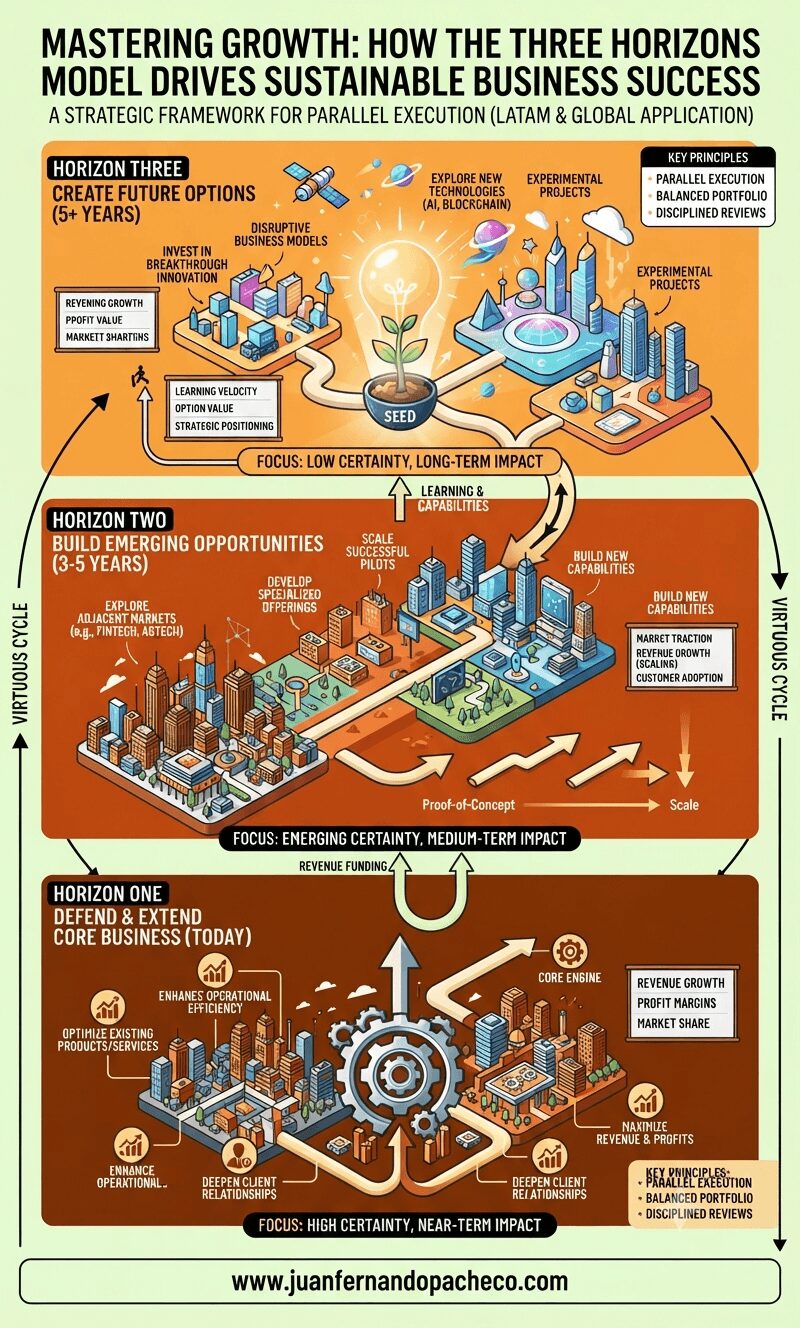
At its core, the three horizons model recognizes that businesses must operate on multiple timeframes simultaneously. Each horizon represents a different type of growth activity, requiring distinct management approaches, resource allocation strategies, and success metrics.
- The first horizon focuses on your core business—the products, services, and operations that currently generate the majority of your revenue and profits. This is about defending and extending your existing market position while maximizing operational efficiency. Think of it as optimizing what you already do well.
- The second horizon involves emerging opportunities—businesses, products, or services that are gaining traction and have the potential to become significant revenue streams. These are your growth engines in development, requiring investment and nurturing before they can replace or supplement your core business.
- The third horizon centers on future ideas and innovations—exploratory initiatives that may seem risky or uncertain today but could define your company’s direction years from now. This is where breakthrough innovations and disruptive business models take root.
The brilliance of this framework lies in its recognition that these horizons aren’t sequential phases but parallel activities that must be managed concurrently. Organizations that focus exclusively on horizon one risk obsolescence. Those that chase only horizon three ideas may never generate sufficient revenue to survive. The key is maintaining a balanced portfolio across all three.
Horizon One: Mastering Your Core Business
Your core business represents the foundation of your organization’s success. It’s what pays the bills today, funds your innovation initiatives, and provides the stability needed to take calculated risks elsewhere. However, treating horizon one as merely a cash cow to be milked is a dangerous mistake.
In my experience leading business development across Latin American markets, I’ve seen how critical it is to continuously invest in and strengthen your core operations. This doesn’t mean resisting change or clinging to outdated models. Rather, it means relentlessly improving what you do best while extending its reach and relevance.
For technology companies serving enterprise clients
Horizon one activities might include optimizing service delivery, enhancing customer support, improving operational efficiency, and deepening relationships with existing clients. It’s about reducing customer request resolution times, streamlining processes, and ensuring that your current offerings remain best-in-class.
The metrics for horizon one are typically well-defined: revenue growth, profit margins, market share, customer satisfaction scores, and operational efficiency indicators. These are the numbers that keep shareholders happy and provide the financial resources needed for horizon two and three investments.
However, horizon one management requires discipline.
It’s easy to get caught up in the urgent demands of current operations and lose sight of the need for continuous improvement. Successful leaders establish clear performance targets, implement robust measurement systems, and create cultures of accountability where excellence in execution becomes the norm rather than the exception.
One common pitfall I’ve observed is allowing horizon one to consume all available resources and leadership attention. When this happens, organizations become vulnerable to competitors who are simultaneously strengthening their core while building future capabilities. The goal isn’t to maximize horizon one at all costs, but to optimize it sufficiently to fund and enable growth in the other horizons.
Horizon Two: Building Emerging Opportunities
If horizon one is about defending and extending your current position, horizon two is about building the businesses that will drive your growth over the next three to five years. These are emerging opportunities that have moved beyond the experimental phase and are demonstrating real market traction.
In the technology services sector
Horizon two initiatives might include expanding into new geographic markets, developing specialized service offerings for emerging customer segments, or building capabilities in adjacent technology areas. For instance, a company traditionally focused on banking solutions might develop offerings for the rapidly growing fintech sector or expand from one Latin American country into several others.
What distinguishes horizon two from horizon three is the level of validation and investment.
Horizon two initiatives have typically passed the proof-of-concept stage. They have identified target markets, developed value propositions, and begun generating revenue, even if profitability remains elusive. The question is no longer whether these opportunities are viable, but how quickly and effectively they can be scaled.
Managing horizon two requires a different skill set than horizon one.
While core business management emphasizes efficiency and optimization, emerging business development demands agility, experimentation, and rapid learning. Teams working on horizon two initiatives must be comfortable with ambiguity, able to pivot based on market feedback, and skilled at building new capabilities from the ground up.
Resource allocation becomes particularly challenging at this stage.
Horizon two initiatives need sufficient investment to achieve scale, but they’re competing for resources with both the core business and more speculative horizon three projects. Leaders must make difficult choices about which emerging opportunities deserve priority investment and which should be deprioritized or abandoned.
From my work coordinating cross-functional teams across multiple countries, I’ve learned that horizon two success often depends on organizational structures that provide these emerging businesses with enough autonomy to move quickly while maintaining sufficient connection to corporate resources and expertise. This balancing act requires thoughtful governance, clear decision rights, and leaders who can navigate both the politics of resource allocation and the practical challenges of building new businesses.
Horizon Three: Creating Future Options
While horizon one keeps the lights on and horizon two builds tomorrow’s revenue streams, horizon three is where you plant the seeds for future transformation. These are the exploratory initiatives, experimental projects, and breakthrough innovations that may or may not pan out but could fundamentally reshape your industry.
Horizon three activities are inherently uncertain.
They involve emerging technologies, unproven business models, or entirely new market spaces where customer needs may not yet be fully articulated. In the technology sector, this might mean exploring artificial intelligence applications, investigating blockchain solutions, or experimenting with new delivery models that could disrupt traditional service paradigms.
The keyword for horizon three is options.
You’re not betting the company on any single initiative. Instead, you’re creating a portfolio of exploratory efforts that give you the flexibility to respond to future opportunities and threats. Some will fail, and that’s not only acceptable but expected. The goal is to learn quickly, fail cheaply, and double down on the few initiatives that show exceptional promise.
Managing horizon three requires a fundamentally different approach than the other horizons.
Traditional business metrics like return on investment or quarterly revenue growth are inappropriate for initiatives that may take years to mature. Instead, success is measured by learning velocity, option value, and strategic positioning.
Leaders must create safe spaces for experimentation where teams can pursue bold ideas without the pressure of immediate commercial results. This often means establishing separate organizational units, innovation labs, or venture arms that operate with different processes, cultures, and incentive structures than the core business.
However, horizon three can’t exist in complete isolation.
There must be mechanisms for transferring successful experiments into horizon two development and eventually into horizon one operations. This requires deliberate attention to knowledge sharing, capability building, and organizational learning.
In my experience working with clients across Latin America, I’ve found that horizon three activities are particularly important in regions experiencing rapid technological and regulatory change. The companies that thrive are those that actively explore how emerging trends might reshape their markets, rather than waiting for disruption to force their hand.
Balancing the Three Horizons
The real challenge isn’t understanding each horizon individually, but managing them as an integrated portfolio. Organizations must allocate resources, talent, and leadership attention across all three horizons in proportions that reflect their strategic ambitions and risk tolerance.
There’s no universal formula for the right balance.
A mature company in a stable industry might allocate 70 percent of resources to horizon one, 20 percent to horizon two, and 10 percent to horizon three. A high-growth technology company in a disruptive market might reverse those proportions. The key is making these allocation decisions deliberately rather than by default.
One framework I’ve found useful is thinking about the horizons in terms of time and certainty.
- Horizon one activities have high certainty and near-term impact.
- Horizon three activities have low certainty and long-term impact.
- Horizon two sits in the middle. Your portfolio should reflect an appropriate mix across this spectrum.
Leaders must also recognize that the horizons interact in important ways.
Insights from horizon three experiments can inform horizon one optimization efforts. Capabilities built in horizon two can create new possibilities for horizon one expansion. Resources generated in horizon one fund investments in horizons two and three. Understanding and leveraging these interconnections is crucial for maximizing the value of your portfolio.
Regular portfolio reviews are essential.
Markets evolve, technologies advance, and competitive dynamics shift. What made sense six months ago may need adjustment today. Establishing disciplined processes for evaluating horizon performance, reallocating resources, and making go-or-no-go decisions prevents stagnation and ensures that your portfolio remains aligned with strategic objectives.
Applying the Model in Practice
For product leaders, business development professionals, and executives operating in complex markets, the three horizons model provides a practical framework for decision-making. Here are some ways to apply it:
When developing product roadmaps, categorize initiatives by horizon.
This helps ensure you’re not over-investing in incremental improvements at the expense of transformational innovations. It also clarifies which metrics and timelines are appropriate for different types of work.
In business development and sales, use the horizons to structure client conversations. Help customers think about their own portfolio of initiatives, and position your offerings as solutions that address needs across multiple timeframes. This creates deeper, more strategic relationships.
For organizational design, consider whether your structure enables or hinders horizon-specific work.
- Do horizon two and three teams have the autonomy they need?
- Are there clear pathways for successful experiments to scale?
- Do performance management systems appropriately differentiate between horizons?
In resource allocation discussions, make the horizon trade-offs explicit.
When someone proposes a new initiative, ask which horizon it serves and what it means for investments in other horizons. This creates more disciplined decision-making and prevents horizon creep.
Finally, use the model for personal career development. Are you building skills relevant to all three horizons? Can you operate effectively in the efficiency-focused world of horizon one and the ambiguity of horizon three? Developing this range makes you more valuable as a leader.
Conclusion
The three horizons model endures because it addresses a fundamental truth about business: sustainable success requires simultaneously managing the present and creating the future. It’s not enough to excel at what you do today. You must also build what you’ll do tomorrow and explore what you might do beyond that.
For leaders navigating complex markets, rapid technological change, and intense competitive pressure, this framework provides clarity amid complexity. It helps you make better decisions about where to invest, how to organize, and what to measure. Most importantly, it prevents the all-too-common trap of choosing between short-term results and long-term innovation.
The companies that thrive over the next decade won’t be those that simply optimize their current operations or those that chase every shiny new opportunity. They’ll be the organizations that master the art of managing all three horizons simultaneously, creating a virtuous cycle where today’s success funds tomorrow’s growth, which in turn creates the platform for future transformation.
As you reflect on your own organization’s portfolio, ask yourself: are we giving appropriate attention to all three horizons? Do we have the right balance of resources, talent, and leadership focus? Are we creating options for the future while maximizing value today? The answers to these questions may well determine whether your organization leads or follows in the years ahead.