The smart insights framework: a simple map for digital growth that lasts
Over more than twenty years of designing products, leading deals, and building business across Latin America, I have watched the same story repeat itself in banks, retailers, telecoms, and technology companies.
Teams invest in digital. They launch campaigns, publish content, buy media, and celebrate the traffic.
Then, a few months later, someone in the boardroom asks the only question that matters: where is the revenue? The effort was real. The money was real. What was missing was a map connecting attention to commercial results. That gap is exactly what the smart insights framework was made to close, and it is the reason I am writing this post as a reference you can use today and reopen in five years with the same usefulness.
Frameworks come and go with fashion, but the physics of commerce do not change.
A business must be found, earn interest, turn that interest into value, and keep the relationship alive. The smart insights framework gives those permanent realities a structure that teams can plan, measure, and improve. Let me walk you through it the way I use it in real conversations with clients, product teams, and sales organizations.
What the smart insights framework is, in plain language
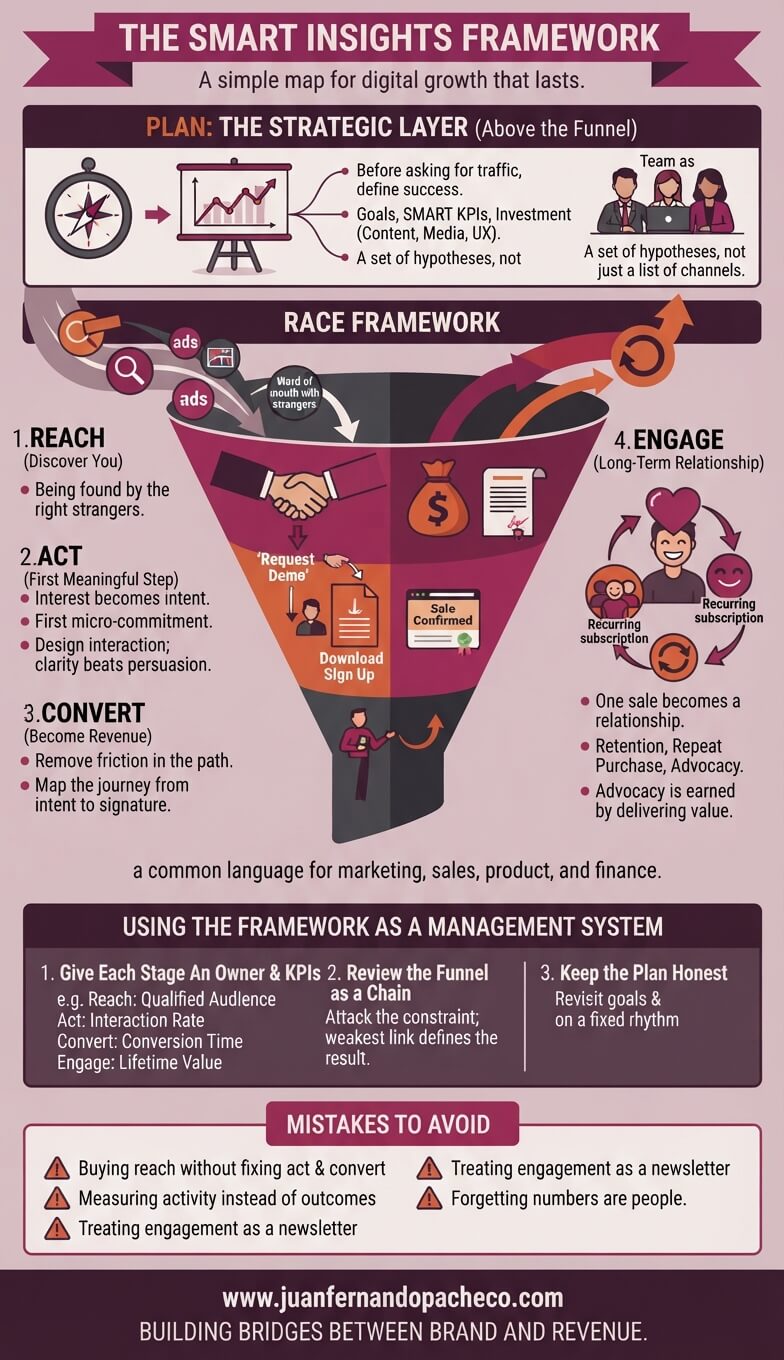
The model reads like a funnel with a lid. At the top sits plan, the strategic layer where objectives, SMART KPIs, and investment in content, media, and user experience are decided. Below it, four stages describe the life of the customer relationship: reach, act, convert, and engage. Together they form the RACE structure that many digital teams already use, wrapped in a planning discipline that keeps it honest.
Reach is how people discover you.
Act is how they take the first meaningful step with you. Convert is how that step becomes revenue. Engage is how one sale becomes a long-term relationship. Nothing exotic, and that is precisely the point. The value of the smart insights framework is not novelty; it is a common language that marketing, sales, product, and finance can all speak.
When cross-functional teams share one language, prioritization stops being a battle of opinions and becomes a review of evidence. In my experience aligning legal, engineering, operations, and commercial people across ten or more countries, that shared language is worth more than any single tactic.
Plan: the stage most teams skip
The framework puts plan above the funnel on purpose. Before asking for traffic, you must define what success means. That means setting goals you can actually measure, choosing a few KPIs for each stage, and deciding where your investment in content, media, and user experience will go.
Let me be blunt: a plan is not a list of channels.
A plan is a set of hypotheses about how a stranger becomes a customer, with numbers attached to each step.
How many people do we need to reach?
- What share of them will interact?
- What share of those will convert?
- What is each conversion worth, and what are we willing to pay for it?
- When you write those numbers down before spending, marketing stops being a cost center and starts behaving like an investment portfolio.
This mirrors how serious buying works in large organizations. In a formal procurement process, nobody evaluates proposals before defining criteria, weights, and thresholds.
Your digital strategy deserves the same discipline: define the criteria first, then let evidence decide which channels and messages win.
The plan stage is also where you decide what you will not do, which is usually the most valuable decision of the cycle.
Reach: being found by the right strangers
Reach covers everything that puts your name in front of a new audience: search, social, advertising, partnerships, events, PR, and word of mouth.
The evergreen principle here is simple: your buyers already ask questions, and you want to own the answers.
Channels will change, and the platforms that dominate this year will not look the same in five years, but the habit of showing up where your buyer looks for answers is permanent.
The discipline that separates reach from vanity is qualification.
Ten thousand visits from people who can never buy from you is noise, not reach. In regulated industries like banking, or in long B2B cycles, I would rather own the attention of a small audience of real decision-makers than a stadium of curious strangers. So the question at this stage is never only “how many,” but “how many of whom.” Build awareness with the people who can actually act on it.
Act: where interest becomes intent
Act is the moment your audience measurably interacts with you: they read a guide, use a calculator, start a trial, leave a contact, request a demo. Some people call this lead generation. I prefer to call it the first micro-commitment, because that wording reminds you that trust is built in small steps, not in leaps.
The evergreen lesson at this stage is that interaction is designed, not hoped for. Every page, every piece of content, and every ad needs one clear next step. If a visitor cannot tell what to do next, you paid for the visit and donated the outcome. My background in user experience taught me that clarity beats persuasion: a page that explains simply and invites one obvious action will outperform a page full of adjectives every single time.
Act is also where you start reading intent.
What someone downloads, watches, or requests tells you what they care about and how mature their need is. That signal should flow straight into your sales and product teams. In complex deals, those early signals are the raw material of a healthy pipeline, long before any formal opportunity exists.
Convert: where the funnel meets the profit and loss
Convert is the stage where intent becomes revenue: a purchase, a signed contract, a renewed subscription. Everything above the funnel exists to serve this moment, so the framework pushes you to measure conversion not as a single click but as a path, and to remove friction at every step of that path.
Commercial experience matters here.
In enterprise sales, conversion is rarely instant. It is a journey with legal reviews, security questionnaires, service level negotiations, and budget approvals. The evergreen principle still applies: map the steps between intent and signature, measure time and drop-off at each step, and attack the biggest source of friction first. I have seen resolution times fall by a third simply by mapping that path and deleting redundant steps, exactly the way you would optimize a checkout in an online store.
Whether you sell a twenty-dollar subscription or a seven-figure technology contract, the discipline is identical: make the next step obvious, make it easy, and measure where people abandon. Conversion rate is not a marketing metric; it is a management metric.
Engage: the compounding machine
Engage is the stage that separates companies that grow from companies that restart. It means staying relevant after the sale: onboarding, support, education, community, personal communication, and well-timed offers. The goals are retention, repeat purchase, and advocacy.
There is a financial reason to love this stage.
Keeping a customer is almost always cheaper than winning a new one, and an engaged customer refers others, which feeds your reach stage for free. The funnel becomes a flywheel. In products serving millions of banking users, the difference between growth and stagnation is rarely the acquisition engine; it is what happens in the first weeks after onboarding.
The evergreen habit here is to design engagement before the sale, not after. Define what success looks like for the customer, then build the touchpoints that lead them there. Advocacy is never asked for; it is earned by delivering value repeatedly, until your customer volunteers to sell on your behalf.
Using the framework as a management system, not a poster
The most common failure is treating the smart insights framework as a diagram in a quarterly presentation. The way to keep it alive is to run it as a management system, with three habits.
- First, give each stage an owner and a short list of KPIs. Reach owns qualified audience and cost per attention. Act owns interaction rates and lead quality. Convert owns conversion rate, cycle time, and acquisition cost. Engage owns retention, lifetime value, and referral. When every stage has an owner, nobody can hide behind the vague idea that “marketing is responsible for growth.”
- Second, review the funnel as a chain. The weakest link defines the result, and doubling traffic into a broken conversion path only doubles the waste. In deal reviews, I always ask where the constraint sits and move investment there first. That habit works in any market, any industry, and any era.
- Third, keep the plan honest. Revisit goals and assumptions on a fixed rhythm, and write down what you learned. Channels will change, algorithms will change, and new platforms will appear every year. The rhythm of plan, measure, and learn is what makes your strategy evergreen while your tactics stay flexible.
Why it holds up in complex and regulated markets
You may wonder whether a framework born for digital marketing survives long, complex sales cycles. It does, precisely because it forces clarity about the journey.
In a bank, a telco, or a public institution, the buyer is a committee. Reach maps to visibility among the right accounts and communities.
Act maps to the micro-commitments that move a committee forward: a workshop, a proof of concept, a reference visit. Convert maps to the formal procurement process, with its requirement documents, compliance reviews, and negotiations. Engage maps to delivery, governance, and expansion.
Translate the stages into the language of your business, and the framework becomes a bridge between marketing and sales, between brand and revenue, between the boardroom and the execution team. Building that bridge is, in the end, most of my job.
Mistakes to avoid, in any year you read this
Some mistakes are permanent, so this list ages well: buying reach without fixing act and convert; measuring activity instead of outcomes; treating engagement as a newsletter instead of a relationship; letting plan become a ritual instead of a decision tool; and forgetting that every number in your funnel is a person who gave you a fragment of their attention, which is a privilege, never a right.
Final thoughts
Tools, platforms, and algorithms will keep changing. The journey of a customer, to discover, interact, decide, and stay, is human, and therefore stable.
The smart insights framework endures because it is organized around that human journey and wrapped in the discipline of planning and measurement. Use it as your map, keep your KPIs honest, attack the constraint, and build engagement as seriously as you build acquisition.
Do that, and your growth will stop depending on luck or on the platform of the season. Keep this post handy and revisit it each planning cycle; it will keep paying you back. That is the whole point of evergreen thinking, in content and in commerce.