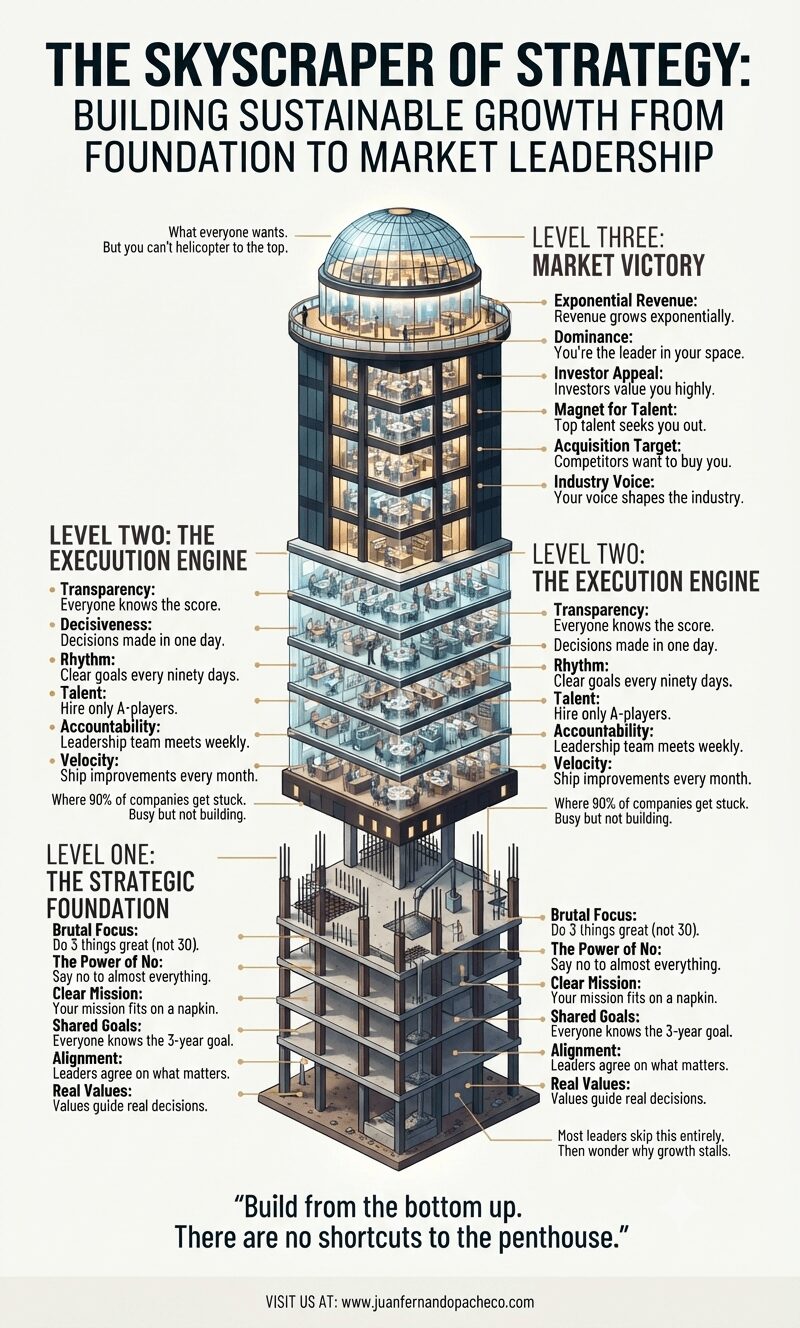
Building sustainable growth from foundation to market Leadership
After years of leading complex technology deals across Latin America, scaling products for banking giants, and navigating high-stakes RFx processes that determine multi-million dollar contracts, I have witnessed a pattern that repeats itself across organizations.
Some companies seem to effortlessly attract top talent, command premium valuations, and shape their industries. Others remain trapped in cycles of busy work, missed targets, and strategic drift.
The difference is not luck.
It is not even necessarily better products or smarter people. The difference lies in how they build their organizations.
There is a framework called the skyscraper of strategy, and it reveals why most companies never reach the penthouse of market victory. More importantly, it shows you exactly what to build, in what order, and why skipping levels guarantees failure.
The three levels that determine your fate
Imagine strategy as a skyscraper with three distinct levels.
- At the base sits the strategic foundation.
- In the middle, the execution engine.
- At the top, market victory.
Here is what most leaders do wrong:
- Try to helicopter directly to the top.
- Chase market victory without building what supports it.
- Want exponential revenue growth, investor admiration, and industry influence, but they skip the hard work of laying concrete at the base.
The truth is brutal and simple:
There are no shortcuts to the penthouse. You must build from the bottom up, level by level, with intention and discipline.
1st level: the strategic foundation most leaders ignore
This is where the story begins, and where most companies fail before they even realize they have started.
The strategic foundation requires brutal clarity and even more brutal restraint.
You do three things great, not thirty.
This principle sounds obvious, yet I watch leaders constantly violate it. They chase every opportunity, say yes to every client request, and dilute their focus across countless initiatives. In the complex world of enterprise technology sales, where RFx processes demand deep expertise and regulatory knowledge, spreading yourself thin is a death sentence.
I have led deals across Mexico, Colombia, Peru, Chile, Argentina, and Brazil. The winners were never the companies trying to be everything to everyone. They were the ones who mastered three core capabilities and executed them flawlessly. Everything else was noise.
You say no to almost everything.
This is the discipline that separates strategists from order-takers. When you know your three things, saying no becomes easier.
- Banking client who wants a custom feature outside your roadmap? No.
- Partnership opportunity that sounds exciting but dilutes your focus? No.
- RFP that does not align with your core strengths? No.
Saying no protects your foundation.
It preserves your resources for the work that truly matters. In my experience negotiating complex deals with stringent SLA requirements and data sovereignty mandates, the ability to walk away from misaligned opportunities has been as important as the ability to close the right ones.
Your mission fits on a napkin. If you cannot explain why your company exists in one clear sentence, your team is flying blind.
This is not about clever taglines or marketing speak. It is about fundamental purpose.
When I lead cross-functional teams across 10+ countries, everyone from product managers in Lima to sales leaders in São Paulo must understand the mission instantly. There is no room for ambiguity when you are navigating government mandates, complex legal clauses, and enterprise security requirements across multiple jurisdictions.
Everyone knows the three-year goal
Not vaguely. Not hopefully. Everyone knows it with precision. This clarity transforms daily work from random activity into purposeful progress.
In technology revenue growth, where sales cycles can stretch across quarters, and deal complexity demands sustained effort, the three-year goal becomes the north star. It answers the “Why are we”questions:
- Enduring this difficult RFx process?
- Investing in this capability?
- Saying no to that distraction?
Leaders agree on what matters
This seems basic, but I have sat in countless boardrooms where:
- C-level executives pursue conflicting agendas.
- Sales leader wants customization to close deals.
- Product leader wants standardization to scale.
- Operations leader wants simplicity to deliver.
Without alignment, the organization tears itself apart.
When I facilitate strategic initiatives with senior management across Latin America, the first task is always alignment.
- What matters most?
- Revenue at any cost?
- Sustainable margins?
- Market share?
- Customer satisfaction?
You can pursue all of these, but not equally, and not simultaneously.
Your values guide real decisions. Not the values printed on your website. The values that actually drive behavior when money is on the line and pressure is high.
In high-stakes procurement processes, values get tested constantly.
- Do you cut corners to meet a deadline?
- Do you overpromise to win a deal?
- Do you hide risks to keep stakeholders comfortable?
Your stated values mean nothing unless they survive these moments.
Most leaders skip the foundation entirely. They jump straight to tactics, to quarterly targets, to competitive battles. Then they wonder why growth stalls.
The foundation is not glamorous. It requires introspection, discipline, and the courage to say no. But without it, everything you build will eventually crumble.
2nd level: the execution engine where 90% get stuck
Once your foundation is solid, you build the execution engine. This is where 90% of companies get stuck. They are busy, but not building. Active, but not advancing.
Everyone knows the score.
Not just the leadership team. Everyone. The developer in Ecuador, the sales rep in Mexico City, the operations specialist in Bogotá. They all know the key metrics, the current status, and how their work contributes to the score.
In my role managing business development across diverse market segments, I have seen the transformation that occurs when transparency replaces opacity.
When people know the score, they play differently. They make better decisions. They hold themselves accountable.
Decisions made in one day.
Speed is a competitive advantage. In the fast-moving technology sector, where client needs evolve and competitors advance daily, slow decision-making is fatal.
I have participated in RFx processes where the difference between winning and losing came down to response time.
- Could we make the go-no-go decision quickly?
- Could we assemble the proposal team without bureaucratic delays?
- Could we get legal approval on contract terms without weeks of back-and-forth?
Companies that decide in one day outmaneuver companies that decide in one month. Every time.
Clear goals every 90 days.
Not annual goals that everyone forgets by March. Ninety-day goals that create urgency and focus. This cadence matches the rhythm of modern business.
When I coordinate relationship-building efforts with partners, subject matter experts, and stakeholders across the region, the ninety-day cycle creates natural checkpoints.
- What did we accomplish?
- What did we learn?
- What will we do differently next quarter?
Hire only A-players.
This is non-negotiable. B-players attract C-players. A-players attract A-players. Your execution engine runs on talent, and compromising on hiring destroys momentum.
I have built high-performing teams focused on user story mapping and MVP efficiency. The difference between a team of A-players and a mixed team is not incremental. It is exponential. A-players raise the bar. They challenge assumptions. They execute without constant supervision.
The leadership team meets weekly.
Not monthly. Not when schedules align. Weekly. Consistent rhythm creates accountability. It surfaces issues before they become crises. It keeps strategy connected to execution.
In my experience leading face-to-face meetings with senior management across Latin America, the weekly cadence prevents drift. It forces prioritization. It maintains momentum on critical initiatives.
Ship improvements every month.
Not every quarter. Every month. This discipline prevents perfectionism from killing progress. It builds a culture of continuous improvement.
When I work with product teams translating client objectives into agile roadmaps, the monthly shipping rhythm accelerates time-to-market. It generates feedback. It demonstrates progress to stakeholders. It builds confidence that the execution engine is working.
This is where 90% of companies get stuck.
- They have strategy, but no engine.
- They have goals, but no rhythm.
- They have talent, but no accountability.
- Busy, but not building.
3rd level: market victory, the natural result
When your foundation is solid, and your execution engine hums, market victory is not a goal you chase. It is a result you attract.
Revenue grows exponentially.
Not linearly. Exponentially. This happens because your foundation allows you to focus on what matters, and your execution engine allows you to compound improvements month after month.
In scaling technology revenue across LATAM markets, I have witnessed this inflection point. The moment when all the unglamorous foundation work and disciplined execution suddenly produces outsized results. Multi-year contracts. Multi-million dollar deals. Revenue that compounds rather than crawls.
You are the leader in your space.
Not by claiming it. By earning it. Clients seek you out. Competitors study you. The market recognizes your authority.
Through years of managing complex deal execution and navigating regulatory compliance across multiple countries, I have learned that market leadership is not about being the biggest. It is about being the most trusted, the most reliable, the most capable in your chosen domain.
Investors value you highly.
Not because you chase valuation. Because you have built something valuable. A solid foundation. A proven execution engine. Consistent results.
Top talent seeks you out.
A-players want to work for winners. They want to be part of something excellent. When your execution engine runs smoothly, when your mission is clear, when your values are real, talented people find you. I have seen this in building teams across the region. The best professionals want to work on meaningful deals, with clear strategy, alongside other A-players. They are attracted to organizations that have done the hard work of building properly.
Competitors want to buy you.
This is the ultimate validation. When your foundation is unshakeable, your execution is superior, and your market position is strong, you become irresistible.
Your voice shapes the industry.
You set standards. You influence direction. You are no longer reacting to market forces. You are creating them.
In the banking and finance sectors where I specialize, the companies that shape industry standards are those that have mastered complex procurement processes, navigated regulatory landscapes, and delivered consistent value at scale. They did not start by trying to shape the industry. They started by building a solid foundation.
Building your skyscraper
Here is what I want you to understand:
- You cannot skip levels.
- You cannot build the execution engine without the foundation.
- You cannot achieve market victory without the engine.
I have spent over twenty years transforming user needs, business goals, and regional complexities into scalable IT products and services. I have led end-to-end RFI, RFQ, and RFP processes for top regional brands. I have driven cross-functional teams across 10+ countries. I have reduced customer request resolution by 30% and accelerated time-to-market by 20%.
None of this happened by accident. It happened because of deliberate, level-by-level construction. Strategic foundation first. Execution engine second. Market victory third.
Most leaders want to start at the top.
- They want market victory without doing the work.
- They want exponential growth without disciplined execution.
- They want industry influence without strategic clarity.
Resist this temptation. Build from the bottom up. Lay your foundation with intention. Construct your execution engine with discipline. Market victory will follow.
There are no shortcuts to the penthouse. But for those willing to build properly, the view from the top is worth every brick.
Your next step
Look at your organization honestly.
- Which level are you really operating from?
- Are you skipping the foundation?
- Stuck in the execution engine?
Chasing market victory without the support structure?
The diagnosis is the first step. The construction begins with a single decision: to build properly, from the bottom up, with patience and discipline.
Your skyscraper awaits. Start building.
.](https://juanfernandopacheco.com/wp-content/uploads/2026/08/Influence-Skills-From-Insight-to-Action-for-Strategists-800x600.png)
