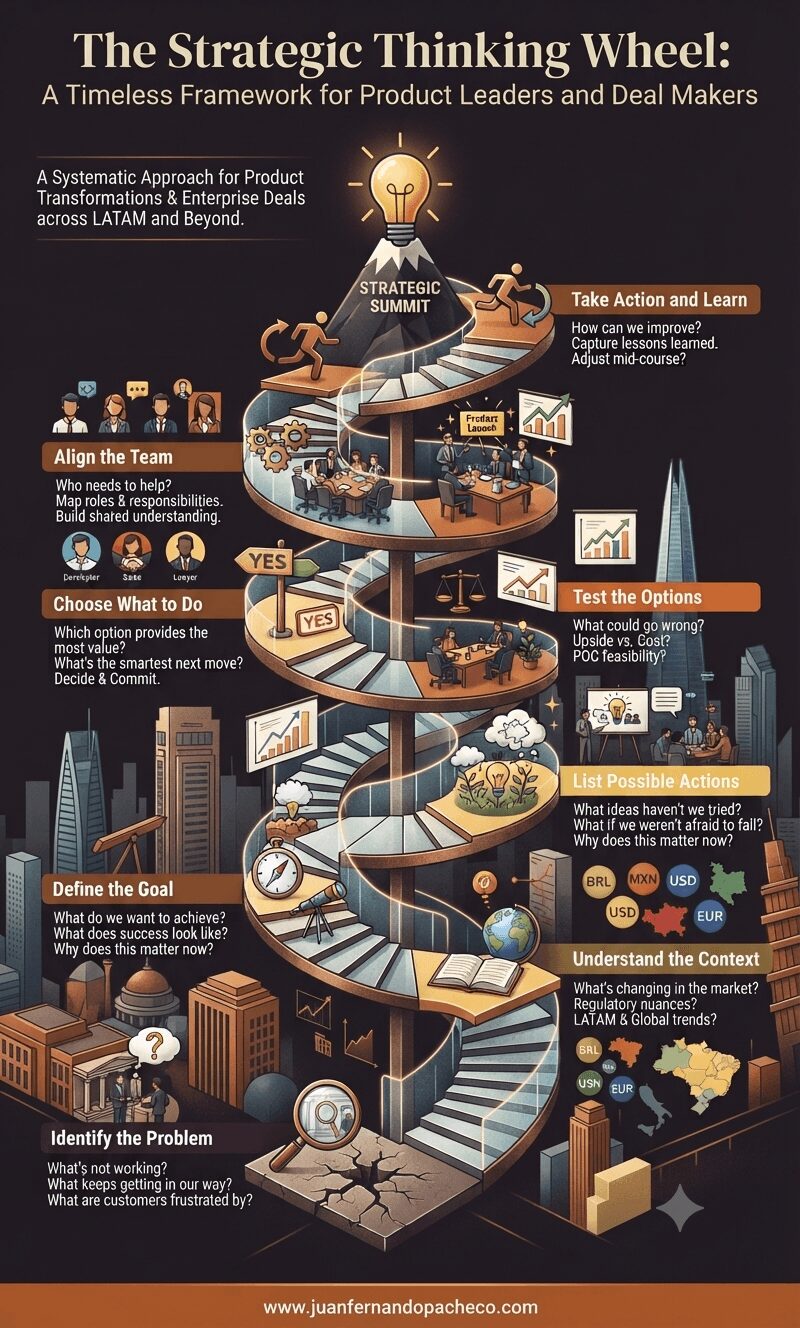
A timeless framework for product leaders and deal makers
After many years of navigating complex technology deals, leading product transformations, and scaling revenue across Latin American markets, I’ve learned one fundamental truth:
Success isn’t about having all the answers. It’s about asking the right questions in the right sequence.
Recently, I came across a powerful visual framework called the Strategic Thinking Wheel, and it immediately resonated with my experience managing multi-million-dollar contracts, leading cross-functional teams across 10+ countries, and translating client objectives into agile product roadmaps.
This isn’t just another business diagram. It’s a systematic approach to problem-solving that separates reactive firefighters from strategic leaders.
Whether you’re closing an enterprise RFQ, launching a new fintech product, or navigating regulatory compliance challenges, this eight-step framework provides the structure you need to think clearly, act decisively, and deliver results that matter.
Why strategic thinking matters more than ever
In my role leading business development across LATAM markets, I’ve seen countless talented professionals stumble not because they lacked technical expertise, but because they skipped the foundational work of strategic thinking:
- They jumped straight to solutions without fully understanding the problem.
- They aligned teams around tactics instead of goals.
- They took action without building in learning mechanisms.
The banking and finance sectors I serve demand precision. When you’re negotiating SLAs with stringent uptime requirements, navigating data sovereignty regulations, or managing complex legal clauses, there’s no room for haphazard decision-making. Every major deal I’ve closed, every product roadmap I’ve shaped, and every cross-functional team I’ve led has benefited from disciplined strategic thinking.
This framework works because it mirrors how complex deals and products actually succeed in the real world.
It’s not linear; it’s cyclical. You learn as you go. You adjust based on feedback. You align people around shared understanding. Let me walk you through each of the eight segments and show you how to apply them.
Step one: identify the problem
The wheel starts here for a reason. Most people think they know what the problem is, but they’re actually looking at symptoms. In my experience with RFI and RFP processes, clients often say they need a specific technology solution when what they really need is to solve a business outcome challenge.
Ask yourself:
- What’s not working?
- What keeps getting in our way?
- What are customers or teams frustrated by?
These questions sound simple, but answering them honestly requires digging beneath the surface.
When a major Latin American bank approached us about their digital transformation, they initially framed the problem as outdated infrastructure. But through strategic questioning, we discovered the real issue was customer churn driven by a poor mobile experience. That reframing changed everything about our proposal and ultimately won us the contract.
Don’t rush this step. Spend time with stakeholders. Look at data. Challenge assumptions. The clarity you gain here determines the effectiveness of everything that follows.
Step two: understand the context
No problem exists in isolation.
- What’s happening inside your business?
- What’s changing in your market?
- What trends should you watch?
These questions force you to zoom out and see the bigger picture.
In LATAM markets, context is everything. Regulatory environments shift. Economic conditions fluctuate. Cultural nuances affect adoption. When I’m leading deals across Mexico, Colombia, Peru, Chile, Argentina, and Brazil, I can’t apply a one-size-fits-all approach.
Each market has its own context that shapes what’s possible.
For product leaders, understanding context means knowing your competitive landscape, your technical debt, your team’s capabilities, and your organization’s appetite for change. It means recognizing that a solution that worked last year might not work today because the context has evolved.
Document your context explicitly. Share it with your team. Make sure everyone is operating from the same understanding of reality. This alignment prevents wasted effort and conflicting priorities later.
Step three: define the goal
- What do we want to achieve?
- What does success look like?
- Why does this matter now?
These questions seem obvious, yet I’m constantly surprised by how many teams are executing without clear, shared goals.
In complex deal execution, goals must be specific and measurable. Not “increase revenue” but “secure a three-year contract worth five million dollars with a 99% uptime SLA.” Not “improve customer satisfaction” but “reduce customer request resolution time by thirty percent through streamlined POC development.”
Goals serve multiple purposes:
- They provide direction when you face difficult trade-offs.
- They create accountability for results.
- They motivate teams by connecting daily work to meaningful outcomes. And
- They give you a clear criterion for deciding which options to pursue.
When defining goals, distinguish between outcomes and outputs. Outcomes are the business results you’re driving toward. Outputs are the deliverables you produce. Too many teams focus on outputs without verifying they’re actually achieving the desired outcomes.
Step four: list possible actions
Now comes the creative phase.
- What are all the ways we could solve this?
- What ideas haven’t we tried yet?
- What would we do if we weren’t afraid to fail?
This is where diverse perspectives become invaluable. In my work coordinating cross-functional teams spanning product, sales, legal, engineering, and operations, I’ve learned that the best solutions emerge when people with different expertise collaborate openly.
Resist the urge to evaluate ideas prematurely. The goal here is breadth, not depth. Capture everything, even ideas that seem impractical at first. Some of my most successful deals started with ideas that initially seemed too ambitious or unconventional.
Use techniques like brainstorming, mind mapping, or scenario planning to generate options.
- Look at how competitors have approached similar challenges.
- Study adjacent industries for transferable solutions.
- Talk to customers about what they wish existed.
The quality of your eventual decision depends heavily on the quality of options you consider. Don’t settle for the first reasonable idea. Push for multiple viable paths forward.
Step five: test the options
- What could go wrong if we try this?
- What’s the upside if it works?
- What will this cost us in time, money, or focus?
These questions shift you from creative mode to analytical mode.
Testing options doesn’t always mean building full prototypes or running expensive pilots. Sometimes it means having honest conversations with stakeholders, doing back-of-the-envelope calculations, or running small experiments to validate assumptions.
In enterprise technology deals, I often use proof of concept development as a testing mechanism. We can:
- Validate technical feasibility
- Gauge user adoption, and
- Identify potential roadblocks before committing to full implementation.
This approach has helped me reduce customer request resolution time by 30% while building confidence among decision-makers.
- Evaluate each option against your defined goals.
- Consider risks and mitigations.
- Assess resource requirements.
- Think through 2nd and 3rd-order consequences.
- Be especially honest about what could go wrong.
Optimism is valuable in leadership, but not when it blinds you to real risks.
Create a simple scoring framework to compare options objectively. Include criteria like strategic alignment, feasibility, cost, time to value, and risk. Involve your team in this evaluation to surface different perspectives and build buy-in.
Step six: choose what to do
- Which option gives us the most value for the effort?
- What’s the smartest next move? What can we do now with what we have?
These questions force you to make decisions despite uncertainty.
Decision-making is where many leaders struggle. Analysis paralysis is real, especially in complex environments with multiple stakeholders and significant consequences. But remember:
A good decision made now is often better than a perfect decision made too late.
Use the work you’ve done in previous steps to inform your choice, but don’t expect complete certainty. You’ve identified the problem, understood the context, defined success, generated options, and tested them. Now you need to commit.
- Consider starting with the option that offers the best balance of impact and feasibility.
- Look for quick wins that build momentum while you work on longer-term transformations.
- Think about sequencing: what needs to happen first to enable other actions?
Document your decision and your rationale. This creates accountability and helps you learn from the outcome. Share the decision clearly with your team and stakeholders, explaining not just what you’re doing but why you chose this path over alternatives.
Step seven: align the team
- Who needs to help make this work?
- What will each person or team own?
- How do we keep everyone aligned?
These questions recognize that strategy execution is fundamentally a team sport.
I’ve led cross-functional teams across 10+ countries, and I can tell you that alignment doesn’t happen automatically. It requires intentional effort, clear communication, and ongoing attention. People need to understand not just their individual tasks but how their work connects to the larger goal.
- Start by identifying all the stakeholders who need to be involved or informed.
- Map out roles and responsibilities explicitly.
- Create mechanisms for regular communication and feedback.
- Address conflicts and misalignments quickly before they derail progress.
In my experience, alignment is strengthened when people feel heard and valued. Create space for team members to ask questions, raise concerns, and contribute ideas.
When people participate in shaping the plan, they’re more committed to executing it.
Use tools like RACI matrices, project charters, or team working agreements to formalize alignment. But don’t rely solely on documentation. Build relationships. Have conversations. Check in regularly. Alignment is a continuous process, not a one-time event.
Step eight: take action and learn
- How can we improve the way we work?
- What needs to change next time?
- What worked and what didn’t?
These questions embed learning into execution, creating a feedback loop that makes you smarter with each cycle.
Action without learning is just busy work. You might be moving fast, but you’re not necessarily getting better.
The most successful product leaders and deal makers I know are obsessive learners. They treat every project, every deal, every launch as an opportunity to refine their approach.
Build learning mechanisms into your execution plan.
- Schedule regular retrospectives.
- Capture lessons learned in real time, not just at the end.
- Celebrate successes but also analyze failures without blame.
- Create psychological safety so people feel comfortable sharing honest feedback.
When I work with clients on complex RFQ processes, we always conduct post-mortems whether we win or lose.
- If we win, we want to understand what worked so we can replicate it.
- If we lose, we need to know why so we can improve.
This discipline has been essential to my track record of securing multi-year contracts.
Use what you learn to adjust your approach mid-course if needed. Don’t stubbornly stick to a plan that isn’t working. But also don’t abandon your strategy at the first sign of difficulty. Discernment comes from combining data with judgment.
Making the Wheel Work for You
Here’s what I love about this framework:
It’s cyclical, not linear. After you take action and learn, you often discover new problems to solve or goals to refine. You re-enter the wheel with greater wisdom and start the cycle again at a higher level.
In my 20+ years of professional experience, I’ve applied variations of this framework to countless situations:
- Launching new products in competitive markets,
- Navigating complex procurement processes,
- Transforming user experiences for millions of banking customers, and
- Scaling revenue across diverse LATAM markets.
The specific context changes, but the fundamental thinking process remains powerful.
Don’t try to do all eight steps perfectly every time. That’s not realistic. Instead, use the wheel as a diagnostic tool. When you’re stuck, ask yourself which step you might be skipping or rushing.
- Are you solving the wrong problem?
- Did you fail to align your team?
- Are you taking action without learning?
Share this framework with your team. Make it part of your organizational language. Use it in meetings, planning sessions, and retrospectives. The more you practice strategic thinking, the more natural it becomes.
Your Next Move
Strategic thinking is a muscle that strengthens with use.
Whether you’re a product owner translating client objectives into agile roadmaps, a business development manager pursuing enterprise deals, or a leader navigating organizational change, this framework gives you a reliable process to follow.
- Start small.
- Pick one current challenge and walk it through the wheel.
- Gather your team and work through it together.
- Document your thinking.
- Take action.
- Learn from the results.
- Then do it again.
The deals you close, the products you launch, and the impact you create will improve not because you’re working harder, but because you’re thinking more strategically.
What problem will you tackle first using this framework? The wheel is waiting. Your move.
.](https://juanfernandopacheco.com/wp-content/uploads/2026/08/Influence-Skills-From-Insight-to-Action-for-Strategists-800x600.png)
