The 7 strategic shifts that scale your business
Over many years of building products, closing complex deals, and scaling technology revenue across Latin American markets, I’ve witnessed a pattern that separates companies that thrive from those that merely survive.
It’s not about having the best product, the most funding, or even the smartest team. It’s about whether the leader can make seven critical mindset shifts that transform them from a founder into a true CEO.
I’ve lived this transformation myself. My career began in the trenches as a UX designer, crafting user experiences one pixel at a time.
I wore every hat, made every decision, and knew every detail because I had to. Today, as I lead business development across multiple countries and manage multi-million-dollar deals, I’ve learned that the skills that got you started are not the skills that will scale your business.
Let me walk you through the seven strategic mindset shifts that will determine whether your company remains a reflection of you or becomes something far greater.
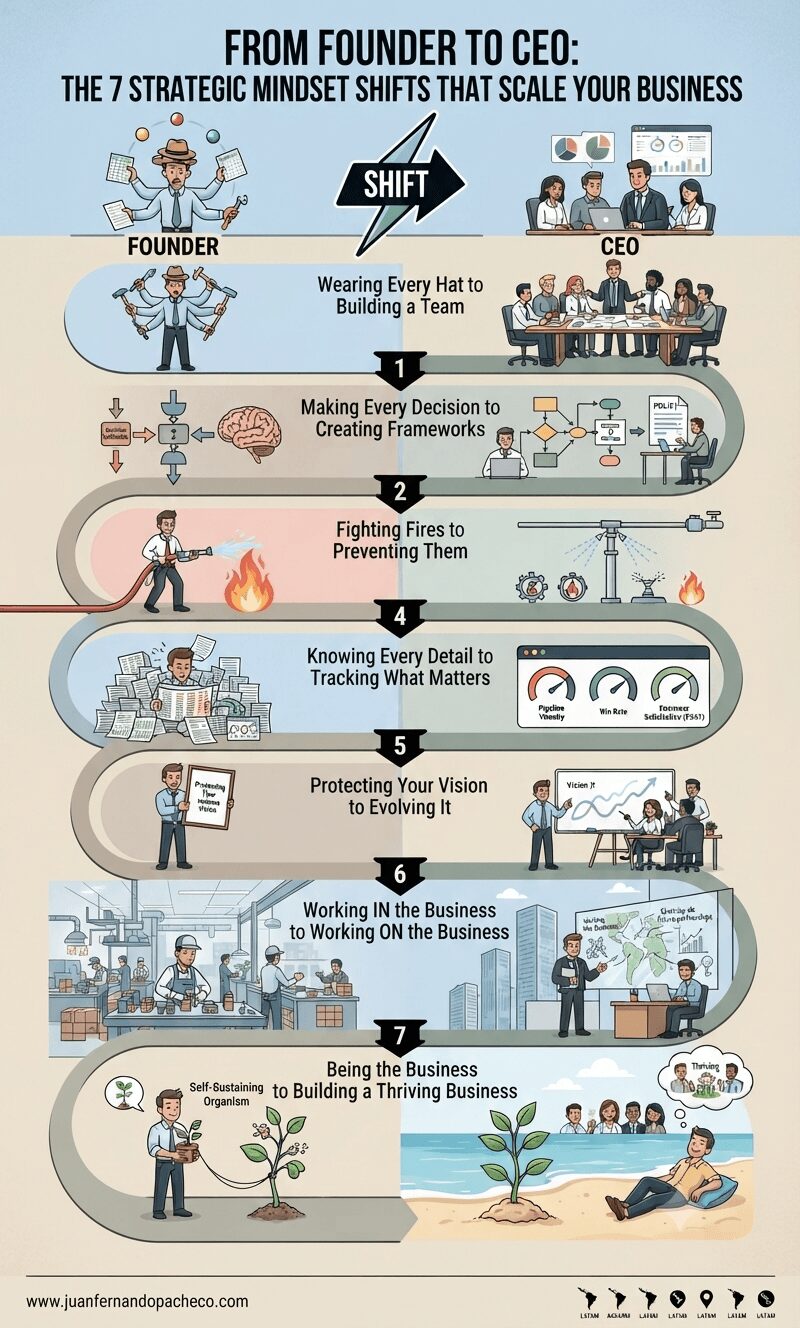
Shift one: From wearing every hat to building a team that wears them better
In the early days, you’re the sales team, the marketing department, customer service, and the product developer all rolled into one. There’s a certain pride in this. You prove your versatility, your commitment, your ability to hustle. I remember those days clearly—juggling client calls while designing interfaces, writing proposals while managing delivery.
But here’s the uncomfortable truth: your versatility becomes your company’s ceiling.
The founder to CEO mindset shift begins when you stop asking “how can I do this?” and start asking “who can do this better than me?” This isn’t about abdication; it’s about orchestration. Your job evolves from showcasing your own talent to recruiting specialists who outperform you in their domains.
In my experience scaling deals across Mexico, Colombia, Peru, and beyond, I’ve learned that the best leaders aren’t the ones who know everything. They’re the ones who build teams where collective expertise far exceeds individual capability. When you hire a sales specialist who closes deals you couldn’t close, or a product manager who sees opportunities you’d miss, you’re not diminishing your value—you’re multiplying it.
The question isn’t whether you can do it. The question is whether doing it yourself serves the business or your ego.
Shift two: From making every decision to creating decision-making frameworks
Early on, every decision flows through you. From office supplies to strategic partnerships, you’re the bottleneck. This feels necessary, even virtuous. After all, who:
- Cares more about the business than you?
- Has more context?
- Can weigh the trade-offs better?
This mindset will strangle your growth.
The founder to CEO mindset shift happens when you stop being the decision-maker and start being the decision-architecture designer. You establish clear decision-making criteria, authority levels, and escalation paths. Your team makes eighty percent of decisions without you, and that’s not just acceptable—it’s essential.
I’ve managed complex RFx processes for top regional brands, navigating government mandates, regulatory compliance, and stringent SLA negotiations. These deals involve millions of dollars and multiple stakeholders across legal, engineering, operations, and client teams.
If I tried to make every decision, nothing would move. Instead, I’ve learned to create frameworks, asking:
- At what level can decisions be made?
- Is information needed?
- Are risks acceptable?
This shift requires trust, but more importantly, it requires clarity.
Your team needs to know the boundaries within which they can operate freely. When you create these frameworks, you’re not losing control—you’re scaling your judgment.
Shift three: from fighting fires to preventing them through systems
As a founder, you’re the company’s best firefighter.
Crises arise, and you solve them. There’s adrenaline in this. There’s heroism. Every solved problem reinforces your identity as the person who saves the day.
But if you’re constantly fighting fires, you’re not building a business—you’re running a crisis management consultancy that happens to have a product.
The CEO mindset shift is brutal in its simplicity
When issues arise, don’t just fix the problem. Fix the system that allowed the problem to exist.
This requires discipline. It’s easier to put out the fire than to install sprinklers. It’s faster to solve the client’s complaint than to redesign the process that created it.
In my work reducing customer request resolution time by 30% through streamlined processes, I learned that sustainable growth comes from prevention, not reaction.
When you build processes and systems that prevent fires, you free yourself to focus on strategy, innovation, and growth.
This shift feels like losing your superhero cape. But the truth is, the best leaders aren’t the ones who solve the most problems. They’re the ones whose companies have so few problems to solve.
Shift four: From knowing every detail to tracking what matters
You know every customer’s name, every invoice amount, every project status. Information is control, and control feels safe. Letting go of details feels like letting go of the business itself.
But here’s what I’ve learned after leading cross-functional teams across 10+ countries:
The details will drown you. You cannot know everything, and attempting to do so prevents you from seeing what truly matters.
The transition from founder to CEO is about moving from information hoarding to insight generation. You focus on key metrics and trends. You trust verified data and dashboards over gut feelings and memory. You establish the critical few indicators that tell you whether the business is healthy, and you let the team manage the rest.
When I’m overseeing multi-year contracts and strategic initiatives across Latin America, I don’t know every line item in every proposal. I know the metrics that matter:
- Pipeline velocity,
- Win rates,
- Customer satisfaction scores,
- Revenue growth against targets.
These indicators tell me what’s working and what needs attention.
This shift requires you to define what “matters” for your business. Not everything is equally important. The CEO’s job is to identify the vital few metrics that drive the business and ensure the organization is aligned around them.
Shift five: From protecting your vision to evolving it with others
The vision is yours alone. Pure, perfect, and personal. Others just don’t get it as you do.
This belief is intoxicating and dangerous.
Your vision got you started, but it won’t get you scaled. The market changes. Customer needs evolve. New technologies emerge. If your vision remains frozen in time, your business becomes a museum piece—interesting to look at, but irrelevant to the present.
The CEO mindset shift is about co-creation.
You bring your leadership team into the visioning process. You listen to their perspectives, their market insights, their customer feedback. The best ideas might not be yours, and that’s exactly the point.
In my experience driving commercial-product synergy and translating client objectives into agile product roadmaps, I’ve seen how collaboration accelerates innovation. When I reduced time-to-market by 20% and boosted user adoption by 50%, it wasn’t because I had all the answers. It was because I created space for the team to contribute their expertise.
This shift requires ego management. You must believe enough in your vision to inspire others, but not so much that you reject improvements. The vision becomes a living document, evolving through dialogue rather than decree.
Shift six: From working in the business to working on the business
You’re deep in daily operations, handling customer calls, perfecting the product. Busy equals productive, or so it seems. This is the most seductive trap of all because it feels like leadership. You’re working hard, you’re involved, you’re essential.
But you’re not leading. You’re laboring.
The founder to CEO mindset shift is the distinction between working in the business and working on the business.
- When you’re working in the business, you’re a participant in operations.
- When you’re working on the business, you’re designing the system that produces results.
You focus on strategy, partnerships, and growth. You measure progress by business transformation, not hours worked.
This shift is particularly challenging for those of us who came up through technical or creative roles. I spent years as a senior UX designer, finding satisfaction in crafting perfect user experiences. Transitioning to business development meant letting go of that direct creation and instead creating the conditions for others to create.
Your calendar reveals your true priorities. If you’re spending most of your time in operational work, you’re not acting as a CEO, regardless of your title. The CEO’s job is to ensure the business has the strategy, resources, and culture to succeed—not to do the work itself.
Shift seven: From being the business to building a business that thrives without you
You are the business. Vacation feels impossible. Every day away costs momentum, money, or morale.
This is the ultimate founder trap: you’ve built a job, not a business. A business that requires your constant presence isn’t a business—it’s a high-stakes dependency.
The final founder to CEO mindset shift is the hardest:
Building a business that thrives without you. This means creating systems, developing leaders, and establishing culture that operates independently of your daily involvement.
Your absence proves the strength of what you’ve built, not threatening its survival.
I’ve scaled revenue over six years by focusing on stakeholder alignment and backlog prioritization, not by being the smartest person in every room.
The goal isn’t to make yourself indispensable.
The goal is to build an organization so strong that your role becomes strategic rather than operational.
This shift requires you to confront an uncomfortable question: if you disappeared tomorrow, would your business continue to thrive, or would it collapse? If the answer is the latter, you haven’t built a business. You’ve built a position.
The Journey Continues
These seven shifts don’t happen overnight. They’re not binary switches you flip. They’re ongoing practices, daily choices, and constant recalibrations. Some days you’ll feel like a CEO. Other days, you’ll find yourself back in founder mode, fighting fires and making every decision.
That’s normal. The key is awareness. When you catch yourself wearing every hat, ask whether you’re building a team. When you’re making every decision, ask whether you’ve created clear frameworks. When you’re fighting fires, ask what system would prevent them.
My journey from UX designer to strategic product and deal leader taught me that growth isn’t just about the business. It’s about the leader. The company can only scale as far as the leader’s mindset allows.
The question isn’t whether you’re ready to make these shifts. The question is whether you’re willing to do the work. Because the alternative is remaining stuck in founder mode, working harder and harder, watching your business plateau while you burn out.
You didn’t start this journey to build a job for yourself. You started it to build something meaningful, something lasting, something that creates value beyond your individual contribution.
Make the shifts.
- Build the team.
- Create the systems.
- Track what matters.
- Evolve the vision.
- Work on the business.
Build something that thrives without you.
That’s not just good business. That’s great leadership.