The Executive’s Guide to Winning Deals and Driving Product Adoption
After many years of navigating complex enterprise deals across Latin America, I’ve learned one uncomfortable truth:
The best technology doesn’t always win. The best story does.
Whether you’re presenting a multi-million dollar RFP response to a banking executive in Mexico City, pitching a product roadmap to your board in Bogotá, or trying to align engineering, sales, and legal teams around a common vision, your success hinges on one skill that most technical leaders underestimate: strategic storytelling.
I’ve sat across from C-level executives who could recite every technical specification but lost the deal because they couldn’t connect their solution to the client’s actual business challenges. I’ve also watched less experienced presenters win massive contracts simply because they structured their narrative in a way that resonated emotionally and logically.
The difference isn’t charisma. It’s framework.
Over the years, I’ve studied and applied various storytelling frameworks to everything from RFx responses to product launches. These aren’t just presentation tricks—they’re strategic tools that help you cut through complexity, align diverse stakeholders, and drive decisions.
Today, I want to share six frameworks that have become essential weapons in my arsenal, along with practical guidance on when and how to use them.
Why Strategic Storytelling Matters in High-Stakes Business
Before diving into the frameworks, let’s address why this matters. In my work scaling technology revenue across LATAM markets, I regularly manage deals involving government mandates, complex legal clauses, stringent SLA requirements, and multiple decision-makers with competing priorities.
In these environments, information overload is the enemy.
Your audience doesn’t need more data—they need clarity.
They need to understand why your solution matters, how it solves their specific problem, and what happens if they don’t act.
Strategic storytelling frameworks give you a repeatable structure to:
- Transform technical complexity into business value
- Build trust with skeptical stakeholders
- Navigate cultural nuances across different LATAM markets
- Accelerate decision-making in lengthy procurement cycles
- Create alignment across cross-functional teams
The frameworks I’m sharing today are evergreen because they’re based on fundamental principles of human psychology and decision-making. Whether you’re reading this in 2026 or 2029, these principles will remain constant.
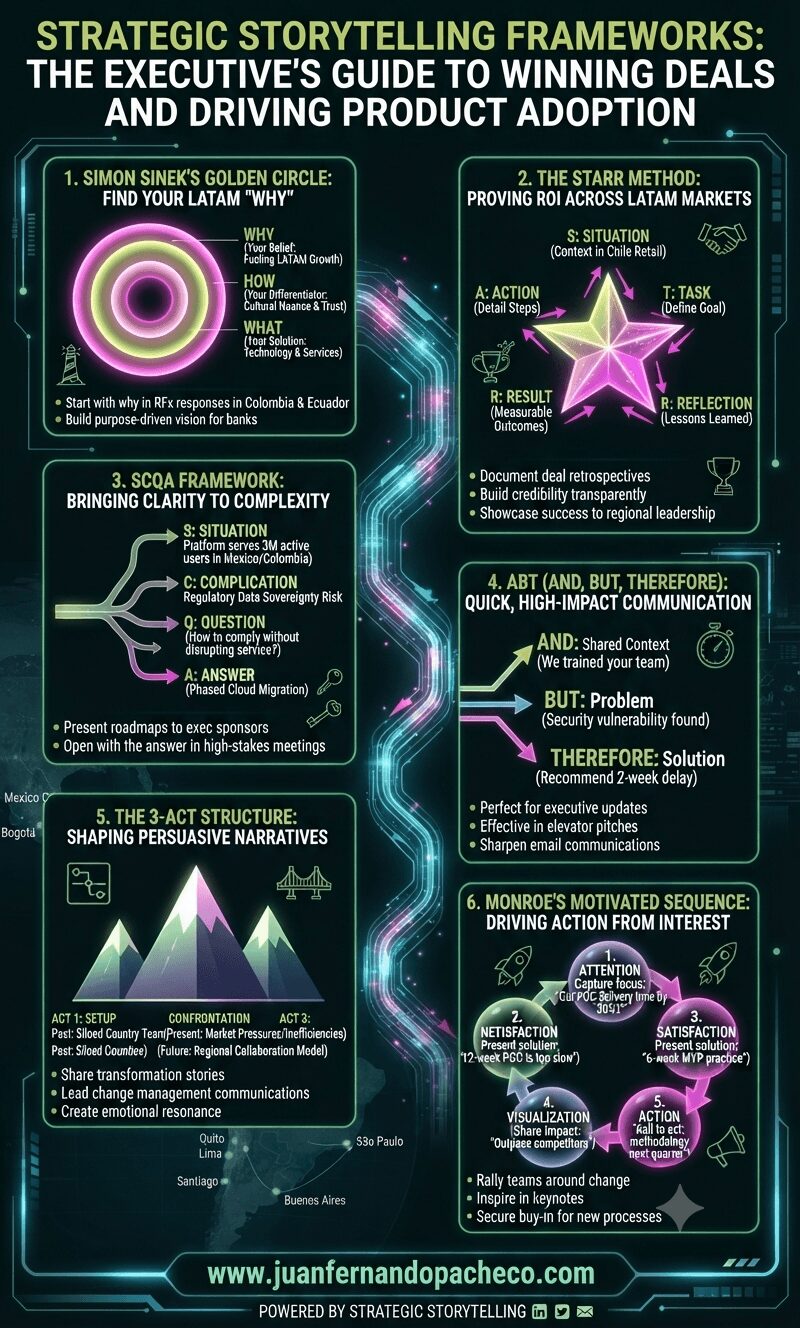
Framework 1: Simon Sinek’s Golden Circle
Start with why. This framework, popularized by Simon Sinek, flips the traditional communication model on its head. Most organizations communicate from the outside in: what they do, how they do it, and maybe why they do it. Inspiring leaders and organizations do the opposite.
The Golden Circle has three layers:
- Why: Your belief, purpose, or cause
- How: Your unique approach or differentiator
- What: Your product, service, or action
I’ve used this framework extensively when positioning solutions for banking clients in Colombia and Ecuador. Instead of leading with features, I start with the purpose:
- Why does this transformation matter for their customers?
- Why does regulatory compliance actually serve their long-term mission?
For example, when presenting a digital transformation initiative, don’t start with “we’re implementing a new cloud platform.” Start with “we’re ensuring your customers can access their financial services securely from anywhere, at any time, because financial inclusion matters.” Then explain how you’ll achieve this, and finally what specific technologies you’ll deploy.
Best practice: Link your team’s daily work back to the why so purpose feels tangible, not abstract. When your engineering team understands how their code connects to customer outcomes, engagement and quality improve dramatically.
Framework 2: The STARR Method
When you need to make your wins concrete and repeatable, STARR is your framework. This is particularly powerful for performance reviews, case studies, proving ROI on initiatives, and documenting lessons learned from complex deals.
STARR stands for:
- Situation: Set the scene and context
- Task: Define the challenge or goal
- Action: Detail specific steps taken
- Result: Share measurable outcomes
- Reflection: Extract lessons learned
I’ve used STARR countless times when presenting deal retrospectives. After securing a multi-year contract with a major retail client in Chile, I didn’t just say “we won the deal.” I structured the presentation using STARR to show exactly how we navigated the procurement process, what obstacles we overcame, and what we’d do differently next time.
This framework is especially valuable in LATAM markets where relationship-building and trust are paramount. By transparently sharing both successes and failures through the reflection component, you build credibility that pays dividends in future negotiations.
Best practice: Lead with result, backfill with STAR, and end with reflection to improve. Your audience wants to know the outcome first, then they’ll care about how you got there.
Framework 3: SCQA Framework
When you need to bring clarity to complex communication, SCQA is indispensable. Developed by Barbara Minto at McKinsey, this framework is perfect for explaining strategy, driving alignment, or communicating tough decisions to stakeholders.
SCQA breaks down as:
- Situation: Set the context
- Complication: Show the challenge
- Question: Raise the key issue
- Answer: Present your solution
I rely on SCQA heavily when presenting product roadmaps to executive sponsors. Let’s say I’m proposing a new feature for a banking platform serving millions of users. I don’t jump straight to the solution. Instead:
- Situation: “Our platform currently serves 3 million active users across Mexico and Colombia with 99.9% uptime.”
- Complication: “However, new regulatory requirements around data sovereignty mean we need to localize data storage within 18 months, or face significant compliance risks.”
- Question: “How do we achieve compliance without disrupting service or exceeding our budget?”
- Answer: “By implementing a phased cloud migration strategy that prioritizes high-risk markets first.”
Best practice: Open with the answer first in high-stakes meetings, then walk through SCQA to back it up. Executives often want the bottom line immediately, then they’ll ask for the supporting logic.
Framework 4: ABT (And, But, Therefore)
Sometimes you need to create quick, persuasive messages. That’s where ABT shines. This framework, popularized by filmmaker Randy Olson, forces you to distill your message to its essence.
ABT structure:
- And: Start with shared context
- But: Highlight the problem or challenge
- Therefore: Present the solution or action
I use ABT constantly in executive updates, pitch decks, and even email communications. It’s remarkably effective for keeping messages sharp and memorable.
For instance, when updating a client on a delayed implementation:
“We’ve completed the infrastructure setup and trained your team on the new system, but we’ve identified a security vulnerability that needs addressing before go-live; therefore, we’re recommending a two-week delay to implement additional safeguards.”
Notice how this is honest about the problem while framing the delay as a protective measure rather than a failure.
Best practice: Test your ABT out loud. If it takes more than 30 seconds, you’ve overcomplicated it. The power of ABT is in its brevity.
Framework 5: The 3-Act Structure
This is the oldest framework in the book—literally. Aristotle identified this structure over 2,000 years ago, and it remains the foundation of virtually every compelling story ever told. For business leaders, the 3-act structure keeps stories simple and memorable.
The three acts:
- Act 1 (Setup): Establish context and character
- Act 2 (Confrontation): Show the main challenge or conflict
- Act 3 (Resolution): Deliver the outcome and next step
I’ve applied this framework to leadership presentations, customer success stories, and even internal change management communications. When you’re rallying teams around a difficult transformation, the 3-act structure helps people understand where we’ve been, what we’re facing, and where we’re going.
For example, when presenting a major organizational restructuring:
- Act 1: “For the past three years, we’ve operated as separate country teams, each with dedicated resources.”
- Act 2: “But market pressures and client demands for cross-border solutions mean this siloed approach is limiting our growth and creating inefficiencies.”
- Act 3: “So we’re moving to a regional model that maintains local presence while enabling seamless collaboration. Here’s what this means for you and the timeline for transition.”
Best practice: End with a clear next step for your team, not just a takeaway but an action. People need to know what to do with the information you’ve shared.
Framework 6: Monroe’s Motivated Sequence
When you need to move audiences from interest to action, Monroe’s Motivated Sequence is your most powerful tool. This five-step framework is particularly effective for inspiring teams, rallying people around change, or delivering keynotes.
The five steps:
- Attention: Capture focus
- Need: Show the problem
- Satisfaction: Present your solution
- Visualization: Share the impact
- Action: Call to act
I’ve used this framework extensively when building high-performing teams and driving adoption of new processes. For instance, when introducing a new POC development methodology that reduced customer request resolution by 30%:
- Attention: “What if I told you we could cut our POC delivery time in half while improving quality?”
- Need: “Right now, our average POC takes 12 weeks, and by the time we deliver, the client’s priorities have often shifted.”
- Satisfaction: “By implementing user story mapping and MVP efficiency practices, we’ve developed a streamlined approach that delivers value in 6 weeks.”
- Visualization: “Imagine presenting working solutions to clients while your competitors are still in requirements gathering. Imagine the competitive advantage this gives us in RFx processes.”
- Action: “Starting next quarter, every POC will follow this new methodology. Here’s your role in making this happen.”
Best practice: Spend most of your time on need and visualization. That’s where buy-in happens. People need to feel the problem acutely and see the solution vividly before they’ll commit to action.
Choosing the Right Framework for Your Situation
With six frameworks at your disposal, how do you choose? Here’s my decision matrix based on years of trial and error:
- Golden Circle when: You’re building culture, defining vision, or establishing purpose-driven initiatives. This is your go-to for leadership communications and brand positioning.
- STARR when: You’re documenting lessons learned, presenting case studies, or demonstrating ROI. Perfect for performance reviews and deal retrospectives.
- SCQA when: You’re explaining complex strategies, driving alignment on difficult decisions, or presenting recommendations to executives. This is McKinsey’s secret weapon for a reason.
- ABT when: You need brevity and impact. Executive updates, elevator pitches, email communications—anytime you have limited attention spans.
- 3-Act Structure when: You’re sharing transformation stories, change management communications, or any narrative that needs emotional resonance alongside logical flow.
- Monroe’s Motivated Sequence when: You need to drive specific action. This is your persuasion framework for rallying teams, securing buy-in, or inspiring change.
Putting It All Together
Here’s what I’ve learned after applying these frameworks across hundreds of deals, presentations, and strategic initiatives in LATAM markets:
- First, frameworks are tools, not straitjackets. Adapt them to your context, your culture, and your audience. What works in a boardroom in São Paulo might need adjustment for a government procurement committee in Quito.
- Second, practice makes permanent. I keep a personal library of stories structured using each framework. Before major presentations, I’ll draft my narrative using two or three different frameworks, then choose the one that feels most authentic and compelling.
- Third, the best storytellers are the best listeners. These frameworks help you structure your message, but you still need to understand your audience’s pain points, cultural context, and decision-making criteria. In LATAM, relationship-building isn’t a prerequisite for business—it is the business.
- Fourth, combine frameworks strategically. You might use Golden Circle to establish your overall vision, SCQA to present a specific recommendation, and Monroe’s Motivated Sequence to drive action. The frameworks complement each other.
Your Next Step
Strategic storytelling isn’t a soft skill. It’s a competitive advantage that separates good leaders from great ones, good products from market leaders, and good deals from transformative partnerships.
Pick one framework from this post and apply it to your next important communication. Maybe it’s an ABT for your weekly executive update. Maybe it’s SCQA for your next product roadmap presentation. Maybe it’s Monroe’s Motivated Sequence for rallying your team around a challenging goal.
Then practice it. Refine it. Make it your own.
Because in the end, the technology you’re selling, the product you’re building, or the deal you’re closing—they all matter. But they only matter if you can tell a story that makes people care enough to act.
That’s the power of strategic storytelling. And that’s how you win in complex, competitive markets.