What lies beneath determines your success
After many years of leading complex deals across Latin American markets, navigating multi-million dollar RFx processes, and building products that serve millions of users, I have witnessed a recurring pattern that separates successful organizations from those that struggle: their understanding of what strategy truly means.
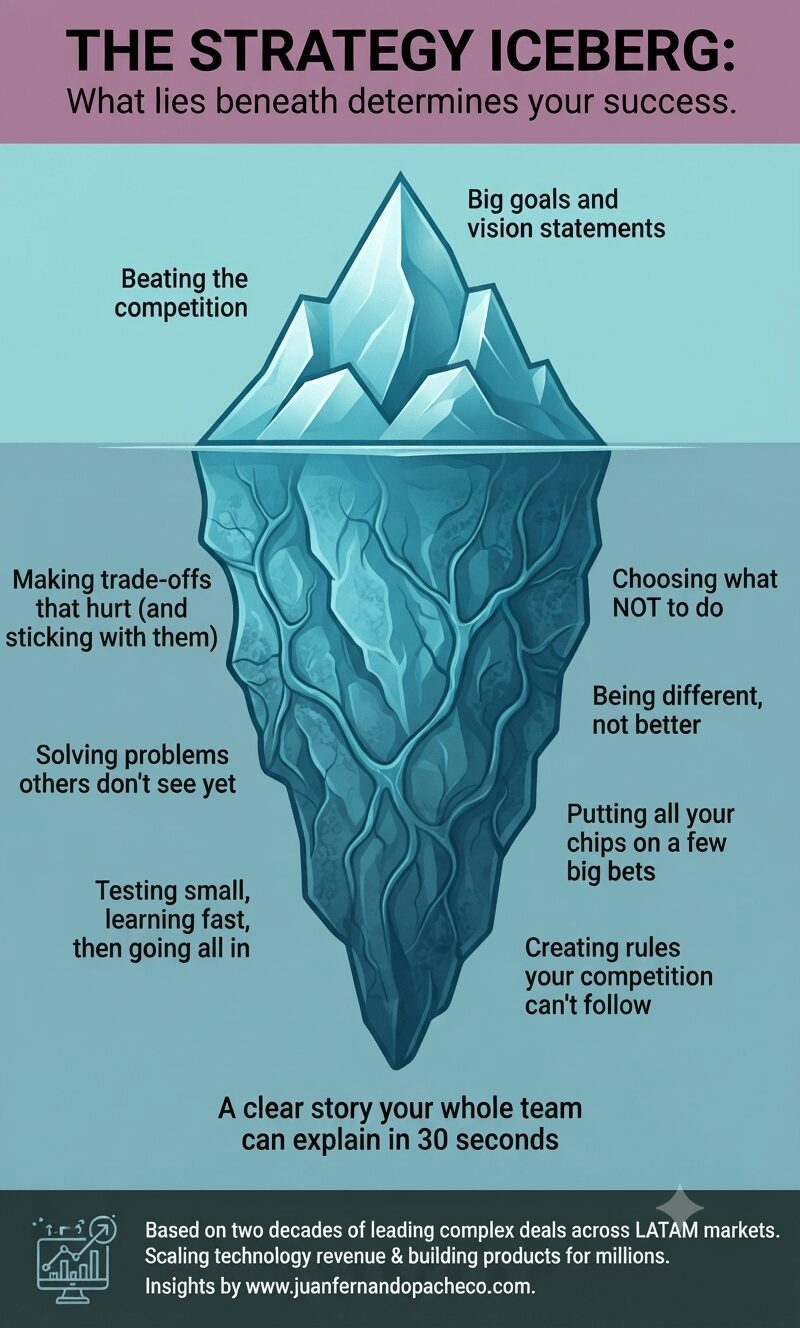
Picture an iceberg.
- The visible tip represents what most people think strategy is—big goals, vision statements, beating the competition, and impressive presentations filled with industry buzzwords. It is what we see in boardrooms, what gets celebrated in annual reports, and what fills countless strategy decks. But here is the uncomfortable truth: that visible portion represents only about ten percent of what actually makes strategy work.
- Beneath the surface lies the real strategy—the ninety percent that determines whether you sink or swim. This hidden foundation is where the difficult work happens, where real decisions get made, and where competitive advantages are truly built. In my experience leading business development across ten-plus countries in Latin America, I have learned that organizations that master what lies beneath the waterline consistently outperform those that focus only on what is visible.
Let me take you beneath the surface to explore what strategy actually is, and why understanding this distinction has been critical to securing multi-year contracts, scaling technology revenue, and building products that resonate across diverse markets.
Choosing what not to do
The most powerful strategic decision you will ever make is not about what you will pursue, but about what you will deliberately ignore. This principle has guided my approach to complex deal execution throughout my career. When leading RFI, RFQ, and RFP processes for top regional brands, the temptation to say yes to everything is overwhelming.
Every client request seems important. Every feature appears critical. Every market opportunity looks promising.
But strategy demands discipline. It requires the courage to decline opportunities that do not align with your core strengths or long-term vision. I have seen organizations fail not because they lacked opportunities, but because they pursued too many. They spread their resources thin, diluted their value proposition, and ultimately delivered mediocrity across the board instead of excellence in specific areas.
In the Latin American market, where regulatory requirements vary dramatically by country and client needs are incredibly diverse, this principle becomes even more critical. Early in my career, I learned that trying to be everything to everyone is a recipe for strategic failure. Instead, we had to make hard choices about which markets to prioritize, which client segments to serve deeply, and which solutions to develop with world-class expertise.
Being different, not better
Competition based on being better is a race you can never win. There will always be someone with more resources, newer technology, or lower costs.
But competition based on being different creates a category where you have no competition.
This insight has shaped how I approach deal leadership and product strategy.
When I work with clients across banking, finance, retail, and telecommunications sectors, I do not compete on price or feature checklists. Instead, I focus on translating their unique regional complexities into tailored solutions that address their specific challenges—government mandates, data sovereignty requirements, local policies, and complex legal clauses that generic providers cannot navigate.
This differentiation strategy has proven particularly powerful in Latin American markets. While competitors focus on offering standardized global solutions, we have succeeded by deeply understanding local nuances and building capabilities that address region-specific needs.
We are not trying to be better at what everyone else does. We are doing something fundamentally different that creates unique value for our clients.
Putting all your chips on a few big bets
Strategic focus requires concentration of resources. You cannot bet big on everything. This principle has been essential in my work scaling technology revenue across LATAM markets. Rather than spreading our efforts across dozens of initiatives, we identify the few opportunities that have the potential to transform our business and commit fully to them.
In complex deal execution, this means dedicating our best people, our deepest expertise, and our full organizational support to pursuits that align with our strategic priorities. It means saying no to deals that might bring short-term revenue but do not advance our long-term strategic position.
This discipline has enabled us to secure multi-million dollar contracts and build lasting relationships with C-level executives and board members across the region.
The challenge is that big bets feel risky. They require conviction in the face of uncertainty. But paradoxically, spreading your resources across many small initiatives is often riskier than concentrating them on a few well-chosen opportunities. Small bets rarely move the needle, and they create organizational complexity without delivering transformational results.
Creating rules your competition cannot follow
True strategy creates structural advantages that competitors cannot easily replicate.
In my experience, this often comes from combining deep domain expertise with regional knowledge and operational excellence.
When I lead cross-functional teams across product, sales, legal, engineering, and operations in ten-plus countries, we are not just executing deals. We are building capabilities that become increasingly difficult for competitors to match.
Consider the complexity of navigating government mandates, regulatory compliance, and data sovereignty requirements across different Latin American countries. This is not just a technical challenge. It is a strategic moat that protects our position and creates barriers to entry for competitors who lack local expertise and established relationships.
These rules are not written in policy documents. They emerge from the unique combination of capabilities, relationships, and knowledge that your organization develops over time. They are the invisible structures that guide decision-making and create sustainable competitive advantage.
A clear story your whole team can explain in thirty seconds
If your strategy cannot be explained simply, it is not a strategy. It is a collection of ideas disguised as strategic thinking.
Throughout my career, I have observed that the most successful organizations are those where every team member—from engineers to sales representatives to operations staff—can articulate the strategic direction in clear, simple terms.
This clarity is essential when managing complex deals that involve multiple stakeholders, tight deadlines, and high stakes. When everyone understands the strategic priorities, decision-making becomes faster and more aligned. Teams can act autonomously while staying coordinated because they share a common understanding of what matters most.
I have found that developing this clarity requires ruthless simplification. It means distilling complex market dynamics, competitive pressures, and organizational capabilities into a narrative that is both accurate and accessible. This is not dumbing down. It is achieving the highest level of strategic thinking—making the complex simple without losing essential truth.
Making trade-offs that hurt and sticking with them
Strategy without sacrifice is not strategy. It is wishful thinking.
Real strategy requires making choices that create genuine pain in the short term—declining profitable opportunities, exiting markets, discontinuing products, or reallocating resources from pet projects. These decisions hurt because they involve real losses, not just theoretical opportunity costs.
In my work, I have faced situations where we had to walk away from deals that would have boosted quarterly numbers but compromised our strategic positioning. We have had to tell clients no when their requests would have diverted us from our core focus. These decisions were uncomfortable. They required explaining to stakeholders why we were leaving money on the table. But they preserved our strategic integrity and positioned us for sustainable growth.
The hardest part is not making the trade-offs. It is sticking with them when pressure mounts, when short-term results disappoint, when stakeholders question the decision. Strategic discipline means maintaining course even when it is painful, trusting that the long-term benefits will outweigh the short-term costs.
Solving problems others do not see yet
The highest level of strategy is anticipating needs before they become obvious. In my experience leading product development and business development across Latin America, this has meant understanding emerging regulatory trends, anticipating technological shifts, and recognizing evolving client needs before they articulate them themselves.
This forward-looking perspective comes from deep market engagement, continuous learning, and the willingness to challenge conventional wisdom. It requires spending time with clients not just to sell, but to understand their businesses, their challenges, and their aspirations. It means investing in research and development for solutions that address problems that will matter tomorrow, not just today.
When we accelerated time-to-market by twenty percent and boosted user adoption by fifteen percent for solutions serving millions of banking and finance users, it was not because we executed better on known requirements. It was because we anticipated needs and designed solutions that addressed problems our clients had not yet fully recognized.
Testing small, learning fast, then going all in
Strategy is not a one-time decision. It is a continuous process of hypothesis, experimentation, learning, and scaling. This iterative approach has been fundamental to reducing customer request resolution by thirty percent through streamlined POC development and execution.
We start with small tests that allow us to validate assumptions with minimal risk. We gather data, learn from failures, and refine our approach. Then, when we have evidence that something works, we commit fully and scale rapidly. This disciplined approach to innovation prevents us from betting big on unproven ideas while ensuring that we do not miss opportunities to capitalize on what works.
In the fast-evolving technology landscape across Latin American markets, this ability to learn and adapt quickly has become a critical strategic capability. It allows us to stay ahead of market shifts, respond to emerging opportunities, and continuously improve our value proposition.
Bringing it all together
The visible part of strategy—the goals, the vision statements, the competitive positioning—is important. But it is meaningless without the foundation beneath the surface. Real strategy is the hard work of making choices, creating differentiation, building unique capabilities, and maintaining discipline over time.
As you develop your own strategic approach, I encourage you to look beneath the waterline. Ask yourself: what are we choosing not to do? How are we being different rather than just better? Where are we placing our biggest bets? What rules are we creating that competitors cannot follow? Can our entire team explain our strategy in thirty seconds? What painful trade-offs are we willing to make? What future problems are we solving? How are we testing and learning?
These questions will not generate impressive slide decks or sound good in press releases. But they will build the foundation for sustainable competitive advantage and long-term success. That is what strategy actually is, and that is what separates organizations that thrive from those that merely survive.
The iceberg metaphor reminds us that what is visible is supported by what is hidden. Your visible success will always depend on the invisible strategic foundation you build beneath the surface. Invest in that foundation with intention, discipline, and courage, and you will create advantages that endure far beyond the next quarter or the next product launch.
That is the lesson two decades of strategic product leadership and complex deal execution have taught me. It is the principle that has guided our success across Latin American markets. And it is the truth that will continue to separate strategic winners from tactical losers for years to come.