A Leader’s Framework for Clarity and Execution
After many years of navigating complex technology deals across Latin America, leading cross-functional teams through high-stakes RFI/RFQ/RFP processes, and scaling revenue in markets as diverse as Mexico, Colombia, Ecuador, and Brazil, I’ve learned one fundamental truth:
Strategy fails not because of bad ideas, but because of poor communication and misalignment.
I’ve sat across from C-level executives in banking and finance, presented to board members, and coordinated with product, sales, legal, engineering, and operations teams across 10+ countries. In every single instance, the difference between winning multi-million dollar contracts and losing opportunities wasn’t technical capability or market knowledge. It was clarity.
That’s why I want to share a framework that has transformed how I approach strategic planning, deal execution, and team alignment. It’s called the one-page strategy map, and it’s deceptively simple. Yet its power lies precisely in that simplicity.
The problem with strategic complexity
Let me be honest about something. Early in my career, I thought comprehensive strategy meant comprehensive documentation. I created hundred-page strategic plans, detailed market analyses, and elaborate roadmaps. I believed that if I just covered every angle, addressed every variable, and documented every contingency, success would follow.
I was wrong.
What I discovered through years of leading corporate business development efforts and managing complex enterprise deals is that people don’t execute what they don’t understand. And they can’t understand what fills a binder or spans fifty slides. When you’re negotiating SLAs with stringent uptime requirements, navigating government mandates and data sovereignty regulations, or aligning stakeholders across different time zones and cultures, you need clarity, not complexity.
The one-page strategy map solves this by forcing discipline.
It demands that you distill your strategy into five essential elements that fit on a single page. This constraint isn’t limiting; it’s liberating. It separates what matters from what merely seems important.
The five pillars of strategic clarity
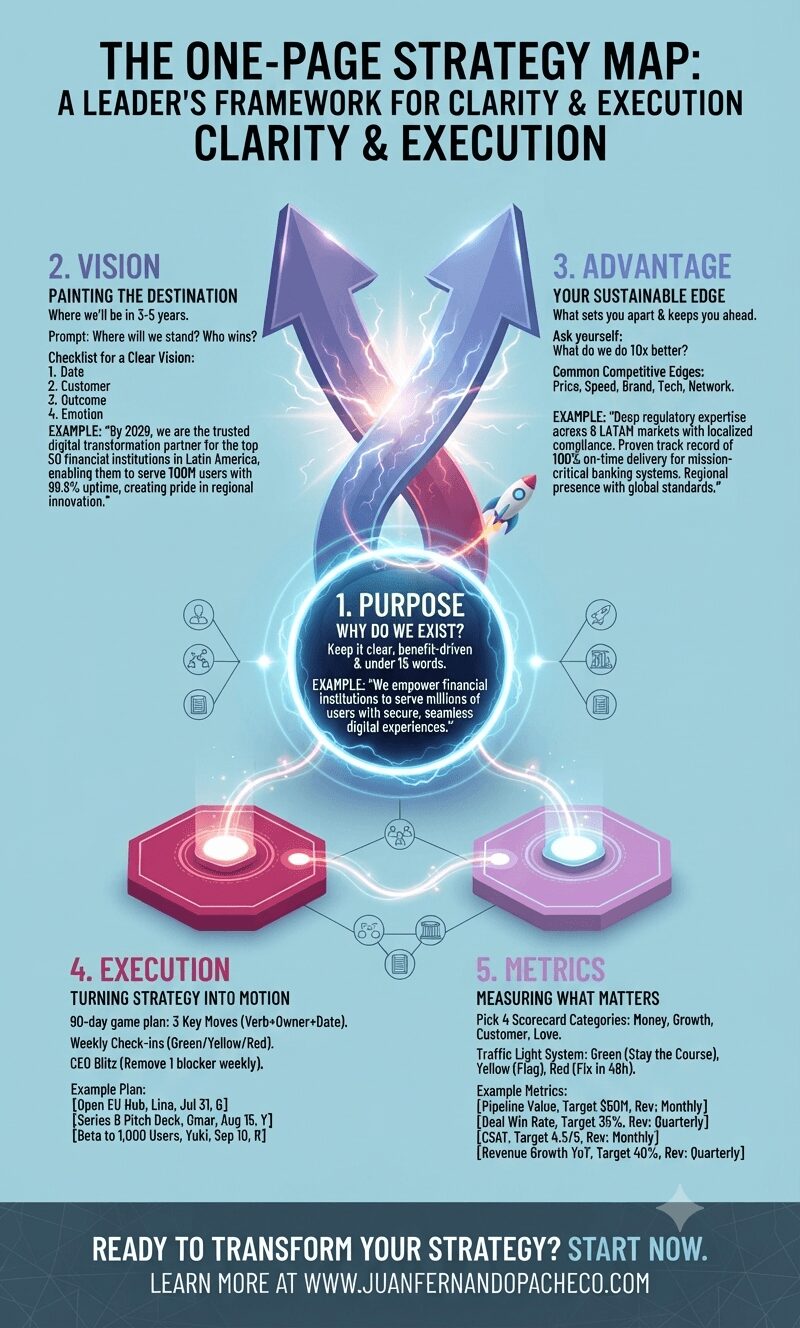
The framework centers on five interconnected components that create a complete strategic picture. Let me walk you through each one, sharing how I’ve applied these concepts in real-world scenarios across LATAM markets.
Purpose: The foundation of everything
At the center sits purpose.
Why do we exist?
This isn’t your mission statement crafted by a marketing committee. This is the fundamental reason your organization, your team, or your initiative matters.
The guideline suggests keeping it clear, benefit-driven, and under fifteen words. For example:
“We help people ship anything, anywhere, in under twenty-four hours.”
Notice what this does. It’s specific about the benefit, clear about the scope, and measurable in its promise.
In my work scaling technology revenue across Latin America, I’ve found that purpose clarity is especially critical when dealing with complex procurement processes. When you’re responding to an RFP that runs hundreds of pages, with complex legal clauses and enterprise security requirements, your team needs an anchor.
They need to remember why they’re doing this work beyond winning the deal.
For a banking technology solution, purpose might be:
“We empower financial institutions to serve millions of users with secure, seamless digital experiences.”
That’s thirteen words. It’s benefit-driven. It’s specific to our market. And it reminds everyone that we’re not just selling software; we’re enabling financial inclusion and better customer experiences.
When I reduced customer request resolution time by thirty percent through streamlined POC development and execution, it wasn’t because of better tools or more resources. It was because every team member understood our purpose and could make decisions aligned with it.
Vision: Painting the destination
If purpose is why we exist, vision is where we’ll be in three to five years. This is where many leaders struggle because they either think too small or too vaguely.
The framework offers excellent prompting questions:
- Where will we stand globally?
- Who wins the most because we exist?
- What headline will Forbes write about us?
- How is the world different because of us?
But here’s what’s critical: your vision needs four specific elements.
- A date. Pick a specific year.
- A customer. Who are you built to serve?
- An outcome. One bold, measurable result.
- An emotion. One word for how people will feel.
Consider this example:
“By 2029, our send-anywhere platform helps fifty million people ship across borders in twenty-four hours, all while cutting carbon per package by fifty percent. We’re called the FedEx of the digital age.”
Notice the specificity. The date. The customer. The measurable outcome. The emotional aspiration.
In my experience driving cross-functional teams across 10+ countries, exceeding KPIs and scaling revenue over six years, vision clarity prevented countless misalignments. When you’re working with stakeholders from Mexico to Argentina, from engineering teams in one city to legal teams in another, everyone needs to see the same destination.
For technology services in LATAM, a vision might read:
“By 2030, we are the trusted digital transformation partner for the top fifty financial institutions in Latin America, enabling them to serve one hundred million users with ninety-nine point nine percent uptime, creating pride in regional innovation.”
That’s specific. That’s measurable. That’s inspiring. And that’s achievable only if everyone rows in the same direction.
Advantage: Your sustainable edge
This is where strategy gets real. What sets you apart and keeps you ahead?
- Not what you hope sets you apart.
- Not what you wish were true.
What actually differentiates you in ways that can’t be easily copied.
The framework challenges you to ask hard questions:
- What do we do ten times better than anyone else?
- What can’t be copied in a year through data, tech, or brand?
- What proof backs each claim?
- What do we need to protect or grow today?
Common competitive edges include price leadership, unique speed, beloved brand, proprietary technology, or exclusive network. But here’s what I’ve learned through securing multi-year contracts by cultivating relationships with top business decision-makers:
Your advantage must be real, provable, and valuable to the customer.
In the complex world of enterprise technology deals, where you’re navigating government mandates, regulatory compliance, and stringent SLA negotiations, your advantage can’t be vague promises. It must be demonstrable capability.
Consider this example:
“Network: two hundred thousand couriers in one hundred thirty countries. AI routing: thirty percent faster delivery. Next move: quarterly upgrades to route accuracy.”
That’s specific. That’s measurable. That’s defensible.
For a technology services firm operating across LATAM, advantage might look like:
“Deep regulatory expertise across six LATAM markets with localized compliance frameworks. Proven track record of 100% on-time delivery for mission-critical banking systems. Regional presence with global standards. Next move: expanding sovereign cloud capabilities in three new markets.”
This isn’t marketing fluff. This is strategic positioning that informs every deal, every proposal, every client conversation. When I participate in proposal creation, highlighting value propositions and key differentiators, this advantage clarity is what wins deals.
Execution: Turning strategy into action
Strategy without execution is hallucination.
This section answers the critical question: how do we turn strategy into motion?
The framework introduces a ninety-day game plan with four elements.
- First, three key moves that start with a verb.
- Second, an owner plus data for each move.
- Third, a weekly check-in using a green, yellow, red system.
- Fourth, a CEO blitz to remove one blocker weekly.
There are also fast filters to apply:
- What starts this week?
- What can we cut?
- Who needs a yes-or-no today?
Let me give you a concrete example from my experience. When I translated client objectives and requests into agile product roadmaps, accelerating time-to-market by 20% and boosting user adoption by 50%, it wasn’t magic. It was disciplined execution.
An example plan might look like:
“Open EU hub, owned by Lina, due July 31st, status green. Series B pitch deck, owned by Omar, due August 15th, status yellow. Beta to one thousand users, owned by Yuki, due September 10th, status red.”
Notice the accountability. Notice the deadlines. Notice the transparency about status.
In managing business opportunities across assigned accounts in Mexico, Colombia, Peru, Chile, Argentina, and Brazil, I’ve found that execution discipline separates winners from losers. When you’re coordinating relationship-building efforts with partners, engagement managers, subject matter experts, and client stakeholders, everyone needs to know what’s happening, who owns it, and when it’s due.
The weekly check-in using green, yellow, red isn’t about micromanagement.
It’s about early warning. It’s about surfacing blockers before they become disasters. And the CEO blitz to remove one blocker weekly? That’s leadership accountability. That’s removing obstacles so your team can execute.
For technology deals in LATAM, your ninety-day plan might include:
- Complete regulatory compliance audit for Colombian banking standards, owned by legal team, due August 15th.
- Deploy proof of concept for top three pipeline opportunities, owned by solutions architecture, due September 30th.
- Secure executive sponsorship meetings with five target accounts, owned by business development, due October 15th.
This is how strategy becomes reality.
Metrics: Measuring what matters
The final piece answers:
How do we measure what matters? Not how do we measure everything. Not how do we track every possible metric. How do we measure what actually matters?
The framework suggests picking four scorecard categories.
- Money, which includes runway and gross margin.
- Growth, tracking weekly users and revenue.
- Customer, measuring on-time percentage and churn.
- Love, captured through NPS and referral rates.
There’s also a traffic light system:
- Green means stay the course,
- Yellow means flag at stand-up,
- Red means fix in forty-eight hours with CEO ownership.
An example metrics table might show:
- Cash runway, target 12 months, review monthly.
- New users per week, target 25000, review weekly.
- On-time delivery, target 95%, review weekly.
- NPS, target seventy, review quarterly.
In my role reporting and measuring progress against quarterly targets with regional and industry leaders,
I’ve learned that metric discipline drives performance.
When you’re managing progress on key deals, following up with leads, and overseeing relationship development, you need leading indicators, not just lagging ones.
For scaling technology revenue across LATAM markets, your metrics might include:
- Pipeline value, target 50 million dollars, review monthly.
- Deal win rate, target 35%, review quarterly.
- Customer satisfaction score, target 4.5/5, review monthly.
- Revenue growth year-over-year, target 40%, review quarterly.
The traffic light system is crucial. When a deal turns red, you don’t wait for the quarterly review. You fix it in forty-eight hours with executive ownership. That’s how you maintain one hundred percent on-time delivery and mitigate operational and legal risks.
Making it work in complex environments
Now, let me address something important. This framework might look simple, but applying it in complex, multi-market, multi-stakeholder environments requires discipline. I’ve used these principles while forging strong connections with C-level executives and board members, facilitating face-to-face meetings with senior management across diverse market segments.
Here’s what I’ve learned:
- First, create the strategy map collaboratively. Don’t dictate it. When you’re driving cross-functional teams including product, sales, legal, engineering, and operations, everyone needs input. Their buy-in determines your execution success.
- Second, revisit it regularly. This isn’t a once-a-year exercise. In fast-moving technology markets across LATAM, with evolving regulatory requirements and competitive dynamics, you need to review and adjust quarterly.
- Third, communicate it relentlessly. I’ve maintained strong partner ties and delivered accurate project estimates by ensuring everyone understands the strategic direction. Your strategy map should be visible, discussed, and referenced in every major decision.
- Fourth, connect it to daily work. When I built high-performing teams focused on user story mapping and MVP efficiency, we connected every sprint, every user story, every feature back to the strategy map. People need to see how their work contributes to the bigger picture.
The compound effect of clarity
Over 20+ years of transforming user needs, business goals, and regional complexities into scalable IT products and services, I’ve seen the compound effect of strategic clarity. Teams that understand their purpose, vision, advantage, execution plan, and metrics outperform those that don’t. It’s that simple.
When you’re specializing in banking, finance, and cross-segment markets across Latin America, dealing with data sovereignty requirements, local policies, and complex enterprise security needs, you can’t afford misalignment. You can’t afford ambiguity.
You need everyone moving in the same direction with the same understanding.
The one-page strategy map isn’t just a planning tool. It’s a communication tool. It’s an alignment tool. It’s an execution tool. And in my experience, it’s the difference between good intentions and great results.
Your next step
Here’s my challenge to you. Don’t just read this and move on. Take the next 90 minutes. Gather your leadership team or your key stakeholders. Create your one-page strategy map.
- Start with purpose. Debate it until you have fifteen words or less that everyone can repeat.
- Move to vision. Pick a date, define your customer, specify your outcome, name your emotion.
- Identify your advantage. Be honest about what truly differentiates you.
- Plan your execution. Three key moves: owners, dates, weekly check-ins.
- Define your metrics. Four categories, specific targets, regular reviews.
Then put it somewhere visible.
- Reference it in every meeting.
- Use it to make decisions.
- Remove blockers weekly.
- Celebrate green metrics.
- Fix red metrics within forty-eight hours.
In six months, you’ll wonder how you ever operated without it. In a year, you’ll have accelerated time-to-market, boosted user adoption, exceeded KPIs, and scaled revenue. Not because the strategy map is magic, but because it creates the clarity that enables execution.
That’s the power of one page. That’s the discipline of strategic thinking. That’s how you turn complexity into competitive advantage.
Now go create your map. Your team is waiting for the clarity only you can provide.