20 Essential Questions That Define Business Success in Any Market
After many years of navigating the complex landscape of technology sales, product development, and business growth across Latin America.
I have learned that success is not about having all the answers from day one. It is about asking the right questions consistently.
Whether I am leading RFx processes for multi-million dollar contracts, aligning cross-functional teams across 10 countries, or translating client needs into agile product roadmaps, the foundation of every successful initiative starts with strategic clarity.
Recently, I have been reflecting on a powerful framework that captures this essence.
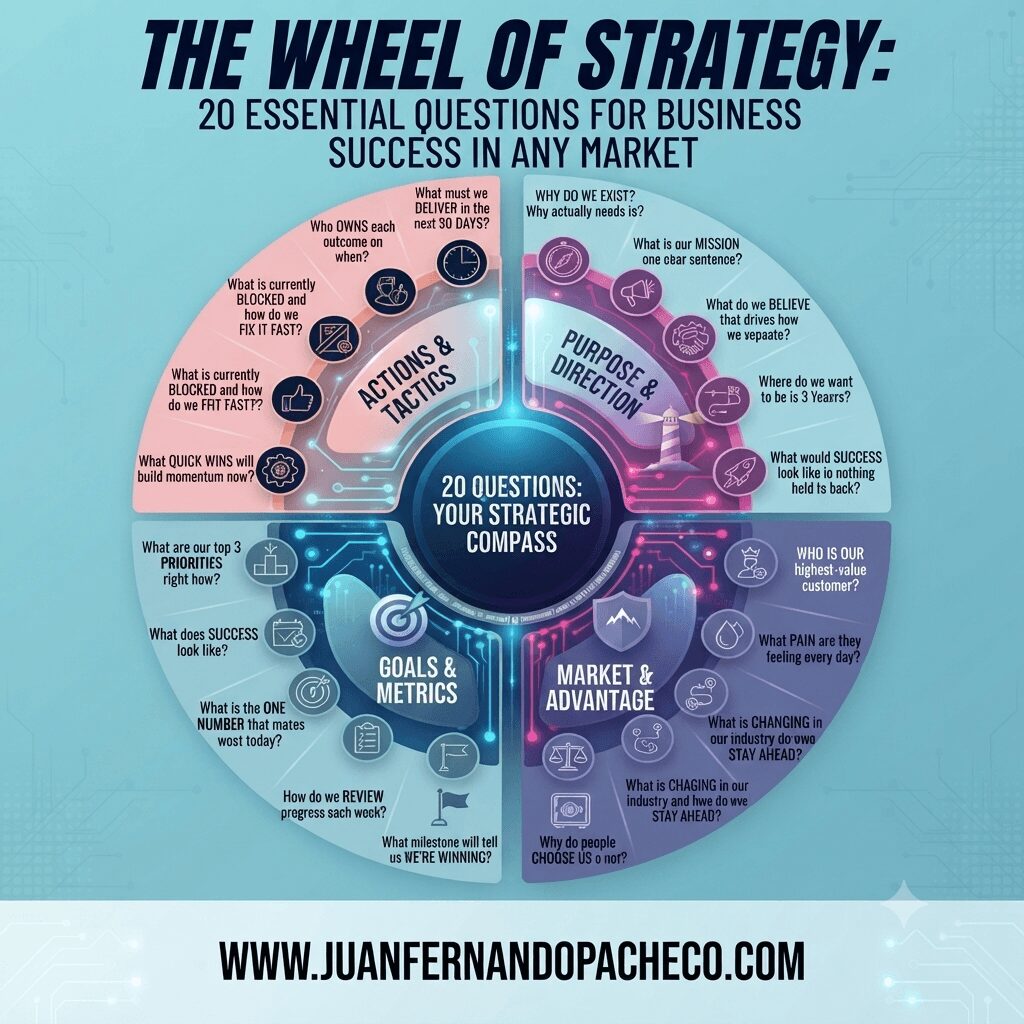
The Wheel of Strategy
This framework presents 20 questions that every CEO and business leader must be able to answer. What makes this framework particularly valuable is its timeless nature. Markets evolve, technologies change, and regional dynamics shift, but these fundamental questions remain as relevant today as they will be five years from now.
In this post, I want to explore these twenty questions through the lens of my experience scaling technology revenue across LATAM markets, executing complex deals, and building products that serve millions of users in the banking and finance sectors.
Whether you are leading a startup in Mexico, managing enterprise deals in Colombia, or driving digital transformation in Brazil, these questions will help you build a solid strategic foundation.
Understanding the Four Quadrants of Strategic Excellence
The Wheel of Strategy organizes these twenty questions into four critical quadrants:
- Purpose and Direction,
- Market and Advantage,
- Goals and Metrics, and
- Actions and Tactics.
Each quadrant addresses a different dimension of strategic thinking, and together they create a comprehensive framework for business leadership.
Let me break down each quadrant and share how these questions have shaped my approach to business development and product leadership across Latin America.
Purpose and Direction: Defining Your Why
The first quadrant focuses on the foundational elements of your organization.
These questions might seem philosophical, but in my experience leading deals across diverse markets like Ecuador, Peru, Chile, and Argentina, they are anything but abstract. They determine whether you can align stakeholders, navigate regulatory complexities, and maintain momentum when challenges arise.
Why do we exist? Who actually needs us?
This is not just about crafting a mission statement for your website. When I am working with C-level executives and board members across LATAM, these questions determine whether we are solving real problems or just selling technology for technology’s sake. In the banking and finance sector, where I have spent significant time, understanding who actually needs your solution can mean the difference between a successful implementation and a costly failure.
What is our mission in one clear sentence? Clarity is power.
When I am coordinating with cross-functional teams including product, sales, legal, engineering, and operations across multiple countries, having a clear, concise mission ensures everyone is moving in the same direction. It eliminates ambiguity and accelerates decision-making.
What do we believe that drives how we operate?
Your core beliefs shape your culture and your approach to business. In LATAM markets, where regulatory compliance, data sovereignty, and local policies vary significantly from country to country, your operational beliefs determine how you navigate these complexities.
- Do you believe in local customization or global standardization?
- Do you prioritize speed or compliance? These beliefs drive every strategic decision.
Where do we want to be in three years?
Vision without a timeline is just a dream. Setting a clear three-year horizon allows you to balance short-term execution with long-term transformation. In my role managing business development across the region, this question helps me prioritize which markets to enter, which partnerships to cultivate, and which capabilities to build.
What would success look like if nothing held us back?
This question removes constraints and encourages bold thinking. When I am working on high-stakes RFx processes, this question helps me understand the client’s ultimate aspirations, not just their immediate requirements. It opens up opportunities for transformative solutions rather than incremental improvements.
Market and Advantage: Understanding Your Competitive Position
The second quadrant shifts focus outward to your market and competitive landscape. In my experience driving revenue growth across 10+ countries, understanding your market position is not optional; it is essential for survival and growth.
Who is our highest value customer?
Not all customers are created equal. In the telecommunications, retail, and banking sectors I serve, identifying your highest value customer allows you to focus your resources where they will have the greatest impact. This is particularly important in LATAM markets where resources may be limited, and market conditions vary dramatically.
What pain are they feeling every day?
Empathy drives innovation. When I am conducting market research and identifying gaps for solution development, understanding the daily pain points of decision-makers helps me craft value propositions that resonate. In enterprise technology sales, especially when dealing with complex procurement processes, addressing real pain is what separates winning proposals from losing ones.
What is changing in our industry and how do we stay ahead?
The technology landscape is evolving rapidly. Cloud computing, digital transformation, cybersecurity, and regulatory changes are reshaping how banks and financial institutions operate across Latin America. Staying ahead requires continuous learning and adaptation. This is why I have pursued certifications in areas like digital marketing, cloud computing, and design thinking throughout my career.
Why do people choose us or not?
Honest self-assessment is critical. When I am participating in proposal creation and highlighting value propositions and key differentiators, I need to understand not just why we win, but also why we lose. This feedback loop is essential for continuous improvement and for refining our go-to-market strategy.
What can we offer that is hard to copy?
Sustainable competitive advantage comes from capabilities that are difficult to replicate. In my work at Tata Consultancy Services, our ability to navigate complex legal clauses, enterprise security requirements, and stringent SLA negotiations across multiple LATAM countries is a competitive advantage that takes years to build. It is not just about technology; it is about deep regional expertise and proven execution capability.
Goals and Metrics: Measuring What Matters
The third quadrant brings focus to execution and measurement.
Strategy without metrics is just wishful thinking. In my role managing business opportunities and reporting progress against quarterly targets, I have seen firsthand how the right metrics drive the right behaviors.
What are our top three priorities right now?
Focus is a superpower. When you are managing cross-functional teams across multiple time zones and markets, trying to do everything means accomplishing nothing. Identifying your top three priorities forces discipline and ensures that everyone is working on what matters most.
What does success look like this quarter?
Short-term accountability drives long-term success. Breaking down your three-year vision into quarterly milestones creates a rhythm of execution. In my experience leading end-to-end RFI, RFQ, and RFP processes, quarterly targets help maintain momentum and ensure that complex deals progress steadily toward closure.
What is the one number that matters most today?
While multiple metrics are important, having one north star metric provides clarity. For me, this might be revenue growth in a specific market, customer adoption rates, or deal closure rates. The key is identifying the metric that best indicates whether you are on track to achieve your strategic objectives.
How do we review progress each week?
Regular review cycles create accountability and enable course correction. When I am coordinating relationship-building efforts with partners, engagement managers, and subject matter experts, weekly check-ins ensure that everyone is aligned and that issues are addressed before they become crises.
What milestone will tell us we are winning?
Celebrating wins is important for team morale and momentum. Whether it is securing a multi-year contract with a top regional brand, achieving a twenty percent acceleration in time-to-market, or reducing customer request resolution time by thirty percent, identifying and celebrating milestones keeps teams motivated and focused.
Actions and Tactics: Executing with Excellence
The final quadrant focuses on the practical execution of strategy. This is where vision meets reality. In my work managing complex deal execution and mitigating operational and legal risks for one hundred percent on-time delivery, I have learned that excellent execution is what separates successful organizations from the rest.
When and how will we check in and adjust?
Agility is essential in dynamic markets. LATAM markets are characterized by regulatory changes, economic volatility, and evolving customer needs. Building in regular check-in points allows you to adjust course based on real-time feedback rather than sticking rigidly to a plan that may no longer be relevant.
What quick wins will build momentum now?
Early wins build confidence and credibility. When I am working on proof of concept development and execution, delivering quick wins demonstrates value and builds trust with stakeholders. This is particularly important when introducing new solutions or entering new markets where you need to establish your track record.
What is currently blocked and how do we fix it fast?
Identifying and removing blockers is a critical leadership responsibility. Whether it is a regulatory approval that is delayed, a technical issue that is preventing deployment, or a stakeholder alignment problem that is slowing decision-making, addressing blockers quickly maintains momentum and demonstrates commitment to execution.
Who owns each outcome and by when?
Clear accountability is non-negotiable. In complex, multi-country engagements, ambiguity about ownership leads to delays and finger-pointing. When I am overseeing progress on key deals and following up with leads, every outcome must have a clear owner and a clear deadline.
What must we deliver in the next ninety days?
The ninety-day horizon is long enough to accomplish meaningful work but short enough to maintain urgency. This question forces prioritization and creates a sense of urgency that drives execution. In my role delivering accurate project estimates and managing relationship development processes, ninety-day deliverables keep teams focused and accountable.
Applying the Framework Across LATAM Markets
What makes this framework particularly powerful for leaders operating in Latin America is its adaptability. The region is incredibly diverse, with 20+ countries, each with its own regulatory environment, cultural nuances, and market dynamics.
What works in Mexico may not work in Brazil. What resonates with banking executives in Colombia may not resonate with telecommunications leaders in Argentina.
By consistently asking these twenty questions, you create a disciplined approach to strategy that can be adapted to local contexts while maintaining overall coherence.
When I am driving cross-functional teams across 10+ countries, this framework ensures that we are aligned on purpose, clear on our market position, focused on the right metrics, and executing with excellence, even as we adapt our tactics to local market conditions.
Building Strategic Capability for the Long Term
Over the years of experience, I have come to believe that strategic thinking is a muscle that must be exercised regularly. It is not enough to ask these questions once during an annual planning cycle.
They must be revisited continuously as markets evolve, as customer needs change, and as new competitive threats emerge.
For young professionals looking to accelerate their careers, developing the ability to think strategically and ask these questions will set you apart.
Whether you are working in product management, business development, sales, or operations, your ability to connect your work to these strategic questions will increase your impact and your value to the organization.
Conclusion: Strategy as a Continuous Practice
The Wheel of Strategy is not a one-time exercise.
It is a continuous practice of reflection, alignment, and execution. As I continue to scale technology revenue across LATAM markets, lead high-stakes RFx execution, and transform user needs into scalable products and services, these twenty questions serve as my compass.
They remind me to stay focused on purpose, to understand my market deeply, to measure what matters, and to execute with excellence. They help me navigate the complexities of government mandates, regulatory compliance, complex legal clauses, and stringent SLA negotiations while maintaining stakeholder alignment and driving revenue growth.
Whether you are a CEO, a product leader, a business development manager, or an aspiring professional looking to make your mark, I encourage you to adopt this framework. Ask these questions regularly. Discuss them with your team. Use them to guide your strategic planning and your day-to-day execution.
The markets will continue to change. New technologies will emerge. Competitive dynamics will shift.
But these twenty questions will remain as relevant tomorrow as they are today. Master them, and you will be well-positioned to drive sustainable growth and create lasting value in any market.
What questions would you add to this framework? I would love to hear your thoughts and continue this conversation. After all, strategy is not a solo endeavor; it is a collective practice that benefits from diverse perspectives and continuous learning.