A Leader’s Guide to Aligning Vision with Execution
After many years of leading complex deals and scaling technology revenue across Latin American markets, I’ve witnessed a recurring pattern that separates high-performing organizations from those that struggle to execute: their mastery of planning at every level. Whether you’re navigating a multi-million dollar RFP process, launching a new product line, or expanding into emerging markets, success hinges on understanding how strategic, tactical, and operational planning interconnect.
Many leaders confuse these three planning types or focus exclusively on one while neglecting the others. The result?
- Brilliant strategies that never see the light of day,
- Tactical initiatives that drift without purpose, or
- Operational teams working tirelessly but moving in the wrong direction.
This guide breaks down each planning level, explains how they work together, and provides actionable insights you can apply regardless of your industry or market.
Understanding the Three Planning Levels
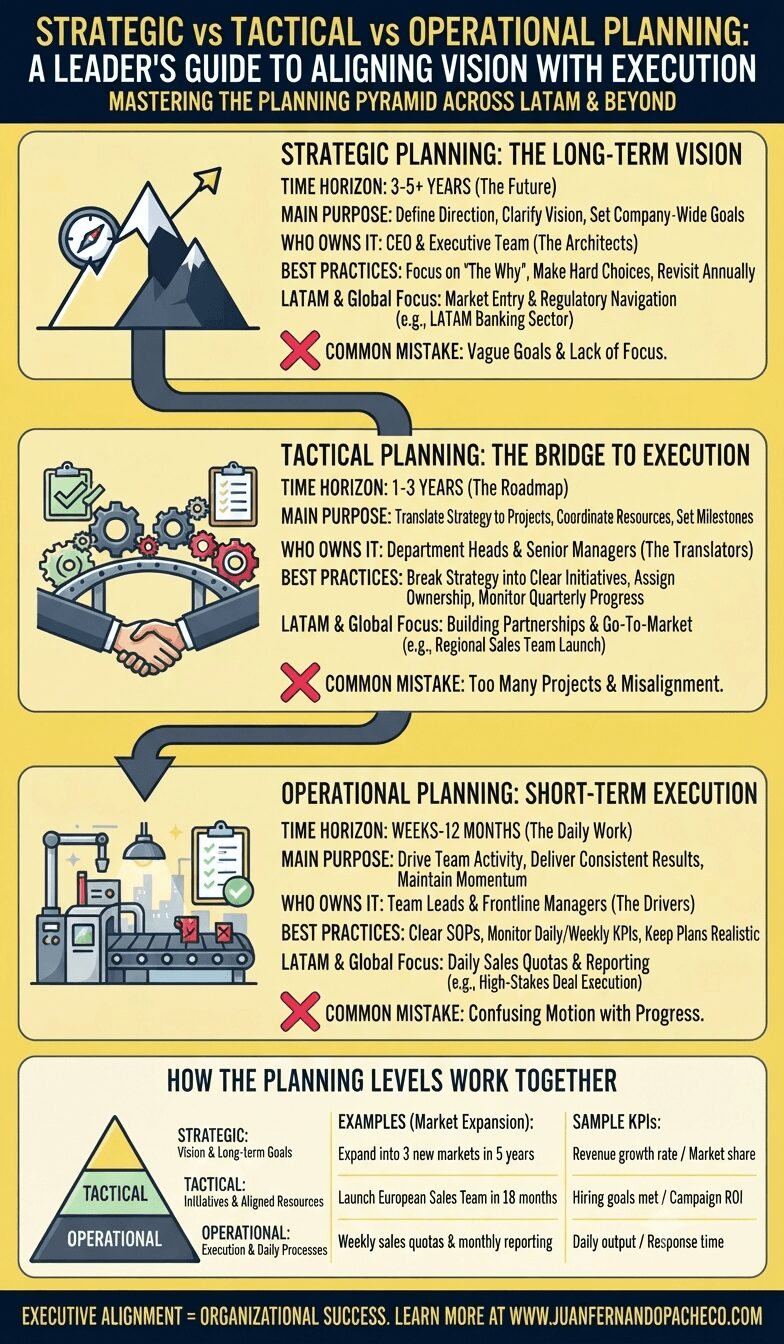
Think of organizational planning as a pyramid.
- At the top sits strategic planning, defining where you’re going and why.
- In the middle, tactical planning determines how you’ll get there.
- At the base, operational planning handles the day-to-day actions that move you forward.
All three are essential, and none can succeed in isolation.
Strategic Planning: Setting the Long-Term Direction
Strategic planning answers the fundamental question:
Where do we want to be in three to five years, and why?
This is where vision meets ambition. Strategic planning sets the long-term direction for the entire organization, defining where and how to compete while guiding company-wide priorities.
The strategic planning horizon typically spans three to five years or longer. It’s big-picture, future-focused work that shapes business trajectory rather than getting bogged down in immediate details. When I’ve led market expansion initiatives across LATAM countries, strategic planning meant identifying which markets offered the best growth potential, understanding regulatory landscapes, and positioning our solutions to meet emerging needs in banking and finance sectors.
The main purpose of strategic planning is to clarify vision and priorities, focus resources on growth opportunities, and align the entire organization around common goals. This isn’t about maintaining the status quo; it’s about deliberate, intentional growth.
Strategic planning is owned by the CEO and executive team.
Senior leaders set the final direction and often incorporate board-level input. This makes sense because strategic decisions affect the entire organization and require authority to commit resources at scale.
Best practices for strategic planning include:
- Keeping goals focused and measurable,
- Revisiting and refining the strategy annually as market conditions evolve, and perhaps most importantly,
- Deciding what you won’t pursue. The discipline of saying no is just as critical as deciding what to pursue.
Common mistakes at the strategic level include setting vague or broad goals that provide no real direction, avoiding hard trade-offs because they’re uncomfortable, and diluting focus across too many priorities. I’ve seen organizations try to be everything to everyone, only to end up being nothing special to anyone.
Tactical Planning: The Bridge to Execution
If strategic planning defines the destination, tactical planning maps the route.
Tactical planning turns strategy into actionable plans, aligns teams around key initiatives, and focuses on medium-term outcomes.
This is the bridge between vision and execution.
The tactical planning horizon typically spans one to three years ahead. It’s shorter than strategy but longer than operations, occupying that crucial mid-range planning space. Tactical planning translates high-level strategic goals into concrete projects and initiatives.
The main purpose of tactical planning is to translate strategy into projects, coordinate resources and execution, and set milestones toward big goals. This is where abstract strategic concepts become concrete action plans with timelines, budgets, and accountable owners.
Tactical planning is owned by department heads and senior managers, cross-functional leadership groups, and mid-level leaders who align their teams. These are the leaders who must interpret strategic direction and figure out how their specific functions contribute to broader organizational goals.
Best practices for tactical planning include:
- Breaking strategy into clear initiatives with defined outcomes,
- Assigning ownership and accountability so nothing falls through the cracks, and
- Monitoring quarterly progress to ensure initiatives stay on track.
This requires regular check-ins and willingness to adjust course when necessary.
Common mistakes at the tactical level include lacking alignment with strategy, which creates busy work that doesn’t advance organizational goals; taking on too many projects simultaneously, which dilutes focus and resources; and failing to define clear roles or timelines, which leads to confusion and delays.
In my experience managing complex RFQ and RFP processes across multiple LATAM markets, tactical planning meant breaking down the strategic goal of market expansion into specific initiatives: building local partnerships, ensuring regulatory compliance, developing region-specific solutions, and establishing operational capabilities in each country. Each initiative required its own timeline, budget, and accountable leaders.
Operational Planning: Short-Term Execution
Operational planning is where plans meet reality. This is the daily execution of tasks and processes, focused on immediate priorities that turn plans into action.
Operational planning covers the weeks-to-twelve-months horizon and deals with the concrete work that drives results.
The operational planning horizon spans weeks to twelve months, covering daily to quarterly goals. This is short-term, immediate work that supports tactical initiatives and ultimately advances strategic objectives.
The main purpose of operational planning is to drive team activity and output, deliver consistent results, and maintain execution momentum.
This is where the rubber meets the road, where plans are executed, and results are generated.
Operational planning is owned by team leads and frontline managers. Employees execute assigned work while supervisors oversee delivery. These are the people closest to the actual work, managing day-to-day activities and ensuring tasks are completed on time and to standard.
Best practices for operational planning include using clear SOPs and checklists to ensure consistency, monitoring KPIs regularly to track performance, and keeping plans realistic and achievable given available resources and constraints.
Common mistakes at the operational level include:
- Confusing motion with progress, where teams are busy but not necessarily advancing important goals;
- Losing sight of strategic context, which leads to optimized processes that don’t matter; and
- Overloading teams with tasks, which creates burnout and reduces quality.
How the Three Levels Work Together
The magic happens when strategic, tactical, and operational planning align. Let me illustrate with a concrete example from technology market expansion.
- At the strategic level, the vision might be to expand into three new markets within five years, with long-term goals of achieving specific revenue targets and market share. This is owned by the executive team and sets the overall direction.
- At the tactical level, this translates into launching a European sales team within eighteen months, with initiatives and aligned resources to make it happen. Department heads own this work, coordinating hiring, training, infrastructure, and go-to-market strategies.
- At the operational level, this becomes weekly sales quotas and monthly reporting, with execution and daily processes that drive results. Team leads and individual contributors own this work, focusing on hitting targets and refining processes.
Sample KPIs cascade down through the levels.
- Strategic KPIs might include revenue growth rate and market share growth.
- Tactical KPIs could track hiring goals met and campaign ROI.
- Operational KPIs focus on daily output and response time.
Applying This Framework to Complex Deal Execution
In my work leading high-stakes RFQ and RFP processes across LATAM, this three-level planning framework proves essential.
- Strategic planning identifies which opportunities align with our capabilities and growth objectives. We assess market potential, competitive positioning, and long-term relationship value.
- Tactical planning breaks down the deal pursuit into workstreams: technical solution design, commercial structuring, legal and compliance review, stakeholder engagement, and proposal development. Each workstream has clear owners, timelines, and milestones.
- Operational planning handles the day-to-day: drafting response sections, coordinating subject matter expert input, reviewing compliance requirements, refining pricing models, and preparing for client presentations. Teams execute against tight deadlines with clear checklists and quality standards.
When all three levels align, we submit winning proposals that meet client needs while advancing our strategic objectives. When they don’t align, even excellent operational execution can’t compensate for pursuing the wrong opportunities or lacking coherent deal strategies.
Common Pitfalls and How to Avoid Them
- One common pitfall is strategic-tactical disconnect, where executive teams set ambitious strategies but fail to resource tactical initiatives adequately.
- The solution is ensuring tactical leaders participate in strategic planning and that resource implications are explicitly addressed.
- Another pitfall is tactical-operational misalignment, where initiatives are launched without considering operational capacity or capability.
- The solution is involving operational leaders early in tactical planning and being realistic about what can be executed.
- A third pitfall is operational myopia, where teams get so focused on daily execution that they lose sight of strategic context.
- The solution is regular communication about strategic goals and helping operational teams understand how their work contributes to larger objectives.
Making This Framework Work in Your Organization
Start by assessing your current planning processes.
- Do you have clear strategic, tactical, and operational plans?
- Are they aligned?
- Do the right people own each level? Is there regular communication across levels?
Next, establish regular planning rhythms.
- Strategic planning typically happens annually with quarterly reviews.
- Tactical planning might occur quarterly with monthly check-ins.
- Operational planning happens weekly or even daily. These rhythms should connect, with insights flowing up and direction flowing down.
Create visual artifacts that show the connections. Strategy maps, initiative roadmaps, and operational dashboards should clearly link to each other. Everyone should understand how their work connects to broader organizational goals.
Finally, build in feedback loops. Operational teams often have the best insights about what’s working and what isn’t. Create mechanisms for these insights to inform tactical adjustments and even strategic refinements.
Conclusion
Mastering strategic, tactical, and operational planning isn’t about creating more documents or holding more meetings.
It’s about creating clarity, alignment, and accountability across your organization. When done well, everyone understands the vision, knows their role in achieving it, and executes with purpose.
Whether you’re scaling technology revenue across emerging markets, managing complex enterprise deals, or building products that serve millions of users, this three-level planning framework provides the structure you need to turn ambition into results. The organizations that excel aren’t necessarily smarter or better resourced than their competitors. They’re simply better at aligning vision with execution across all three planning levels.
Start where you are. Assess your current planning maturity. Identify gaps and misalignments. Then systematically strengthen each level while improving connections between them. The payoff is an organization that moves with purpose, adapts with agility, and executes with excellence.
Key Takeaways
- Strategic planning sets long-term direction, tactical planning bridges to execution, and operational planning drives daily results
- All three levels must align for organizational success; weakness at any level undermines the entire system
- Clear ownership, regular rhythms, and strong communication across levels are essential
- Regular feedback loops ensure operational insights inform tactical and strategic adjustments
- Start with assessment, then systematically strengthen each planning level and their connections