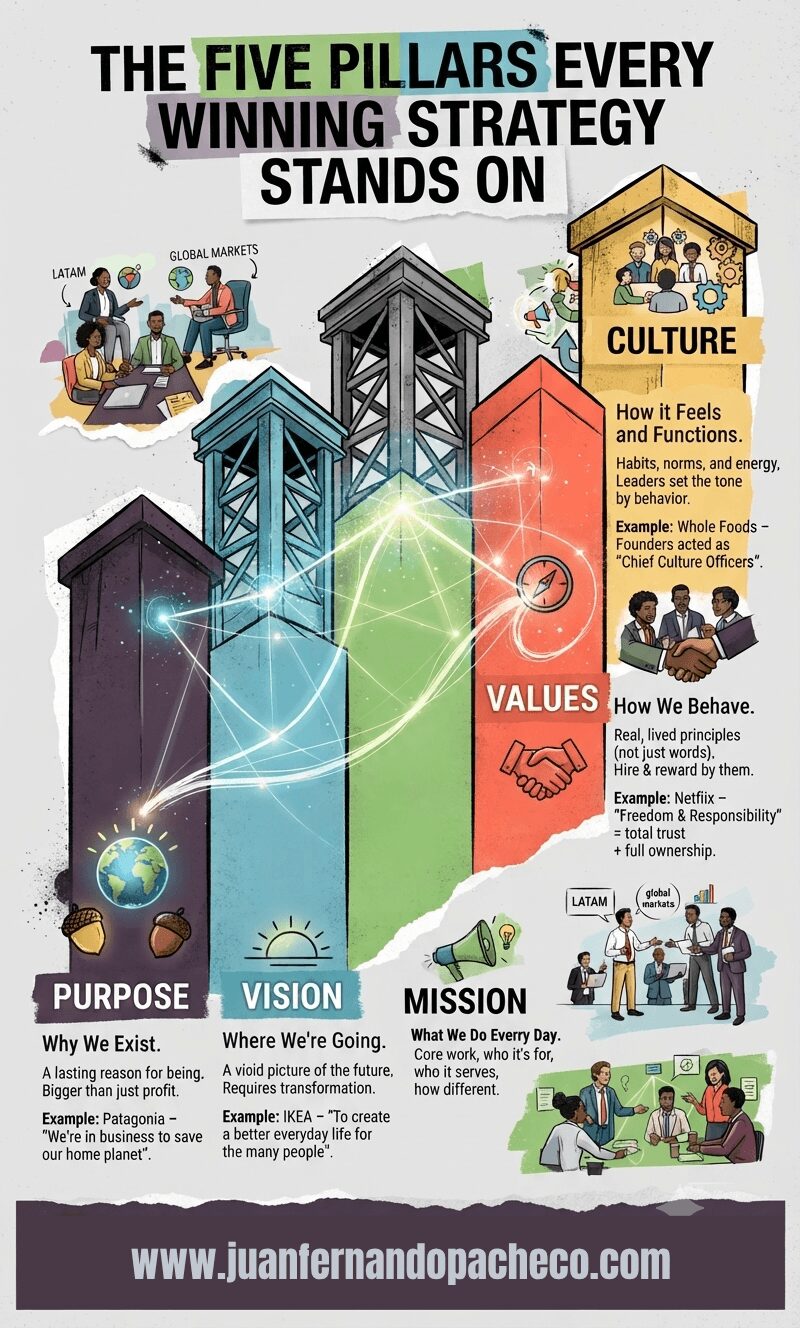
A leader’s guide to building lasting success
After many years of navigating complex technology deals, building products for millions of users across Latin America, and leading cross-functional teams through high-stakes negotiations, I’ve learned something fundamental:
Strategies don’t fail because of poor execution. They fail because they were never built on solid ground.
I’ve sat across from C-level executives in Mexico City, Bogotá, and São Paulo, watching them present elaborate strategic plans filled with ambitious targets and innovative initiatives.
Some of these strategies transformed their organizations. Others gathered dust in boardroom presentations within six months.
The difference wasn’t talent, resources, or market conditions. The difference was whether their strategy rested on five non-negotiable pillars.
Whether you’re scaling a tech startup, leading digital transformation in a legacy bank, or positioning your company for enterprise contracts, these pillars determine whether your strategy will soar or collapse under pressure. Let me walk you through what I’ve learned about building strategies that actually work.
Pillar one: purpose – the foundation that answers why we exist
Purpose sits at the base of everything because it answers the most fundamental question any organization must confront:
Why do we exist beyond making money?
I’ve worked with financial institutions across Latin America that treated purpose as a nice-to-have statement for their website. Then I’ve worked with organizations that embedded purpose into every decision, every hire, every product feature. The results were dramatically different.
Purpose isn’t your mission statement dressed up in inspirational language. It’s the lasting reason your organization should exist even if it never turned a profit. It’s what would be missing from the world if you closed tomorrow.
Take Patagonia, for example.
Their purpose isn’t to sell outdoor clothing. It’s to save our home planet.
That purpose shapes everything from their supply chain decisions to their marketing to their product development. When a company’s purpose is this clear, strategic decisions become easier, not harder.
In the technology sector, I’ve seen companies struggle because they defined their purpose around their product rather than the problem they solve. A software company isn’t in business to write code. They’re in business to solve specific problems for specific people. When you anchor your strategy in purpose, you give your team permission to pivot tactics while staying true to why you exist.
Here’s what I’ve learned from negotiating multi-million dollar contracts:
Clients can smell when a company lacks purpose.
They can tell when you’re just trying to close a deal versus when you genuinely believe your solution will transform their business.
Purpose isn’t soft. It’s your most powerful commercial asset.
To define your purpose, ask yourself: if we disappeared tomorrow, what would the world miss? Not what products would be unavailable, but what value would vanish? The answer to that question becomes the bedrock of your strategy.
Pillar two: vision – painting the picture of where we’re going
If purpose is your foundation, vision is your north star. It’s a vivid, specific picture of the future you’re building together. Not a vague aspiration, but a concrete description of what success looks like five to ten years from now.
I’ve led product teams through digital transformations where the vision was so unclear that engineers, designers, and business stakeholders were all building toward different futures. The result? Wasted months, frustrated teams, and products that missed the mark.
A powerful vision does three things.
- First, it’s specific enough that people can see it.
- Second, it’s inspiring enough that people want to work toward it.
- Third, it’s ambitious enough that it requires transformation, not just incremental improvement.
Consider IKEA‘s vision:
To create a better everyday life for the many people.
Notice what they didn’t say. They didn’t say “to sell the most furniture” or “to dominate the home goods market.” They painted a picture of a future state – better everyday life – and defined who they serve – the many people.
In my work scaling technology solutions across Latin American markets, I’ve found that vision becomes especially critical when you’re operating across different countries and cultures. Teams in Mexico, Colombia, and Brazil might face different regulatory environments, customer behaviors, and competitive landscapes. But if they share a clear vision of where you’re going, they can adapt their tactics while moving in the same direction.
The mistake I see leaders make is confusing vision with strategy.
Vision is the destination. Strategy is the route you’ll take to get there.
You can adjust your route based on roadblocks, traffic, or new opportunities, but your destination should remain steady.
When crafting your vision, describe the world you’re creating, not your company’s metrics. Don’t say “we’ll be the market leader with thirty percent share.”
Say what that leadership enables for your customers, your industry, or society. Make it inspiring and specific enough that your team can see it, feel it, and work toward it every day.
Pillar three: mission – defining what we do every day
If vision is where you’re going, mission is what you do every single day to get there. It’s your core work, who it’s for, and how you’re different.
I’ve sat through countless strategic planning sessions where teams struggled to articulate their mission clearly. They’d describe their products, their services, their features – but not their fundamental reason for existing in the market today.
A strong mission statement can be expressed in one sentence that combines verb plus who plus what makes you unique.
TED‘s mission is to spread ideas.
That’s it. Simple, clear, actionable. Every decision they make – from which speakers to invite to how they structure their events – flows from that mission.
In the enterprise technology space where I’ve spent most of my career, mission clarity separates winners from also-rans. When you’re competing for multi-year contracts against global competitors, clients need to understand not just what you do, but why you do it differently and better than anyone else.
Your mission should guide daily decisions. When I’m working with product teams on agile roadmaps, we constantly refer back to the mission.
- Does this feature serve our mission?
- Does this prioritization decision align with what we said we do every day?
If not, it’s a distraction, no matter how attractive it might seem.
The danger is mission creep – slowly expanding what you do until you’re trying to serve everyone and ending up serving no one well. I’ve watched technology companies add product after product, service after service, until their mission became so broad it was meaningless. They lost focus, their teams became confused, and their market position weakened.
A clear mission creates boundaries. It tells you what not to do as clearly as what to do. In my experience negotiating complex deals across banking, retail, and telecommunications sectors, the companies that won were rarely the ones trying to do everything. They were the ones with crystal-clear missions that resonated with specific customer needs.
To craft your mission, complete this sentence:
We [verb] [who] by [what makes you unique].
Keep iterating until it’s so clear that anyone in your organization could explain it to a stranger.
Pillar four: values – how we behave on the journey
Values are where strategy meets reality. They’re not the nice words on your website. They’re your real, lived principles that determine how you actually behave when no one’s watching.
I’ve worked with organizations that had beautiful value statements – integrity, innovation, collaboration – but whose actual behaviors rewarded the opposite.
- They claimed to value innovation but punished failure.
- They claimed to value collaboration but promoted individual stars.
The disconnect between stated values and actual behavior created cynicism that poisoned their culture and undermined their strategy.
Here’s what I’ve learned:
Values only matter when they’re paired with specific behaviors.
Netflix famously values “freedom and responsibility.” But they don’t stop there. They define what that looks like in practice – total trust plus full ownership. That clarity tells people exactly how to behave.
To make values real, pick three to five and pair each with a behavior statement.
- Instead of just saying “integrity,” say “we tell the truth even when it’s uncomfortable.”
- Instead of just “innovation,” say “we experiment fast and fail forward.”
In my years managing complex RFx processes and high-stakes negotiations, I’ve seen values tested in real time. When a deal is on the line, and there’s pressure to cut corners or overpromise, your values determine whether you’ll maintain your integrity or sacrifice it for short-term gain.
Companies with weak values cave under pressure. Companies with strong values use pressure as proof of their commitment.
Values also guide hiring, promotion, and reward decisions. I’ve built high-performing teams by hiring for values alignment as much as skills.
Skills can be taught. Values are much harder to change.
When someone consistently demonstrates your values, promote them. When someone violates them, even if they’re a top performer, address it immediately. Your team is watching to see if you’ll actually live your values or just talk about them.
One practice I’ve found powerful is surfacing proud moments – times when someone demonstrated your values in action. Share these stories widely. Celebrate them. Make them part of your organizational folklore. This reinforces that values aren’t abstract concepts but real behaviors that earn recognition and reward.
Pillar five: culture – how it feels and functions
Culture sits at the top of the pyramid because it’s the culmination of everything below it.
Culture is how it feels and functions every single day.
It’s the habits, norms, and energy people experience when they walk into your office or join your video call.
I’ve led cross-functional teams across 10+ countries, and I can tell you this:
Culture eats strategy for breakfast. You can have the most brilliant strategy built on rock-solid purpose, vision, mission, and values, but if your culture doesn’t support it, you’ll fail.
Culture is shaped by what you tolerate, what you celebrate, and what you punish. Leaders set the tone through their behavior, not their words. If you say you value work-life balance but send emails at midnight expecting immediate responses, you’ve just defined your real culture. If you claim to value innovation but shoot down every risky idea, you’ve revealed your actual culture.
In my experience transforming user needs into scalable products,
I’ve seen culture make or break digital transformation initiatives.
Teams with strong cultures of collaboration, experimentation, and customer focus adapted quickly and delivered results. Teams with cultures of blame, risk-aversion, and internal competition struggled regardless of how talented the individuals were.
Culture is reinforced through systems – your rewards, meetings, stories, and rituals. Whole Foods famously had founders act as “chief culture officers,” intentionally designing systems to reflect their values. They didn’t leave culture to chance. They engineered it.
To shape culture intentionally, start by observing what actually happens versus what you say should happen. Where are the gaps? What behaviors are actually rewarded? What stories do people tell about “how things really work around here?” Then, design systems that reinforce the culture you need to execute your strategy.
Remember:
Culture isn’t ping pong tables and free snacks.
It’s whether people feel safe speaking up, whether failures are treated as learning opportunities, whether collaboration is rewarded over internal competition. These are the cultural elements that determine strategic success.
Bringing the pillars together
Here’s what makes these five pillars powerful: they work together as an integrated system. Purpose without vision is just philosophy.
Vision without mission is just dreaming. Mission without values is just tactics. Values without culture is just hypocrisy.
When I’m advising organizations on scaling their technology revenue or navigating complex enterprise deals, I always start by assessing these five pillars.
- Are they clear?
- Are they aligned?
- Are they actually driving decisions and behaviors?
The organizations that win aren’t necessarily the ones with the smartest people or the biggest budgets. They’re the ones with strategies built on these five solid pillars, consistently reinforced through daily actions and decisions.
Your strategy is only as strong as its weakest pillar. Strengthen all five, and you’ll build something that lasts.
What pillar needs the most attention in your organization? I’d love to hear your thoughts. Connect with me at juanfernandopacheco.com or through LinkedIn to continue the conversation.

