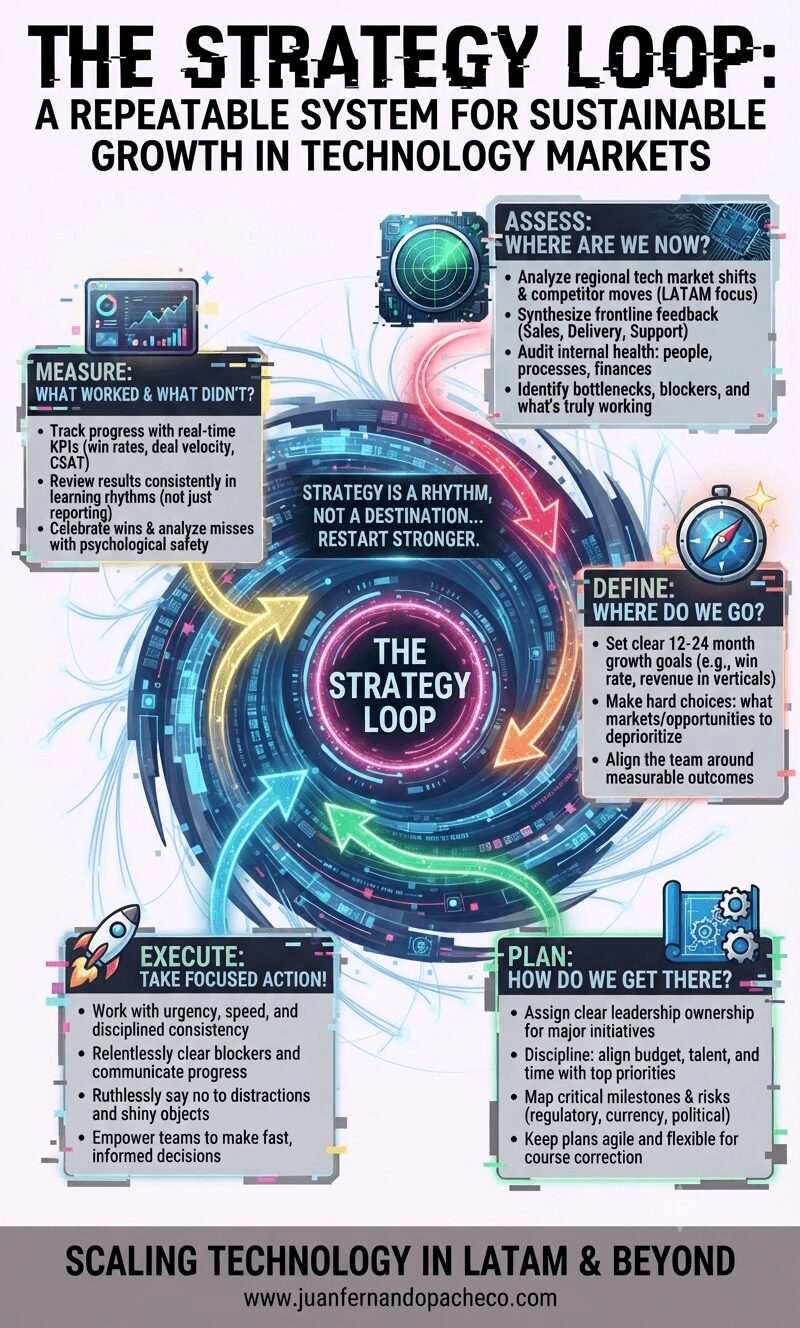
A repeatable system for sustainable growth in technology markets. Strategy Loop
After two decades of navigating complex technology deals across Latin America, I have learned one fundamental truth:
Strategy is not a destination. It is a rhythm. A cycle. A disciplined practice of continuous reassessment and adaptation.
Too many leaders treat strategic planning as an annual event—a week-long retreat, a deck of slides, a set of goals written in stone.
Then they wonder why, six months later, those carefully crafted plans feel disconnected from reality.
- The market has shifted.
- Customer needs have evolved.
- Competitors have moved.
And that static strategy is now collecting digital dust on a shared drive.
The solution is not better planning. It is better looping.
Why strategy must be cyclical, not linear
In the technology sector, particularly when scaling across diverse markets like Latin America, change is the only constant.
- Regulatory frameworks shift.
- Economic conditions fluctuate.
- Digital transformation accelerates.
What worked in Mexico last quarter may not work in Colombia this quarter. A solution that resonated with banking clients in Brazil might need significant adaptation for retail customers in Chile.
This is why the most successful technology leaders I have worked with do not think in straight lines. They think in loops.
They understand that strategy is a repeatable system—a disciplined cycle of assessment, definition, planning, execution, and measurement that repeats continuously.
This approach is particularly critical when managing complex procurement processes like RFI, RFQ, and RFP cycles. These high-stakes deals require constant calibration.
You must assess where you stand, define what winning looks like, plan your approach, execute with precision, and measure your progress—then loop back and do it again with greater intelligence.
First step: Assess – where are we now?
The foundation of any effective strategy is brutal honesty about your current reality.
This is not about wishful thinking or optimistic projections. It is about gathering unvarnished truth from multiple sources.
Start by analyzing market shifts and competitor movements. In Latin America’s technology landscape, this means understanding not just global trends but regional nuances.
- How are data sovereignty regulations evolving in Ecuador?
- What new compliance requirements are emerging in Brazil’s financial sector?
- Which competitors are gaining traction in Mexico’s retail space?
Next, gather customer and frontline feedback. Your sales teams, your delivery managers, your support staff—they are your sensors in the market; they:
- Hear what customers really think, not what they say in formal meetings.
- See where your solutions create value and where they fall short.
Create systematic ways to capture this intelligence and bring it into your strategic discussions.
Review performance across three dimensions: people, processes, and finances.
- Are the teams equipped with the right skills and resources?
- Are the delivery processes efficient and scalable?
- Achieving the revenue and margin targets that sustain growth?
Finally, identify what is working and what is holding you back. This requires intellectual courage. Celebrate the wins, yes, but do not shy away from uncomfortable truths. Perhaps your proof-of-concept development is too slow. Maybe your legal review process is creating bottlenecks. Your value proposition may not be differentiated enough in crowded markets.
Second step: Define – where do we want to go?
Once you have assessed your current reality, you must define your destination with clarity and precision.
Vague aspirations like “grow revenue” or “expand market share” are not strategies. They are wishes.
Set clear 12 to 24-month goals that are specific, measurable, and ambitious yet achievable.
In technology services, this might mean targeting a specific revenue milestone in a particular vertical, achieving a certain win rate in competitive deals, or establishing market leadership in an emerging technology domain.
Choose priorities that drive growth, but perhaps more importantly, decide what you will not pursue.
This is where many leaders struggle. The temptation to say yes to every opportunity, every market, every customer segment is strong. But strategy is about trade-offs. It is about focus. When I work with teams across Latin America, I often see more success when they concentrate resources on three or four high-potential markets rather than spreading themselves thin across ten.
Align your team around outcomes, not activities.
People should understand not just what they are doing but why it matters. How does their work contribute to the broader strategic goals? How will success be measured? When everyone understands the destination, they can navigate the journey with greater autonomy and creativity.
Third step: Plan – how will we get there?
With your destination defined, you must chart the course. This is where strategy meets operational reality. Break your goals into owner-led initiatives with clear accountability.
Each major objective should have a leader who owns the outcome and has the authority to make decisions.
In complex technology deals, this might mean creating cross-functional teams for major pursuits—one person owns the technical solution design, another owns the commercial modeling, another owns the client relationship. Each has clear milestones and deliverables, but they work together toward a common outcome.
- Allocate resources to your top priorities with discipline. This is where many strategies fail. Leaders define bold goals but do not back them with budget, talent, or time. If expanding into Colombia’s financial services sector is a strategic priority, so are you:
- Investing in local talent?
- Dedicating senior leadership attention?
- Allocating marketing budget? Resources follow priorities—or they should.
- Define milestones and risks. Map out the critical checkpoints that will tell you whether you are on track. Identify potential derailments to your plans and develop mitigation strategies. In Latin American markets, this often means planning for regulatory changes, currency fluctuations, or political shifts that could impact your business.
- Keep plans simple and flexible. The most elegant strategy is useless if it is so complex that nobody can remember it or so rigid that it cannot adapt to changing circumstances. Create plans that provide clear direction while allowing for course correction as you learn and the market evolves.
Step four: Execute – take focused action
Strategy without execution is hallucination. This is where the rubber meets the road, where plans become results.
Execute with speed, discipline, and consistency. In competitive technology markets, hesitation is costly. Opportunities have windows, and those windows close.
- Work with urgency but not panic. There is a difference between moving fast and moving recklessly. Speed comes from clarity of purpose, streamlined decision-making, and empowered teams—not from cutting corners or burning out your people.
- Communicate progress and clear blockers relentlessly. Create rhythms of communication that keep everyone informed and aligned. Weekly check-ins, monthly reviews, quarterly assessments—whatever cadence makes sense for your organization. But when blockers emerge, address them immediately. Do not let obstacles fester.
- Say no to distractions that do not align with goals. This is perhaps the hardest part of execution. New opportunities will emerge. Shiny objects will appear. Customers will request customizations that pull you off strategy. Leaders must be the guardians of focus, constantly asking: does this move us toward our strategic goals, or does it divert our energy?
- Empower teams to make decisions and move forward. Hierarchy and bureaucracy are the enemies of execution. When you have aligned your team around clear outcomes and provided them with the resources they need, trust them to figure out the how. Micromanagement slows everything down.
Step five: Measure – what worked and what did not?
Execution without measurement is noise.
You must track progress with real data, not anecdotes or gut feelings. Define the metrics that matter and review them consistently. In technology services, this might include win rates, deal velocity, customer satisfaction scores, revenue growth, margin performance, or employee engagement.
Review results monthly or quarterly, depending on the metric and the pace of your business.
The goal is not to create bureaucratic reporting burdens but to create learning loops.
- Are you on track? If not, why?
- What assumptions proved wrong?
- What unexpected opportunities emerged?
Celebrate wins and learn from misses. Recognition matters.
When teams achieve milestones, acknowledge it publicly. But equally important is creating psychological safety to discuss failures and misses. What did not work is often more instructive than what did. Apply these insights to the next cycle.
This is where the loop closes and begins again. The insights from measurement feed directly into your next assessment phase. You now have better data, deeper market intelligence, and a clearer understanding of your capabilities. Use this to recalibrate and start the cycle again, stronger and smarter.
The power of the loop in Latin American technology markets
Having spent years scaling technology revenue across Latin America, I can attest to the particular value of this cyclical approach in our region. The diversity of markets—from Mexico’s manufacturing hubs to Brazil’s financial centers to Ecuador’s emerging tech scene—demands constant adaptation.
What works in one country may need significant adjustment in another.
Complex procurement processes like RFI, RFQ, and RFP cycles are themselves loops within loops. Each pursuit requires assessment of the opportunity, definition of the win theme, planning of the response, execution of the proposal, and measurement of the outcome. Then you loop back, applying lessons learned to the next opportunity.
The regulatory complexity of Latin American markets—data sovereignty requirements, local content rules, varying compliance frameworks—makes the strategy loop essential. You cannot set a strategy once and execute it blindly. You must continuously assess the regulatory environment and adapt your approach.
Similarly, the commercial-product synergy that drives growth in technology services requires constant calibration. Customer feedback must flow into product roadmaps. Market insights must shape solution development. This happens through repeated loops of assessment, definition, planning, execution, and measurement.
Making the strategy loop stick
The strategy loop is simple to understand but challenging to practice consistently. It requires discipline. It demands honesty. It needs leadership commitment.
- Start by institutionalizing the rhythm. Create calendar events for each phase. Make strategy review a standing agenda item, not an ad-hoc discussion. Build the loop into your operating cadence.
- Develop the muscles of strategic thinking across your organization. Not just at the executive level but throughout your teams. Train people to assess situations objectively, define clear outcomes, plan systematically, execute with discipline, and measure rigorously.
- Create accountability for the loop itself. Who ensures that assessment happens? Who facilitates the definition phase? Who tracks whether plans are being executed and measured? Assign ownership.
- Most importantly, embrace the iterative nature of strategy. Let go of the illusion that you can get it perfect the first time. The goal is not a flawless plan. The goal is a learning organization that gets smarter with each loop.
Your next loop starts now
The strategy loop is not a theoretical framework. It is a practical system used by high-performing technology organizations to navigate complexity, seize opportunities, and sustain growth. Whether you are leading a product team, managing complex deals, or scaling across new markets, this cyclical approach provides the structure you need while allowing the flexibility that reality demands.
- Stop treating strategy as a once-a-year event. Start treating it as a continuous practice. Assess your current reality with honesty.
- Define your destination with clarity. Plan your approach with discipline. Execute with focus. Measure with rigor. Then loop back and do it again, stronger and smarter.
- In the fast-moving world of technology, particularly in the dynamic markets of Latin America, this is not just a competitive advantage. It is a survival imperative.
The question is not whether you will adapt and evolve. The question is whether you will do it systematically, intentionally, and ahead of the competition. The strategy loop gives you the system. Now it is time to practice it.
Your next loop starts today.

