A framework for sustainable growth in Latin American markets
After many years of navigating complex technology deals, building products for banking and finance sectors, and scaling revenue across Latin American markets, I have learned that successful strategies are not accidental. They are built on foundational pillars that, when properly aligned, create unstoppable momentum. But when misaligned, they lead to wasted resources, missed opportunities, and strategies that look great on paper but fail in execution.
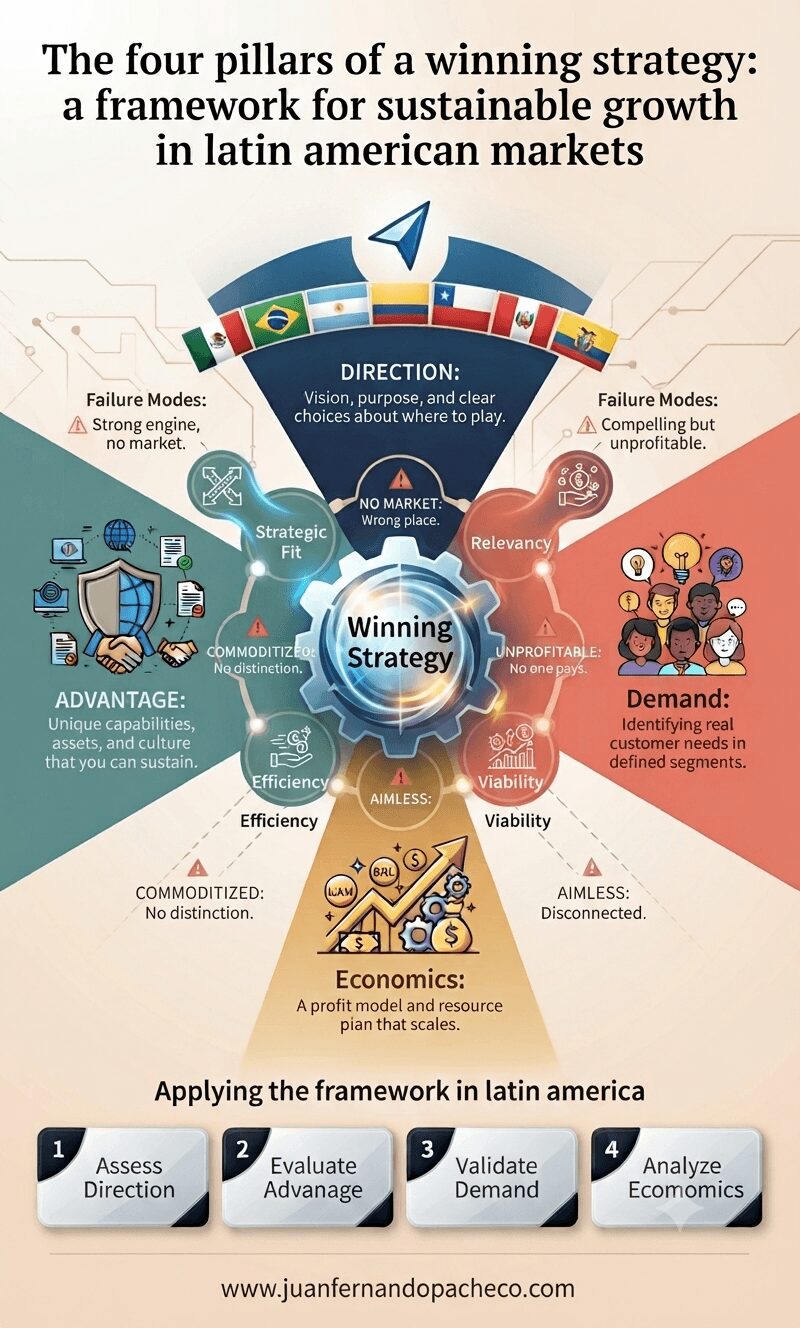
The framework I want to share with you today breaks down winning strategy into four essential pillars: direction, advantage, demand, and economics. Each pillar is critical on its own, but the real magic happens at their intersections. This is not just theory; it is a practical framework I have used to secure multi-million dollar contracts, navigate complex RFx processes, and build products that serve millions of users across Mexico, Colombia, Brazil, Argentina, and beyond.
Whether you are a product leader, business development professional, or executive responsible for growth in Latin America, this framework will help you diagnose strategic gaps, align stakeholders, and build strategies that withstand market volatility and regulatory complexity.
Pillar one: direction
Direction is about vision, purpose, and making clear choices about where to play.
In my experience leading deals across Latin America, I have seen too many organizations confuse activity with strategy. They chase every opportunity, respond to every RFP, and try to be everything to everyone. The result is scattered resources and mediocre outcomes.
True direction requires discipline.
It means saying no to opportunities that do not align with your core capabilities or strategic vision. When I lead complex procurement processes for top regional brands, the first question I ask is not “can we do this?” but “should we do this?”
- Does this opportunity move us toward our long-term vision?
- Does it leverage our unique strengths?
- Does it serve a market segment where we can dominate?
In the Latin American context, direction becomes even more critical because of the region’s diversity. What works in Mexico may not work in Brazil. Regulatory requirements in Colombia differ significantly from those in Argentina. A winning strategy requires clear choices about which markets to prioritize, which segments to serve, and which problems to solve.
Without clear direction, you end up with what the framework calls “compelling but unprofitable” strategies. You might have innovative solutions and enthusiastic teams, but without clear choices about where to play, you burn cash chasing growth that cannot scale or sustain.
I have witnessed this firsthand when companies expand too quickly across Latin America without establishing a solid foundation in their initial markets.
Pillar two: advantage
Advantage is about your unique capabilities, assets, and culture that you can sustain over time.
In the technology services sector, where I have spent most of my career, competitive advantage is not just about having the best technology. It is about combining technical expertise with deep market knowledge, regulatory understanding, and the ability to navigate complex stakeholder environments.
My advantage in leading RFx processes across Latin America comes from many years of experience transforming user needs, business goals, and regional complexities into scalable solutions. I understand the nuances of government mandates, data sovereignty requirements, and local policies that vary from country to country. This is not knowledge you can acquire overnight; it is built through years of on-the-ground experience and relationship building.
For organizations operating in Latin America, sustainable advantage often comes from understanding the unique characteristics of the region. This includes navigating economic volatility, managing currency risks, building trust in markets where relationships matter more than contracts, and adapting global solutions to local realities.
However, advantage without direction leads to what the framework describes as “strong engine, no market.”
You might have world-class capabilities and an amazing product, but if you are solving problems that nobody cares about or targeting markets that do not value your unique strengths, you will struggle. I have seen brilliant technical teams build sophisticated solutions for banking and finance sectors only to discover that their target customers have different priorities or budget constraints.
Pillar three: demand
Demand is about identifying real customer needs in defined segments.
This seems obvious, yet it is one of the most commonly neglected pillars in strategy development. Too often, organizations fall in love with their solutions rather than falling in love with the problems they are solving.
In my work across Latin America, I have learned that demand validation requires more than market research reports and surveys. It requires deep customer engagement, understanding not just what customers say they want, but what they actually need to achieve their business objectives. When I lead discovery sessions for complex deals, I spend significant time understanding the customer’s strategic priorities, operational challenges, regulatory constraints, and success metrics.
The Latin American market presents unique demand characteristics.
- Banking and finance sectors, for example, face intense pressure to digitize while maintaining strict regulatory compliance.
- Retail companies need to serve customers who increasingly expect digital experiences but may have limited internet access or prefer cash transactions.
- Telecommunications companies must navigate infrastructure challenges while meeting growing data demands.
Understanding these nuances is critical for identifying real demand. It is not enough to know that there is a market for digital banking solutions; you must understand which specific problems are most urgent, which regulatory requirements are non-negotiable, and which customer segments are ready to pay for solutions.
When you have demand without advantage, you end up in what the framework calls “profitable but commoditized” situations. There is real customer need, and you can make money, but you have nothing unique or defensible. Competitors can easily replicate your offering, and you end up competing on price rather than value. I have seen this happen repeatedly in the technology services sector, where companies chase hot trends without building sustainable differentiation.
Pillar four: economics
Economics is about having a profit model and resource plan that scales.
This pillar is often overlooked in the excitement of building innovative products or chasing new markets, but it is fundamental to long-term success. A strategy without sound economics is not a strategy; it is a hobby.
In my experience managing complex deals across Latin America, economics extends beyond simple pricing and margins. It includes understanding the total cost of delivery, accounting for regional complexities like currency fluctuations, regulatory compliance costs, and the need for local presence. It means building resource plans that can scale as you grow, without requiring proportional increases in overhead.
For technology services companies operating in Latin America, economic sustainability often requires balancing global efficiency with local responsiveness.
You need enough local presence to understand market nuances and build customer relationships, but not so much that you cannot achieve economies of scale. You need to invest in compliance and security to meet regulatory requirements, but not so much that you price yourself out of the market.
When you have economics without direction, you create what the framework describes as “profitable but aimless” strategies. You might make money in the short term, but your priorities are scattered, resources are spread thin, and you lack the focus needed to build market leadership. I have seen companies achieve quarterly targets while slowly losing strategic position because they said yes to every opportunity without evaluating strategic fit.
The power of intersection
The real power of this framework emerges when you examine the intersections between pillars. These intersections represent the critical alignment points that separate winning strategies from failing ones.
- Strategic fit, the intersection of direction and advantage, is where your vision meets your capabilities. This is where you answer the question: are we playing in markets where we can win? In my work, strategic fit means focusing on sectors where I have deep expertise, like banking and finance, and markets where I have established relationships and regulatory knowledge.
- Relevancy, where direction meets demand, ensures that your vision addresses real customer needs. This is critical in Latin America, where customer needs can vary significantly by country and segment. A solution that is highly relevant for Mexican banks may not be relevant for Brazilian retailers.
- Viability, the intersection of demand and economics, confirms that there is a sustainable business model. Customers may need your solution, but will they pay enough for you to deliver profitably at scale? This question is particularly important in price-sensitive Latin American markets.
- Efficiency, where advantage meets economics, is about leveraging your unique capabilities most cost-effectively. This is where operational excellence meets strategic differentiation. For example, my ability to navigate complex RFx processes efficiently creates value for both my organization and our clients.
Applying the framework in Latin America
Let me share how I apply this framework in practice when evaluating opportunities across Latin America. When a new RFx comes in, or a potential client expresses interest, I systematically evaluate it against all four pillars.
- I assess direction: does this opportunity align with our strategic focus on banking, finance, and cross-segment markets? Does it move us toward our vision of being the trusted technology partner for Latin America’s leading organizations?
- I evaluate advantage: do we have unique capabilities that give us a competitive edge in this specific opportunity? Do we understand the regulatory environment, cultural nuances, and stakeholder dynamics?
- I validate demand: is this a real priority for the client, or just a nice-to-have? What are the consequences if they do nothing? How urgent is their need?
- I analyze economics: can we deliver this profitably? What are the resource requirements? Are there hidden costs related to compliance, localization, or ongoing support?
Only when all four pillars are strong, and the intersections are aligned, do I pursue the opportunity aggressively. This discipline has allowed me to maintain a high win rate while avoiding deals that look attractive on the surface but lack strategic foundation.
Building your winning strategy
As you reflect on your own strategy, I encourage you to use this framework as a diagnostic tool. Map your current initiatives against the four pillars.
- Where are you strong?
- Where are you weak?
- Which intersections need attention?
If you are launching a new product or entering a new market, validate all four pillars before making significant investments. Do not assume that strength in one area compensates for weakness in another.
A great product with no market will fail. A real market need with no economic model will fail. Unique capabilities with no strategic direction will fail.
In the dynamic, complex markets of Latin America, where regulatory environments shift, economic conditions fluctuate, and customer needs evolve rapidly, having a solid strategic foundation is not optional; it is essential for survival and growth.
Remember, a winning strategy is not about having all the answers upfront. It is about asking the right questions, making informed choices, and continuously validating that your pillars remain strong and aligned as conditions change.
That is how you build strategies that win, not just today, but for years to come.