A timeless framework for product leaders and deal makers
After many years of navigating complex technology deals across Latin America, leading product transformations in banking and finance, and closing multi-million dollar contracts through rigorous RFx processes, I’ve learned one fundamental truth:
Strategy without structure is just wishful thinking.
The difference between organizations that consistently win major deals and those that struggle isn’t talent or resources—it’s strategic clarity. It’s the ability to connect your highest aspirations to your daily actions through a coherent framework that everyone understands and executes.
That’s why I want to share a framework that has guided my approach to product leadership and business development throughout my career: The pyramid of strategy.
Understanding the Three Levels of Strategic Excellence
The pyramid of strategy isn’t just another business diagram. It’s a practical roadmap that connects your deepest purpose to your daily tasks.
Whether you’re leading a product team, managing complex enterprise deals, or scaling technology revenue across multiple markets, this framework provides the structure you need to turn ambition into results.
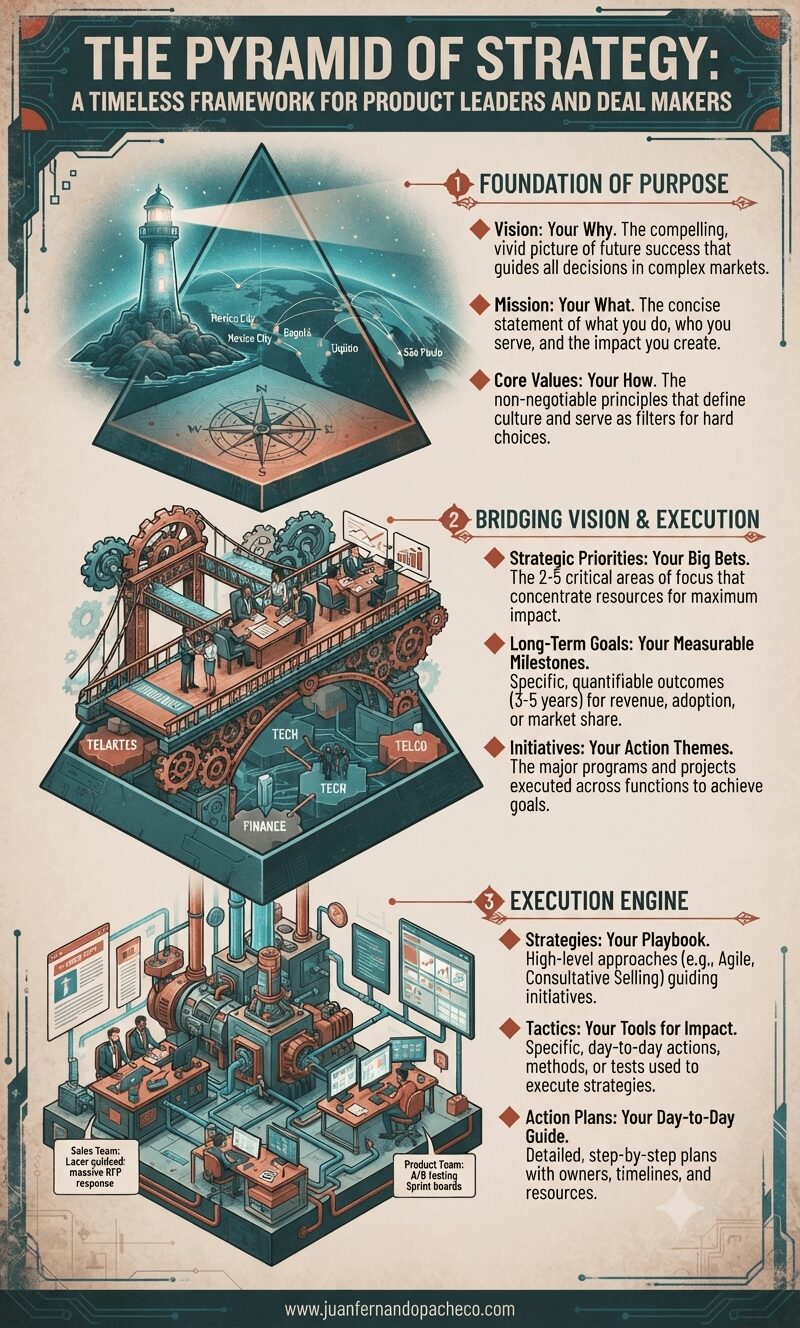
The pyramid consists of three distinct levels, each serving a critical function in your strategic architecture. At the top, you have your foundation of purpose. In the middle, your bridge from vision to action. At the base, your execution engine. Let me break down each level and show you how they work together to create sustainable competitive advantage.
Level One: Your Foundation of Purpose
At the apex of the pyramid sit three interconnected elements that define why your organization exists and how it operates: vision, mission, and core values.
Your vision is your why.
It’s the ultimate destination you’re working toward—a vivid picture of success that inspires your team and guides your decisions. In my experience leading deals across Mexico, Colombia, Ecuador, and beyond, I’ve seen how a compelling vision can be the difference between winning and losing a multi-year contract. When you’re negotiating stringent SLAs, navigating government mandates, or addressing complex data sovereignty requirements, your vision keeps everyone focused on the bigger picture.
For product leaders, vision translates into understanding where the market is heading and positioning your solutions accordingly. When I’ve worked with banking and finance clients across Latin America, the vision wasn’t just about delivering software—it was about transforming how millions of users interact with financial services. That vision shaped every product decision, every feature prioritization, and every user experience design choice.
Your mission is your what.
It’s a concise statement of what you do, who you serve, and the impact you create. While vision looks to the future, mission grounds you in the present. It answers the question: what do we actually do every day to move toward that vision?
In the context of complex deal execution, your mission might focus on delivering transformative technology solutions that help enterprises navigate digital transformation while meeting regulatory compliance. For product teams, it might center on building user-centered experiences that solve real problems for specific market segments.
Core values are your how.
These are the principles that define your culture, shape decisions, and inspire action. They’re non-negotiable. In my years managing RFx processes and negotiating with C-level executives, I’ve learned that core values aren’t just words on a wall—they’re filters for decision-making.
When you’re facing pressure to cut corners on security requirements or compromise on uptime guarantees to close a deal faster, your core values determine what you do. When you’re prioritizing product backlog items with limited resources, your core values guide which features make the cut. Organizations that consistently win in competitive markets have core values that aren’t just stated—they’re lived, every single day.
Level Two: Bridging Vision and Execution
The middle tier of the pyramid is where strategy becomes tangible. This is where you translate your purpose into focused action through strategic priorities, long-term goals, and initiatives.
Strategic priorities are your big bets.
These are the two to five critical areas that need focus to move your vision forward. The key here is focus. In my experience scaling technology revenue across LATAM markets, I’ve seen too many organizations try to pursue too many opportunities simultaneously, diluting their impact and exhausting their teams.
When I’m leading business development efforts across multiple countries, I have to make hard choices about which markets to prioritize, which client segments to pursue, and which partnerships to develop. Strategic priorities force you to say no to good opportunities so you can say yes to great ones. They ensure that your limited resources—time, talent, and capital—are concentrated on the areas that will deliver the highest return.
- For product leaders, strategic priorities might focus on market expansion, platform modernization, or user experience transformation.
- For deal leaders, they might center on penetrating new industry verticals, strengthening partner ecosystems, or building specialized capabilities in high-demand areas like cloud computing or data analytics.
Long-term goals are your measurable milestones.
These are specific outcomes you aim to achieve over three to five years. Unlike strategic priorities, which are directional, long-term goals are quantifiable. They answer the question: what does success look like in concrete terms?
- In my work managing complex enterprise deals, long-term goals might include achieving a specific revenue target in a particular market, securing a certain number of strategic accounts, or reducing customer request resolution time by a specific percentage.
- For product teams, long-term goals could focus on user adoption rates, market share, or product performance metrics.
The power of long-term goals lies in their measurability. They create accountability. They allow you to track progress and course-correct when necessary. But they also provide motivation—they give your team something concrete to work toward and celebrate when achieved.
Initiatives are your action themes.
These are the programs or projects designed to achieve your long-term goals. If long-term goals define what you want to achieve, initiatives define how you’ll get there. They’re the major efforts that require coordinated action across multiple teams and functions.
In the context of product and deal leadership, initiatives might include launching a new solution offering, implementing a customer success program, developing a partner channel strategy, or executing a market expansion plan. Each initiative should directly support one or more long-term goals, creating a clear line of sight from action to outcome.
What I’ve learned from leading cross-functional teams across ten-plus countries is that initiatives require more than just good ideas—they require disciplined execution. They need clear ownership, adequate resources, and regular progress reviews. They also need to be adaptable, because markets change, client needs evolve, and unexpected challenges emerge.
Level Three: Your Execution Engine
The base of the pyramid is where strategy meets reality. This is where your plans become actions, and your actions become results. This level consists of strategies, tactics, and action plans.
Strategies are your how-to playbook.
These are high-level approaches for achieving your initiatives and goals. While initiatives define what you’re going to do, strategies define the approach you’ll take. They’re the methodologies, frameworks, and philosophies that guide your execution.
In my experience managing high-stakes RFx processes, strategy might involve a consultative selling approach that positions us as trusted advisors rather than vendors. It might mean focusing on value-based pricing rather than competing on cost. For product development, strategy might center on agile methodologies, design thinking principles, or customer development frameworks.
The key distinction between strategy and tactics is scope and duration. Strategies are broader and more enduring. They provide the framework within which tactics operate. A good strategy aligns all your tactical decisions and ensures they’re working toward the same objective.
Tactics are your tools for impact.
These are the concrete actions, tools, or methods you use to execute your strategies. If strategy is the playbook, tactics are the specific plays you run. They’re the day-to-day activities that move the needle.
For business development professionals, tactics might include conducting targeted market research, developing customized proof of concepts, creating compelling proposal content, or executing strategic account planning sessions. For product teams, tactics might involve user story mapping sessions, sprint planning, usability testing, or A/B testing new features.
What separates high-performing teams from average ones isn’t necessarily better tactics—it’s better alignment between tactics and strategy. Every tactical decision should serve your strategic approach. When tactics drift from strategy, you create confusion, waste resources, and dilute impact.
Action plans are your day-to-day guide.
These are detailed, step-by-step plans with timelines, resources, and responsibilities. They answer the questions: who does what, by when, with what resources?
In managing complex deals across Latin America, action plans are critical. When you’re coordinating with engagement managers, subject matter experts, legal teams, engineering groups, and client stakeholders, you need absolute clarity on roles and timelines. Action plans provide that clarity.
For product teams, action plans translate initiatives into sprints, user stories into tasks, and roadmaps into releases. They ensure that everyone knows what they’re responsible for and when it needs to be done.
The best action plans are specific but flexible. They provide enough detail to guide execution but allow for adaptation when circumstances change. They’re living documents that get updated regularly based on progress, feedback, and new information.
Making the Pyramid Work for You
Understanding the pyramid of strategy is one thing. Making it work in practice is another. Based on my experience leading product transformations and closing complex deals across LATAM markets, here are the principles that make this framework truly effective.
Start from the top.
Too many organizations start with tactics—what’s urgent, what’s easy, what’s familiar—without clarifying their vision, mission, and values. This creates activity without direction. Always begin by ensuring your foundation of purpose is clear, compelling, and shared across your organization.
Ensure alignment across levels.
Every element at each level should connect logically to the levels above and below. Your action plans should support your tactics. Your tactics should execute your strategies. Your strategies should achieve your initiatives. Your initiatives should reach your long-term goals. Your long-term goals should advance your strategic priorities. And your strategic priorities should fulfill your vision, mission, and values. When there’s misalignment, you create friction and waste energy.
Communicate relentlessly.
The pyramid only works if everyone understands it and knows where they fit. As a leader, your job isn’t just to create strategy—it’s to communicate it clearly and repeatedly. Help your team see how their daily work connects to the bigger picture. When people understand the why behind what they’re doing, they’re more engaged, more creative, and more resilient in the face of challenges.
Review and adapt regularly.
Strategy isn’t set-it-and-forget-it. Markets change. Client needs evolve. Competitors emerge. Technologies advance. You need regular checkpoints to assess progress, gather feedback, and adjust course. I recommend quarterly reviews of your strategic priorities and long-term goals, monthly reviews of initiatives, and weekly or daily reviews of tactics and action plans.
Balance discipline with agility.
The pyramid provides structure, but it shouldn’t create rigidity. In fast-moving markets like technology services, you need the discipline to stay focused on your priorities and the agility to adapt when circumstances demand it. The framework gives you the stability to pivot without losing direction.
The Payoff of Strategic Clarity
When you implement the pyramid of strategy effectively, the results are transformative. You reduce customer request resolution time because everyone knows their role and responsibilities. You accelerate time-to-market because product roadmaps are aligned with strategic priorities. You increase win rates on complex deals because your proposals clearly articulate how your solutions advance client objectives.
Most importantly, you create an organization that can scale. As I’ve grown from UX designer to product owner to business development manager over the past two decades, I’ve learned that sustainable growth requires more than individual talent—it requires systems and frameworks that multiply impact.
The pyramid of strategy is one such framework.
It’s stood the test of time because it addresses a fundamental challenge every organization faces: how to connect purpose to execution. Whether you’re reading this today or three years from now, this framework will remain relevant because the challenge it solves is timeless.
Your vision defines your destination. Your strategic priorities chart your course. Your action plans power your journey. Master all three levels, and you’ll not only survive in competitive markets—you’ll thrive.
The question isn’t whether you need strategic clarity. The question is: when will you commit to building it?