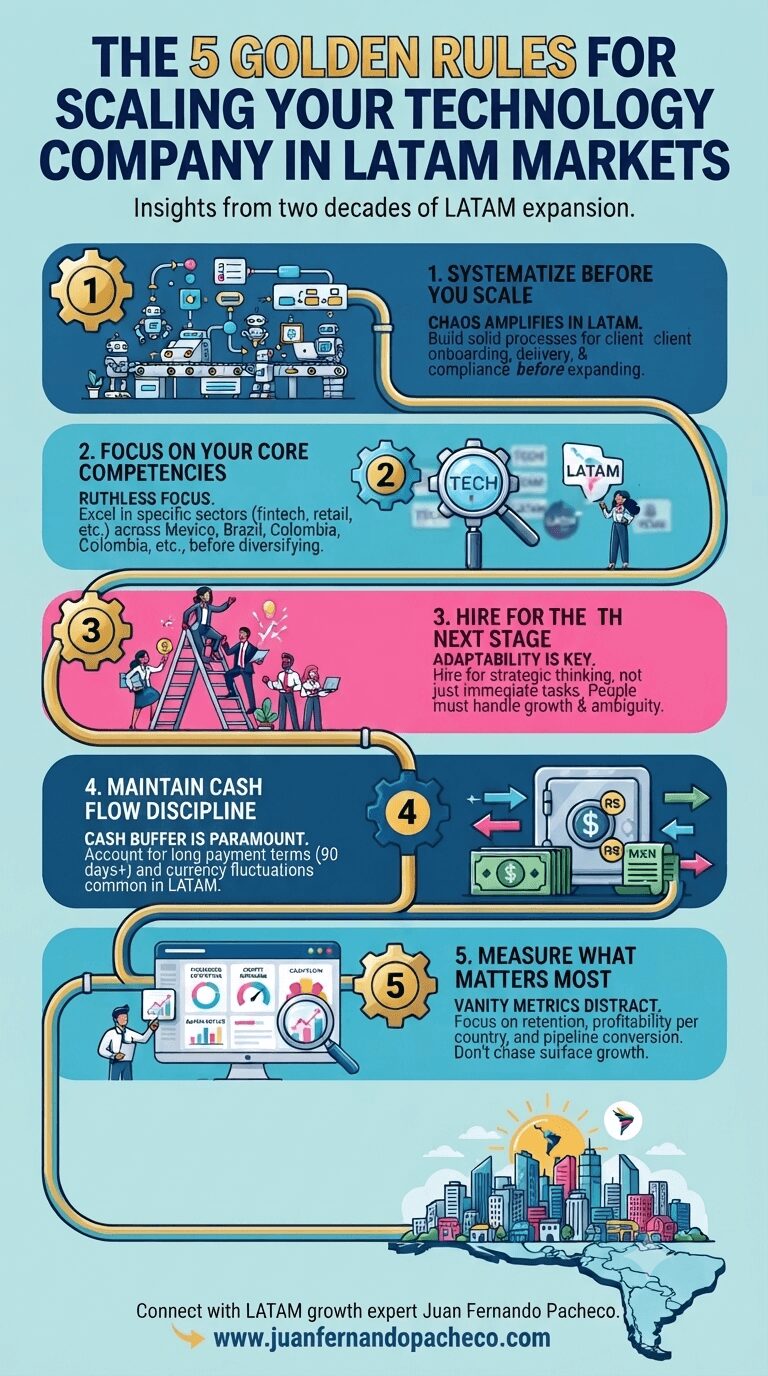
Scaling your company in LATAM markets
After years of navigating the complex terrain of Latin American technology markets, I have witnessed countless companies attempt the leap from stable operation to regional powerhouse. Some soar. Others crash spectacularly. The difference rarely comes down to the quality of their technology or even their market opportunity. It comes down to whether they understood the fundamental rules of scaling before they pulled the trigger.
Scaling a technology company across Latin America presents unique challenges that differ markedly from expansion in more mature markets.
You are dealing with diverse regulatory environments, varying levels of digital infrastructure, distinct cultural business practices across countries, and currency fluctuations that can make or break your margins overnight. I have led business development efforts across Mexico, Colombia, Peru, Chile, Argentina, and Brazil, and I have learned that sustainable growth requires more than ambition. It requires discipline, strategy, and adherence to principles that withstand the test of time.
Let me share five golden rules that have guided my approach to scaling technology revenue across LATAM markets. These are not trendy frameworks or buzzword-laden methodologies. They are timeless principles that remain as relevant today as they will be three years from now.
Rule 1: Systematize Before You Scale
Here is a hard truth that many founders and executives resist:
If your current operations are chaotic, scaling will not fix them. It will amplify them.
I have seen technology companies rush into new LATAM markets with inadequate processes for client onboarding, project delivery, or compliance management. Within months, they are drowning in operational debt, unable to deliver on promises, and burning through reputation capital they cannot afford to lose.
Before you expand your footprint, you must build solid systems that can handle increased demand without collapsing. This means documenting your processes for everything from RFI and RFP responses to contract negotiation, from project estimation to delivery governance. In the technology services space, where I have spent most of my career, this is particularly critical because you are selling expertise and reliability. If your internal operations are unpredictable, your client delivery will be too.
Systematization also means establishing clear decision-making frameworks. When you are operating across multiple countries, you cannot be the person who approves every contract clause or resolves every client escalation.
You need systems that empower your teams to make sound decisions autonomously while maintaining quality and compliance standards.
This includes everything from standardized proposal templates that account for country-specific regulatory requirements to automated workflows that ensure nothing falls through the cracks during complex deal execution.
The temptation to skip this step is strong. Growth feels urgent. Competitors are moving. Investors are pushing. But remember this: if you try to scale with bad systems, you will just scale your problems too. And problems multiplied by geographic expansion become exponentially harder to solve.
Rule 2: Focus on Your Core Competencies
In the excitement of expansion, it is easy to chase every opportunity that crosses your path.
- A potential client in the retail sector asks if you can handle their logistics platform.
- A government agency wonders if you can build their citizen services portal.
- A fintech startup needs blockchain expertise.
Before you know it, you have diluted your resources across a dozen different verticals and technology stacks, and you are no longer excellent at anything.
I have learned through experience that sustainable scaling requires ruthless focus on what you do best.
When I lead business development efforts across Latin America, I concentrate on sectors where we have deep expertise: banking, finance, telecommunications, and retail. These are complex, regulated industries where our track record and domain knowledge create genuine competitive advantages. We do not say yes to every opportunity. We say yes to the right opportunities.
Focusing on your core competencies does not mean you cannot evolve or expand your capabilities over time.
It means you do it strategically, building on existing strengths rather than leaping into completely unfamiliar territory. If you are a company that excels at cloud migration for financial institutions, your next capability build should logically be in cloud security or regulatory compliance for financial services, not in developing mobile games or e-commerce platforms.
This discipline becomes even more critical when scaling across LATAM markets because each country presents its own set of opportunities and distractions.
Mexico might have booming demand in one sector while Colombia is experiencing growth in another.
The key is to resist the urge to become everything to everyone. Instead, become indispensable to a specific set of clients in specific sectors who value your specialized expertise.
Rule 3: Hire for the Next Stage, Not Just for Today
One of the most common mistakes I see in scaling technology companies is hiring only for immediate needs. You have a new client contract in Brazil, so you hire a project manager who can handle that specific account. You are launching a new service line in Argentina, so you bring on a specialist with that exact skill set.
This reactive approach creates a workforce that is perfectly sized for today but completely inadequate for tomorrow.
When you scale across Latin American markets, you need people who can thrive in ambiguity, adapt to rapidly changing circumstances, and take on responsibilities that expand well beyond their initial job descriptions. The market dynamics shift constantly. Regulatory requirements evolve. Client needs transform. If you hire people who can only execute narrowly defined tasks, you will find yourself in a perpetual hiring cycle, constantly playing catch-up as your business outgrows each new employee.
I look for candidates who demonstrate strategic thinking, commercial acumen, and the ability to navigate complex stakeholder environments.
In LATAM business development, for example, I work with team members who can engage with C-level executives, understand the nuances of government procurement processes, and collaborate effectively with internal teams across engineering, legal, and operations. These are not skills you can easily train into someone who lacks the foundational capacity for this level of work.
Short-term hires might solve your immediate resource gap, but they often struggle when responsibilities inevitably expand.
- The person who was hired to manage a single client account suddenly needs to oversee a portfolio.
- The specialist who was brought on for one project now needs to build an entire practice area.
If you hire for potential and adaptability, you build a team that grows with your company rather than one that requires constant replacement.
Rule 4: Maintain Cash Flow Discipline
Here is an uncomfortable reality:
Scaling burns cash, often faster than expected.
I have watched technology companies secure impressive contracts and celebrate revenue growth, only to find themselves in a cash crunch because they did not account for the working capital requirements of expansion. When you scale across LATAM markets, this challenge intensifies due to varying payment terms, currency exchange risks, and the upfront investments required to establish operations in new countries.
Cash flow discipline means maintaining adequate buffers to weather the inevitable delays and surprises that come with regional expansion.
A government contract in Ecuador might have 90-day payment terms. A banking client in Chile might require you to post performance bonds. A retail project in Mexico might encounter unexpected scope changes that delay invoicing. Without sufficient cash reserves, these normal business realities become existential threats.
This discipline also extends to how you structure your growth investments.
- Do you lease office space or go fully remote?
- Do you hire full-time employees or engage contractors for specific projects?
- Do you invest in building proprietary tools or leverage existing platforms?
Each decision impacts your cash position, and the cumulative effect of these choices determines whether you can sustain your growth trajectory.
I have learned to be conservative in the cash flow projections and aggressive in risk mitigation.
This means negotiating favorable payment terms with clients where possible, maintaining diverse revenue streams across sectors and countries to avoid concentration risk, and building strong relationships with banking partners who understand the LATAM technology services landscape. Cash problems can kill even profitable companies in a growth phase, so treat cash flow management as a strategic imperative, not an administrative task.
Rule 5: Measure What Matters Most
In the age of data analytics, it is tempting to track everything. Dashboards proliferate. Metrics multiply. Reports stack up. But here is the truth:
Most of these numbers do not actually drive your business forward.
They are vanity metrics that make you feel productive without providing actionable insights.
When scaling across LATAM markets, you need to focus relentlessly on the numbers that actually matter:
- Customer retention rates,
- Profit margins by country and sector,
- Cash flow positions,
- Pipeline conversion rates, and
- Client satisfaction scores.
These are the metrics that tell you whether your scaling strategy is working or whether you are building on a foundation of sand.
Customer retention is particularly critical in technology services because the cost of acquiring a new client far exceeds the cost of maintaining an existing relationship.
If you are growing your revenue but losing clients at an unsustainable rate, you are not scaling successfully. You are running on a treadmill. In LATAM markets, where relationship capital and reputation are paramount, client retention becomes even more important.
Profit margins matter because growth without profitability is not sustainable.
I have seen companies expand aggressively across multiple countries, only to discover that their pricing models do not account for the true cost of delivery in each market.
- Currency fluctuations,
- Local tax obligations,
- Compliance requirements, and
- Talent costs vary significantly across Latin America.
You must track profitability at a granular level to ensure your expansion is creating value, not just revenue.
These core metrics will guide you through the chaos of growth. They will tell you when to double down on a particular market or sector, when to pull back and restructure, and when to celebrate genuine progress versus superficial growth. Do not get caught up in flashy metrics that look impressive on a board presentation but do not reflect the health of your business.
The Long View
Scaling a technology company across Latin American markets is not a sprint. It is a marathon that requires endurance, discipline, and strategic clarity. These five rules are not revolutionary. They are fundamental. But in the excitement of growth, it is easy to forget fundamentals in pursuit of shortcuts.
I have built my career on the belief that sustainable success comes from doing the basics exceptionally well, consistently, over a long period of time. Systematize your operations. Focus on your strengths. Hire for potential. Protect your cash. Measure what matters.
If you adhere to these principles, you will build a company that not only scales but thrives across the diverse and dynamic markets of Latin America.
The companies that win in this region are not necessarily the ones with the most innovative technology or the most aggressive growth targets. They are the ones that execute with discipline, adapt with intelligence, and maintain their focus on creating genuine value for clients while building sustainable business models. That is the path I have chosen, and it is the path I recommend to any leader serious about scaling their technology company in LATAM markets.