A timeless framework for building high-performance organizations
Over many years of navigating complex technology deals, leading product transformations, and scaling operations across Latin American markets have learned one fundamental truth:
Organizational success is never about getting one thing right. It is about creating harmony among multiple interconnected elements that either propel you forward or hold you back.
The McKinsey 7S Model remains one of the most powerful frameworks I have encountered for diagnosing organizational effectiveness and driving sustainable transformation. Whether you are closing multi-million dollar contracts in the banking sector, launching new digital products, or restructuring teams across multiple countries, this model provides the clarity needed to see the whole picture.
What makes this framework particularly valuable is its timeless nature. Markets change, technologies evolve, and customer expectations shift, but the fundamental principles of organizational alignment remain constant. This is why I continue to reference the 7S Model when advising clients, building product roadmaps, or leading cross-functional teams through complex transformations.
Understanding the seven strategic levers
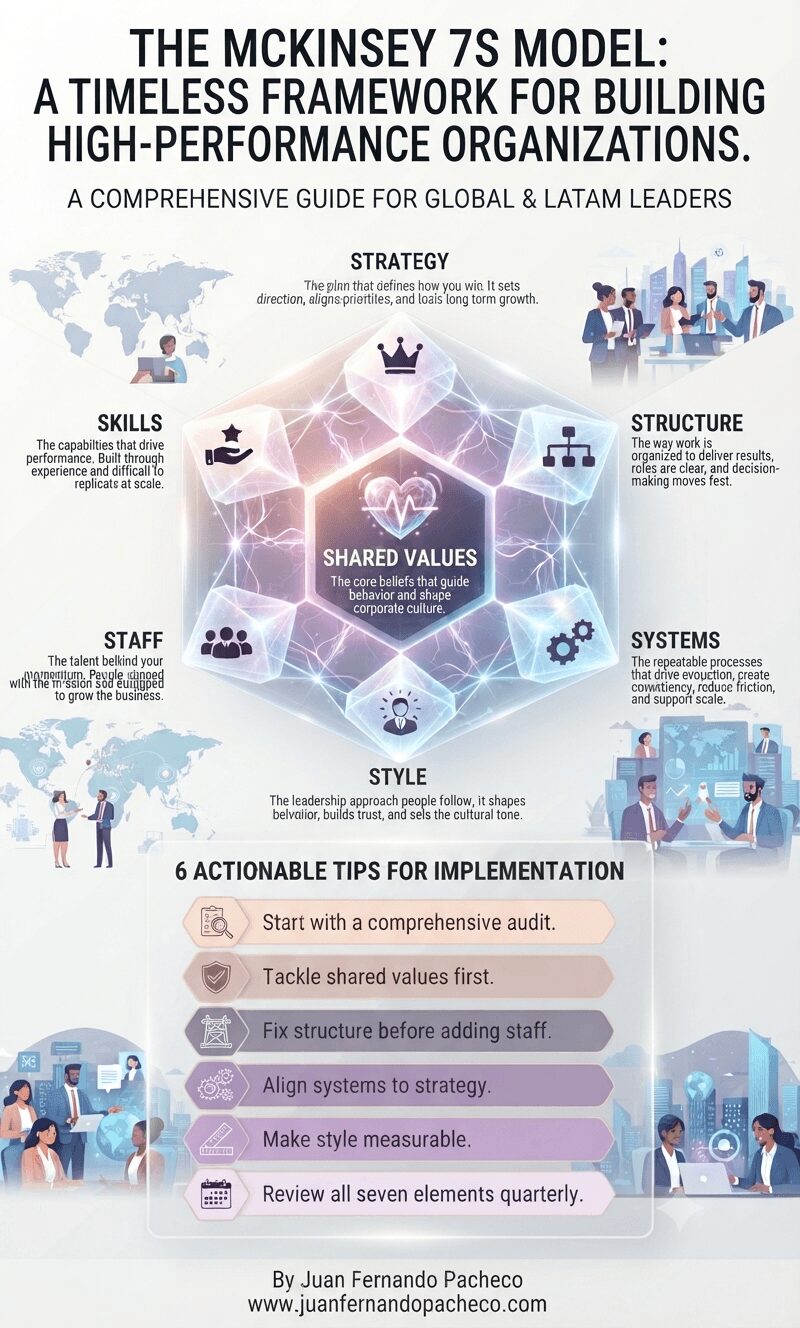
The model identifies seven critical elements that organizations must align to achieve high performance. These elements are divided into hard elements (strategy, structure, systems) and soft elements (shared values, skills, staff, style), with shared values sitting at the center as the foundation that influences all other components.
- Strategy represents your plan to win. It defines how you will compete, where you will focus your resources, and what differentiates you from competitors. In my work securing complex IT procurement deals across LATAM, I have seen how a clear strategy aligns teams and accelerates decision-making. However, strategy alone means nothing without the organizational capability to execute it.
- Structure determines how work gets organized and how decisions flow through the organization. It establishes reporting lines, defines roles, and clarifies accountability. When I led product teams across ten-plus countries, I learned that structure must support your strategy, not hinder it. Bureaucratic layers that made sense in one market created bottlenecks in another, requiring constant adaptation.
- Systems encompass the repeatable processes that drive execution. These include everything from budgeting and performance management to product development methodologies and customer relationship management. In high-stakes RFx processes, having robust systems for proposal development, risk assessment, and stakeholder coordination often meant the difference between winning and losing multi-year contracts.
- Shared values sit at the heart of the model because they influence every other element. These are the core beliefs that guide behavior and decision-making across the organization. When values are clearly defined and consistently lived, they create cultural cohesion that transcends geographical boundaries. In my experience working across diverse Latin American markets, shared values provided the stability needed to navigate different regulatory environments and business cultures.
- Skills represent the capabilities that drive performance. These are built through experience and are difficult to replicate at scale. The technology landscape demands continuous skill development, particularly in areas like agile methodologies, data analytics, and digital transformation. I have invested significantly in building teams with complementary skills that collectively address complex client needs.
- Staff refers to the talent behind your momentum. These are the people aligned with the mission and equipped to grow the business. Attracting and retaining top talent in competitive markets requires more than competitive compensation. It demands clear career paths, meaningful work, and an environment where people can thrive. My approach has always been to hire for potential and invest in development.
- Style describes the leadership approach people follow. It shapes behavior, builds trust, and sets the cultural tone. Leadership style must adapt to different situations while maintaining consistency in core values. Leading teams across multiple time zones and cultural contexts has taught me that effective leadership balances direction with empowerment, accountability with support.
The interconnection that drives results
What makes the 7S Model particularly powerful is its emphasis on interconnection. Change one element, and you inevitably impact the others. When I transitioned from senior UX designer to Business Development Manager, I experienced this firsthand. The new role required different skills, which influenced my leadership style, which affected how I structured my team, which ultimately shaped our strategy for engaging clients.
Many organizational transformations fail because leaders focus on one or two elements while neglecting the others. You might develop a brilliant strategy, but if your structure creates silos, your systems reward the wrong behaviors, or your staff lacks necessary skills, execution will falter.
I have witnessed this pattern repeatedly in technology implementations where the solution was sound, but organizational readiness was insufficient.
Consider a scenario where a company decides to accelerate digital transformation. This strategic shift requires new technical skills, which means hiring or developing staff with different capabilities. The structure may need to shift from functional silos to cross-functional product teams. Systems must evolve to support agile development and continuous deployment. Leadership style must become more experimental and comfortable with failure. Throughout this change, shared values provide the anchor that keeps the organization grounded.
Six actionable tips for implementation
The framework becomes truly valuable when you move from understanding to action. Here are six practical approaches I have used to implement the 7S Model effectively:
- Start with a comprehensive audit. Before making changes, score your organization on each of the seven elements. Ask key leaders to do the same independently. Gaps of three or more points reveal your biggest blind spots and priority areas. I have used this approach when joining new accounts or taking on complex deals, and it consistently surfaces misalignments that would otherwise remain hidden.
- Tackle shared values first. If your values are not lived daily, the other six elements will not stick. Define three to five core values, then audit every major decision against them. Values drive behavior, and behavior drives results. In my work across diverse LATAM markets, establishing clear values around customer centricity, integrity, and collaboration created consistency despite geographical and cultural differences.
- Fix structure before adding staff. Hiring into a broken structure multiplies problems. Map decision rights, eliminate overlapping roles, and clarify reporting lines before your next hiring wave. Structure enables talent. I learned this lesson early in my career when we hired excellent people into unclear roles, resulting in frustration and turnover despite having top talent.
- Align systems to strategy. Your quarterly planning, budgeting, and performance reviews should directly support your strategy. If they do not, you are accidentally rewarding the wrong behaviors and outcomes. I have seen organizations proclaim customer-centricity as a strategy while rewarding sales teams solely on revenue, creating fundamental misalignment.
- Make style measurable. Define what good leadership looks like in your organization. Create specific behavioral anchors for your leadership style, then measure and coach against them in regular reviews. Leadership cannot be vague if you want consistent results. This became particularly important as I scaled teams across multiple countries, requiring consistent leadership standards despite cultural variations.
- Review all seven elements quarterly. Dedicate thirty minutes in each quarterly leadership meeting to assess 7S alignment. Ask what is out of sync. Small misalignments compound quickly, so course-correct before they become crises. This discipline has helped me maintain organizational health through rapid growth and market changes.
Lessons from the LATAM market
Working across Latin American markets has provided unique insights into applying the 7S Model in complex, dynamic environments. The region presents distinct challenges: regulatory diversity, economic volatility, cultural variations, and rapidly evolving digital landscapes. Success requires organizational agility grounded in stable fundamentals.
In Mexico, I found that structure and systems needed to accommodate complex government mandates and data sovereignty requirements. In Colombia and Peru, building the right skills and staff was critical as the technology talent market remained competitive. In Brazil and Chile, shared values became essential for navigating economic uncertainty and maintaining team cohesion.
The RFx processes I have led across these markets demonstrate the 7S Model in action.
Winning complex deals requires strategic positioning, but also the structural capability to coordinate across multiple stakeholders, the systems to manage proposal development, the skills to craft compelling value propositions, the staff to execute flawlessly, the leadership style to inspire confidence, and the shared values to ensure ethical, client-focused solutions.
One particular deal that stands out involved a multi-year digital transformation for a major financial institution. Our strategy was sound, but initial proposals failed because our structure did not adequately represent local market expertise. We restructured the team, bringing in regional subject matter experts. We updated our systems to include local regulatory compliance checks. We invested in developing skills specific to banking transformation. We adjusted our leadership style to be more collaborative with client stakeholders. Throughout, our shared values around client success kept us focused. The result was a successful engagement that generated significant revenue and opened doors to additional opportunities.
Applying the framework to product leadership
For product leaders, the 7S Model offers a comprehensive lens for evaluating product organization effectiveness.
- Strategy defines your product vision and roadmap.
- Structure determines how product teams are organized and how they collaborate with engineering, design, and business stakeholders.
- Systems include your product development methodologies, prioritization frameworks, and metrics.
- Shared values shape your product culture.
- Do you value speed over quality?
- Customer empathy over technical elegance?
- Innovation over stability? These values influence every product decision.
- Skills determine your product organization’s capability to deliver. Do you have the right mix of technical knowledge, business acumen, and user experience expertise?
- Staff refers to having the right people in the right roles with clear accountabilities.
- Style describes how product leaders engage with teams and stakeholders.
I have applied this framework when building product roadmaps for banking and finance solutions serving millions of users. Ensuring alignment across all seven elements accelerated time to market by twenty percent and boosted user adoption by fifteen percent. The framework helped identify that while our strategy and skills were strong, our systems for translating client requests into agile backlogs created bottlenecks. Addressing this gap delivered measurable results.
Why this framework endures
In an era of constant disruption, where new management frameworks emerge regularly, the McKinsey 7S Model endures because it addresses fundamental organizational truths. It recognizes that organizations are complex systems where multiple elements must work in harmony. It balances hard and soft factors, avoiding the trap of overemphasizing structure and strategy while neglecting culture and people.
The McKinsey 7S Model is simple enough to be memorable yet comprehensive enough to be useful.
It provides a common language for discussing organizational effectiveness across different levels and functions. Most importantly, it is actionable, offering clear guidance for diagnosis and improvement.
As I look at the organizations I have worked with over two decades, the ones that consistently outperform are those that maintain alignment across these seven elements. They have clear strategies supported by appropriate structures, efficient systems, strong capabilities, talented staff, effective leadership, and unifying values. When misalignment occurs, they detect it early and course-correct.
Moving forward
Whether you are leading a product organization, managing complex deals, scaling operations across markets, or driving digital transformation, the McKinsey 7S Model offers timeless guidance. It reminds us that organizational excellence is multidimensional and requires continuous attention to multiple interconnected elements.
I encourage you to conduct your own 7S audit. Gather your leadership team and honestly assess where you stand on each element. Identify the gaps and misalignments. Prioritize your improvement efforts based on impact and feasibility. Remember that shared values are the foundation, so start there if you are unsure.
The beauty of this framework is that it applies regardless of your industry, market, or organizational size. The principles remain constant even as tactics evolve. This is why, after decades of use, the McKinsey 7S Model remains relevant and valuable.
In my work scaling technology revenue across LATAM markets, leading complex RFx processes, and building high-performing product teams, this framework has been an invaluable compass. It has helped me diagnose problems, design solutions, and drive sustainable transformation. I am confident it can do the same for you.
Organizational excellence is not about perfection in one area. It is about alignment across all areas. The 7S Model gives you the lens to see the whole picture and the framework to make it work together. That is why it remains essential reading for any leader serious about building high-performance organizations.