Bridging the Gap Between Strategy and Execution in Technology Business Growth
After many years of experience navigating complex technology deals, leading product strategies across Latin America, and managing multi-million dollar contracts in the banking and finance sectors, I have witnessed a recurring pattern that separates thriving organizations from those that merely survive. It is not the quality of their technology, the size of their budgets, or even the talent of their teams. The real differentiator is something far more fundamental.
The ability to bridge the gap between strategy and execution.
Too many companies fail not because they lack vision, but because they cannot translate that vision into measurable results. Teams drift out of sync, goals become wishful thinking, and growth slows or stalls completely. This is where the SCALE framework becomes essential. It provides a blueprint for growing with clarity instead of chaos, offering a structured approach to transforming strategic intent into tangible business outcomes.
Understanding the SCALE Framework
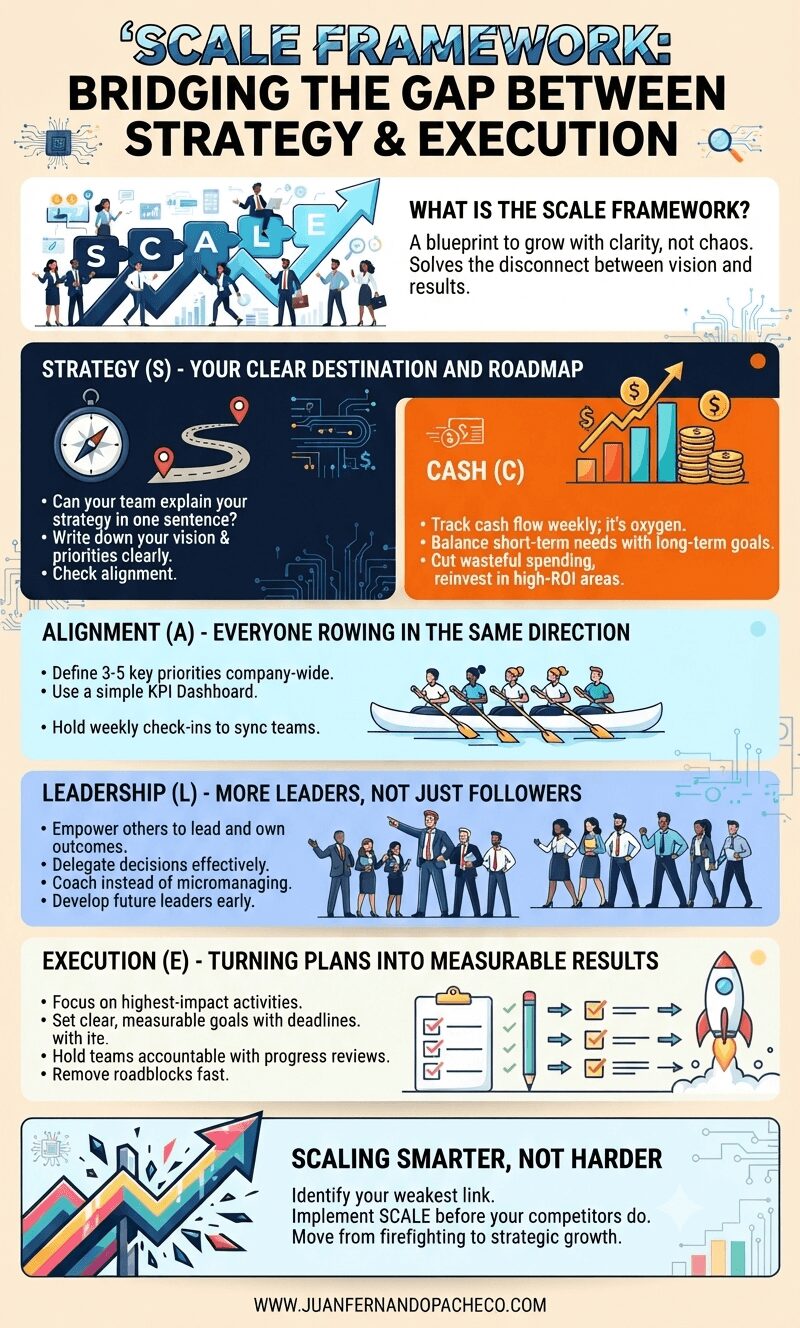
The SCALE framework represents five interconnected pillars that every technology leader must master to achieve sustainable growth: Strategy, Cash, Alignment, Leadership, and Execution. Each element builds upon the others, creating a cohesive system that prevents the common pitfalls of organizational growth.
When I reflect on my experience leading business development across Mexico, Colombia, Peru, Chile, Argentina, and Brazil, I recognize how each component of this framework has played a crucial role in securing complex deals and scaling revenue across diverse markets. The framework is not just theoretical; it is a practical guide that addresses the real challenges technology companies face when attempting to grow in competitive, regulated environments.
Strategy: Your Clear Destination and Roadmap
Strategy forms the foundation of the SCALE framework, and for good reason. Without a clear destination and roadmap, even the most talented teams will wander. In the technology sector, where markets evolve rapidly and customer needs shift constantly, having a well-defined strategy is not a luxury; it is a necessity.
Ask yourself this critical question:
Can your team explain your strategy in one sentence?
If the answer is no, you have already identified your first obstacle. Strategy must be simple enough for every team member to understand yet comprehensive enough to guide decision-making at all levels. This means writing down your vision, value proposition, and key priorities in a way that eliminates ambiguity.
In my work managing complex RFI, RFQ, and RFP processes for top regional brands, I have learned that strategy clarity directly impacts deal success. When negotiating multi-year contracts with government entities or financial institutions, every stakeholder must understand not just what we are offering, but why it matters and how it aligns with broader business objectives. This clarity accelerates decision-making, builds confidence with clients, and ensures that internal teams remain focused on what truly matters.
Simplifying your strategy does not mean dumbing it down. It means distilling complex market realities, competitive dynamics, and technological capabilities into a coherent narrative that guides action. Check alignment regularly by asking team leads to explain the strategy in their own words. Their responses will reveal whether your message has been understood or merely heard.
Cash: Growth Fueled by Financial Discipline
While strategy provides direction, cash provides oxygen.
The second pillar of the SCALE framework reminds us that growth must be fueled by financial discipline.
Too many technology companies, especially in high-growth phases, lose sight of this fundamental truth. They chase revenue without considering profitability, expand teams without analyzing return on investment, and invest in new capabilities without understanding cash flow implications.
The question every leader must ask is whether they are balancing short-term needs with long-term growth. This balance is particularly challenging in the technology services sector, where sales cycles can extend for months, payment terms stretch even longer, and upfront investments in proof of concept development, proposal creation, and relationship building are substantial.
Tracking cash flow weekly is not micromanagement; it is essential stewardship.
When you oversee progress on key deals across Latin American markets, you should maintain constant visibility into project estimates, resource allocation, and revenue recognition timelines. This discipline allows us to make informed decisions about which opportunities to pursue, which partnerships to strengthen, and where to reinvest for maximum impact.
Setting revenue and profitability targets provides direction, but working backward from those targets reveals the path. This means identifying the deals that matter most, understanding the resources required to win them, and ensuring that every dollar spent contributes to sustainable growth. Cutting wasteful spending and reinvesting in high-ROI areas is not about being cheap; it is about being strategic with limited resources.
Alignment: Everyone Rowing in the Same Direction
Strategy and cash mean little if your teams are not working toward the same goals. Alignment, the third pillar of the SCALE framework, addresses one of the most common causes of organizational failure:
Teams that are busy but not productive, active but not effective.
In my experience leading cross-functional teams across ten countries, I have seen how easily misalignment can occur. Product teams may prioritize features that sales teams cannot sell. Engineering may build solutions that do not address customer pain points. Legal may create processes that slow down deal closure. Without deliberate effort to align these functions, even the best-intentioned teams will work at cross-purposes.
The solution lies in defining three to five key priorities and making them visible company-wide. These priorities should not be confidential executive directives but shared commitments that every team member can reference when making decisions. When I work with stakeholders across banking, retail, and telecommunications sectors, I ensure that everyone understands not just their individual responsibilities but how their work contributes to broader objectives.
Using a simple KPI dashboard helps teams see progress in real time.
This transparency eliminates the guesswork and speculation that often lead to misalignment. When everyone can see the same metrics, understand the same goals, and track the same outcomes, coordination becomes natural rather than forced.
Holding weekly check-ins reinforces focus and eliminates misalignment before it becomes problematic. These are not status update meetings designed to micromanage; they are alignment sessions where teams can surface challenges, share insights, and adjust course as needed. In fast-moving technology markets, weekly alignment is not excessive; it is essential.
Leadership: More Leaders, Not Just More Followers
The fourth pillar of the SCALE framework challenges a common misconception about growth: that scaling requires more followers executing orders from a few leaders.
In reality, sustainable growth demands more leaders at every level of the organization.
This shift from command-and-control to empowerment and delegation is one of the most difficult transitions for growing companies, but it is also one of the most critical.
Ask yourself whether you are empowering others to lead. This question goes beyond simply delegating tasks; it is about giving people ownership over outcomes. When I built high-performing teams focused on user story mapping and MVP efficiency, I learned that the best results came not from directing every detail but from setting clear objectives and trusting team members to determine the best path forward.
Delegating decisions is uncomfortable, especially for leaders who have built their careers on being the smartest person in the room. But scaling requires letting go of the need to control every outcome. It means coaching your team instead of micromanaging them, providing guidance and support while allowing them to make mistakes and learn from them.
Recognizing and developing future leaders early is an investment in your organization’s future.
I have seen how identifying leadership potential and providing growth opportunities creates a pipeline of talent capable of driving expansion into new markets, managing complex client relationships, and leading strategic initiatives.
Leadership development is not a soft skill; it is a strategic imperative.
Organizations that fail to develop leaders at every level will eventually hit a ceiling where growth becomes impossible because the existing leadership structure cannot scale.
Execution: Turning Plans Into Real, Measurable Results
All the strategy, cash management, alignment, and leadership in the world mean nothing without execution. The fifth and final pillar of the SCALE framework is where plans become reality, where vision transforms into measurable results. Execution is where many organizations fail, not because they lack good ideas but because they cannot translate those ideas into consistent action.
Ask yourself whether you are focusing on the highest-impact activities.
This question requires ruthless prioritization and the willingness to say no to good ideas in favor of great ones. In managing business opportunities across Latin America, I have learned that success comes not from pursuing every opportunity but from identifying the deals that will drive the most significant impact and dedicating resources accordingly.
Setting clear, measurable goals with deadlines creates accountability. Vague objectives like “improve customer satisfaction” or “increase revenue” are not actionable. Specific targets like “reduce customer request resolution time by 30 percent within six months” or “secure three multi-year contracts in the banking sector by year-end” provide clarity and focus.
Holding teams accountable with regular progress reviews is not about punishment; it is about course correction.
When teams know they will review progress regularly, they stay focused on priorities. When leaders review progress regularly, they can identify obstacles early and provide support before small issues become major problems.
Removing roadblocks fast is essential because execution dies in bottlenecks. Whether the bottleneck is a slow approval process, unclear decision rights, or resource constraints, leaders must act quickly to eliminate barriers to progress. This requires both authority and agility, the willingness to make decisions and the flexibility to adapt when circumstances change.
Applying SCALE to Technology Business Growth
The SCALE framework is not industry-specific, but it has particular relevance for technology companies operating in complex, competitive markets. In my work scaling technology revenue across Latin American markets, I have seen how each pillar addresses specific challenges that technology leaders face.
- Strategy becomes critical when navigating diverse regulatory environments, data sovereignty requirements, and local policies across different countries.
- Cash management is essential when managing long sales cycles and complex procurement processes.
- Alignment is crucial when coordinating cross-functional teams across multiple time zones and cultural contexts.
- Leadership development is vital when expanding into new markets that require local expertise and decision-making.
- Execution is everything when competing for high-stakes deals where the difference between winning and losing often comes down to flawless delivery.
The companies that master the SCALE framework do not just grow; they skyrocket. They transform from organizations that struggle to execute into machines that consistently deliver results. They move from reactive firefighting to proactive strategic management. They evolve from collections of individuals into cohesive teams working toward shared objectives.
Moving Forward
Scaling is not about working harder; it is about working smarter.
The SCALE framework provides the structure to do exactly that. It offers a way to find and fix your biggest roadblocks, to identify where you are stuck and what you need to do to move forward.
Whether you are leading a technology startup, managing business development for a global services firm, or driving digital transformation in the banking sector, the principles of the SCALE framework remain constant.
Strategy provides direction. Cash fuels growth. Alignment ensures coordination. Leadership multiplies impact. Execution delivers results.
The question is not whether your organization needs the SCALE framework. The question is whether you will implement it before your competitors do. Because in the technology sector, where markets move fast and competition is fierce, the gap between strategy and execution is not just a management challenge; it is the difference between leading your market and being left behind.
Start today. Assess where your organization stands on each pillar of the SCALE framework. Identify your weakest link and strengthen it. Build on your strengths and address your gaps. Most importantly, remember that scaling is a journey, not a destination. It requires continuous attention, regular adjustment, and unwavering commitment to bridging the gap between what you plan and what you deliver.
The companies that master this do not just survive; they thrive. They do not just grow; they scale. And they do not just compete; they lead.