Lessons from Leading Tech Deals Across Latin America
After many years of navigating complex technology deals across Latin America, from banking transformations in Mexico to digital initiatives in Colombia and Brazil, I have witnessed a recurring pattern that separates successful organizations from those that struggle.
It is not about having more resources or better technology.
It is about understanding a fundamental truth that many leaders miss:
A plan is not a strategy.
This distinction became crystal clear to me during my tenure at Tata Consultancy Services, where I have led business development across multiple LATAM markets. I have sat in boardrooms with C-level executives who presented meticulously detailed project plans, complete with Gantt charts, resource allocations, and weekly milestones, yet could not articulate why their solution would win against competitors or how they would navigate the unique regulatory and cultural complexities of Latin American markets.
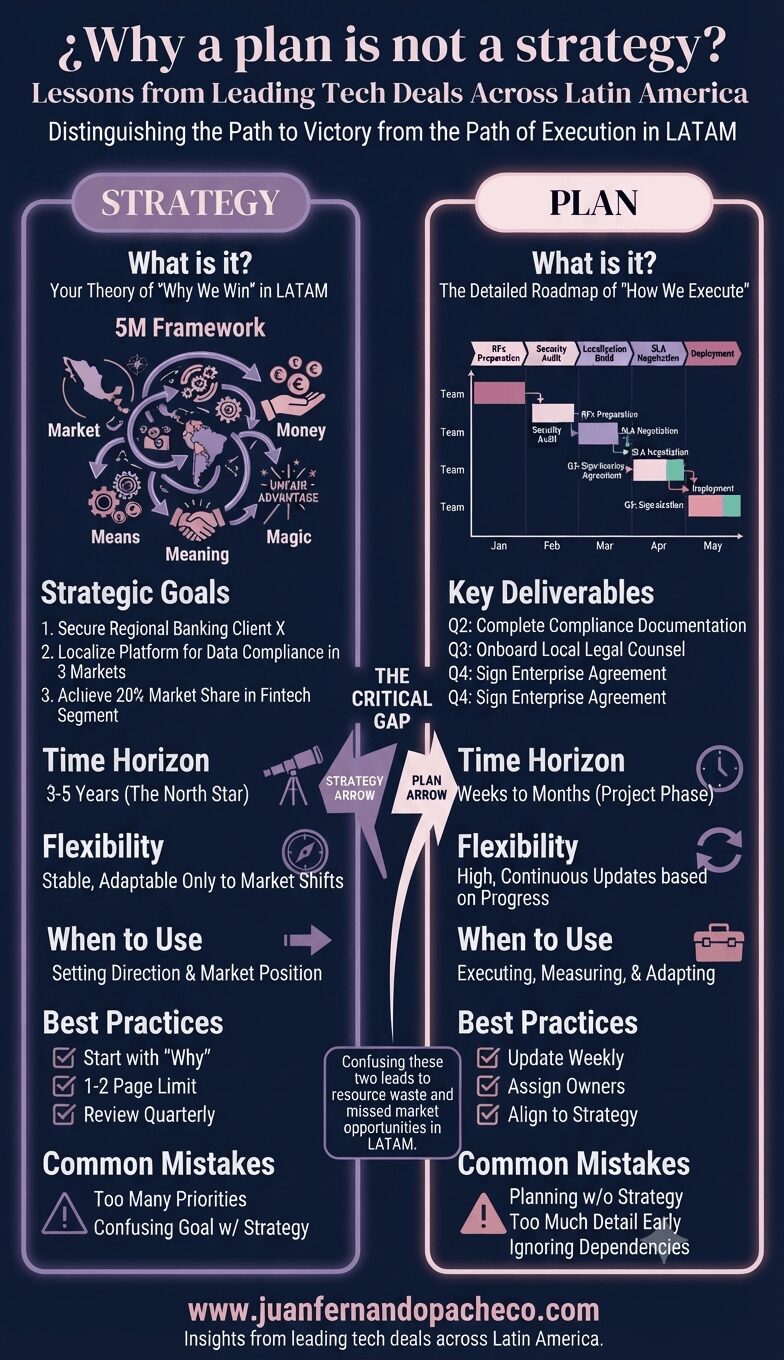
The image shared tries to capture this critical gap. It shows us that while plans and strategies are both essential, they serve fundamentally different purposes.
One defines how you will win; the other defines how you will execute.
Confusing the two is one of the most expensive mistakes organizations make, especially when operating across diverse markets like Latin America where regulatory requirements, data sovereignty laws, and cultural nuances demand both strategic clarity and tactical precision.
Understanding the fundamental difference
- Strategy answers the question of why you will win. It is your theory of competitive advantage. When I approach a complex RFx process for a major banking client in Brazil or Colombia, the strategy is not about the specific tasks we will complete. It is about understanding our unique position in the market, our unfair advantage, and how we will differentiate ourselves from competitors vying for the same multi-million-dollar contract.
- A plan, on the other hand, is the roadmap. It breaks down the how, when, and who. Once we have won the deal through our strategic positioning, the plan ensures we deliver on our promises. It specifies which team member will handle compliance documentation, when we will conduct security audits, and what resources we need to meet the stringent SLA requirements demanded by Latin American enterprises.
The time horizon difference is crucial.
Strategy operates on a three to five years horizon, remaining stable until market conditions fundamentally shift. In my experience scaling technology revenue across LATAM, this long-term view is essential. Markets like Mexico, Colombia, and Chile evolve differently, and a solid strategy accounts for these regional variations while maintaining a consistent competitive position.
Plans operate on a much shorter timeline, measured in weeks to months by project phase. They are flexible and update continuously as progress is made or missed. When managing complex deals across ten-plus countries, I have learned that plans must adapt constantly to local realities, regulatory changes, and stakeholder dynamics. At the same time, the underlying strategy remains our north star.
The 5M framework for strategic thinking
The image references the 5M framework, which I have found invaluable in my work. Let me break down how each element applies to technology business development in Latin America:
- Market asks where we will compete. In my role, this means identifying which segments offer the best opportunities. Banking and finance have been my primary focus because these sectors in LATAM face unique challenges around digital transformation, regulatory compliance, and customer experience. But the market question also extends to geography. Do we prioritize Mexico’s mature market or focus on emerging opportunities in Ecuador and Peru?
- Means examines what capabilities set us apart. For technology services firms operating in LATAM, this could be local presence, understanding of regional regulations, bilingual teams, or proven experience with data sovereignty requirements. My own background transitioning from UX design to strategic deal leadership has taught me that core competencies must be genuine differentiators, not just nice-to-have features.
- Money addresses how we will fund growth. In the context of LATAM technology deals, this involves understanding the financial models that work in different markets. Some countries prefer CAPEX models, others OPEX. Some clients need flexible payment terms due to currency volatility. A winning strategy accounts for these financial realities.
- Meaning explores why we exist beyond making money. This is particularly important in Latin America, where relationship-based business culture means clients want to partner with vendors who share their values and long-term vision. When I work with banking clients, meaning often centers on financial inclusion, digital accessibility, or economic development.
- Magic identifies our unfair advantage, our secret sauce. For me, this has been the ability to translate complex client objectives into agile product roadmaps while navigating the regulatory and cultural complexities of multiple LATAM markets. It is the combination of technical expertise, regional knowledge, and commercial acumen that competitors cannot easily replicate.
Strategy in the LATAM context
Operating across Latin America adds layers of complexity that make strategic clarity even more critical.
Each country has its own regulatory environment, business culture, and market dynamics. A strategy that works in Mexico may not translate directly to Colombia or Argentina.
Government mandates and regulatory compliance are non-negotiable in many LATAM markets. Data sovereignty laws require that certain information remain within national borders. Local policies may favor domestic vendors or require specific certifications. A winning strategy anticipates these requirements and turns them into competitive advantages rather than obstacles.
When I led RFx processes for top regional brands, success depended on navigating complex legal clauses and enterprise security requirements while maintaining stringent SLA negotiations around uptime, response times, and penalties. The strategy was not just about having the technical capability to meet these requirements. It was about positioning our understanding of local regulations as a differentiator that reduced risk for the client.
Commercial-product synergy is another critical strategic element in LATAM. I have seen too many organizations develop excellent products that fail because they did not account for regional complexities. Translating client objectives into agile product roadmaps requires deep market understanding. When we accelerated time-to-market by twenty percent and boosted user adoption by fifteen percent for banking solutions, it was because our strategy integrated market realities from the beginning, not as an afterthought.
From strategy to execution: the planning discipline
Once you have a winning strategy, execution becomes paramount.
This is where planning excellence separates high-performing organizations from the rest. In my experience managing deals across ten-plus countries, the plan must be as rigorous as the strategy, even though they serve different purposes.
- Activities must be specific and assignable. What tasks need completion? Who owns each deliverable? When I coordinate cross-functional teams including product, sales, legal, engineering, and operations, clarity on these questions prevents confusion and delays. In complex RFx processes, a single missed dependency can jeopardize a multi-million dollar contract.
- Timeline management is critical. When each milestone must be hit becomes especially important in LATAM markets where procurement cycles can be lengthy and unpredictable. Building buffer time into plans while maintaining urgency requires experience and judgment. I have learned to anticipate common delays, from regulatory approvals to stakeholder alignment, and plan accordingly.
- Resource allocation must be realistic. Who owns each deliverable is not just about assigning names to tasks. It is about ensuring the right people with the right skills are available at the right time. In my role, this often means coordinating across time zones, languages, and organizational structures to ensure seamless execution.
- Dependencies must be mapped and monitored. What must happen in sequence is crucial in technology implementations where one team cannot proceed until another completes their work. In banking and finance projects, security audits cannot begin until architecture is approved, which cannot happen until compliance requirements are documented. Understanding and managing these dependencies is a planning discipline that directly impacts delivery success.
- Metrics provide the feedback loop. How we measure progress must be clear, objective, and tied to strategic outcomes. I routinely report and measure progress against quarterly targets with regional and industry leaders. These metrics inform both plan adjustments and, when necessary, strategic pivots.
Common mistakes and how to avoid them
Having led business development across LATAM for over a decade, I have observed common mistakes that organizations make when confusing plans with strategies or failing at either.
The first mistake is having too many priorities. The image suggests that having too many priorities is a common strategic error.
I would argue that in complex markets like LATAM, focus is even more critical. When I reduced customer request resolution time by thirty percent through streamlined POC development, it was because we said no to good opportunities to say yes to great ones.
Strategic discipline means making hard choices about where to compete and where to walk away.
Confusing goals with strategy is another frequent error. A goal might be to secure five million dollars in new revenue. The strategy is how you will achieve that goal through competitive positioning, market selection, and differentiated value propositions. I have seen organizations set ambitious goals without a coherent strategy to achieve them, resulting in scattered efforts and disappointing results.
Changing strategy every quarter destroys organizational momentum.
While plans should update continuously based on progress and market feedback, strategy should remain stable unless market conditions fundamentally shift. In my experience, successful LATAM market expansion requires consistent strategic positioning over multiple years to build brand recognition, partner relationships, and market credibility.
On the planning side, common mistakes include planning without a clear strategy, which leads to inefficient execution of the wrong things. Too much detail too early creates rigidity and wastes effort on activities that may never be needed. Ignoring dependencies causes delays and cost overruns that could have been prevented with proper sequencing and coordination.
Best practices for integrating strategy and planning
The most successful organizations I have worked with excel at both strategy and planning, understanding that each requires different mindsets, processes, and disciplines.
- Start with why, not what. This applies to both strategy and planning. Before defining what you will do, clarify why it matters. When I facilitate face-to-face meetings with senior management at client organizations, we always begin with strategic objectives before diving into tactical details. This ensures alignment and prevents the common mistake of executing efficiently toward the wrong goals.
- Keep strategy documents concise. The recommendation of one to two pages maximum is sound. In my work, I have found that if you cannot articulate your strategy clearly and concisely, you do not understand it well enough. Complex markets like LATAM require strategic clarity, not complexity.
- Review strategy quarterly but revise annually. This cadence allows you to monitor whether your strategic assumptions remain valid without overreacting to short-term market fluctuations. In my role, I report progress against quarterly targets while maintaining an annual strategic review that assesses whether market conditions have shifted enough to warrant strategic adjustment.
For planning, update progress weekly. This frequency provides timely visibility into execution challenges without creating administrative overhead. When managing deals across multiple countries, weekly check-ins ensure that issues surface early before they become critical. - Assign clear owners for every deliverable. Accountability is essential for execution excellence. In cross-functional teams spanning product, sales, legal, and engineering, ambiguity about ownership creates gaps where important tasks fall through the cracks.
Stay aligned to strategy. Every planning decision should trace back to strategic objectives. When I prioritize backlog items or allocate resources, I constantly ask whether this activity advances our strategic position or simply keeps us busy.
The path forward
As technology continues to transform industries across Latin America, the distinction between strategy and planning will only become more critical. Organizations that master both will scale revenue and market share. Those that confuse the two will struggle to compete.
My journey from UX designer to strategic product and deal leader has taught me that success requires both the strategic thinking to identify winning positions and the planning discipline to execute flawlessly. Whether you are leading digital transformation in banking, expanding into new LATAM markets, or navigating complex RFx processes, remember that a plan is not a strategy. You need both.
Define your theory of how to win. Understand your competitive advantage. Clarify your market position. Then build the detailed plans that will turn that strategy into reality. Do not let excellent execution of the wrong strategy waste your resources. Do not let brilliant strategy fail due to poor planning.
In the complex, dynamic markets of Latin America, where regulatory requirements, cultural nuances, and competitive dynamics create both challenges and opportunities, this dual discipline of strategic clarity and planning excellence is not optional. It is the foundation of sustainable growth and market leadership.
The question is not whether you will create strategies and plans. The question is whether you will distinguish between them clearly enough to excel at both.