Building Strategies That Win Deals and Drive Growth
During the time of navigating complex enterprise deals across Latin American markets, I have witnessed countless strategies fail not because the technology was weak or the team lacked talent, but because the central idea was unclear. We live in an era where decision-makers face information overload daily.
Your strategy needs more than good intentions; it requires a big idea that cuts through the noise and creates undeniable momentum.
The big idea is the central, unifying concept of your strategy. It gives your approach purpose, momentum, and differentiation. Without it, you are just another vendor pitching features. With it, you become the obvious choice.
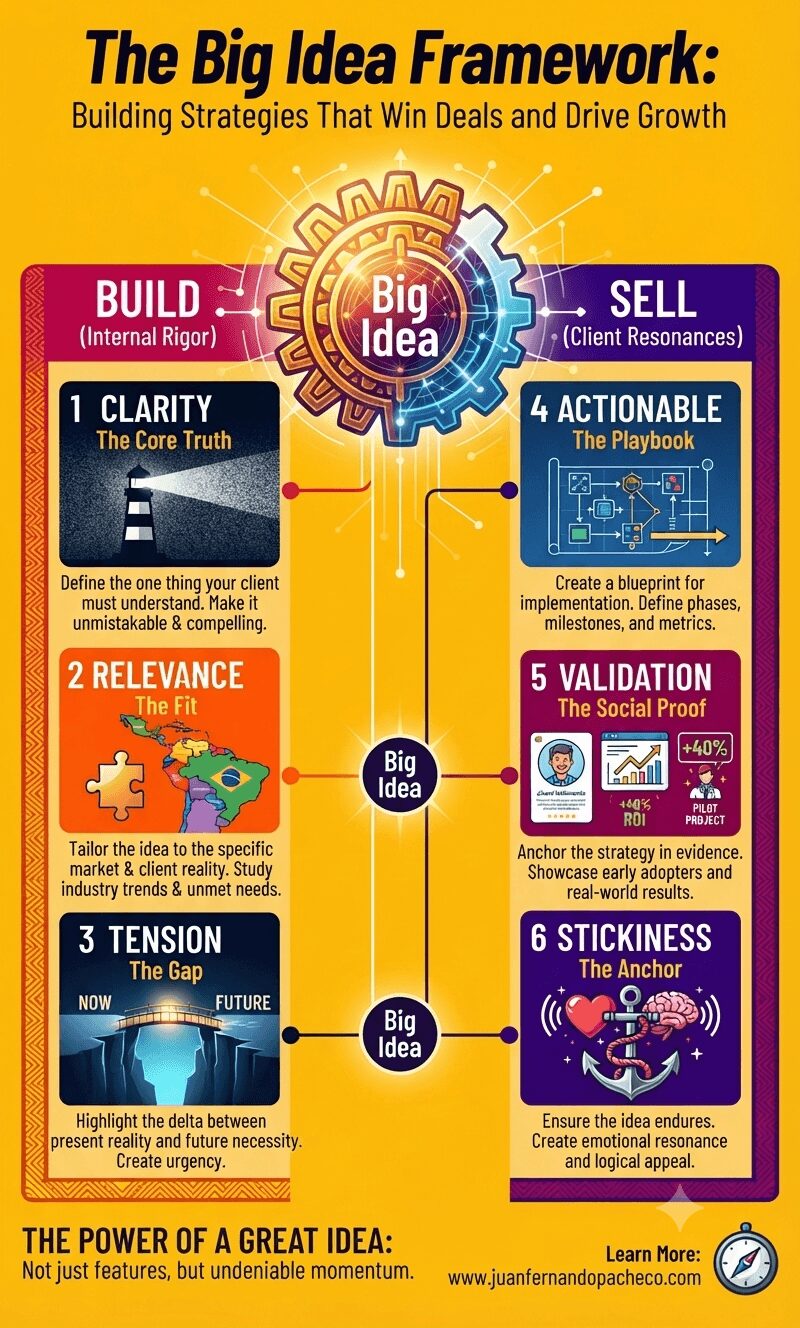
After years of leading high-stakes RFx processes and scaling technology revenue across Mexico, Colombia, and Peru, I have refined my understanding of what makes strategies work. The framework I want to share with you breaks down the big idea into six essential elements, divided into two phases: build and sell. Master these, and you will transform how you approach enterprise deals, product strategy, and business development.
The foundation: understanding the build and sell phases
Before diving into the six elements, it is crucial to understand the distinction between building your strategy and selling it. The first three elements focus on building a solid strategic foundation. These are internal work, the rigorous thinking you must do before you ever present to a client or stakeholder. The last three elements focus on selling, translating that strategic foundation into language and proof points that resonate with your audience.
Many professionals make the mistake of jumping straight to selling without doing the build work. They lead with case studies and implementation plans before establishing why their approach matters. This reversed order weakens their position. You must build before you sell.
Element one: Clarity – the core truth
The first element of building your big idea is clarity. This is about making the central truth of your strategy unmistakable and compelling. In enterprise technology sales, complexity is the enemy of execution. When your strategy requires a twenty-minute explanation before someone understands the value, you have already lost.
Clarity demands ruthless prioritization.
What is the one thing your client must understand for everything else to make sense?
In my experience leading deals for global IT services, the winning proposals always had a central thesis that could be stated in one sentence. For example, instead of saying we offer comprehensive digital transformation solutions with cloud migration, cybersecurity, and change management, the clear version might be:
We help traditional banks compete with fintechs by modernizing their core systems in six months, not six years.
Achieving clarity requires you to challenge your assumptions. Ask yourself: if my client remembers only one thing from this presentation, what should it be? That one thing is your core truth. Everything else supports it.
Element two: Relevance – the fit
Once you have clarity, you must establish relevance. Your big idea should feel inevitable, as if it were tailor-made for this specific moment and this specific client. Generic strategies fail because they ignore the unique context of the buyer.
Relevance comes from deep market understanding. In Latin American markets, I have learned that what works in Mexico City may not resonate in Bogotá or São Paulo. Each market has distinct regulatory environments, cultural nuances, and competitive dynamics. Your big idea must account for these factors.
To establish relevance, study industry trends and identify unmet needs.
- What keeps your client awake at night?
- What competitive threats are they facing?
- What regulatory changes are forcing them to adapt?
When you connect your solution to these immediate concerns, your big idea stops being abstract and starts being essential.
I recall a deal where we were competing against three other firms for a major retail modernization project. While competitors pitched generic omnichannel solutions, we discovered the client was specifically worried about losing market share to international e-commerce players entering the country market. We reframed our entire proposal around defensive growth, showing how our approach would not just modernize their systems but specifically protect and expand their market position against these new entrants. We won the deal because our big idea fit their reality.
Element three: Tension – the gap
The third building element is tension, which represents the gap between where your client is now and where they need to be. This is the delta between present reality and future necessity. Without tension, there is no urgency. Without urgency, deals stall and strategies gather dust.
Highlighting tension requires honesty about stakes.
- What happens if your client does nothing?
- What opportunities will they lose?
- What risks will accumulate?
This is not fear-mongering; it is strategic clarity.
Decision-makers need to understand the cost of inaction to justify the investment in change.
However, tension without a credible solution creates anxiety, not action. You must propose a bold yet achievable path forward. The tension should be significant enough to warrant attention but not so overwhelming that it feels insurmountable.
In technology deals, I often frame tension around competitive disadvantage. For instance, when working with traditional manufacturers, I might highlight how competitors using IoT and predictive maintenance are reducing downtime by forty percent while our client still relies on reactive maintenance.
The gap is clear, the stakes are quantifiable, and the solution becomes compelling.
Element four: Actionable – the playbook
Now we shift from building to selling. The fourth element is making your big idea actionable. You must create a blueprint that shows how the idea comes to life. It must be something your client can actually implement.
Enterprise buyers are skeptical of grand visions without execution plans. They have seen too many consulting decks full of inspiring concepts that never materialized.
Your big idea needs teeth. It needs phases, milestones, resource requirements, and success metrics.
The playbook should answer practical questions:
- Where do we start?
- What does success look like in thirty, sixty, and ninety days?
- What internal resources do you need from the client?
- What are the potential roadblocks and how do we address them?
I have found that the most effective playbooks balance ambition with pragmatism. They show a transformative end state but break the journey into manageable steps. This approach reduces perceived risk and builds confidence that change is possible.
Element five: Validation – the social proof
The fifth element is validation through social proof. The more credible your big idea feels, the more likely people are to rally behind it.
You must anchor your strategy in evidence and highlight early adopters who have already proven the concept.
In Latin American markets, where relationship and trust are paramount, validation is especially critical. Decision-makers want to know that others have walked this path successfully. Case studies, testimonials, pilot results, and third-party endorsements all serve as validation.
However, validation must be relevant. A case study from a Fortune 500 company in North America may impress but not convince a mid-sized enterprise in Chile. Whenever possible, use examples from similar companies, similar markets, or similar challenges.
The closer the parallel, the stronger the validation.
I always recommend building a validation portfolio that includes quantitative results (revenue growth, cost reduction, efficiency gains) and qualitative benefits (improved employee satisfaction, better customer experience, enhanced agility).
Different stakeholders care about different outcomes, so your validation should speak to multiple audiences.
Element six: Stickiness – the anchor
The final element is stickiness, which ensures your big idea endures beyond the initial presentation.
For an idea to stick, it needs both emotional resonance and logical appeal. You must make it the hero of your story.
Stickiness comes from connecting your big idea to deeper values and aspirations. It is not just about implementing new technology; it is about transforming the organization, empowering employees, delighting customers, or securing market leadership. When you tap into these higher-order motivations, your idea becomes memorable.
Logical appeal alone creates understanding but not commitment. Emotional resonance alone creates excitement but not confidence. You need both.
The sticky big idea makes people feel something and believe something.
One technique I use is creating a simple, repeatable phrase that encapsulates the big idea. In a complex digital transformation deal, we used the phrase from legacy to agility as our anchor. Every discussion, every slide, every conversation returned to this phrase. Six months later, the client team was still using it to describe their transformation journey. That is stickiness.
Putting it all together: the integrated approach
These six elements do not work in isolation. They reinforce each other.
- Clarity makes relevance easier to establish.
- Relevance amplifies tension.
- Tension creates demand for an actionable playbook.
- Actionability requires validation.
- Validation enhances stickiness. And
- Stickiness ensures your big idea survives the inevitable challenges of implementation.
When preparing for enterprise deals, I use this framework as a checklist. Before any major presentation or proposal submission, I ask:
- Do we have clarity on the core truth?
- Have we established relevance to this specific client?
- Have we articulated the tension that creates urgency?
- Do we have an actionable playbook?
- Can we provide credible validation? And will this idea stick?
If I cannot answer yes to all six questions, the strategy is not ready.
Why this framework matters now
The business landscape is more competitive than ever. Technology buyers have more options, more information, and more skepticism. Generic pitches and feature-focused presentations no longer win. Decision-makers are looking for partners who bring strategic clarity and proven approaches.
The big idea framework gives you a structured way to develop that strategic advantage. It forces you to do the hard thinking upfront. It ensures you address both the rational and emotional dimensions of decision-making. And it creates a foundation for long-term client relationships, not just one-time transactions.
Whether you are leading RFx responses, developing product strategies, or scaling technology revenue across markets, the principles remain the same. Build with clarity, relevance, and tension. Sell with actionability, validation, and stickiness.
Make your big idea the central force that drives your strategy forward.
Moving forward
I encourage you to apply this framework to your current strategic challenges. Take an active deal or initiative and evaluate it against the six elements. Where are you strong? Where are you weak? What would it take to strengthen each element?
The big idea is not a one-time exercise. It is a discipline.
As markets evolve, as client needs shift, and as competitive dynamics change, your big idea may need refinement. But the framework remains constant. Use it to build strategies that win deals, drive growth, and create lasting impact.
In the end, the difference between good strategies and great strategies is not the quality of the technology or the depth of the expertise. It is the power of the central idea that holds everything together. Master the big idea framework, and you will master the art of strategic influence.