After spending many years of work navigating complex markets across Latin America, from banking and finance to retail and telecommunications, I have learned that:
Success is not just about working harder. It is about working smarter by focusing your energy where it matters most.
One of the most critical decisions any business leader, product manager, or entrepreneur makes is choosing which market segment to serve. Get this right, and you unlock exponential growth. Get it wrong, and you waste years chasing opportunities that were never meant for you.
I want to share a strategic framework that has guided my decisions throughout my career, helping me secure multi-million dollar contracts and scale revenue across diverse Latin American markets. This is not theory. This is a battle-tested approach that works whether you are leading product strategy at a global technology firm or building your own venture.
Why market segment selection matters
Before diving into the methodology, let us address why this decision is so crucial. In my experience as a business development manager across Mexico, Colombia, Peru, Chile, Argentina, and Brazil, I have seen companies spread themselves too thin trying to serve everyone. They customize solutions for film and television companies one week, then pivot to serve internal corporate clients the next, while also chasing small businesses and individual creators.
The result is mediocrity across the board.
When you try to be everything to everyone, you end up being nothing to no one. Your product roadmap becomes fragmented. Your sales team loses focus. Your operations become inefficient. And ultimately, your profitability suffers.
The alternative is deliberate focus. It is about identifying the specific segment where your capabilities align perfectly with market opportunities. This is where you can make the biggest impact, generate the highest returns, and build sustainable competitive advantages.
The five-step strategic framework
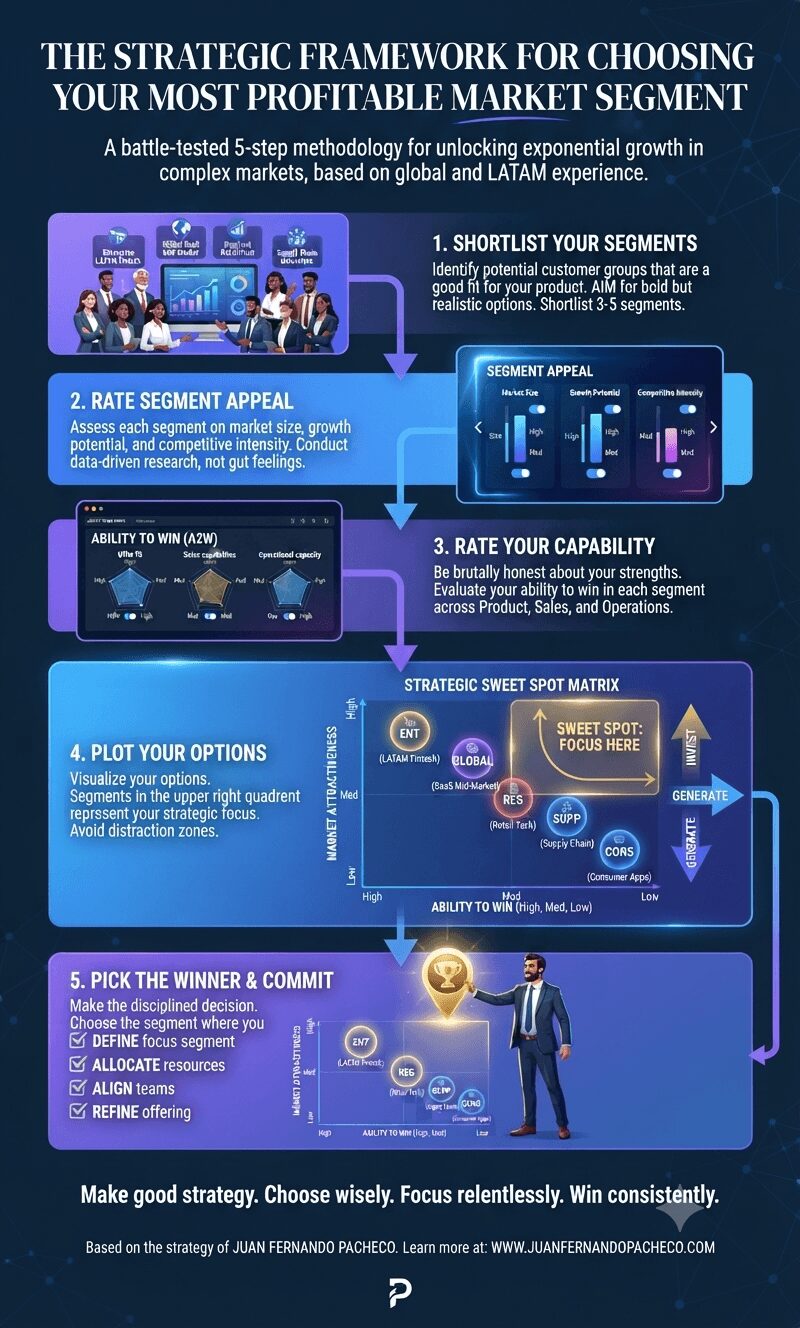
Let me walk you through a systematic approach to finding your sweet spot. This framework breaks down a complex strategic decision into five manageable steps.
Step one: Shortlist your segments
The first step is to identify which groups are a good fit for your product or service. This requires honest assessment and strategic thinking. Do not just list every possible customer type you can imagine. Instead, aim for bold but realistic options.
In my work with enterprise technology solutions, I have evaluated segments ranging from large financial institutions to small retail businesses. Each has distinct needs, buying processes, and decision-making structures. For example, when pursuing banking clients in Latin America, I had to consider regulatory compliance requirements, data sovereignty laws, and complex procurement processes that differ significantly from retail or telecommunications sectors.
Ask yourself these questions:
- Who benefits most from what you offer?
- Which customers have the resources and urgency to buy?
- Where do you already have credibility or relationships?
Be specific. Instead of saying “businesses,” think “mid-sized financial services companies in emerging markets.” Instead of “consumers,” consider “tech-savvy professionals aged twenty-five to forty who value convenience.”
Create a shortlist of three to five segments. This gives you enough options to compare without overwhelming your analysis. Remember, you are not making a final decision yet. You are simply creating a menu of possibilities to evaluate.
Step two: Rate segment appeal
Now that you have your shortlist, it is time to assess the attractiveness of each segment. This evaluation should focus on three key factors: market size, growth potential, and competitive intensity.
- Market size matters because it determines your ceiling for growth. A segment that is too small will limit your expansion, no matter how well you execute. However, bigger is not always better. Massive markets often attract intense competition and require significant resources to penetrate.
- Growth potential indicates whether the segment is expanding or contracting. In my experience scaling technology revenue across Latin America, I have learned to favor segments with strong tailwinds. Digital transformation in banking, for example, has created enormous opportunities over the past decade. Companies that recognized this trend early and positioned themselves accordingly captured disproportionate value.
- Competitive intensity affects your ability to win deals and maintain profitable pricing. A segment dominated by established players with strong relationships and deep pockets is harder to penetrate than one where customers are dissatisfied with current options or where new needs are emerging.
Rate each segment on these dimensions using a simple scale: low, medium, or high. Be honest and data-driven. Conduct market research, talk to industry experts, analyze competitor positioning, and review industry reports. Do not rely on gut feelings or wishful thinking.
Step three: Rate your capability
While market attractiveness is important, it means nothing if you cannot compete effectively. This step requires brutal honesty about your strengths and weaknesses. Evaluate your ability to win in each segment across three dimensions: your offer, your sales capabilities, and your operational capacity.
- Your offer refers to how well your product or service meets the specific needs of the segment. Does it solve their most pressing problems? Is it differentiated from competitors? Can you deliver measurable value? In my work managing complex RFI, RFQ, and RFP processes, I have seen deals won or lost based on how precisely solutions addressed client requirements. Generic offerings rarely win against tailored solutions.
- Your sales capabilities include your relationships, credibility, and go-to-market effectiveness. Do you have access to decision-makers? Do you understand the buying process? Can you articulate value in terms that resonate with this segment? When I lead face-to-face meetings with C-level executives and board members across Latin America, success depends on a deep understanding of their business context, not just product features.
- Your operational capacity encompasses your ability to deliver consistently at the quality and scale the segment demands. Do you have the right talent, processes, and infrastructure? Can you meet service level agreements? In enterprise technology deals, operational excellence is non-negotiable. Clients expect ninety-nine percent plus uptime, rapid response times, and seamless integration with their existing systems.
Rate your capability for each segment as low, medium, or high. This is not about where you want to be. It is about where you are today. Gap analysis and capability building come later. First, you need an accurate baseline.
Step four: Plot your options
Now comes the visual analysis that brings clarity to your decision. Create a three-by-three matrix with market attractiveness on the vertical axis and your ability to win on the horizontal axis. Plot each segment on this grid based on your ratings from steps two and three.
This visualization reveals strategic patterns that are not obvious from lists or tables. Segments in the upper right quadrant, high attractiveness and high ability to win, represent your sweet spot. These are opportunities where market conditions favor you, and you have the capabilities to capitalize.
This is where you should focus your energy.
- Segments in the upper left quadrant are attractive markets where you currently lack capability. These represent potential growth areas, but they require investment to build strength. Segments in the lower right quadrant are markets where you have capability but limited attractiveness. These might generate steady revenue but offer limited growth potential.
- Segments in the lower left quadrant are neither attractive nor aligned with your strengths. These are distraction zones. Avoid them, or exit them if you are already there.
In my career, I have seen this framework work repeatedly. When evaluating opportunities across different industries and geographies in Latin America, plotting options on this matrix helped me prioritize deals that had the highest probability of success and the greatest strategic value. It prevented me from chasing attractive-looking opportunities where we had no realistic chance of winning.
Step five: Pick the winner
The final step is committing. Choose the segment where you are both capable and rewarded. This is your strategic focus. This is where you will concentrate resources, refine your offering, build deep expertise, and dominate.
Picking a winner requires discipline. It means saying no to other segments, even attractive ones. It means resisting the temptation to customize for every prospect. It means accepting short-term opportunity cost for long-term strategic advantage.
In my experience leading cross-functional teams across more than ten countries, focus creates momentum.
When everyone in the organization understands which segment you serve and why, alignment improves.
Product development becomes more efficient. Sales messaging becomes more compelling. Marketing becomes more targeted. Customer success becomes more effective.
However, picking a winner does not mean you are locked in forever. Markets evolve. Capabilities develop. New opportunities emerge. Revisit this analysis annually or when significant changes occur. Your sweet spot today might shift tomorrow, and that is okay. What matters is making deliberate choices based on current reality, not drifting aimlessly.
Putting the framework into practice
Let me share how this framework applies to real-world scenarios. Imagine you are leading a technology services company considering different market segments. You might evaluate large enterprises, mid-market companies, and small businesses.
- Large enterprises offer big contract values and long-term relationships, but they have complex procurement processes, demanding requirements, and intense competition from global players. If you lack enterprise-grade certifications, reference customers, and delivery capacity, your ability to win is low despite high attractiveness.
- Mid-market companies might offer moderate contract values with simpler buying processes. If you have strong relationships in this segment and proven solutions that address their specific challenges, this could be your sweet spot.
- Small businesses might have low barriers to entry but also low contract values, high churn, and limited growth potential. Even if you can easily win deals here, the segment attractiveness might be too low to justify focus.
The framework forces you to make these trade-offs explicitly rather than implicitly.
Common pitfalls to avoid
As you apply this framework, watch out for common mistakes.
- First, do not confuse segment attractiveness with segment size. A massive market is not attractive if it is saturated with competitors, has low margins, or is in decline. Look at the complete picture.
- Second, do not overestimate your capabilities. It is natural to be optimistic about your strengths, but wishful thinking leads to poor decisions. Seek external validation. Talk to customers. Analyze win-loss data. Be humble.
- Third, do not ignore the dynamics of change. A segment that is attractive today might not be tomorrow. Technology shifts, regulatory changes, and competitive moves can alter the landscape quickly. Build in regular review cycles.
- Fourth, do not try to serve multiple segments equally. While you might eventually expand to adjacent segments, trying to do everything at once dilutes your focus and weakens your position. Master one segment before expanding.
The compound effect of focus
When I reflect on my professional journey from UX designer to strategic product and deal leader, the pattern is clear. My most significant achievements came from focused effort in well-chosen segments. Whether leading complex deal execution for top regional brands or driving cross-functional teams to exceed KPIs, success followed focus.
The compound effect of concentrating on the right segment is powerful. You build deeper customer insights, which leads to better solutions. Better solutions generate stronger references, which accelerates sales cycles. Faster sales cycles improve cash flow, which funds capability building. Stronger capabilities create competitive moats, which protect margins. It is a virtuous cycle.
Conversely, spreading yourself thin creates a vicious cycle. Shallow customer understanding leads to generic solutions. Generic solutions require heavy discounting to win. Discounting pressures margins, which limits investment in capabilities. Weak capabilities make it harder to win, leading to more discounting. It is a death spiral.
Your next move
The framework I have shared is not complicated, but it is powerful. It has guided my decisions across banking, finance, retail, and telecommunications sectors in multiple Latin American countries. It has helped me secure multi-year contracts, scale revenue, and build lasting client relationships.
Your situation is unique. Your market context differs from mine. Your capabilities are different. But the fundamental strategic challenge is the same: where should you focus your limited resources to create maximum impact?
Take time this week to work through the five steps. Shortlist your segments. Rate their appeal. Assess your capabilities. Plot your options. Pick your winner. Then commit fully.
The biggest strategic move you can make is not launching a new product, entering a new geography, or hiring a star performer. It is choosing the right battlefield where your strengths meet market opportunities. Everything else follows from that decision.
Make good strategy. Choose wisely. Focus relentlessly. Win consistently.