¿Why your best strategies fail to gain traction?
During years of navigating complex technology deals across Latin America, I’ve witnessed a recurring pattern: brilliant strategies dying in boardrooms, not because they lacked merit, but because they failed to resonate. I’ve seen technical teams present flawless solutions that fell flat with C-level executives. I’ve watched promising RFP responses get rejected despite superior capabilities. The common denominator?
Poor strategic storytelling.
As someone who has led end-to-end RFI/RFQ/RFP processes for top regional brands, securing multi-million-dollar contracts in banking, finance, and telecommunications, I’ve learned that technical excellence alone doesn’t close deals. What separates winning proposals from forgotten ones is the ability to frame your strategy in a way that makes stakeholders feel the urgency, understand the solution, and commit to action.
This is where the Strategy Story Arc becomes your most powerful weapon.
The communication crisis in strategic leadership
Let me share an uncomfortable truth:
Most business leaders are terrible at communicating strategy.
We drown our audiences in data, bury them in technical specifications, and overwhelm them with features. We assume that if we just present enough information, rational decision-makers will naturally arrive at our conclusion.
But human decision-making doesn’t work that way.
After managing cross-functional teams across 10+ years and facilitating countless face-to-face meetings with senior management, I’ve observed that even the most analytical executives make decisions based on narrative coherence.
They need a story that connects the dots between their current pain and your proposed future.
The problem intensifies in complex enterprise sales cycles. When you’re navigating government mandates, regulatory compliance, data sovereignty requirements, and complex legal clauses across multiple LATAM markets, the temptation to over-explain is overwhelming.
Yet paradoxically, the more complex your solution, the simpler your communication must be.
This isn’t about dumbing down your message. It’s about structuring it in a way that respects your audience’s cognitive load while maximizing persuasion.
Understanding the Strategy Story Arc Framework
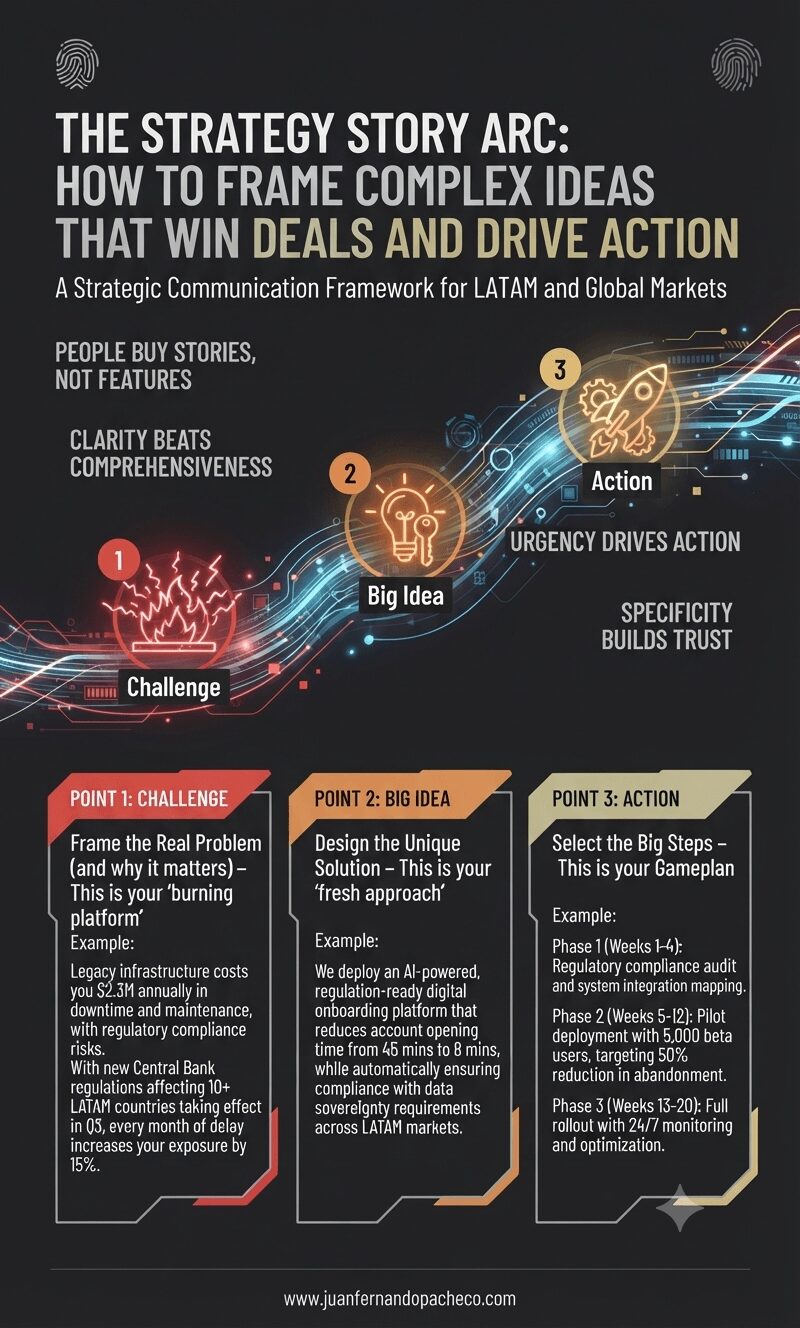
The Strategy Story Arc distills strategic communication into three essential components that mirror how humans naturally process information and make decisions. This framework has become my go-to structure for everything from RFP responses to board presentations, and it’s helped me accelerate time-to-market by 20% and boost user adoption by 15% across solutions serving millions of banking and finance users.
Point 1: Challenge – Frame the Real Problem
The first movement of your strategy story must establish the “burning platform.” This isn’t just about identifying a problem; it’s about framing
Why it matters right now and what happens if nothing changes.
In my experience leading high-stakes RFx execution, I’ve learned that most proposals fail at this first hurdle. Vendors jump straight into their solution without first creating shared understanding of the problem’s magnitude. They assume everyone perceives the challenge the same way they do.
The Anatomy of a Compelling Challenge:
A powerful challenge statement does three things:
- Quantifies the pain: Instead of saying “your legacy systems are inefficient,” specify “your current infrastructure costs you $2.3 million annually in downtime and maintenance, while exposing you to regulatory compliance risks.”
- Creates urgency: Explain why this can’t wait. In LATAM markets, this often involves regulatory deadlines, competitive threats, or technological obsolescence. For example, “With new data sovereignty regulations taking effect in Q3, every month of delay increases your compliance exposure by 15%.”
- Connects to strategic priorities: Link the challenge to what your stakeholders care about most—revenue growth, risk mitigation, customer retention, or market expansion.
When I’m working with banking clients in Mexico, Colombia, or Brazil, I don’t start by talking about our technical capabilities. I start by demonstrating that I understand their specific regulatory environment, their competitive pressures, and their growth objectives. This establishes credibility and creates the psychological safety for them to consider change.
Common Mistake: Don’t confuse symptoms with root causes. A client might say they need “faster transaction processing,” but the real challenge might be “inability to scale during peak periods, resulting in customer churn and reputational damage.” Dig deeper.
Point 2: Big Idea – Design the Unique Solution
Once you’ve established the burning platform, you introduce your “fresh approach.” This is where you present your unique solution—not as a list of features, but as a fundamentally different way of solving the challenge you just framed.
The Big Idea must be:
- Distinctive: Not just better, but different
- Memorable: Simple enough to repeat in a hallway conversation
- Credible: Backed by evidence and expertise
- Relevant: Directly addressing the challenge you outlined
Crafting Your Big Idea:
In my role as Business Development Manager at TATA Consultancy Services, I’ve learned that the most powerful Big Ideas reframe the conversation entirely. Rather than positioning against competitors on price or features, they create a new category or approach.
For instance, when a consulting firm is struggling to differentiate in a crowded market (as shown in the framework example), the Big Idea isn’t “we have better consultants.” It’s “we deliver results in weeks instead of months through rapid innovation sprints.” This shifts the evaluation criteria from “who has the most impressive credentials” to “who can deliver value fastest.”
Applying This to Technology Deals:
When I’m structuring proposals for complex IT procurement in LATAM, the Big Idea might be:
- Instead of “we provide cloud migration services,” it becomes “we enable zero-downtime cloud transformation with built-in regulatory compliance for LATAM markets.”
- Rather than “we offer 24/7 technical support,” we position “proactive AI-driven monitoring that prevents 94% of incidents before they impact your customers.”
The Big Idea should be your “onlyness statement”—the one thing that only you can deliver in this specific way.
Testing Your Big Idea:
Ask yourself:
- Can I explain this in one sentence?
- Does it directly solve the challenge I outlined?
- Is it genuinely different from how competitors approach this?
- Can I back it up with proof points?
If you hesitate on any of these, refine further.
Point 3: Action – Select the Big Steps
The final movement transforms your compelling narrative into concrete commitment. This is your gameplan—the specific, sequential steps that will make the Big Idea real.
Too many strategic presentations end with vague promises like “we’ll work together to implement this solution.” That’s not action; that’s aspiration. Action requires specificity, timelines, and accountability.
Structuring Your Action Plan:
An effective action section answers four questions:
- What exactly will happen? Break down the implementation into clear phases or workstreams. For a cloud migration project, this might be: Assessment → Architecture Design → Pilot Migration → Full-Scale Deployment → Optimization.
- When will it happen? Provide realistic timelines with milestones. In LATAM markets, where regulatory deadlines often drive urgency, this is critical. “Phase 1 completes in 6 weeks, ensuring compliance before the Q3 regulatory deadline.”
- Who does what? Clarify responsibilities. “Your team provides subject matter experts for weekly workshops; our team delivers technical implementation and risk mitigation.”
- How do we measure success? Define KPIs upfront. “We’ll track system uptime (target: 99.9%), user adoption rates (target: 85% within 90 days), and cost reduction (target: 30% reduction in infrastructure costs by month 6).”
The Psychology of Action:
From my experience reducing customer request resolution by 30% through streamlined POC development, I’ve learned that people commit to action when they can see the path forward.
Vague promises create anxiety; specific plans create confidence.
When I’m negotiating stringent SLAs for uptime, response times, and penalties, the action plan becomes our risk-mitigation tool. By showing exactly how we’ll achieve 100% on-time delivery, we transform skepticism into partnership.
Building Momentum:
Structure your action steps to create early wins. In complex multi-year contracts, the first 90 days are critical. Identify quick victories that demonstrate value and build trust for the longer journey ahead.
For example, before a full-scale digital transformation, we might pilot a two-week sprint with clear goals and daily check-ins to deliver immediate, visible impact. This proves the concept and creates internal champions who will advocate for the broader initiative.
Applying the Story Arc to Complex LATAM Deals
Let me show you how this framework plays out in real-world scenarios across Latin American markets.
Scenario: Banking Digital Transformation in Colombia
- Challenge: “Your current digital banking platform experiences 40% customer abandonment during account opening, costing you an estimated $8M in lost deposits annually. Meanwhile, fintech competitors are capturing market share with mobile-first experiences, and new Central Bank regulations require enhanced KYC processes by year-end.”
- Big Idea: “We deploy an AI-powered, regulation-ready digital onboarding platform that reduces account opening time from 45 minutes to 8 minutes while automatically ensuring compliance with Colombian data sovereignty requirements.”
- Action: “Phase 1 (Weeks 1-4): Regulatory compliance audit and system integration mapping. Phase 2 (Weeks 5-12): Pilot deployment with 5,000 beta users, targeting 50% reduction in abandonment. Phase 3 (Weeks 13-20): Full rollout with 24/7 monitoring and optimization. Success metrics: 70% reduction in abandonment, 100% regulatory compliance, 25% increase in new account conversions.”
This structure transforms a complex, multi-million dollar technology deal into a clear narrative that resonates with both technical teams and C-level executives.
Making the Framework Evergreen: Principles That Transcend Trends
What makes the Strategy Story Arc evergreen is that it’s built on timeless principles of human psychology and decision-making, not on fleeting business trends.
Principle 1: People Buy Stories, Not Features
Whether you’re selling to a bank in Mexico, a retailer in Chile, or a telecom in Brazil, decision-makers are human. They process information through narrative structures. This won’t change in three years or thirty.
Principle 2: Clarity Beats Comprehensiveness
In an age of information overload, the ability to distill complexity into clarity is increasingly valuable. As technology becomes more sophisticated, the need for simple, compelling communication only intensifies.
Principle 3: Urgency Drives Action
The “burning platform” concept isn’t manipulative; it’s honest. If there’s a real problem that needs solving, framing its urgency is a service to your stakeholders. This principle applies whether you’re discussing digital transformation, regulatory compliance, or market expansion.
Principle 4: Specificity Builds Trust
Vague promises create skepticism. Specific plans build confidence. This is as true today as it will be in the future. The more complex the deal, the more critical detailed action planning becomes.
Common Pitfalls and How to Avoid Them
After 20+ years of crafting strategic narratives, I’ve made every mistake in the book. Here are the most common traps and how to avoid them:
Pitfall 1: Skipping the Challenge
Don’t assume everyone agrees on the problem. Spend adequate time framing the challenge with data, context, and urgency. I’ve seen deals lost because the vendor assumed the client understood the severity of their situation.
Pitfall 2: Making the Big Idea Too Complex
If your Big Idea requires a 20-minute explanation, it’s not a Big Idea. Distill it to its essence. You can provide details later; first, you need buy-in.
Pitfall 3: Vague Action Steps
“We’ll implement the solution over the next few months” is not an action plan. “We’ll complete Phase 1 by March 15 with three deliverables: X, Y, and Z” is an action plan.
Pitfall 4: Ignoring Stakeholder Diversity
In complex enterprise deals, you’re not presenting to one person. You’re presenting to a committee with different priorities—CFOs care about ROI, CTOs care about technical feasibility, CROs care about risk. Your story arc must address all these perspectives.
Pitfall 5: Failing to Adapt to Cultural Context
Across LATAM markets, communication styles vary. What works in Mexico might need adjustment in Argentina or Brazil. The framework remains constant, but your delivery must be culturally intelligent.
Putting It Into Practice: Your Next Strategic Presentation
Here’s how to apply this framework to your next RFP response, board presentation, or client pitch:
Step 1: Start with the End in Mind
Before you open PowerPoint, answer this: What specific action do I want my audience to take? Every element of your story should drive toward this action.
Step 2: Research Your Audience’s Challenges
Don’t guess. Conduct discovery. Talk to stakeholders. Understand their pain points, their strategic priorities, their constraints. In my role managing business opportunities across LATAM, I invest heavily in market research and stakeholder interviews before crafting any proposal.
Step 3: Craft Your Challenge Statement
Write one paragraph that quantifies the problem, creates urgency, and connects to strategic priorities. Test it with a trusted colleague: Does this make them feel the importance of the problem?
Step 4: Develop Your Big Idea
Distill your solution into one memorable sentence. If you can’t, keep refining. The discipline of simplicity is worth the effort.
Step 5: Build Your Action Plan
Create a phased implementation roadmap with specific milestones, responsibilities, and success metrics. Make it so clear that someone could execute it without you.
Step 6: Test and Refine
Present your story arc to someone unfamiliar with the project. If they can repeat back your Challenge, Big Idea, and Action, you’ve succeeded. If not, simplify further.
The Compound Effect of Strategic Storytelling
Mastering the Strategic Story Arc isn’t just about winning individual deals. It compounds over your career.
When you consistently communicate with clarity and impact, you build a reputation as a strategic thinker. Stakeholders seek your input. Teams rally behind your vision. Deals close faster. Projects gain momentum.
In my journey from UX Designer to Strategic Product and Deal Leader, the ability to structure complex ideas into compelling narratives has been as important as technical expertise. It’s what enabled me to forge strong connections with C-level executives, lead cross-functional teams across 10+ countries, and drive revenue growth over six years.
Conclusion: Your Story Starts Now
The Strategy Story Arc—Challenge, Big Idea, Action—is more than a presentation framework. It’s a discipline for strategic thinking. It forces you to clarify the problem, differentiate your solution, and commit to concrete action.
Whether you’re responding to an RFP, pitching a new product, or presenting a digital transformation roadmap, this framework will help you cut through the noise and create the buy-in you need.
The markets we serve across LATAM are evolving rapidly. Regulatory requirements are tightening. Competition is intensifying. Customer expectations are rising. In this environment, the ability to communicate strategy clearly isn’t a nice-to-have—it’s a competitive necessity.
So here’s my challenge to you: Take your next strategic presentation and restructure it using this three-point arc. Frame the burning platform. Articulate your fresh approach. Define your gameplan with specificity.
Then watch what happens when you stop presenting information and start telling a story that demands action.
Because in the end, the best strategy in the world is worthless if you can’t get people to understand it, believe in it, and act on it.
Make good strategy. Tell better stories. Win bigger deals.

