Building habit-forming products that last in Latin American markets
After years of transforming user needs into scalable technology products across Latin America, I have learned that the difference between a successful digital product and one that fades into obscurity often comes down to a single question: does it create lasting habits?
My journey from a Senior UX Designer to leading complex deal executions and business development has shown me that user attention is the scarcest resource. In the competitive landscapes of banking, finance, and telecommunications that I navigate daily across Mexico, Colombia, Peru, Chile, Argentina, and Brazil, customers have countless options at their fingertips.
The products that win are not necessarily those with the most features or the lowest prices, but those that seamlessly integrate into users’ daily lives until they become indispensable.
This is where the hooked model becomes an essential framework for product leaders, business developers, and anyone responsible for driving digital adoption in our region.
Understanding the hooked model framework
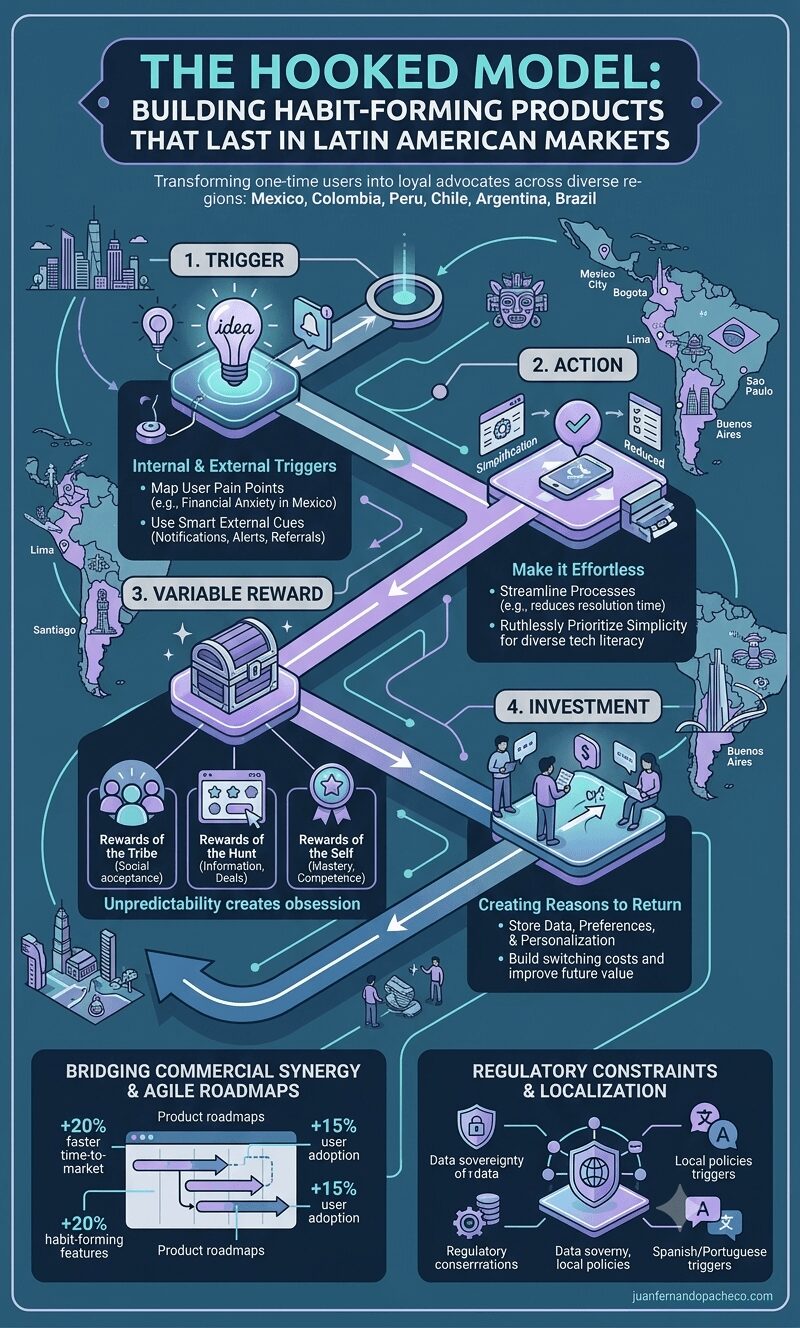
The hooked model presents a four-phase cycle that transforms one-time users into loyal advocates through habit formation. Unlike traditional marketing funnels that focus purely on acquisition, this model emphasizes retention and repeated engagement through a continuous loop: trigger, action, variable reward, and investment.
What makes this framework particularly powerful for our work is its psychological foundation. It recognizes that lasting behavior change does not happen through force or persuasion alone, but through creating positive feedback loops that align with how human brains naturally form habits.
When I lead high-stakes RFx execution—managing complex Request for Proposal and Quote processes—or develop product roadmaps for regional brands, I constantly reference this model. It ensures we are not just solving immediate problems for multi-million-dollar contracts, but building solutions that users will return to voluntarily, repeatedly, and enthusiastically.
Phase one: trigger – the spark that starts everything
Every habit begins with a trigger, a cue that prompts users to take action.
Triggers come in two forms: external and internal.
- External triggers are the obvious ones: push notifications, emails, alerts, advertisements, or a friend’s recommendation. These are the tools we traditionally use in marketing and product design to prompt engagement. However, relying solely on external triggers creates a fragile product. Users become dependent on reminders, and engagement drops the moment you stop prompting them. The real magic happens when external triggers successfully connect to internal triggers.
- Internal triggers are emotions, situations, or pain points that automatically prompt users to think of your product. When someone feels anxious about their finances, they instinctively open their banking app. When a retail shopper in Mexico fears missing out on deals, it triggers habitual checking of e-commerce platforms.
In my experience securing contracts for top regional brands, the most successful digital products are those that have successfully mapped their users’ internal pain points. For a small business owner in Colombia, the anxiety of cash flow management becomes an internal trigger that leads them to check their business banking dashboard every morning.
To build effective triggers, you must deeply understand your users’ emotional landscape. Your product must become the automatic response to these internal states.
Phase two: action – making it effortless to engage
Once a trigger has done its work, users must take action.
This is where many products fail. They create friction, complexity, or confusion that causes users to abandon the intended behavior.
The hooked model teaches us that the action phase must be the simplest possible behavior undertaken in anticipation of a reward. This aligns perfectly with what I have observed across diverse market segments in our region: users will not jump through hoops, no matter how valuable the result might be.
Three elements determine whether a user will complete an action: motivation, ability, and a clear prompt.
Motivation is addressed through the trigger. The prompt is the specific instruction or interface element that guides the user. But ability is where product design becomes critical.
To increase ability, you must reduce the time, effort, and cognitive load required to complete the action. In banking and finance, where security and regulatory compliance often create natural friction, this becomes particularly challenging. Yet I have seen institutions successfully reduce customer request resolution time by 30% simply by streamlining proof of concept development and eliminating unnecessary steps in their user journeys.
The key is to ruthlessly prioritize simplicity. Every additional field in a form, every extra click in a process, every moment of confusion is an opportunity for users to abandon the action. In Latin American markets, where digital literacy varies widely, and users may be accessing your product on older devices or slower connections, simplicity is not a luxury; it is a necessity.
Phase three: variable reward – the engine of engagement
Here is where the hooked model reveals its psychological sophistication.
Not all rewards are created equal. Predictable rewards create satisfaction, but variable rewards create obsession.
Think about the difference between checking your email and checking social media. Email offers relatively predictable rewards. Social media, by contrast, offers variable rewards: you never know what you will find when you pull to refresh. This unpredictability keeps you coming back.
The hooked model identifies three types of variable rewards:
- Rewards of the tribe satisfy our need for social connection and acceptance. This includes likes, comments, shares, and social validation.
- Rewards of the hunt satisfy our need to acquire resources and information. This is the thrill of finding a deal, discovering new content, or uncovering valuable data. Financial platforms that offer personalized insights or investment opportunities tap into this reward type.
- Rewards of the self satisfy our need for mastery, competence, and completion. This includes achieving goals, completing tasks, or leveling up.
In my work scaling technology revenue across Latin American markets, I have found that the most engaging products often combine multiple reward types. A banking app might offer rewards of the hunt through personalized financial insights, rewards of the self through savings goal completion, and rewards of the tribe through family account features.
The critical element is unpredictability. However, ethical considerations are paramount. Variable rewards should enhance user value, not exploit psychological vulnerabilities. In financial services especially, we must ensure that engagement drives better financial outcomes for users, not compulsive behaviors that harm them.
Phase four: investment – creating reasons to return
The final phase of the hook is investment, and it is what transforms the cycle from a one-time engagement into a self-reinforcing loop.
Investment means users put something into the product: time, data, effort, preferences, or content.
This investment serves two critical functions.
- First, it increases the likelihood of the user returning because they have created something valuable that they do not want to lose.
- Second, and more importantly, it loads the next trigger, making the cycle more likely to repeat.
When users personalize their experience, store preferences, upload data, or build profiles, they are investing in the product. In enterprise software and banking solutions, where I spend most of my time leading cross-functional teams across product, sales, legal, engineering, and operations, investment might look different but follows the same principle. When a business client configures dashboards, sets up automated reports, or integrates data sources, they are investing. These investments create switching costs and increase the perceived value of the solution.
The investment phase also improves the product for future use. The more users invest, the better the product becomes at serving them.
Recommendation algorithms improve with more data. Personalized experiences become more relevant.
This creates a powerful flywheel effect that becomes self-sustaining, requiring less external prompting to maintain engagement.
Translating commercial synergy into agile roadmaps
One of the most critical aspects of applying this model in enterprise environments is bridging the gap between commercial promises and product reality. During high-stakes RFI, RFQ, and RFP processes, we often make grand commitments to clients regarding user adoption and engagement.
To deliver on these promises, I focus heavily on commercial-product synergy. By translating client objectives and complex requests into Agile product roadmaps, we can accelerate time-to-market by 20% and boost user adoption by 15% for solutions serving millions of banking and finance users.
The hooked model serves as the North Star for these roadmaps.
When prioritizing the backlog, we ask ourselves:
- Which user story strengthens the trigger?
- Which feature reduces friction in the action phase?
- Which enhancement introduces a meaningful variable reward?
By keeping the hook cycle at the center of our Agile ceremonies, we ensure that every sprint contributes to long-term habit formation rather than just short-term feature delivery.
Applying the hooked model in Latin American markets
Implementing the hooked model in Latin America requires cultural sensitivity and regional awareness.
Our markets are diverse, with varying levels of digital adoption, different regulatory environments, and distinct user behaviors across countries.
Navigating government mandates, data sovereignty, and local policies is a massive part of my role when securing multi-million-dollar contracts. These regulatory constraints shape how we implement each phase. Data sovereignty requirements and local privacy laws are not obstacles to habit formation; they are parameters within which we must design ethical, compliant, and effective user experiences.
Language and cultural nuances matter too. A trigger that works in Spanish might not resonate in Portuguese. Successful products localize not just language but the entire psychological framework of engagement.
Measuring success beyond vanity metrics
When implementing the hooked model, traditional metrics like downloads or registrations tell only part of the story.
What matters is whether users are moving through the complete hook cycle repeatedly.
Track trigger effectiveness by measuring how often external prompts lead to actions. Monitor action completion rates to identify friction points. Analyze reward engagement to understand what keeps users coming back. Measure investment behaviors to predict long-term retention. Most importantly, measure the time between hooks. As products become more habit-forming, the time between user engagements should decrease, and the reliance on external triggers should diminish as internal triggers take over.
Building habits responsibly
With the power to create habits comes significant responsibility. As product leaders, we must ensure that the behaviors we are reinforcing serve our users’ genuine interests and well-being.
In financial services, this means creating habits that improve financial health, not compulsive checking that increases anxiety. The hooked model is a tool, and like any tool, its impact depends on how we use it. When applied ethically, it helps create products that genuinely improve users’ lives by making valuable behaviors easier, more rewarding, and more sustainable.
Conclusion
The hooked model offers more than a framework for product design; it provides a lens through which to understand human behavior and create technology that serves people more effectively. Across my twenty years of work in Latin America, transitioning from crafting user-centered experiences as a UX designer to driving commercial strategy and high-stakes RFx execution, I have seen time and again that products succeed because they become indispensable parts of users’ daily lives.
By thoughtfully implementing triggers, simplifying actions, delivering variable rewards, and encouraging investment, we can build digital experiences that create genuine value and lasting engagement. But we must do so with cultural sensitivity, ethical responsibility, and an unwavering focus on user benefit.
In the end, the goal is not to hook users for the sake of engagement metrics. The goal is to create products so valuable, so well-designed, and so aligned with user needs that forming a habit around them is the natural, beneficial outcome. That is the kind of product leadership that drives sustainable growth across Latin American markets and builds the foundation for long-term success in our increasingly digital world.