The art of turning brilliant ideas into action
After two decades working in technology sales, product strategy, and business development across Latin America, I’ve witnessed a pattern that never ceases to amaze me. Brilliant strategies die quiet deaths not because they lacked merit, but because they were communicated poorly.
- I’ve seen million-dollar deals slip away not due to inferior solutions, but because the value proposition was buried in jargon and complexity
- I’ve watched transformation initiatives stall because the strategic narrative failed to resonate with stakeholders who needed to understand and act.
Here’s the uncomfortable truth:
Your strategy is only as good as your ability to make others understand it, believe in it, and execute it.
Whether you’re responding to a complex RFx, pitching a digital transformation to a C-suite audience in Bogotá or Mexico City, or aligning your product team around a new roadmap, the difference between success and failure often comes down to one skill—strategic storytelling.
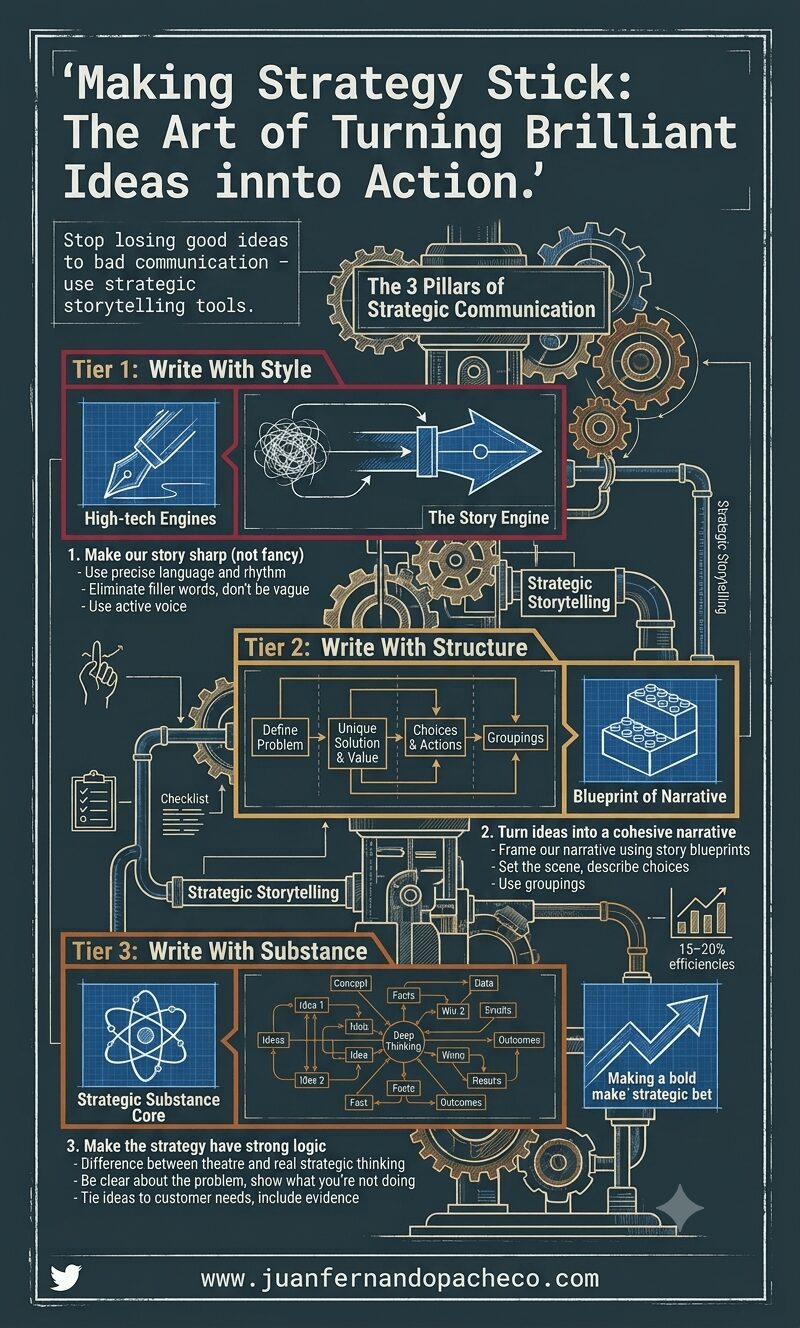
Let me share a framework that has transformed how I approach strategic communication in enterprise technology deals and organizational leadership. It rests on three pillars:
Writing with style, structure, and substance.
Master these, and you’ll stop losing good ideas to bad communication.
The first pillar: write with style
When I review proposal responses or strategic documents from my teams, the most common mistake I see is the attempt to sound impressive rather than clear. there’s a mistaken belief that complex challenges require complex language. nothing could be further from the truth.
In high-stakes RFx processes, evaluators often review dozens of responses. they’re tired, they’re pressed for time, and they’re looking for reasons to eliminate vendors quickly.
If your response requires them to decode your meaning, you’ve already lost.
The same applies when you’re presenting a product strategy to executive sponsors or trying to get buy-in from cross-functional teams.
Writing with style doesn’t mean writing with flair or creativity. it means writing with precision and purpose. it means making your story sharp, not fancy.
Here’s what this looks like in practice.
- Instead of saying “we leverage synergistic paradigms to optimize operational efficiencies,” say “we reduce your costs by 30 percent through automation.”
- Instead of “our solution facilitates enhanced customer engagement touchpoints,” say “our platform helps you respond to customer inquiries 50 percent faster.“
The steps are deceptively simple but require discipline.
- First, eliminate filler words and get straight to the point. every sentence should earn its place. if you can remove a word without losing meaning, remove it.
- Second, don’t be vague. Include specific details, numbers, and outcomes. “improved performance” is forgettable. “reduced processing time from 4 hours to 15 minutes” is memorable.
- Third, use active voice with clear positions. passive voice creates distance and ambiguity. “the decision was made to implement” is weak. “we will implement” is strong. in enterprise sales and strategic leadership, you’re being evaluated on your ability to take ownership and drive results. Your language should reflect that.
- Finally, make your big points stand out with strong opening lines. Don’t bury your value proposition in paragraph three. Lead with it.
In my RFx work, I coach teams to front-load their responses with the most compelling differentiators. evaluators shouldn’t have to hunt for why you’re the best choice.
The second pillar: write with structure
I once reviewed a 200-page competitor proposal that contained excellent content but was organized so poorly that the evaluation team couldn’t find the information they needed. The competitor lost that deal. I’m sure the lesson was painful but clear:
Great ideas without structure are like having a warehouse full of inventory with no organization system—you know you have value, but no one can find it.
Structure transforms disconnected ideas into a cohesive narrative that guides your audience from problem to solution to action. when you’re dealing with complex enterprise technology deals or multi-year transformation programs, structure isn’t optional—it’s essential.
Think about the last time you sat through a presentation that jumped from topic to topic without clear connections. How engaged were you? now think about a presentation that took you on a logical journey, where each point built on the previous one. That’s the power of structure.
In my work across LATAM markets, I’ve found that proven strategy story blueprints work universally, whether you’re presenting to a financial services client in São Paulo or a retail executive in Mexico City.
The human brain craves narrative coherence regardless of culture or industry.
Here’s the framework I use for structuring strategic communications.
- First, set the scene and define the problem clearly. don’t assume everyone shares your understanding of the challenge. Paint the picture of the current state, the pain points, and the cost of inaction. make it specific and quantified where possible.
- Second, share the unique solution and its value. This is where many strategic documents fail—they describe features without connecting them to outcomes. every capability you mention should be tied to a specific benefit. not “our platform has AI-powered analytics,” but “our AI-powered analytics identify cost savings opportunities you’re currently missing, typically revealing 15-20 percent in operational efficiencies.“
- Third, describe the choices and actions required to make it real. strategy without execution is fantasy. be explicit about what needs to happen, who needs to do it, and when. In RFx responses, this means outlining implementation approaches, timelines, and resource requirements. in product strategy, this means defining roadmaps, dependencies, and success metrics.
- Finally, use groupings to make complex information easier to follow. The human brain can only hold so much information at once. Chunk related concepts together. use frameworks and categories. in my proposal work, I organize responses around evaluation criteria, making it effortless for evaluators to score us favorably.
Structure is the scaffolding that holds your strategic narrative together. without it, even the most brilliant ideas collapse under their own weight.
The third pillar: write with substance
Here’s where I see many talented professionals stumble. They create beautifully written, well-structured documents that ultimately say nothing of real strategic value. They confuse activity with strategy, features with differentiation, and aspirations with choices.
Substance is what separates real strategic thinking from theater. It’s the difference between a generic proposal that could have been written by any vendor and one that demonstrates deep understanding of the client’s unique situation. It’s the difference between a product roadmap that’s just a list of features and one that reflects clear strategic priorities and trade-offs.
In enterprise technology sales, substance is non-negotiable. Evaluators can smell generic content from a mile away. They’ve read hundreds of proposals that claim “excellence,” “innovation,” and “customer focus” without providing any evidence of what that actually means in practice.
Making your strategy have strong logic requires intellectual honesty and rigor. it means being clear about the specific problem you’re solving. not “digital transformation” or “modernization,” but “reducing customer churn by 25 percent through predictive analytics” or “cutting infrastructure costs by 40 percent through cloud migration.“
It also means showing what you’re choosing not to do. This is uncomfortable but essential.
Strategy is about choices and trade-offs. If everything is a priority, nothing is.
When I review product strategies, I push teams to articulate what they’re explicitly deprioritizing and why. This demonstrates strategic discipline and helps stakeholders understand the rationale behind resource allocation.
Tie your ideas back to real customer needs with evidence. don’t just assert that your solution will work—prove it. include case studies, data, pilot results, or research that supports your claims. In my RFx work, we back up every value proposition with specific examples from similar engagements. “We reduced costs” becomes “we reduced infrastructure costs by 35 percent for a similar financial services client in Colombia, as documented in this case study.“
Make a strategic bet. this is where many organizations play it too safe. they present strategies that are so hedged and qualified that they’re meaningless. Real strategy requires taking a position, making a bet on where the market is going, or how technology will evolve, or what customers will value most.
In the LATAM technology market, I’ve seen companies succeed by making bold strategic bets—investing in cloud infrastructure before it was mainstream, prioritizing mobile-first solutions in markets with low desktop penetration, or focusing on specific verticals rather than trying to be everything to everyone.
Putting it all together
Style, structure, and substance aren’t independent elements—they work together synergistically. sharp, clear writing (style) makes your logical framework (structure) accessible, which allows your strategic insights (substance) to land with impact.
I’ve used this framework to transform proposal win rates, align product teams around clear roadmaps, and secure executive buy-in for major transformation initiatives. It works because it respects the audience’s time and intelligence while demonstrating your expertise and value.
Here’s my challenge to you:
Take your current strategic document, proposal, or presentation and evaluate it against these three pillars.
- Is every sentence pulling its weight, or are you hiding behind jargon and filler?
- Does your narrative flow logically from problem to solution to action, or is it a collection of disconnected points?
- Are you making real strategic choices backed by evidence, or are you stating the obvious?
The quality of your strategic communication directly impacts your ability to win deals, drive product success, and lead organizational change. In my years of experience navigating complex enterprise technology markets across Latin America, this has been the constant differentiator between good and great outcomes.
Make your strategy stick. not because you repeat it often, but because you communicate it with such clarity, logic, and substance that it becomes impossible to ignore or forget.
Your ideas deserve to be heard. make sure they are.