Your guide to mastering digital product design today and beyond
The digital product design landscape continues to evolve at a breathtaking pace. Yet, despite constant technological changes, the fundamental principles of creating exceptional user experiences remain remarkably consistent. Whether you’re just starting your design journey or looking to level up your skills, having a clear roadmap is essential for navigating this complex field successfully.
After years of working with product teams and studying the evolution of design practices, I’ve come to understand that great product design isn’t just about making things look beautiful—
It’s about solving real problems for real people while meeting business objectives.
This comprehensive guide will walk you through the essential components of becoming a well-rounded UX/UI product designer, providing you with a framework that will serve you for years to come.
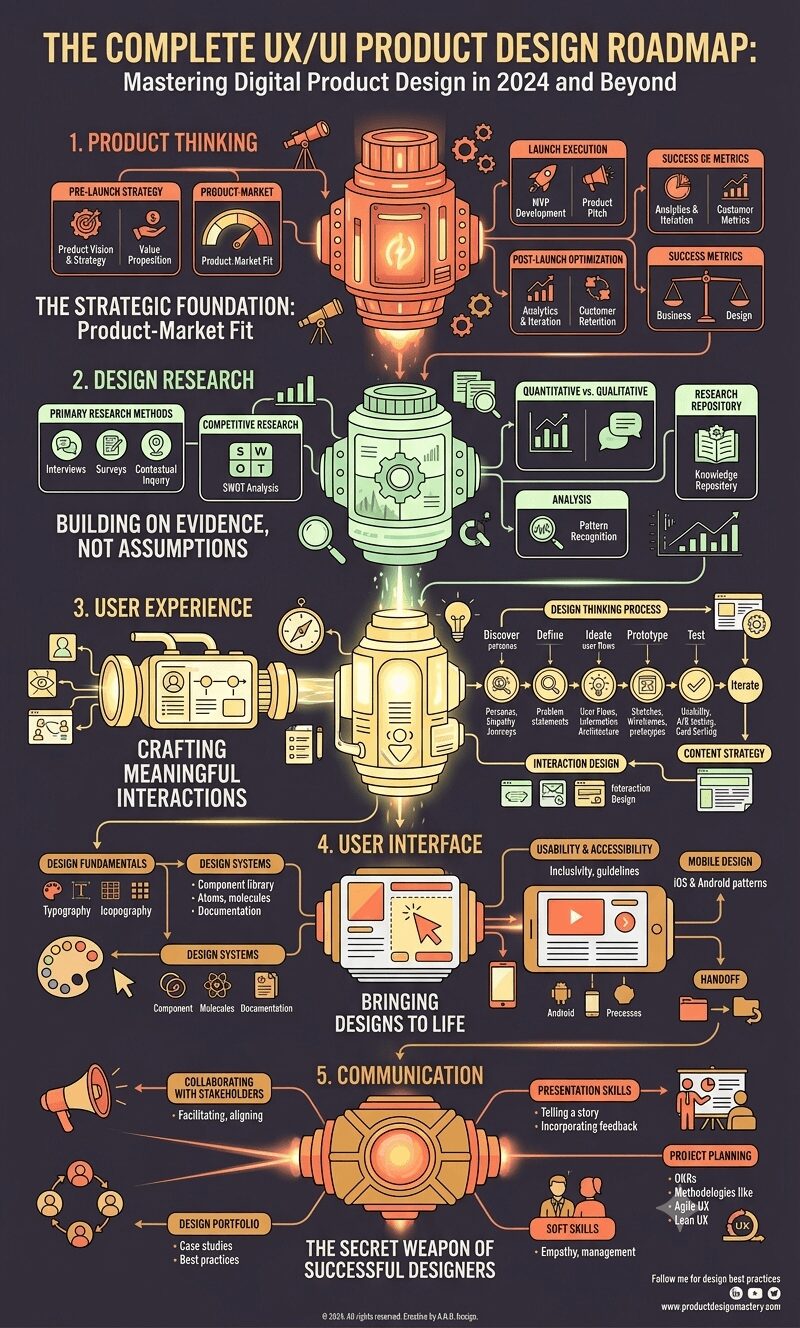
Understanding the Five Pillars of Product Design
Modern product design rests on five interconnected pillars that form the foundation of successful digital products. Each pillar represents a critical area of expertise that, when mastered, enables you to create products that users love and businesses value.
1. Product Thinking: The Strategic Foundation
Product thinking separates good designers from great ones. It’s the ability to see beyond individual screens and features to understand the broader context in which your design exists. This strategic mindset ensures that every design decision contributes to both user value and business success.
Pre-Launch Strategy
Before a single pixel is designed, successful product designers engage in critical strategic work.
Developing a clear product vision provides the North Star for all design decisions. This vision should articulate not just what you’re building, but why it matters and for whom.
Your product strategy translates this vision into actionable plans. It considers market positioning, competitive landscape, and unique value propositions. A well-crafted value proposition clearly communicates why users should choose your product over alternatives, focusing on the specific problems you solve and the benefits you provide.
Achieving product-market fit remains one of the most crucial objectives in the pre-launch phase.
This occurs when your product satisfies strong market demand, evidenced by user engagement, retention, and organic growth. Understanding and measuring product-market fit helps validate your approach before significant resources are invested.
Creating a product roadmap establishes timelines and priorities, while crafting a compelling product pitch helps secure stakeholder buy-in and resources. These documents should remain flexible, adapting to new insights while maintaining strategic direction.
Launch Execution
The launch phase transforms strategy into reality. Developing a Minimum Viable Product (MVP) allows you to test core assumptions with minimal risk. An MVP includes only essential features needed to validate your value proposition and learn from real user behavior.
A successful product launch extends beyond simply releasing software. It involves coordinated efforts across marketing, customer support, and communications. A well-planned press release and launch strategy generate awareness and excitement while setting appropriate expectations.
Post-Launch Optimization
The work intensifies after launch. Product usage analytics provide insights into how users actually interact with your product, revealing gaps between intended and actual behavior. These data-driven insights inform iterative improvements and feature prioritization.
Customer retention becomes the primary focus post-launch.
Retaining existing users proves far more cost-effective than acquiring new ones. Understanding why users stay or leave helps you address pain points and amplify what’s working.
Sometimes, the data reveals that significant course correction is necessary. A product pivot—whether in features, target audience, or value proposition—demonstrates strategic agility rather than failure. The willingness to pivot based on evidence separates successful products from those that fade into obscurity.
Success Metrics
Measuring success requires balancing business metrics with design metrics.
Business metrics might include revenue, user acquisition costs, lifetime value, and conversion rates.
Design metrics focus on user satisfaction, task completion rates, error rates, and usability scores.
Together, these metrics provide a holistic view of product health, ensuring that business success doesn’t come at the expense of user experience, and vice versa.
2. Design Research: Building on Evidence, Not Assumptions
Great design decisions stem from deep understanding, not guesswork. Design research provides the evidence base that informs every stage of the product development process.
Primary Research Methods
- Direct user engagement through interviews reveals motivations, pain points, and behaviors that surveys alone cannot uncover. Well-conducted interviews balance structure with flexibility, allowing unexpected insights to emerge while covering essential topics.
- Surveys efficiently gather quantitative data from larger audiences, helping validate patterns discovered in qualitative research. The key is crafting questions that avoid bias and yield actionable insights.
- Contextual inquiry—observing users in their natural environment—reveals the gap between what people say they do and what they actually do. This method uncovers workflow nuances and environmental factors that influence product usage.
- Competitive research analyzes how similar products address user needs, identifying opportunities for differentiation and learning from others’ successes and failures. SWOT analysis (Strengths, Weaknesses, Opportunities, Threats) provides a structured framework for evaluating your product’s strategic position.
Research Types
Understanding the distinction between qualitative and quantitative research helps you choose the right approach for each question.
- Qualitative research explores the “why” behind user behaviors, providing rich, detailed insights.
- Quantitative research measures the “what” and “how much,” offering statistical validity and generalizability.
Exploration and Experimentation
- Task analysis breaks down how users accomplish goals, identifying friction points and optimization opportunities. Analytics reveal actual usage patterns, showing which features are used, where users drop off, and how different segments behave.
- A/B testing allows you to make data-driven design decisions by comparing variations with real users. Card sorting helps inform information architecture by revealing how users naturally categorize content.
Planning and Analysis
Research planning ensures your efforts are focused and efficient. Define clear research questions, choose appropriate methods, and establish timelines. Analysis of findings transforms raw data into actionable insights through pattern recognition and synthesis.
Maintaining a research repository preserves institutional knowledge, preventing redundant efforts and enabling longitudinal insights. This living library of findings becomes invaluable as teams scale and products evolve.
3. User Experience: Crafting Meaningful Interactions
User experience design encompasses the entire journey users have with your product, from first awareness through long-term usage and advocacy.
The Design Thinking Process
- The discovery phase builds empathy and understanding.
- Creating personas—research-based archetypes of your users—keeps design decisions grounded in real needs rather than assumptions.
- Empathy maps capture what users say, think, feel, and do, providing a holistic view of their experience.
- Customer journey maps visualize the complete user experience across touchpoints and time, revealing emotional highs and lows, pain points, and opportunities for delight.
- In the define phase, you synthesize research into a clear problem statement that guides design efforts. A well-crafted problem statement focuses on user needs rather than solutions, providing clarity without constraining creativity.
- The ideate phase generates diverse solutions through brainstorming and creative techniques.
- Information architecture organizes content and functionality in ways that align with user mental models.
- User flows map the paths users take to accomplish tasks, while mind maps explore relationships between concepts.
- Prototyping brings ideas to life at varying fidelities.
- Sketching enables rapid exploration of concepts.
- Wireframing establishes structure and hierarchy without visual distraction.
- Interactive prototypes allow testing of flows and interactions before development investment.
- Testing and iteration validate assumptions and reveal improvements.
- Usability testing with real users uncovers issues before they reach production. This cyclical process of testing and refinement continues throughout the product lifecycle.
Interaction Design Fundamentals
- Understanding human-computer interaction principles helps you design interfaces that align with human capabilities and limitations.
- Cognitive psychology insights inform decisions about attention, memory, and decision-making.
- Jobs-to-be-Done framework focuses on the progress users seek to make in their lives, rather than demographic characteristics.
- User stories capture requirements from the user’s perspective, maintaining focus on value delivery.
Visual Design Principles
Mastering visual design fundamentals creates interfaces that are both beautiful and functional.
- Understanding Gestalt principles—how humans perceive visual elements as groups—helps you create clear, intuitive layouts.
- Visual hierarchy guides users’ attention to what matters most through size, color, contrast, and spacing.
These principles ensure users can quickly understand and navigate your interface.
Strategic UX Practices
- Content strategy ensures the right content reaches the right users at the right time.
- UX storytelling creates emotional connections and helps stakeholders understand user needs and experiences.
- UX benchmarking establishes baselines and tracks progress against competitors and industry standards.
4. User Interface: Bringing Designs to Life
While user experience focuses on the overall feel, user interface design addresses the specific visual and interactive elements users engage with.
Design Fundamentals
- Color palette selection influences emotion, brand perception, and usability. Understanding color theory, accessibility requirements, and cultural associations ensures your choices serve all users effectively.
- Typography affects readability, hierarchy, and brand personality. Mastering type scales, line heights, and font pairing creates professional, accessible interfaces.
- Grids and spacings create visual rhythm and consistency. A well-designed grid system ensures alignment and balance across different screen sizes and layouts.
- Iconography communicates concepts quickly and universally. Effective icons are simple, recognizable, and culturally appropriate.
Component Libraries and Systems
- Building a component library creates consistency and efficiency. Reusable components for buttons, forms, cards, and navigation patterns ensure visual coherence while speeding up design and development.
- UI patterns represent proven solutions to common design challenges. Understanding when and how to apply these patterns reduces cognitive load for users familiar with digital interfaces.
- Design principles document your team’s approach to common challenges, while documentation ensures consistency across teams and over time.
Interaction Design
UI animation enhances usability by providing feedback, showing relationships, and guiding attention. Micro-interactions—small, functional animations—delight users while communicating system status.
Understanding HTML and CSS fundamentals enables better collaboration with developers and more feasible design solutions. Responsive layouts ensure your designs work beautifully across devices and screen sizes.
Usability and Accessibility
- Usability principles like visibility, feedback, and error prevention create intuitive interfaces. Recognizing and addressing common usability issues prevents frustration and abandonment.
- Accessible design ensures people with disabilities can use your products effectively. Inclusive design goes further, considering the full range of human diversity. Tools and checklists help verify compliance with accessibility standards like WCAG.
Mobile Design
Mobile app design requires understanding platform-specific conventions for iOS and Android. Mobile UI patterns address unique constraints and opportunities of touch interfaces, limited screen space, and mobile contexts.
Design Systems and Handoff
- Design systems codify your design language into a comprehensive system of components, patterns, and guidelines.
- Atomic design methodology breaks interfaces into fundamental building blocks—atoms, molecules, organisms, templates, and pages—creating scalable, maintainable systems.
- Design handoff processes ensure a smooth transition from design to development.
- Design tools facilitate collaboration and specification, while clear communication prevents misunderstandings and rework.
5. Communication: The Secret Weapon of Successful Designers
Technical skills alone don’t make a successful product designer. Your ability to communicate, collaborate, and influence determines the impact of your work.
Collaborating with Stakeholders
- Analysis and alignment ensure everyone understands the problem and agrees on the approach. Facilitating workshops and design sessions builds shared ownership and surfaces diverse perspectives.
- Understanding team structure and dynamics helps you navigate organizational complexity. Effective collaboration with product managers, engineers, and business stakeholders requires speaking their languages and understanding their constraints.
Presentation Skills
Design presentations tell the story of your work, connecting research insights to design decisions to expected outcomes. Collecting and incorporating feedback demonstrates humility and commitment to the best outcome rather than attachment to your ideas.
Interview Skills
Whether interviewing for a position or conducting user research, strong interview skills are essential. An interview guide ensures consistency while allowing flexibility. Preparing thoughtful interview questions reveals deeper insights and builds rapport.
Design Portfolio
Your portfolio showcases your best work and thinking. Including best practices and detailed case studies demonstrates your process, not just final outputs. Strong case studies articulate the problem, your approach, challenges faced, and impact achieved.
Methodologies
Agile UX adapts design practices to iterative development cycles, ensuring design keeps pace with development. Lean UX emphasizes rapid learning and validation over extensive documentation.
Project Planning and Management
Defining OKRs (Objectives and Key Results) aligns design work with business goals. Project planning balances ambition with realism, accounting for research, iteration, and unexpected challenges.
Soft skills—empathy, active listening, conflict resolution—often determine career success more than technical abilities. Management skills become increasingly important as you advance, whether you manage people or projects.
Your Journey Forward
Mastering UX/UI product design is a marathon, not a sprint. This roadmap provides the structure, but your growth comes from consistent practice, curiosity, and reflection. Start where you are, focus on one area at a time, and remember that even experienced designers continue learning every day.
The field will continue evolving, but these fundamentals will remain relevant. Build your skills systematically, seek feedback generously, and always keep the user at the center of your work. Your journey to becoming an exceptional product designer starts now.