Creating Meaningful Digital Experiences That Last
In today’s rapidly evolving digital landscape, where trends come and go with dizzying speed, one principle remains constant:
Value is the ultimate currency of success.
Yet, despite knowing this fundamental truth, countless organizations struggle to create digital experiences that truly resonate with users and deliver lasting impact.
After years of working with diverse teams across industries, I’ve observed a recurring pattern.
- We often get caught up in the latest tools, technologies, and methodologies while losing sight of what really matters.
- We optimize for metrics without understanding meaning.
- We build features without validating value.
- We launch products without considering the complete ecosystem of user needs.
That’s why I want to share a framework that has consistently guided successful digital initiatives—a holistic, value-centered approach that puts what matters most at the very center of everything we do.
The Heart of the Matter: Value at the Core
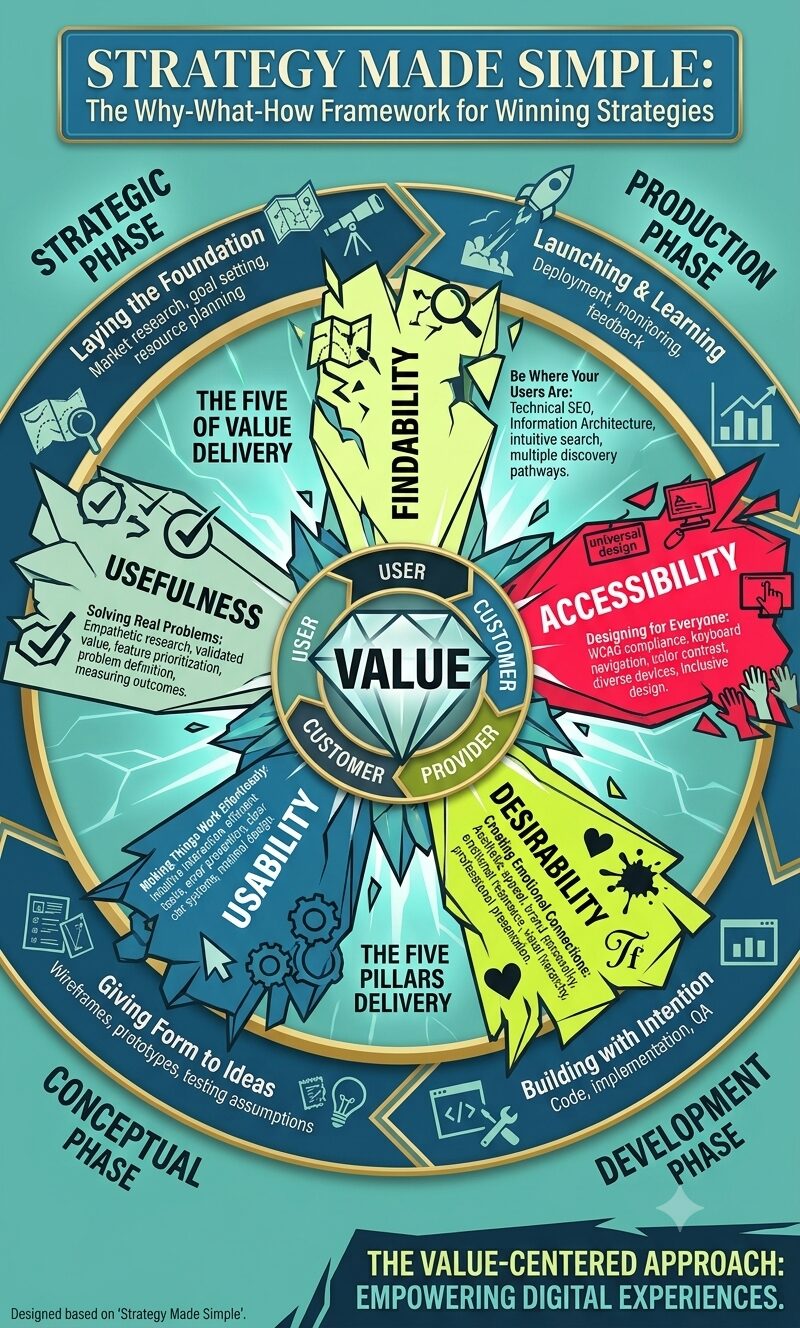
Imagine a wheel with VALUE at its absolute center. This isn’t just a visual metaphor; it’s a fundamental principle that should drive every decision, every feature, every line of code, and every design choice. Value is the gravitational force that holds everything together.
But value doesn’t exist in a vacuum. It emerges from the intersection of three critical perspectives:
- The User: The person interacting with your product or service
- The Customer: The entity paying for the solution (sometimes the same as the user, sometimes not)
- The Provider: Your organization delivering the experience
When these three perspectives align around genuine value creation, magic happens. But achieving this alignment requires attention to five essential dimensions that surround and support the central value core.
The Five Pillars of Value Delivery
1. Findability: Being Where Your Users Are
What good is the most brilliant solution if nobody can find it? Findability is the foundation upon which all other dimensions rest. It encompasses everything from search engine optimization and information architecture to intuitive navigation and clear labeling.
- In the strategic phase, findability begins with understanding where your users search for solutions and what language they use. It involves keyword research, competitive analysis, and mapping user journeys.
- During the conceptual phase, you’re structuring content and defining taxonomies that make sense to humans, not just machines.
- The development phase brings these concepts to life through technical SEO implementation, semantic markup, and performance optimization.
- Finally, the production phase ensures ongoing visibility through content updates, link building, and adaptation to changing search algorithms.
But findability isn’t just about search engines. It’s about creating multiple pathways for users to discover what they need, whether through direct navigation, internal search, recommendations, or external references. It’s about meeting users where they are, not where you wish they would be.
2. Accessibility: Designing for Everyone
Accessibility is both a moral imperative and a business necessity.
It ensures that your digital experiences work for people regardless of their abilities, devices, or circumstances. This dimension encompasses browser compatibility, compliance with standards (including WCAG guidelines), and thoughtful consideration of diverse user needs.
In practice, accessibility means building interfaces that work with:
- Screen readers,
- Ensuring sufficient color contrast,
- Providing keyboard navigation,
- Creating content that’s understandable at various literacy levels, and
- Designing for different connection speeds and device capabilities.
The implementation of accessibility isn’t a checkbox at the end of a project—it’s woven throughout every phase.
- During strategic planning, you’re committing to inclusive design principles.
- In the conceptual phase, you’re creating wireframes and prototypes that consider diverse interaction patterns.
- Development brings these to life with semantic HTML, ARIA labels, and progressive enhancement.
- Production ensures ongoing compliance through testing and monitoring.
Remember: when you design for accessibility, you design for everyone.
Features created for users with disabilities often benefit all users—captions help people in noisy environments, clear navigation helps everyone find information faster, and responsive design ensures your content works on any device.
3. Desirability: Creating Emotional Connections
Desirability is where art meets science. It’s the dimension that transforms functional tools into experiences people love.
This encompasses:
- Graphic design,
- Color schemes,
- Typography,
- Visual hierarchy, and
- The overall aesthetic appeal of your product.
But desirability goes deeper than surface-level beauty. It’s about creating emotional resonance, building trust through professional presentation, and crafting experiences that feel intuitive and delightful. It’s the difference between a product people tolerate and one they advocate for.
- In the strategic phase, desirability starts with understanding your brand personality and the emotional response you want to evoke.
- The conceptual phase translates these insights into mood boards, style guides, and design systems.
- During development, designers and developers collaborate to bring these visions to life with pixel-perfect precision and smooth interactions.
- The production phase maintains consistency while evolving the design based on user feedback and emerging trends.
The key to lasting desirability is authenticity. Don’t chase trends for their own sake. Instead, create visual experiences that genuinely reflect your brand values and resonate with your audience’s aspirations and identity.
4. Usability: Making Things Work Effortlessly
Usability is the bridge between intention and action. It’s about ensuring that users can accomplish their goals efficiently, effectively, and with satisfaction.
This dimension covers:
- Interaction design,
- Navigation patterns,
- Information architecture, and
- The overall flow of user tasks.
Great usability feels invisible. When interactions are intuitive, users don’t notice the design—they accomplish what they set out to do. When usability fails, frustration mounts, and even the most valuable features become irrelevant.
- During the strategic phase, usability planning involves defining user personas, mapping key tasks, and establishing success metrics.
- The conceptual phase brings wireframes, user flows, and prototypes that test these interactions before development begins.
- In the development phase, usability principles guide every interface decision, from button placement to error messages.
- The production phase involves continuous testing, user feedback collection, and iterative improvements.
Remember Jakob Nielsen’s usability heuristics:
- Visibility of system status,
- Match between the system and the real world,
- User control and freedom,
- Consistency and standards,
- Error prevention,
- Recognition rather than recall,
- Flexibility and efficiency of use,
- Aesthetic and minimalist design,
- Help users recognize and recover from errors, and
- Provide help and documentation.
These timeless principles remain as relevant today as when they were first articulated.
5. Usefulness: Solving Real Problems
Usefulness is the dimension that answers the fundamental question:
“Does this actually help?”
It’s about ensuring that every feature, every piece of content, every interaction serves a clear purpose aligned with user needs and business objectives.
Usefulness requires deep empathy and rigorous validation. It demands that we resist the temptation to build features simply because we can or because competitors have them. Instead, we must constantly ask:
“What problem are we solving? For whom? And how do we know it’s working?”
- In the strategic phase, usefulness begins with thorough user research, market analysis, and problem definition.
- The conceptual phase involves prioritizing features based on user value, creating minimum viable products, and validating assumptions through testing.
- During development, usefulness guides scope management and feature refinement.
- The production phase focuses on measuring outcomes, gathering feedback, and iterating based on real-world usage.
The ultimate test of usefulness is whether users would be disappointed if your product disappeared. If the answer isn’t a resounding “yes,” it’s time to go back to the drawing board and reconnect with genuine user needs.
The Phases of Value Creation
Understanding the five dimensions is crucial, but equally important is recognizing how they unfold across four interconnected phases:
Strategic Phase: Laying the Foundation
This is where vision meets reality. Strategic work involves market research, stakeholder alignment, goal setting, and resource planning. It’s about asking the right questions before rushing to solutions. Don’t skip this phase or rush through it—the quality of your strategy determines the ceiling of your success.
Conceptual Phase: Giving Form to Ideas
Here, abstract strategies take concrete shape through wireframes, prototypes, content strategies, and information architectures. This phase is about exploring possibilities, testing assumptions, and refining concepts before committing to full-scale development.
Development Phase: Building with Intention
This is where concepts become reality through coding, design implementation, and quality assurance. But development isn’t just about technical execution—it’s about maintaining fidelity to the strategic vision while adapting to real-world constraints and emerging insights.
Production Phase: Launching and Learning
Production isn’t the end—it’s the beginning of a new cycle. This phase involves deployment, monitoring, user feedback collection, and continuous improvement. The most successful products evolve based on real usage patterns, not just initial assumptions.
Putting It All Together: A Holistic Approach
The power of this framework lies not in its individual components but in their integration. Findability without usefulness is hollow. Usability without accessibility is exclusionary. Desirability without usefulness is superficial. Each dimension reinforces and amplifies the others.
Similarly, the phases aren’t linear checkpoints but overlapping cycles of learning and refinement. Strategic thinking should continue throughout development. Conceptual exploration should inform production decisions. The boundaries between phases are permeable by design.
Your Path Forward
As you embark on or continue your digital product journey, I encourage you to use this framework as both a planning tool and an evaluation lens.
When starting a new project, map out how you’ll address each dimension across each phase. Identify potential gaps or over-emphases. Ensure all three perspectives—user, customer, and provider—are represented in your planning.
When evaluating existing products, audit each dimension honestly. Where are you strong? Where are you weak? What’s missing entirely? Use these insights to prioritize improvements and allocate resources effectively.
Most importantly, remember that this framework serves value creation, not the other way around. Don’t get so caught up in perfecting each dimension that you lose sight of the central purpose: creating genuine value for real people.
The Timeless Truth
Tools will change. Technologies will evolve. Trends will come and go. But the fundamental principles of value-centered design remain constant. By keeping value at the center, balancing all five dimensions, and respecting the full lifecycle of creation, you’ll build digital experiences that not only succeed today but continue to deliver value for years to come.
That’s not just good design. That’s responsible creation. And it’s the legacy we should all strive to leave in the digital world we’re building together.