A Comprehensive Guide to Human-Centred Service Design
In today’s rapidly evolving business landscape, organizations face an unprecedented challenge:
How to create services that truly resonate with people while remaining sustainable, scalable, and strategically sound.
The answer lies in understanding design for services not as a single discipline, but as a holistic, human-centred approach that bridges multiple fields of expertise.
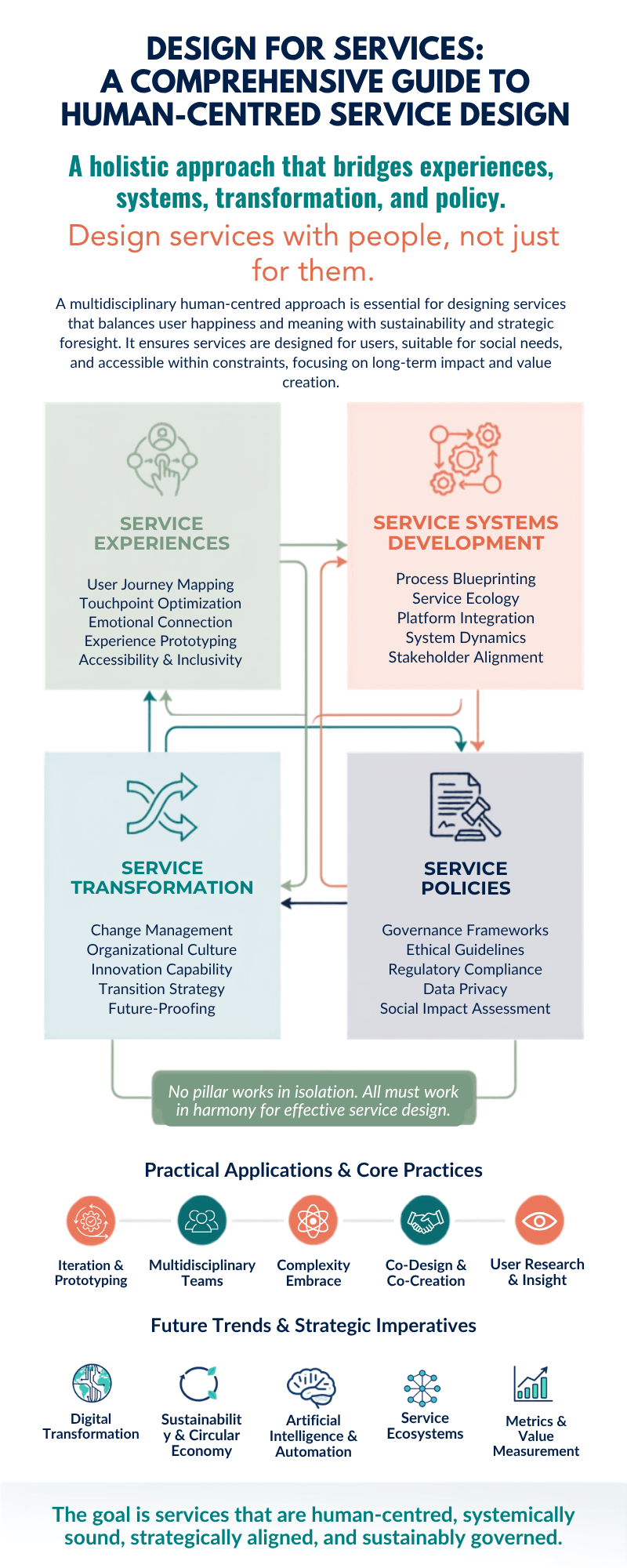
The framework developed by Meroni and Sangiorgi in 2011 offers a powerful lens for understanding this complexity. At its core, this model reveals that effective service design operates across four interconnected dimensions:
Design for Service Experiences, Design for Service Systems Development, Design for Service Transformation, and Design for Service Policies.
Each dimension draws from diverse disciplines—from ethnography to strategic planning, from cognitive psychology to network organization studies—creating a rich ecosystem of knowledge and practice.
Understanding the Human-Centred Core
At the heart of this framework lies a simple yet profound principle:
Services must be designed with people, not just for them.
This human-centred approach represents a fundamental shift from traditional service delivery models that prioritized efficiency and standardization above all else.
When we place humans at the centre of service design, we acknowledge that every touchpoint, interaction, and system exists to serve real people with complex needs, emotions, and contexts.
This perspective transforms how we approach everything from frontline service encounters to backend operational systems, from organizational strategy to policy development.
The beauty of this framework is its recognition that human-centred service design cannot exist in isolation. It requires integrating multiple perspectives, methodologies, and disciplines in concert to create services that are not only functional but also meaningful, accessible, and sustainable.
The Four Pillars of Service Design
Design for Service Experiences
The first pillar focuses on the immediate, tangible interactions between users and services. This is where disciplines like experience design, interaction design, and participatory design come into play. These fields help us understand how people perceive, engage with, and derive value from services at the point of contact.
- Experience design ensures that every interaction feels intuitive, pleasant, and purposeful. It considers the emotional journey of users, mapping out moments of delight, friction points, and opportunities for meaningful engagement.
- Interaction design dives deeper into the specific mechanisms of engagement—how interfaces work, how information flows, and how users navigate complex service ecosystems.
- Participatory design takes this further by involving users directly in the design process. Rather than designing services in isolation and then testing them with users, participatory design brings stakeholders into the creative process from the beginning.
This collaborative approach ensures that services reflect genuine needs and contexts rather than assumptions made by designers or business leaders.
- Cognitive psychology helps us understand how people process information, make decisions, and form memories—critical knowledge for designing services that align with natural human cognition.
- Ethnography provides deep contextual understanding through immersive observation, revealing the unspoken needs, cultural norms, and environmental factors that shape how people interact with services.
Service marketing and service operations management complete this pillar by ensuring that experiences are not only well-designed but also effectively communicated and efficiently delivered. Marketing helps articulate value propositions and build relationships with users, while operations management ensures that the backend systems support seamless frontline delivery.
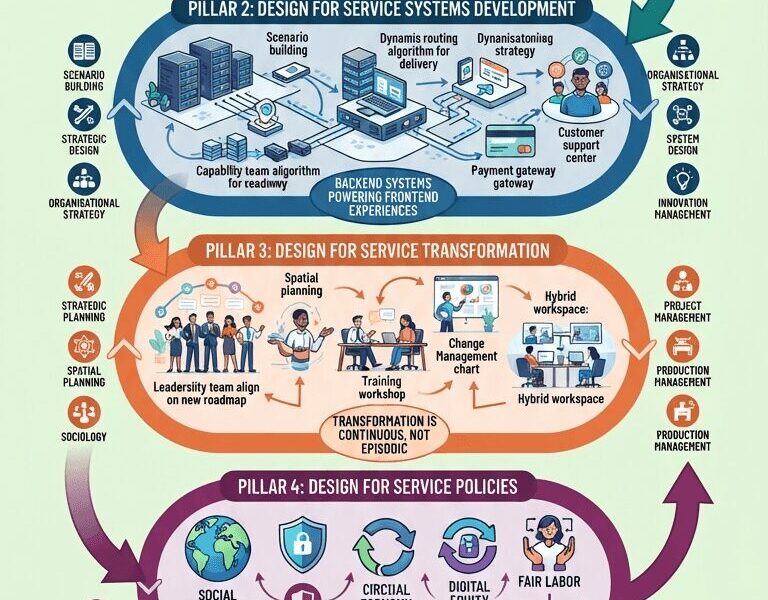
Design for Service Systems Development
While the first pillar focuses on individual experiences, the second pillar addresses the broader systems that enable those experiences to occur consistently and sustainably.
This is where system design, organizational studies, and innovation management become essential.
- System design takes a holistic view of services, recognizing that every touchpoint is part of a larger ecosystem. A banking app, for example, doesn’t exist in isolation—it connects to physical branches, call centres, backend databases, regulatory frameworks, and countless other elements. System designers map these connections, identify dependencies, and ensure that changes in one area don’t create unintended consequences in another.
- Organizational studies examine how structures, cultures, and processes within organizations enable or hinder service delivery. Even the most brilliantly designed service will fail if the organization delivering it lacks the capabilities, culture, or structures to support it. This discipline helps align organizational design with service design, ensuring that internal systems empower rather than constrain frontline delivery.
- Innovation management brings a forward-looking perspective, helping organizations continuously evolve their services in response to changing needs, emerging technologies, and competitive pressures. It establishes processes for experimentation, learning, and adaptation—critical capabilities in today’s fast-paced environment.
Scenario building and strategic design provide tools for navigating uncertainty and complexity.
- Scenario building helps organizations explore multiple possible futures, preparing for various outcomes rather than betting everything on a single prediction.
- Strategic design applies design thinking to high-level strategic challenges, helping organizations define their purpose, positioning, and long-term direction.
Design for Service Transformation
The third pillar addresses the profound changes that occur when organizations fundamentally reimagine how they create and deliver value.
This is the domain of organisational strategy, strategic planning, and behavioural science.
Service transformation goes beyond incremental improvements to question foundational assumptions about what services an organization provides, who it serves, and how it creates value. This might involve shifting from product-centric to service-centric business models, moving from transactional to relational approaches, or redefining organizational boundaries through partnerships and ecosystems.
- Organisational strategy provides the framework for making these transformative decisions, helping leaders align service transformation with broader business objectives, competitive positioning, and resource capabilities.
- Strategic planning translates these strategic directions into concrete roadmaps, timelines, and resource allocations.
- Behavioural science offers crucial insights into how people actually behave versus how we assume they behave.
Understanding cognitive biases, social influences, and motivational drivers helps design transformations that people will actually adopt and sustain. This is particularly important because transformation often requires changes not just in systems and processes, but in mindsets and behaviours across the organization.
- Spatial planning might seem an unexpected inclusion here, but physical and digital spaces profoundly shape how services are experienced and delivered.
Transformation often requires reimagining these spaces—whether redesigning physical environments to support new ways of working or creating digital platforms that enable new forms of collaboration and value creation.
Design for Service Policies
The final pillar addresses the governance, standards, and frameworks that guide service design and delivery at scale. This is where sociology, network organisation studies, social psychology, and project management converge.
Service policies establish the principles, standards, and guidelines that ensure consistency, quality, and accountability across complex service ecosystems. In large organizations or multi-stakeholder environments, policies provide the guardrails that enable autonomy and innovation while maintaining coherence and alignment.
- Sociology helps us understand how services function within broader social systems, considering issues of equity, access, and social impact. It reminds us that services don’t exist in a vacuum—they shape and are shaped by social structures, power dynamics, and cultural norms.
- Network organisation studies examine how value is created through relationships and collaborations rather than hierarchical structures. As services become increasingly ecosystem-based, involving multiple partners, platforms, and providers, understanding network dynamics becomes essential for effective governance and coordination.
- Social psychology provides insights into group dynamics, social influence, and collective behaviour—critical for designing policies that people will actually follow and for fostering cultures of collaboration and continuous improvement.
- Project management and production management ensure that service policies are implemented effectively and sustainably. They provide the methodologies, tools, and disciplines needed to translate policy into practice, managing the complexities of implementation across diverse contexts and stakeholder groups.
The Interconnected Nature of Service Design
What makes this framework so powerful is its recognition that these four pillars are not separate silos but interconnected dimensions that must work together.
You cannot design exceptional service experiences without robust systems to support them.
You cannot transform services effectively without thoughtful policies to guide the change. And none of this matters if it’s not grounded in a deep understanding of human needs and contexts.
Consider a healthcare organization redesigning its patient services.
- The experience design team might create intuitive digital tools for appointment scheduling and health monitoring.
- But these tools require backend systems that integrate with electronic health records, scheduling systems, and clinical workflows.
- Implementing these changes requires organizational transformation—new roles, new skills, new ways of working. And throughout this process, policies must ensure patient privacy, clinical safety, and equitable access.
Each pillar informs and constrains the others. The best experience design is useless if systems can’t support it. The most sophisticated systems are wasteful if they don’t serve real human needs. Transformation without clear policies creates chaos. Policies without attention to experience become bureaucratic obstacles.
Practical Applications for Practitioners
For those working in service design, this framework offers several practical implications:
- First, cultivate T-shaped expertise. Develop great skills in one or two disciplines while maintaining broad literacy across the entire framework. A service designer might specialize in experience design while understanding enough about systems thinking, organizational strategy, and policy development to collaborate effectively with specialists in these areas.
- Second, build diverse, multidisciplinary teams. No single person can master all the disciplines represented in this framework. Effective service design requires bringing together people with different expertise, perspectives, and ways of thinking. Create environments where these diverse voices can collaborate productively.
- Third, work iteratively across all four pillars. Don’t sequence your work as “first we’ll design the experience, then we’ll build the systems, then we’ll transform the organization.” Instead, work iteratively across all dimensions, constantly checking that decisions in one area align with and support the others.
- Fourth, maintain the human-centred focus. With so many disciplines and dimensions to consider, it’s easy to lose sight of the people you’re designing for. Regularly return to user research, testing, and feedback to ensure that all your systems, strategies, and policies actually serve human needs.
- Fifth, embrace complexity rather than fighting it. Services are inherently complex, involving multiple stakeholders, touchpoints, and contexts. Rather than trying to simplify away this complexity, develop the capabilities to navigate and orchestrate it effectively.
The Future of Service Design
As we look ahead, the principles outlined in this framework will only become more critical. Several trends are amplifying the need for comprehensive, human-centred service design:
- Digital transformation continues to blur the boundaries between physical and digital services, creating new possibilities and new complexities. Services increasingly exist across multiple channels and platforms, requiring sophisticated systems thinking and seamless experience design.
- Sustainability imperatives demand that we design services that are not only user-friendly but also environmentally and socially sustainable. This requires systems thinking that considers long-term impacts and policies that align incentives with sustainable outcomes.
- Increasing complexity in organizational ecosystems means that services are rarely delivered by single organizations anymore. They emerge from networks of partners, platforms, and providers, requiring new approaches to governance, coordination, and value creation.
- Rising expectations from users who increasingly demand personalized, seamless, and meaningful experiences. Meeting these expectations requires a deep understanding of human needs combined with sophisticated capabilities in experience design and systems integration.
Conclusion
The framework of design for services offers more than just a conceptual model—it provides a roadmap for creating services that truly serve people while remaining viable, sustainable, and adaptable.
By integrating insights from multiple disciplines across four interconnected pillars, we can move beyond superficial improvements to create fundamental transformations in how value is created and delivered.
Whether you’re a designer, strategist, manager, or policy-maker, this human-centred approach offers tools and perspectives that can elevate your work. The key is to embrace the complexity, cultivate diverse capabilities, and never lose sight of the people at the heart of everything we design.
As services continue to evolve and new challenges emerge, the principles outlined here will remain relevant. Technology will change, business models will shift, and user expectations will rise. But the fundamental need to design services that are human-centred, systemically sound, strategically aligned, and sustainably governed will endure.
The question is not whether to adopt this comprehensive approach to service design, but how quickly we can develop the capabilities to practice it effectively. The organizations and individuals who master this integration will be best positioned to create services that matter—services that improve lives, strengthen communities, and build a better future.